UK Butterflies
Building a Community of Responsible Butterfly Enthusiasts in Britain & Ireland
Building a Community of Responsible Butterfly Enthusiasts in Britain & Ireland
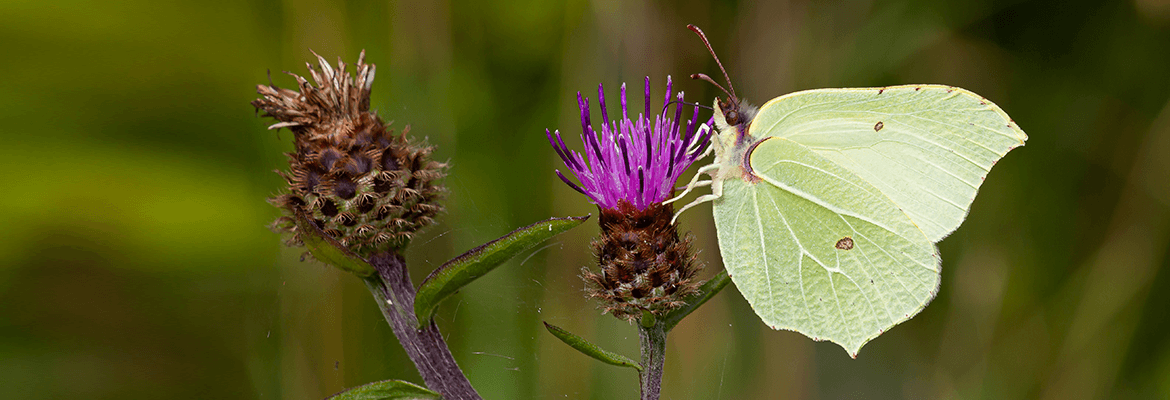
Wingspan
60 - 74 mm
Checklist Number
58.013
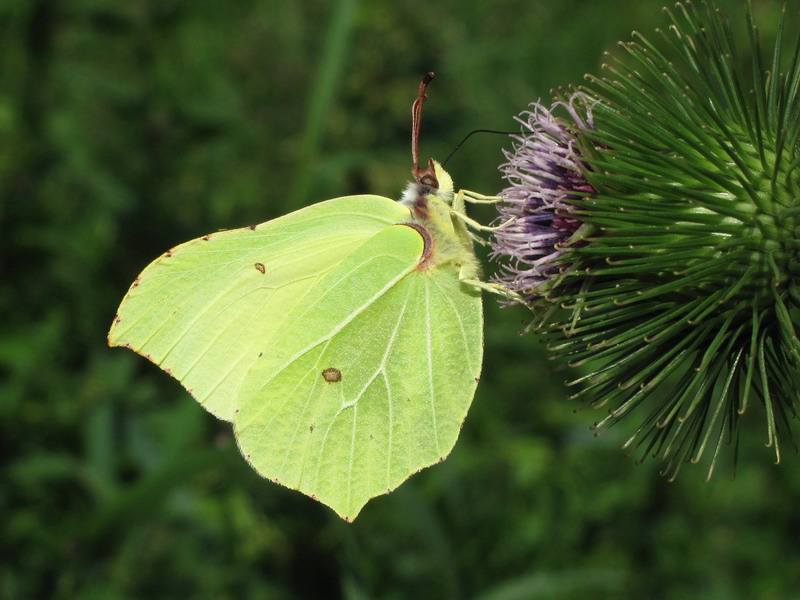
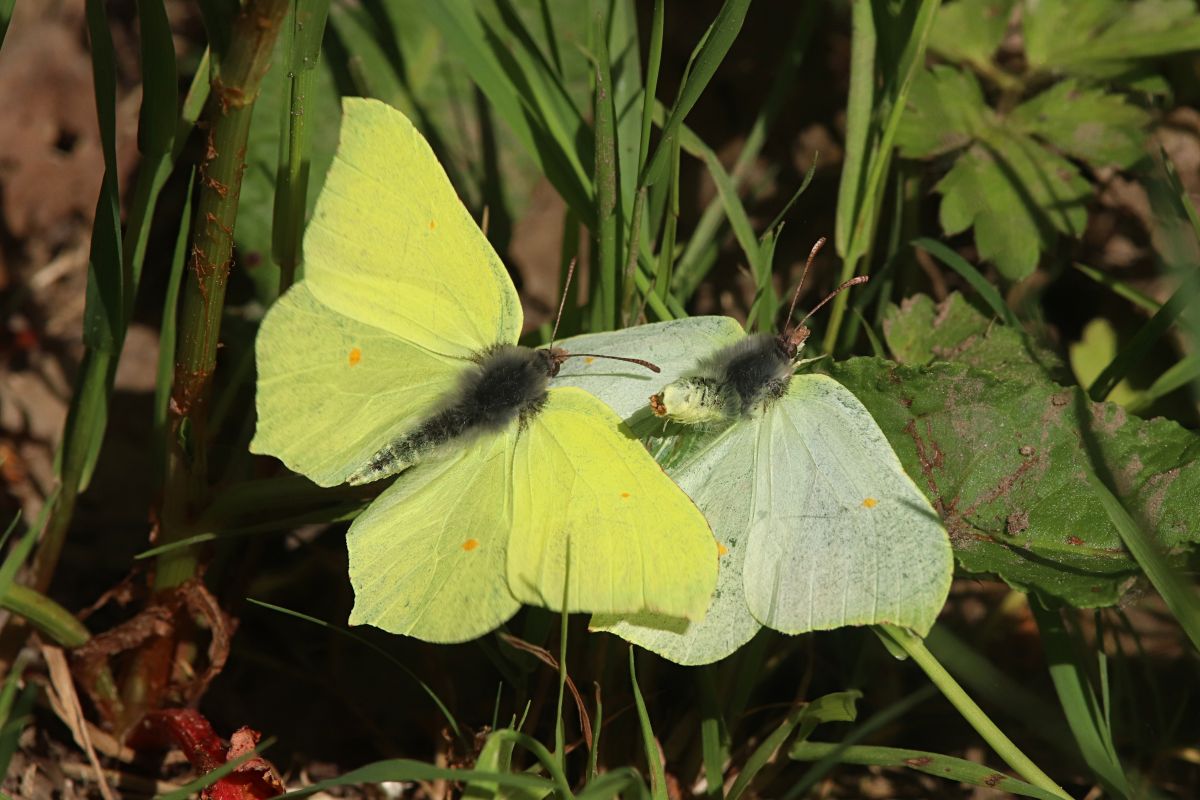
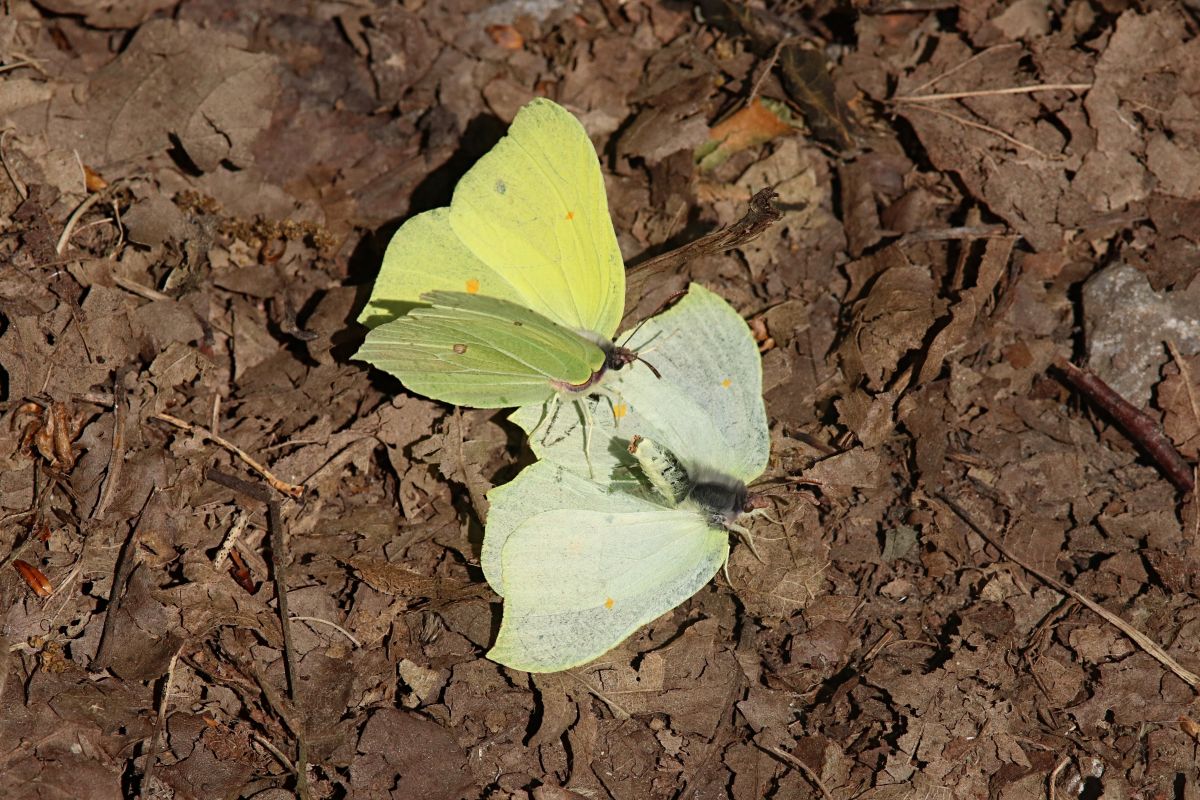
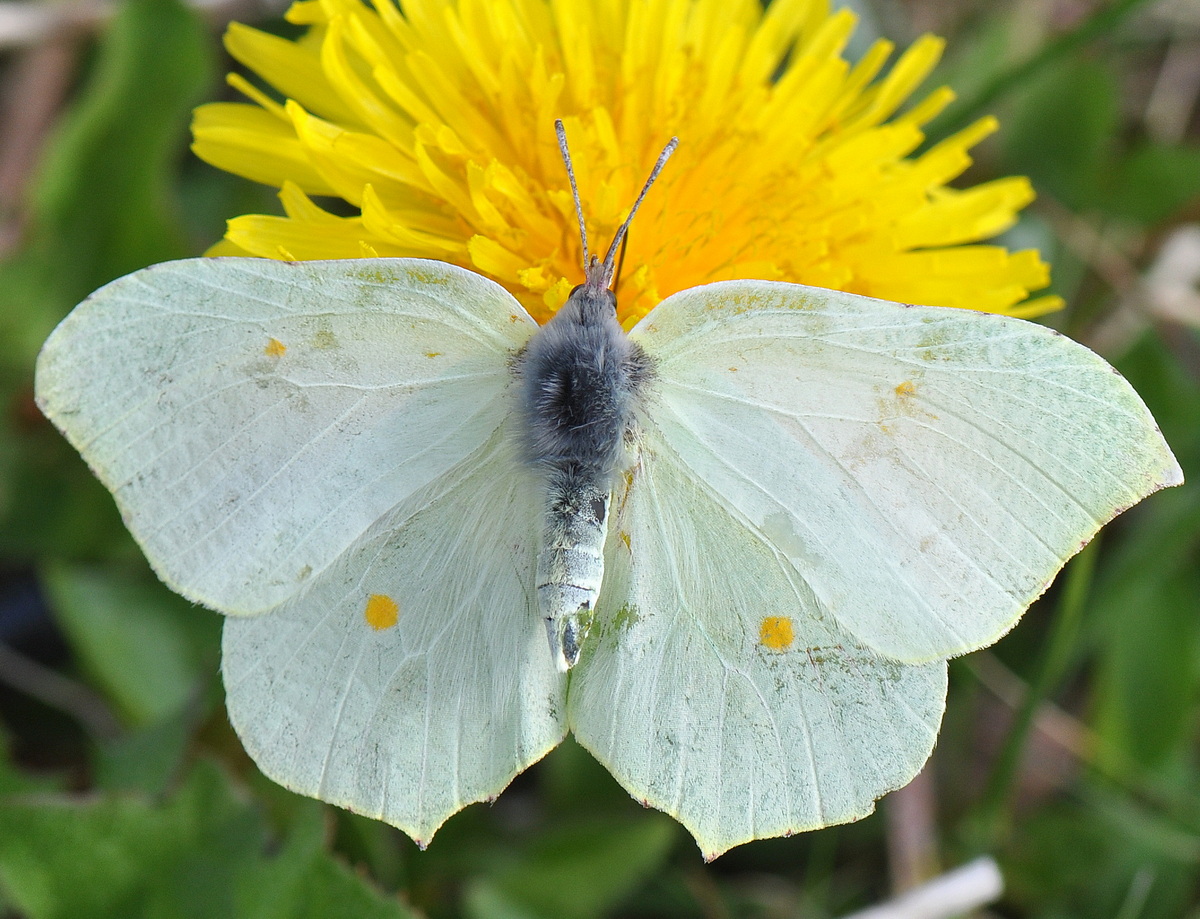
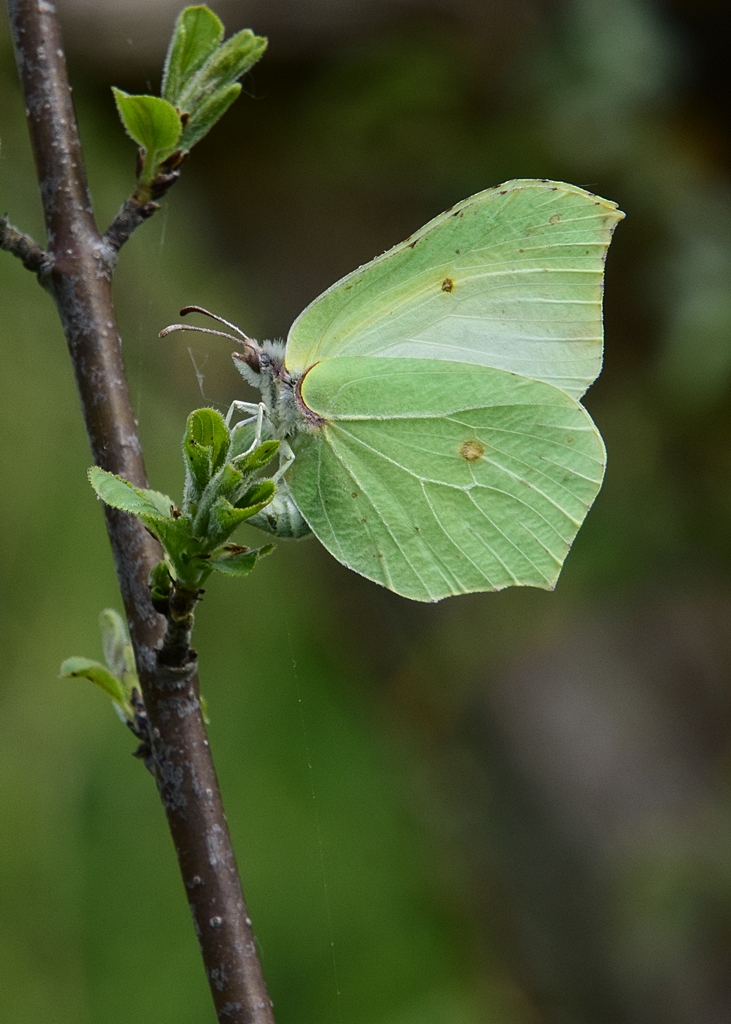
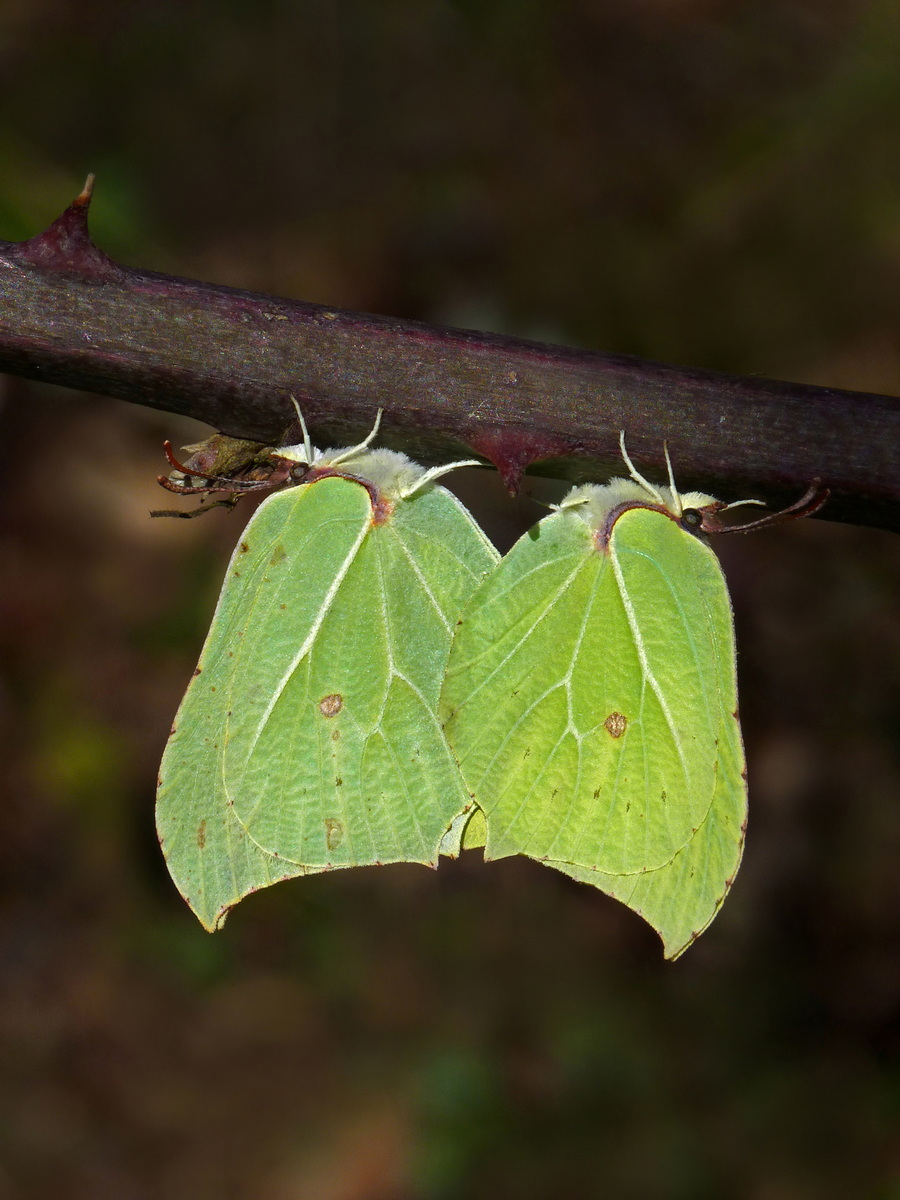
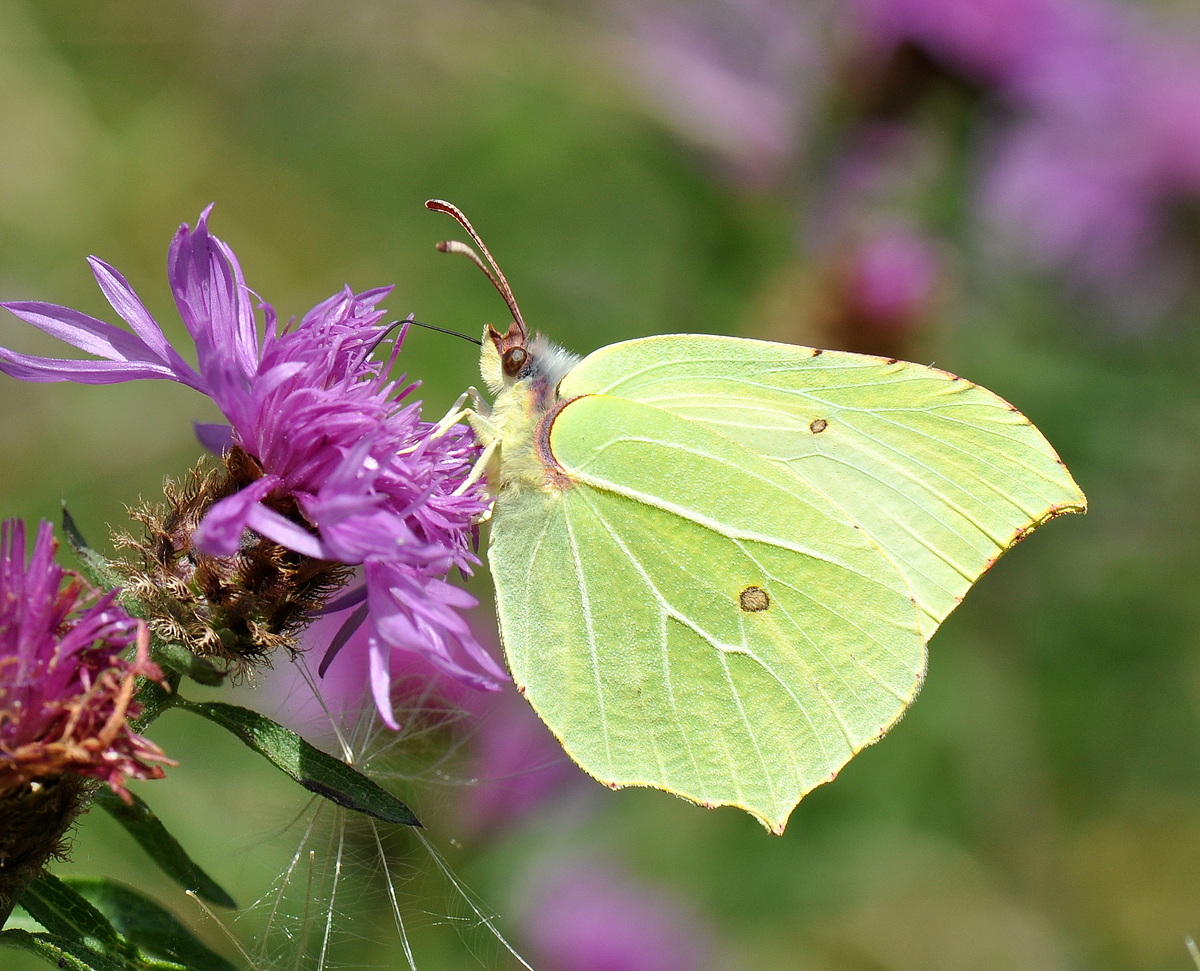
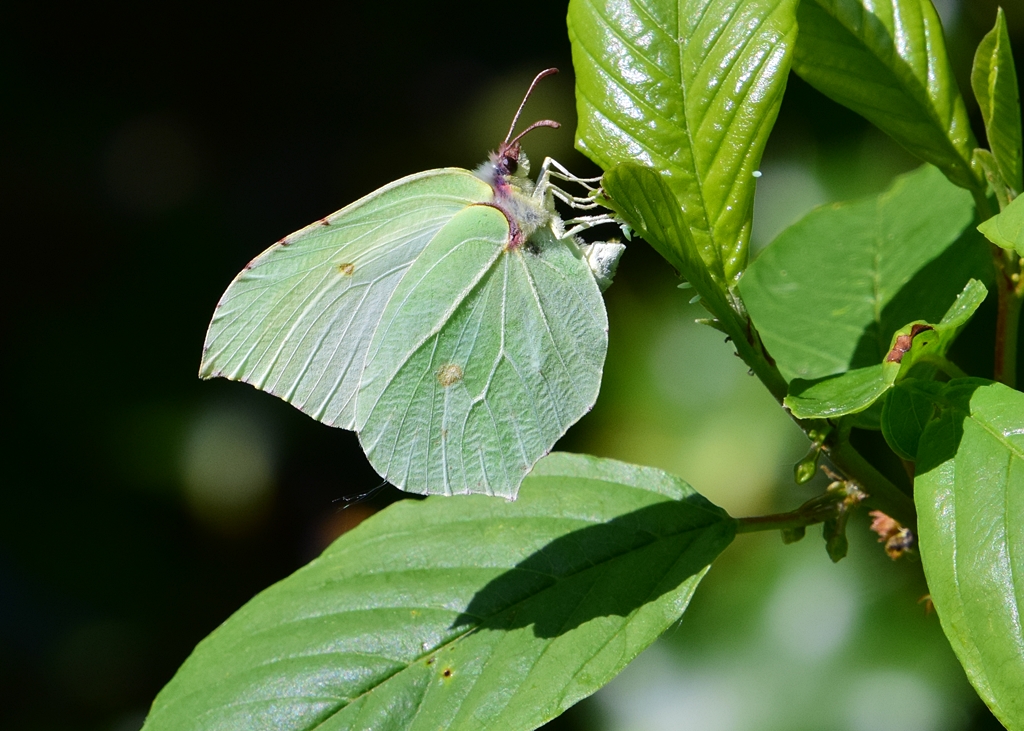
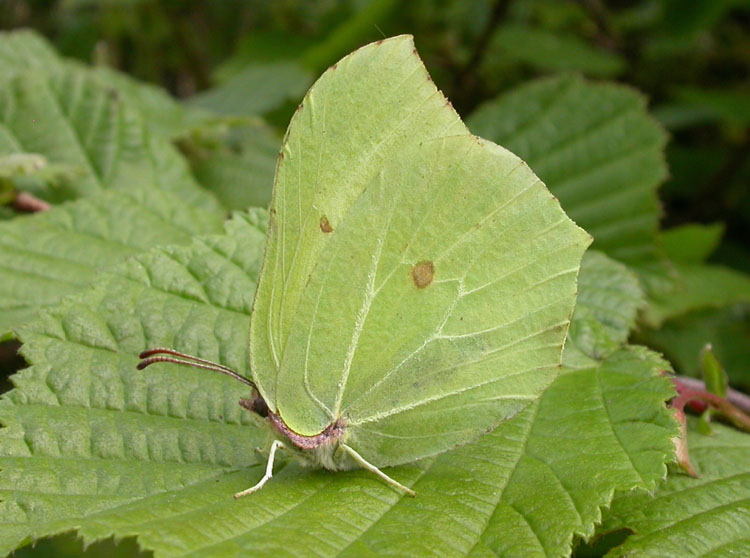
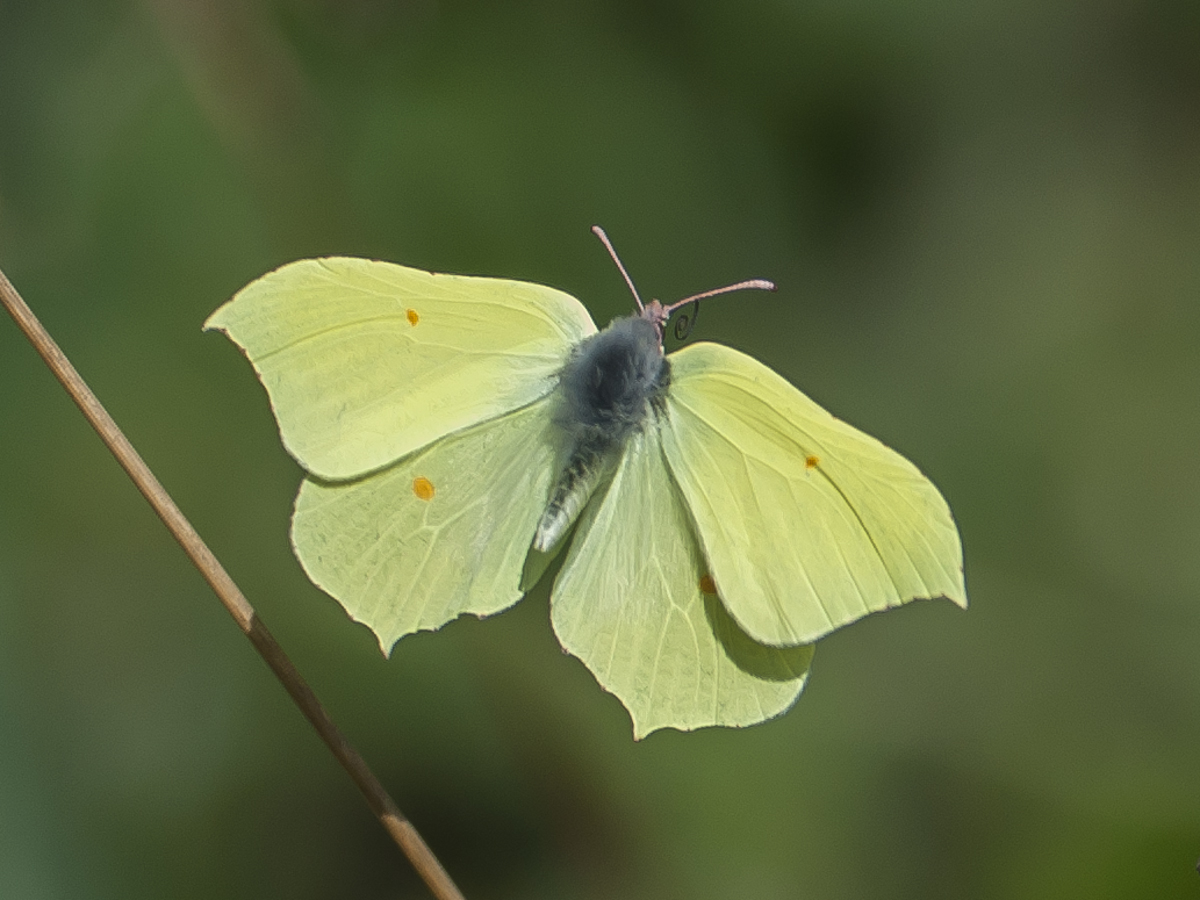
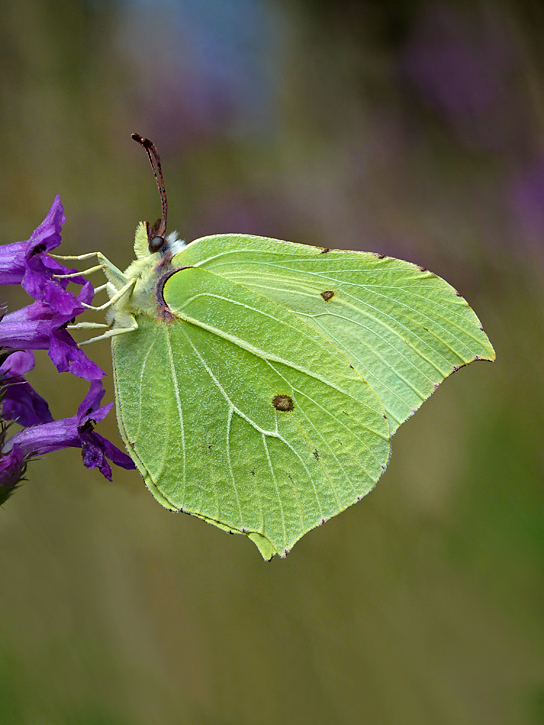
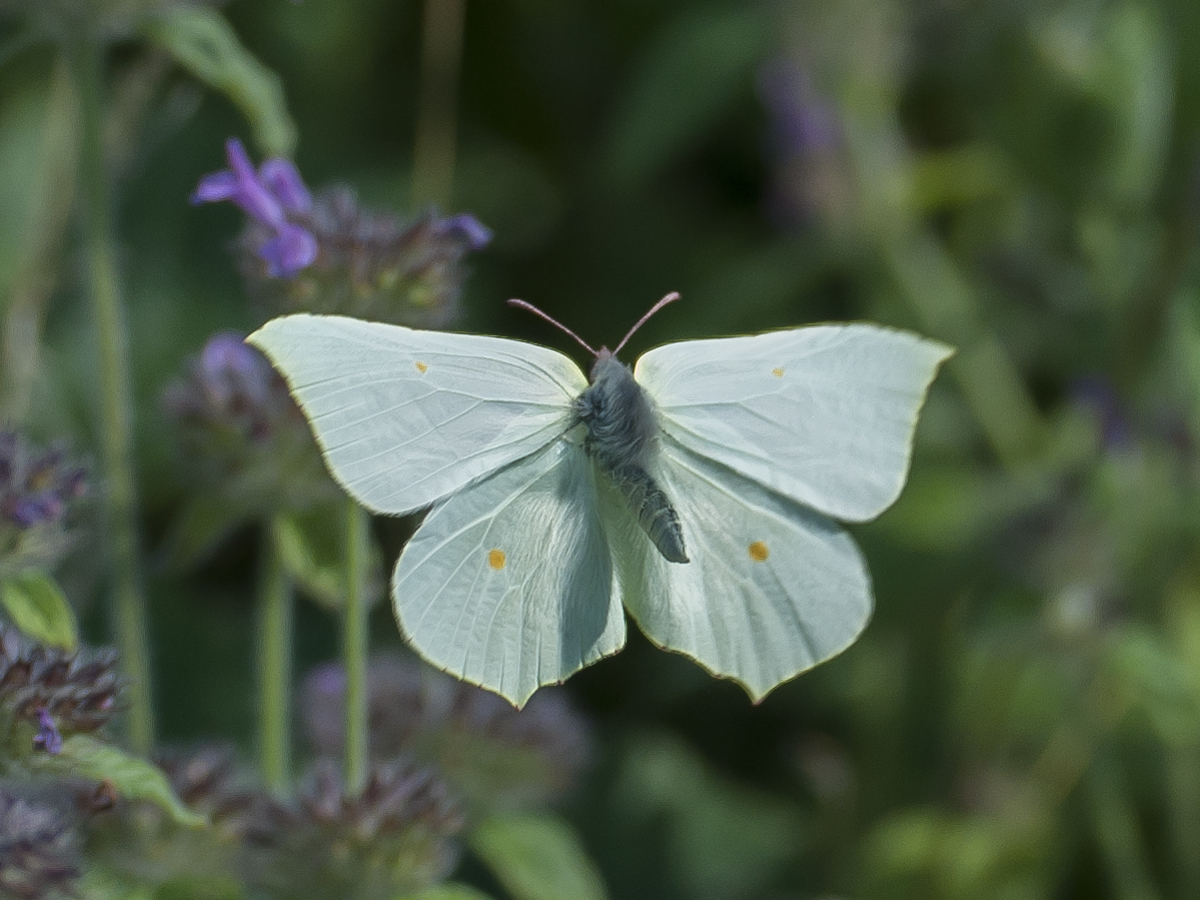
It is commonly believed that the word "butterfly" is a derived from "butter-coloured fly" which is attributed to the yellow of the male Brimstone butterfly, the female being a much paler whitish-green. The Brimstone has a most exquisite wing shape, perfectly matching a leaf when roosting overnight or hibernating within foliage. This is one of the few species that hibernates as an adult and, as such, spends the majority of its life as an adult butterfly. The distribution of this species closely follows that of the larval foodplant. In England, where it is represented by the subspecies rhamni, it can be found south of a line from Cheshire in the west to South-east Yorkshire in the east, although vagrants may turn up in other areas. In Ireland, where it is represented by the subspecies gravesi, its strongholds are in a small area that lies between the borders of West Galway, West Mayo and East Mayo, and a band running through central Ireland from Clare in the west to Kildare in the east.
This species was first defined in Linnaeus (1758) as shown here (type locality: Europe, Africa).
The population found in England, Wales, the Isle of Man and the Channel Islands is represented by the nominate subspecies.
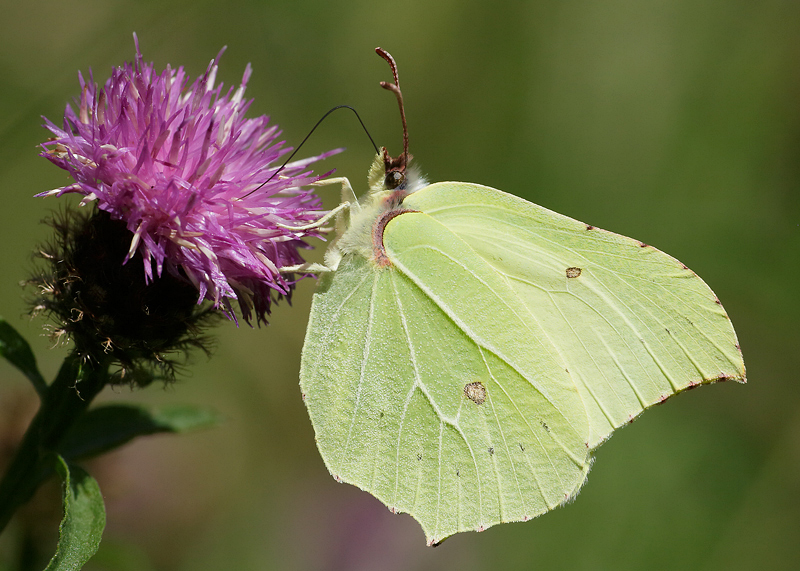
This subspecies was first defined in Huggins (1956b).
This subspecies represents the population found in Ireland, and exhibits minor colour differences with the subspecies rhamni which, based on the formal description, are:
♂. Upperside fore wings as in G.rhamni rhamni but slightly paler. Hind wings lighter and greener. Underside fore wings have the middle portion below the costal area greenish white, almost as in the female. This portion is strongly suffused with yellow in English examples.
♀. Fore wings upperside bordered with greenish yellow, particularly at the apex. Hind wings whole area strongly suffused with green yellow.
Type ♂, Kildare 26.viii.16 (D.Westropp). Type ♀, King's County 1900 (D.Westropp).


| Family: | Pieridae | Swainson, 1820 |
| Subfamily: | Coliadinae | Swainson, 1820 |
| Tribe: | Gonepterygini | |
| Genus: | Gonepteryx | [Leach], [1815] |
| Subgenus: | ||
| Species: | rhamni | (Linnaeus, 1758) |
| Subspecies: | rhamni | (Linnaeus, 1758) |
| gravesi | Huggins, 1956 |
Description to be completed.
The distribution data (2000-2009) has been made available through the generosity of Butterfly Conservation and any subspecies distribution is taken from Riley (2007). Click here to see the distribution of this species together with site information overlaid.
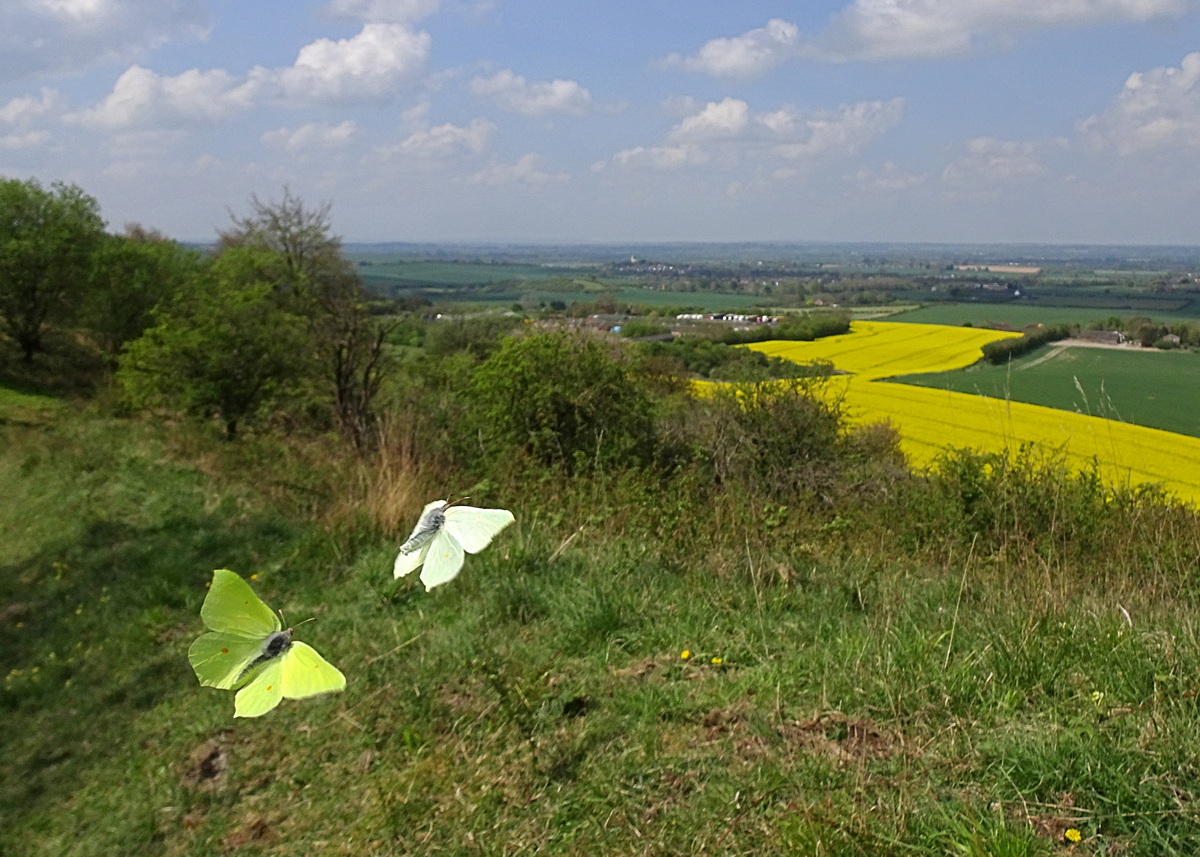
The Brimstone is a great wanderer and can be found in almost any habitat, from chalk downland to woodland rides to gardens.
The status of the Brimstone is considered stable and it is not, therefore, considered a species of conservation concern.
The table below shows the occurrence (distribution) and abundance (population) trends, using information from The State of the UK's Butterflies 2015 (Fox, 2015). Any UK BAP status is taken from the UK Biodiversity Action Plan (UK BAP) (2007 review).
1976-2014 (%) | 1976-2014 (%) | 2005-2014 (%) | 2005-2014 (%) |  +20 +20 |  +1 +1 | +14 | -1 |
|---|
This single-brooded butterfly can be found in most months of the year, although peak flight times are in April and May as the hibernating adults emerge, and again in August when their offspring reach adulthood. Autumn is a good time to see this species as the adults are avid nectar-feeders as they build up their fat reserves in preparation for hibernation.
"On May 25th, 1907, at Thundersley, Essex, three females were captured and placed on three separate small plants of Rhamnus cartharticus [Rhamnus cathartica, Purging Buckthorn], but owing to the continuance of dull, cold weather they remained quiet for some days. On June 6th three eggs were deposited, and several others were laid during the following few days. The first laid hatched on June 16th, remaining in the egg state ten days. On June 23rd, 1907, a female captured at Hempstead Wood, Sussex, deposited a few eggs on June 30th, and many others on July ist and following days. On July 6th the eggs were counted, sixty-seven in all; about twenty of these were laid on the 5th, a few more were laid between the 8th and 14th, on which day she died. The eggs hatched, and the larvae became fully grown by the end of the first week in August. The first two pupated August 9th, the larval stage occupying about four weeks. The first pupae produced imagines on August 21st, remaining twelve days in the pupal state. All the others emerged by the end of the month. The period occupied by the complete metamorphosis, i.e., from the deposition of the egg to the emergence of the imago, is about fifty days. The life of the butterfly may extend over ten months of the year. Those emerging from the pupa in August may still remain on the wing the following summer, overlapping those of recent emergence. Therefore the Brimstone is the longest-lived of our British butterflies. The egg is laid singly, standing erect on the under surface of the young leaf, chiefly on the ribs, but occasionally on the stem of the young shoot close to the leaves." - Frohawk (1924)


Newly-emerged adults spend much of their time feeding, where they always settle with their wings closed, showing a preference for purple and nectar-rich flowers such as Thistle and Devil's-bit Scabious. The long proboscis of this species also allows the butterfly to take nectar from flowers, such as Teasel, that are beyond the reach of many other butterfly species. With the approach of autumn, the butterfly settles down to hibernate - often among leaves of Ivy, Holly or Bramble.
Adults emerging in the spring nectar on a variety of available flowers, such as Dandelion, Primrose, Cowslip, Bugle and Bluebell. They can often be seen resting with their wings at right angles to the sun to gain the full effect of the warm rays at this relatively-cool time of year.
Males are the first to be seen in the spring and can be seen patrolling woodland edges, hedgerows and other habitats looking for a mate. When a virgin female is found, male and female fly high into the air, often out of sight, before tumbling back down into a bush where they then mate. Females are quite selective about the plants on which they lay - even on sites with many Buckthorns present, only a very small proportion of these will tend to be used by females in the area.
Adults feed primarily on thistles (Carduus spp. and Cirsium spp.). Betony (Betonica officinalis), Bluebell (Hyacinthoides non-scripta), Bugle (Ajuga reptans), Common Fleabane (Pulicaria dysenterica), Cowslip (Primula veris), dandelions (Taraxacum spp.), Devil's-bit Scabious (Succisa pratensis), knapweeds (Centaurea spp.), Primrose (Primula vulgaris), Ragged-Robin (Silene flos-cuculi), Red Campion (Silene dioica), Selfheal (Prunella vulgaris), vetches (Vicia spp.), Wild Marjoram (Origanum vulgare) and Wild Teasel (Dipsacus fullonum) are also used.
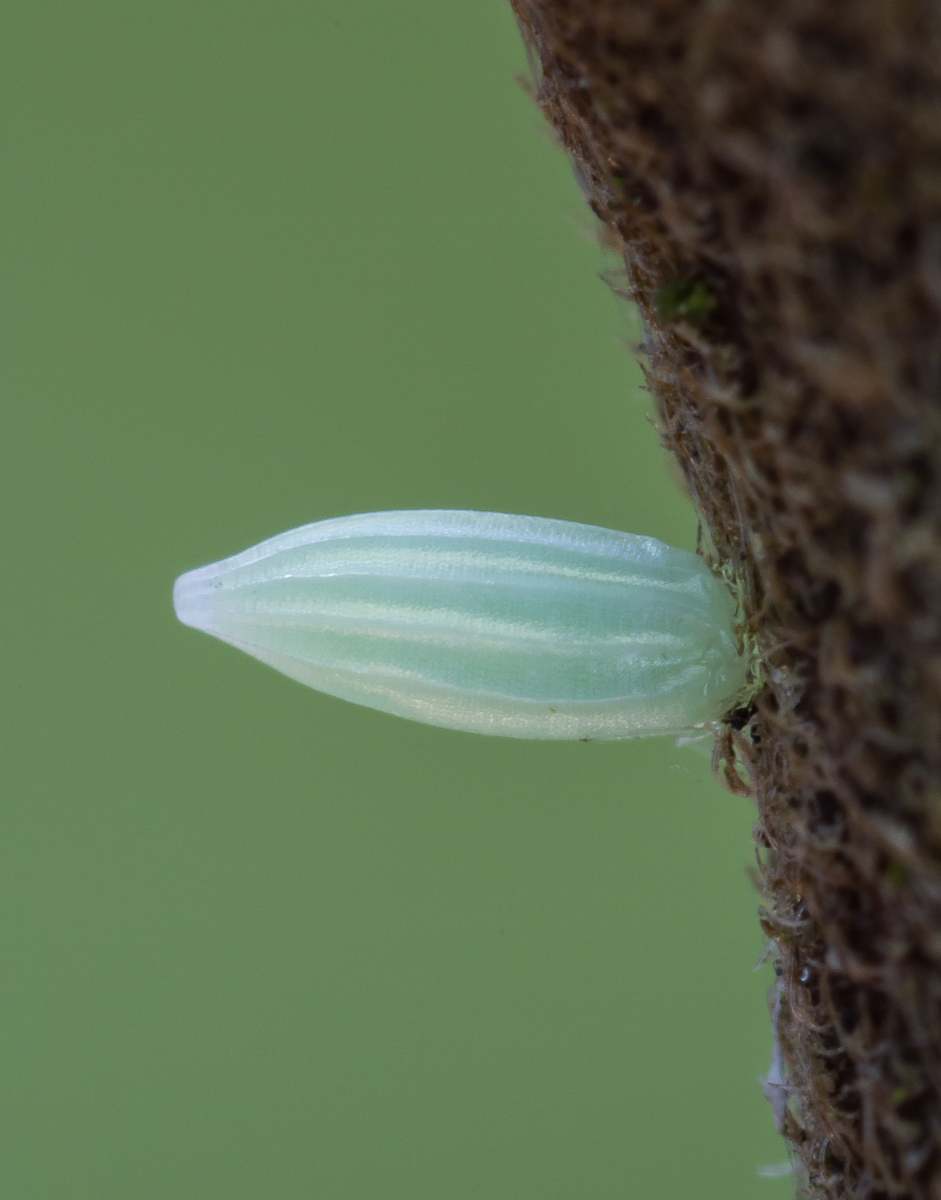
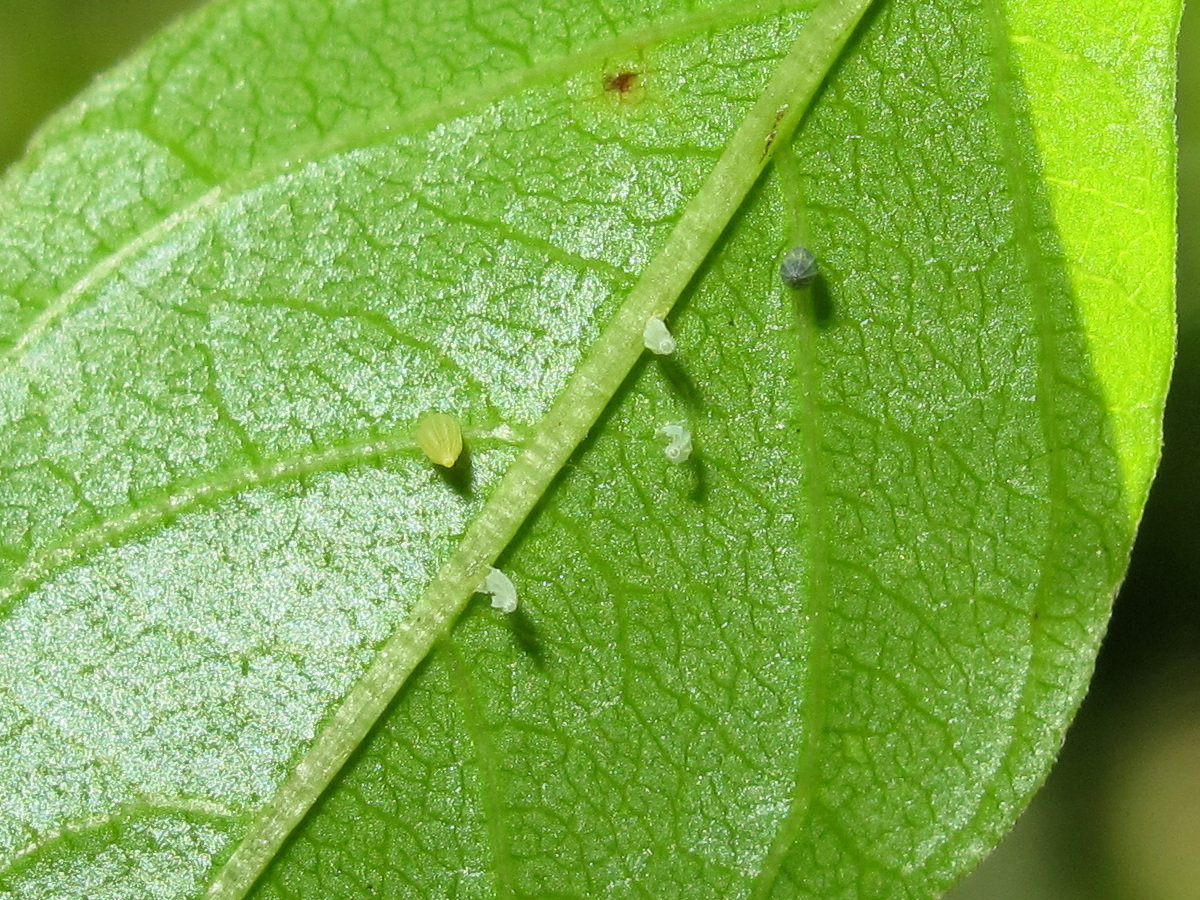
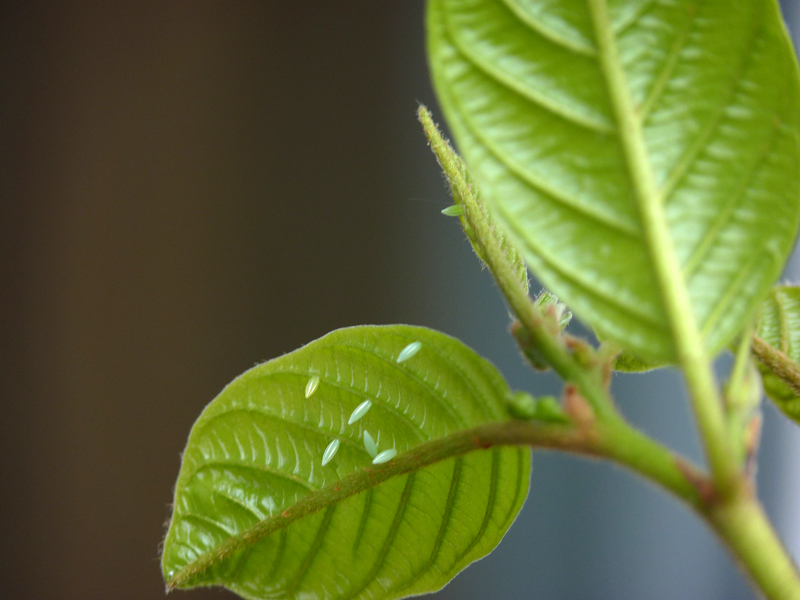
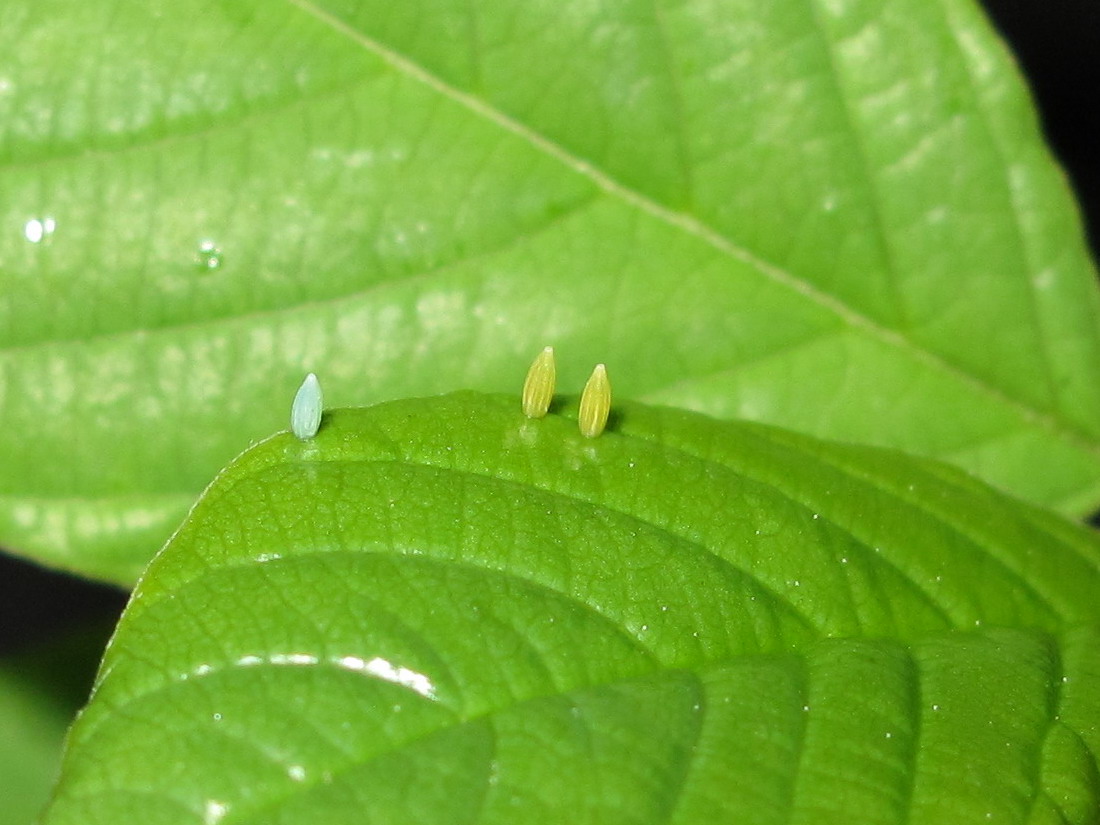
The skittle-shaped eggs are laid singly on the undersides of the youngest Buckthorn leaves at all heights on the foodplant. Although several eggs may be found together, this is either the result of different females using the same leaf, or the same female revisiting the spot at a different time. Newly-laid eggs are pale green, turning yellow and eventually grey as the larva develops inside. This stage lasts between 1 and 2 weeks.
"The egg is 1.3 mm. high, slender, and somewhat resembles a champagne bottle in shape, thickest about the middle, sloping to the base, and attenuated at the apical fourth; the extreme summit is rounded and the base rather flattened and firmly adhering to the leaf; there are, as a rule, ten longitudinal keels running from the summit to base, and about forty-five very fine transverse ribs; the surface is minutely cellular. The colour when first laid is a whitish-blue-green, keeping the same colour for about three days, then gradually turning a citrinc-yellow and afterwards a deeper yellow, and shortly before hatching it assumes a drab-grey. Often specimens are asymmetrical in form, having a tendency to bend to one side, and sometimes the keels are not continuous the whole length, but branch off to the next one. Most of the eggs hatched by June 18th, 1907." - Frohawk (1924)

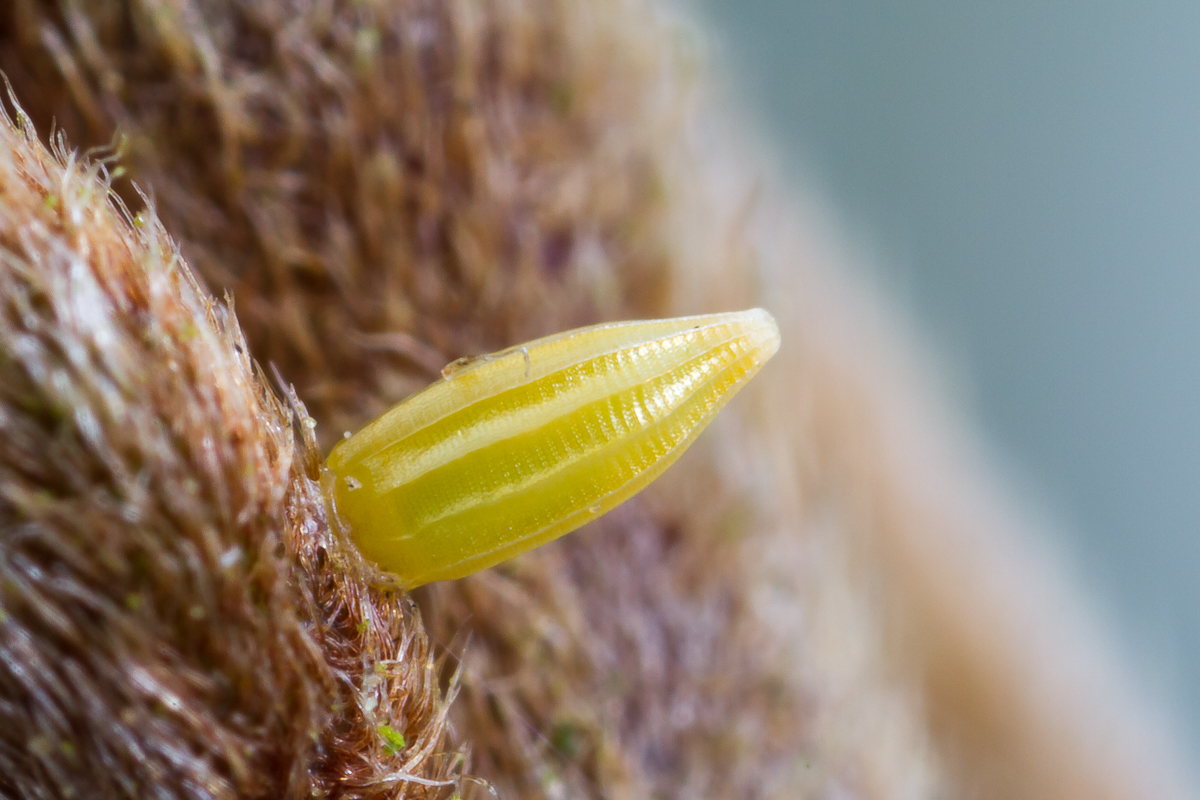
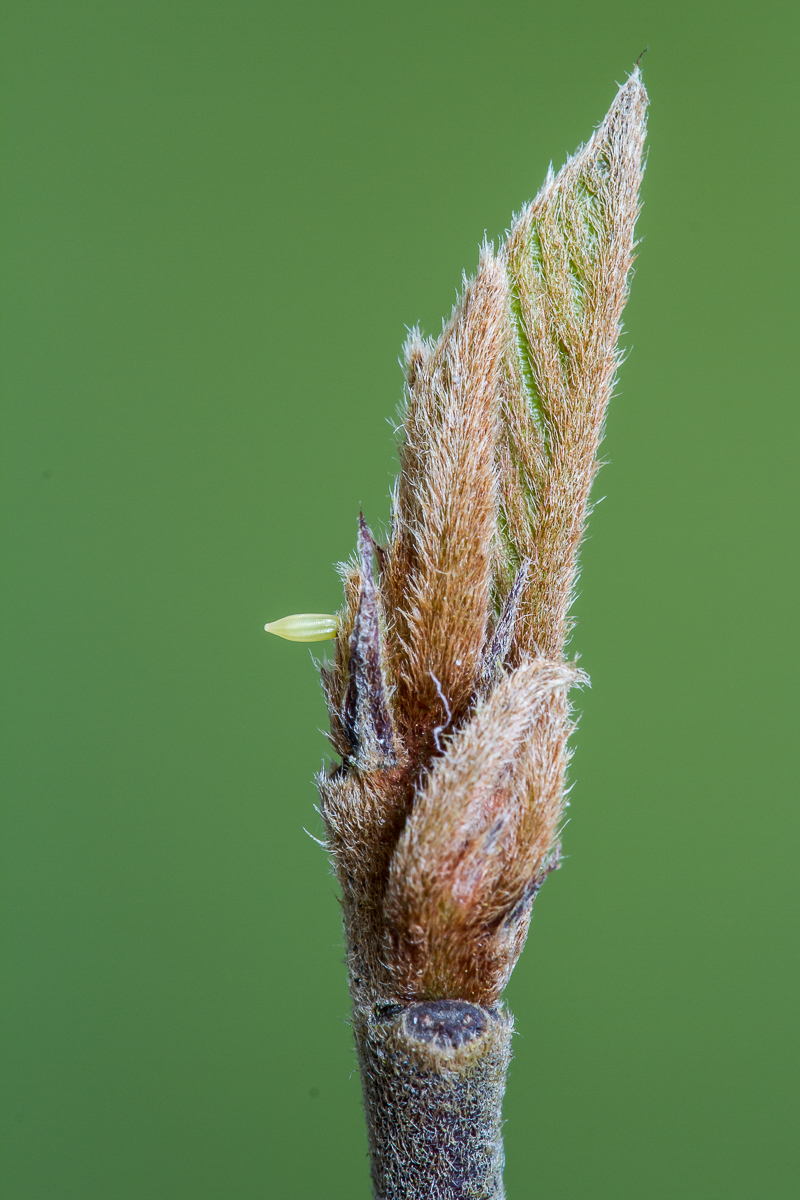
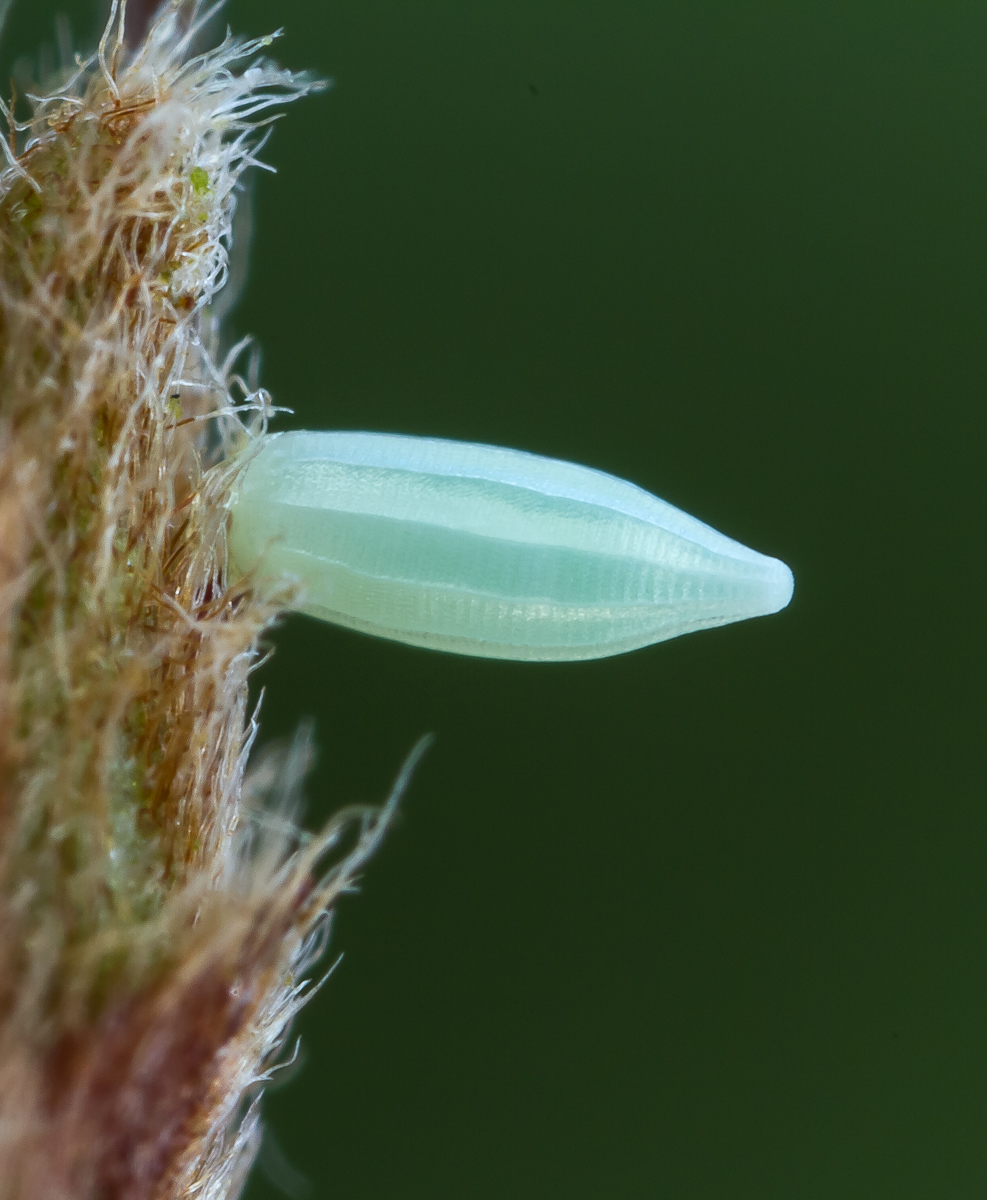
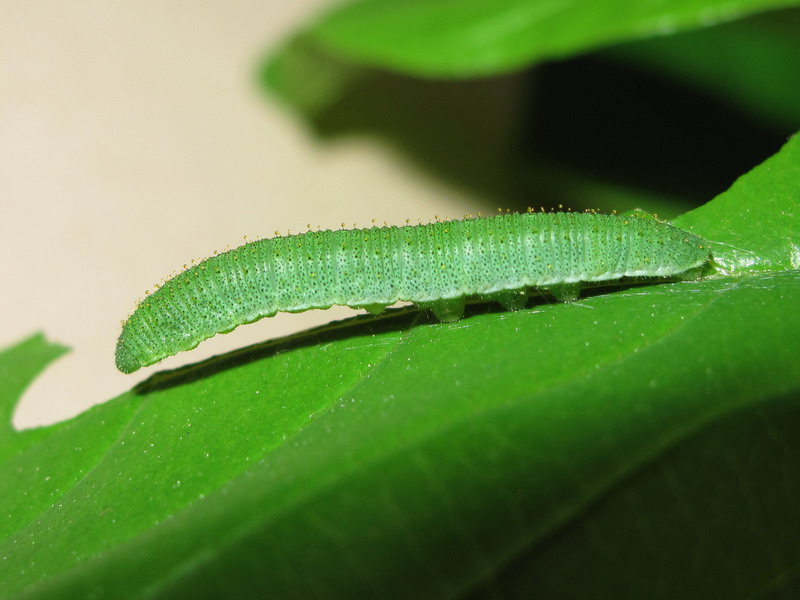
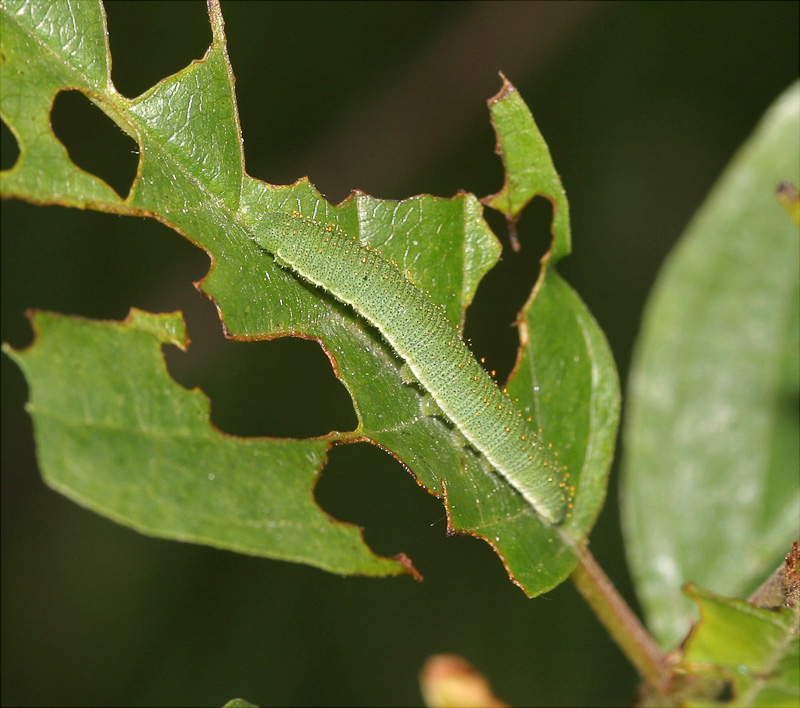
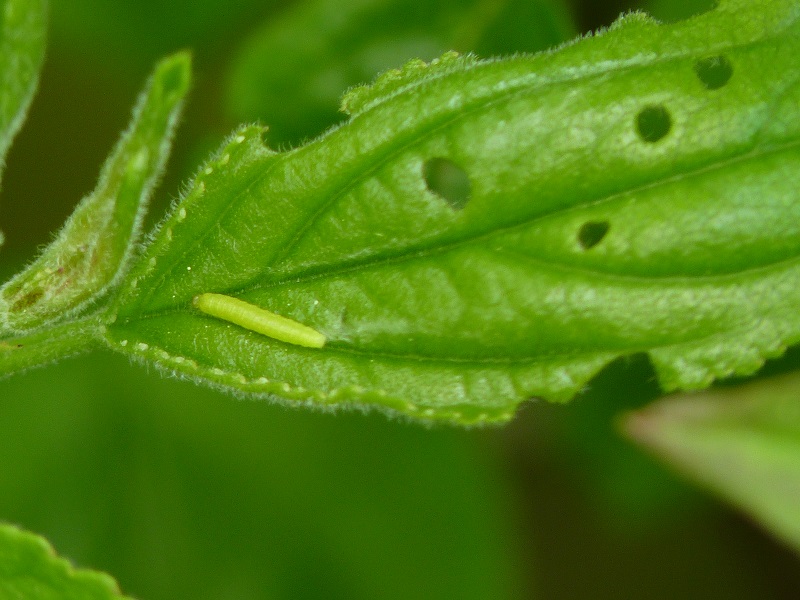
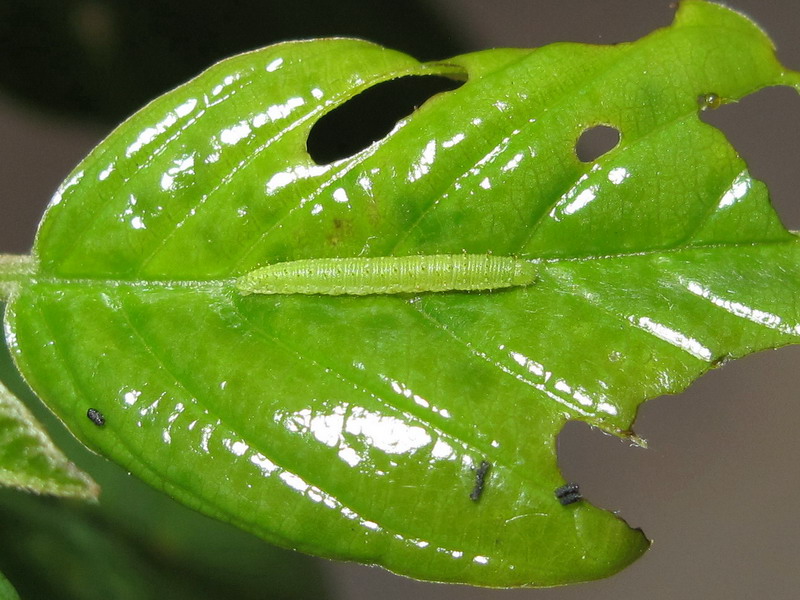
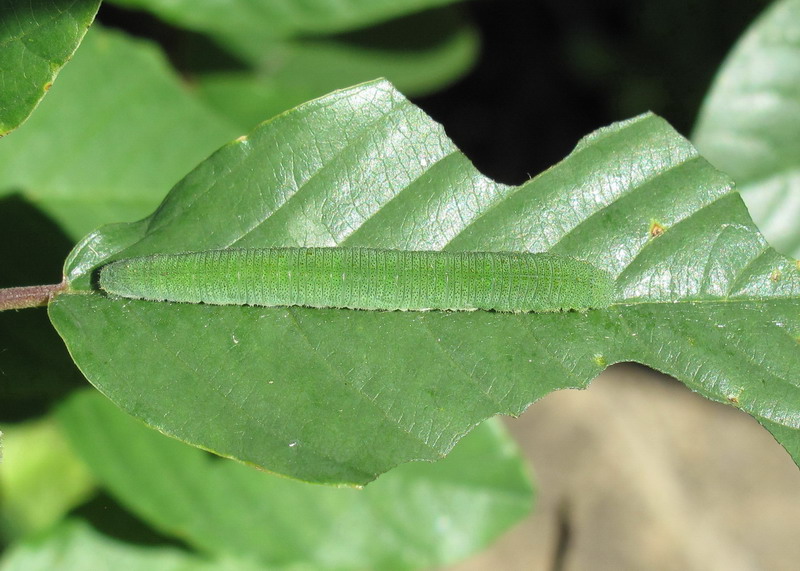
The newly-emerged larva moves to the upperside of the leaf and starts to feed. Despite their superb camouflage, larvae can be relatively-easy to find since they nibble away the edges of the leaf on which they are resting and the feeding damage gives their presence away. When at rest, the larva has a curious habit of lifting the front half of its body off the leaf. The larva goes through 4 moults in total and this stage lasts about a month.
The primary larval foodplants are Alder Buckthorn (Frangula alnus) and Buckthorn (Rhamnus cathartica).
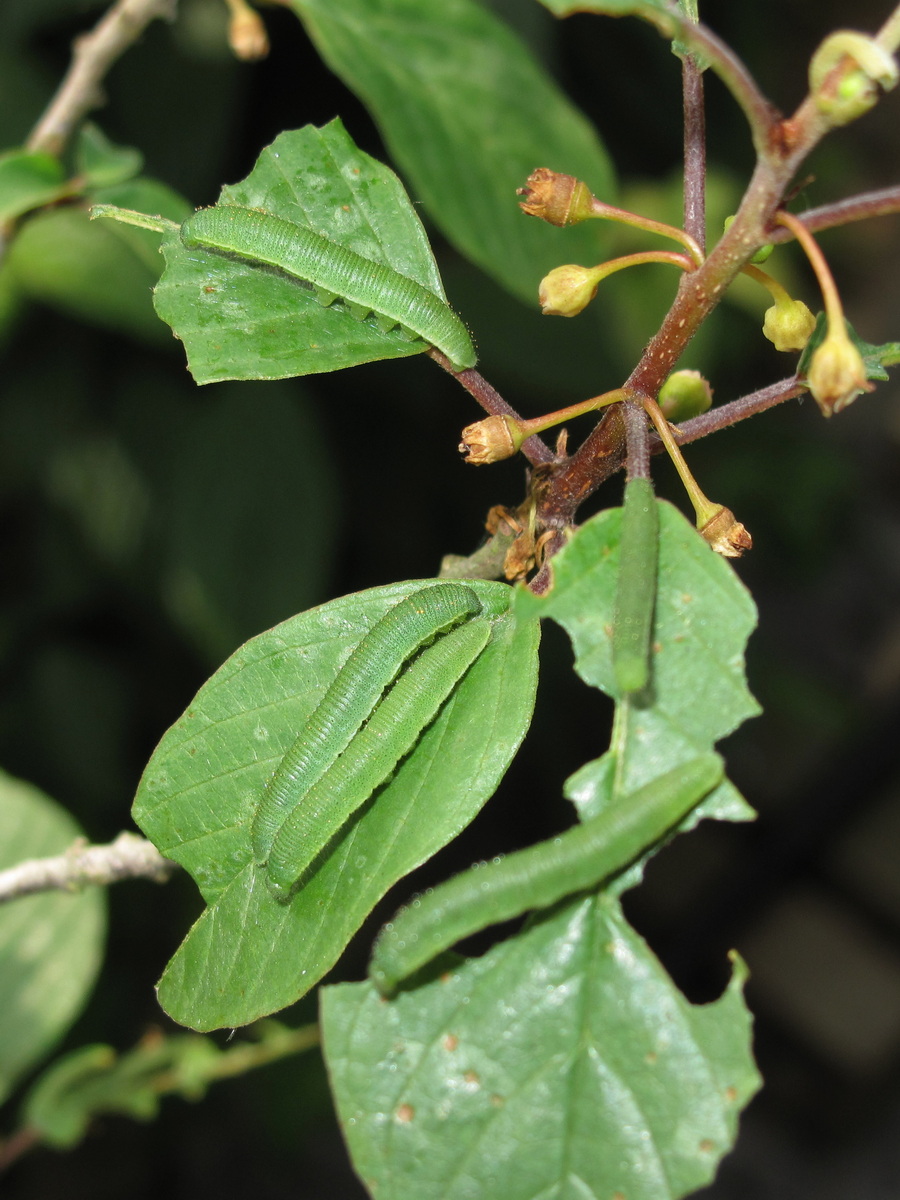

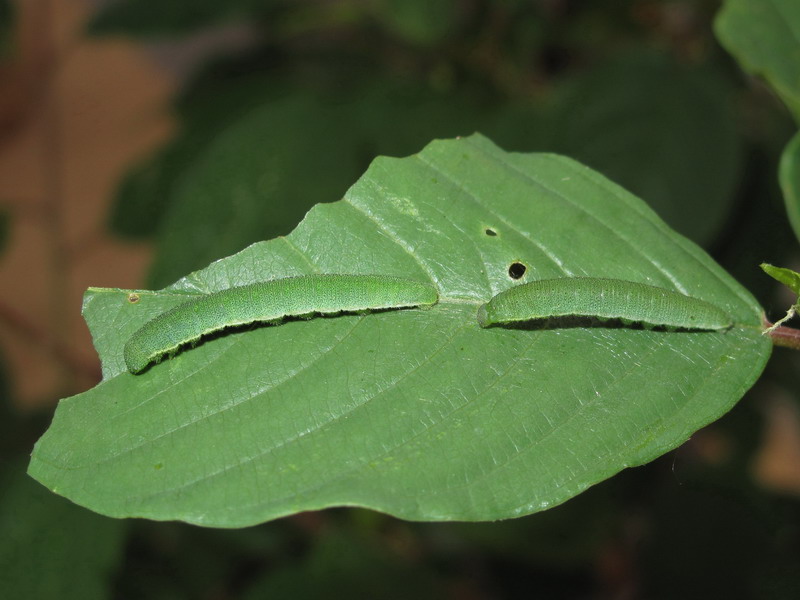
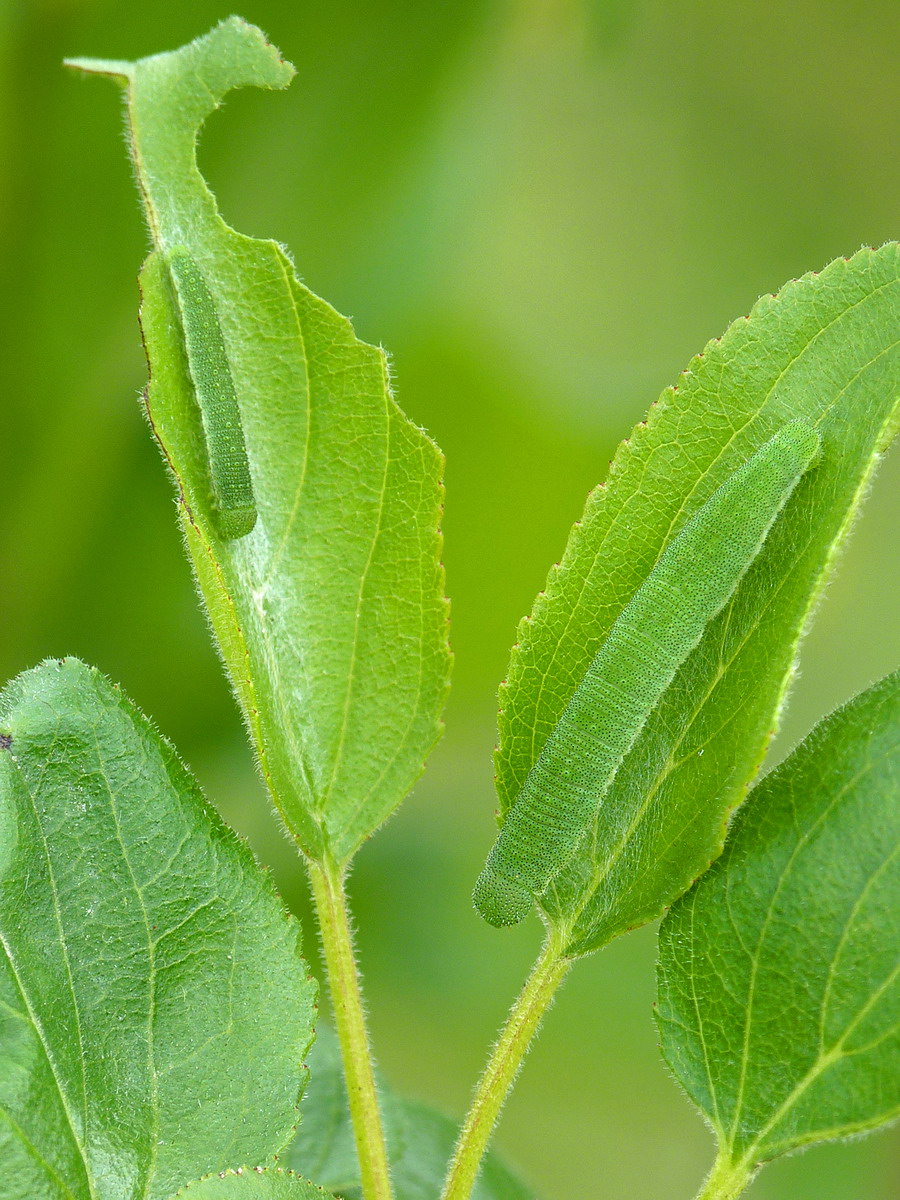
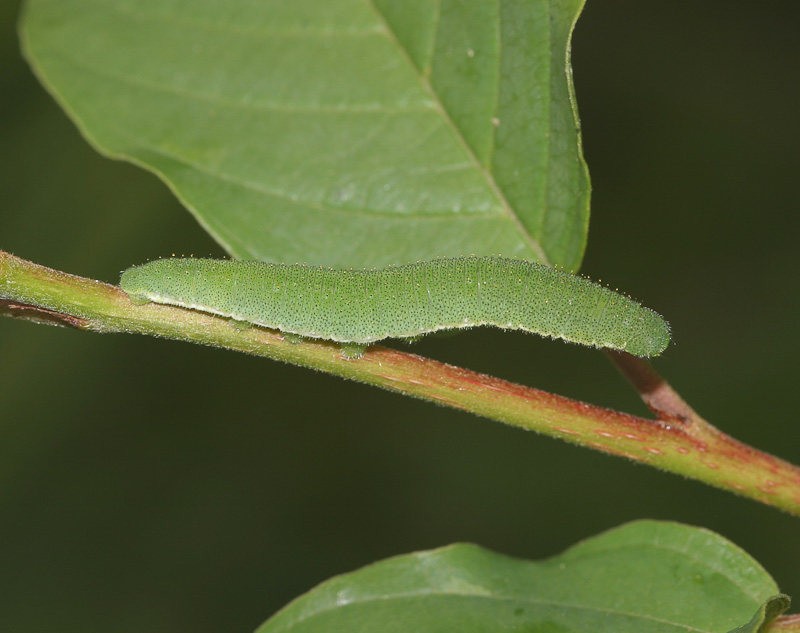
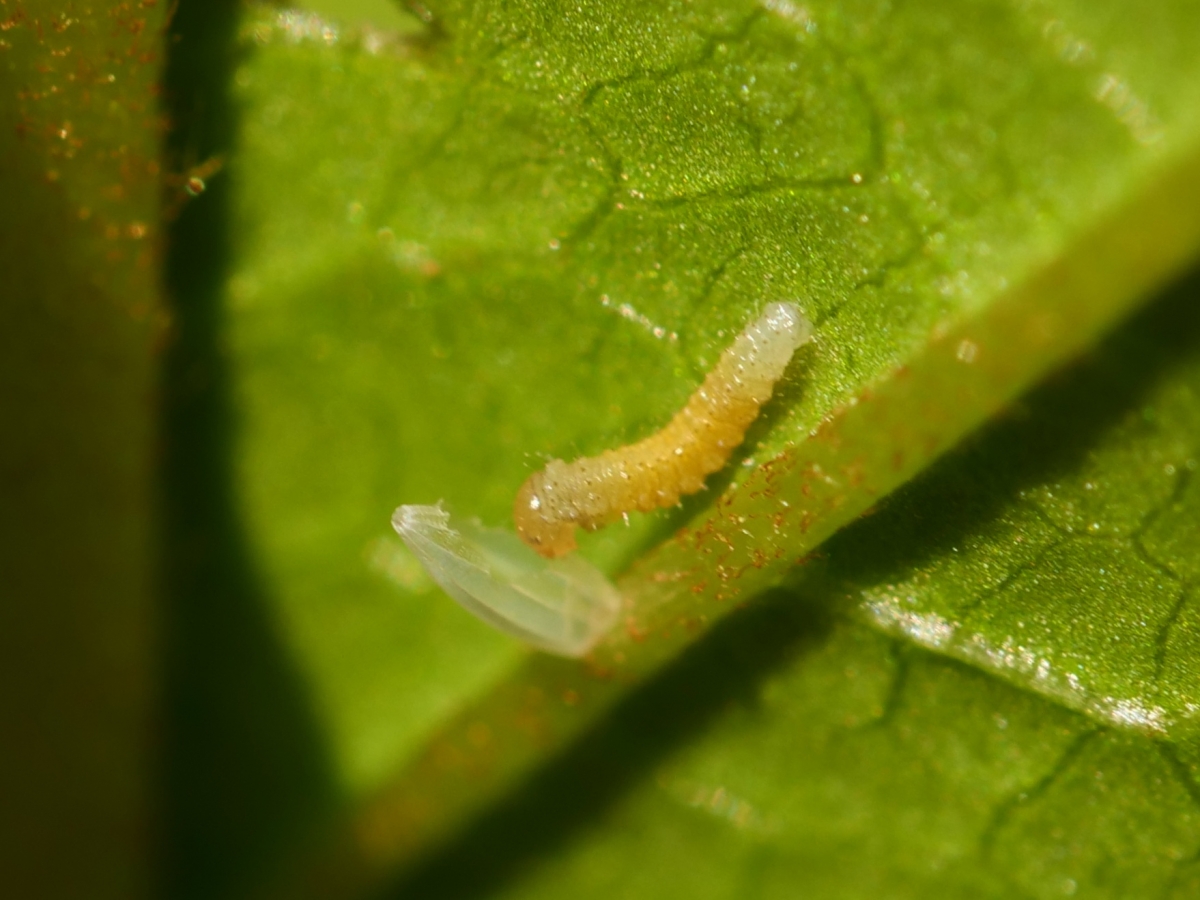
"The larva directly after emerging from the egg measures 1.7 mm. long. The body is cylindrical, but somewhat strongly lobed laterally. Each segment has four transverse wrinkles, the first is large and includes the spiracle; this and the next are surmounted dorsally by an olive-brown wart bearing a white glassy knobbed hair or spine. The extreme point rises above the knob. These form a double dorsal longitudinal series; above the spiracle is a slender simple white hair and two others below, also two on each clasper; all have olive-brown shining bulbous bases. The head is globular, with black eye spots, and sparsely studded with white spinous hairs. The hairs on the anal segment are rather long. The entire colour is citrinous or olivaccous-yellow. The surface is rather densely covered with dusky warts of different sizes. It rests in a straight position, lying along one of the ribs, and in feeding perforates the leaf. Soon after feeding it assumes a greenish hue." - Frohawk (1924)
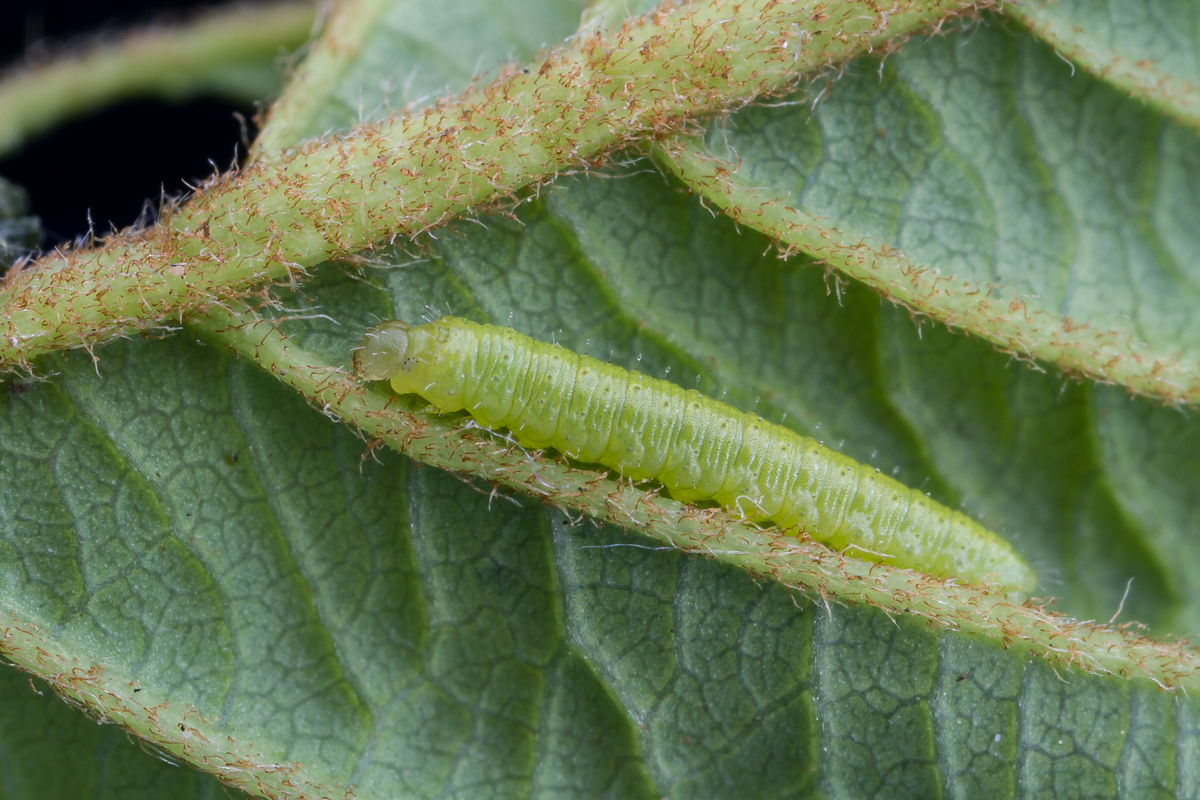

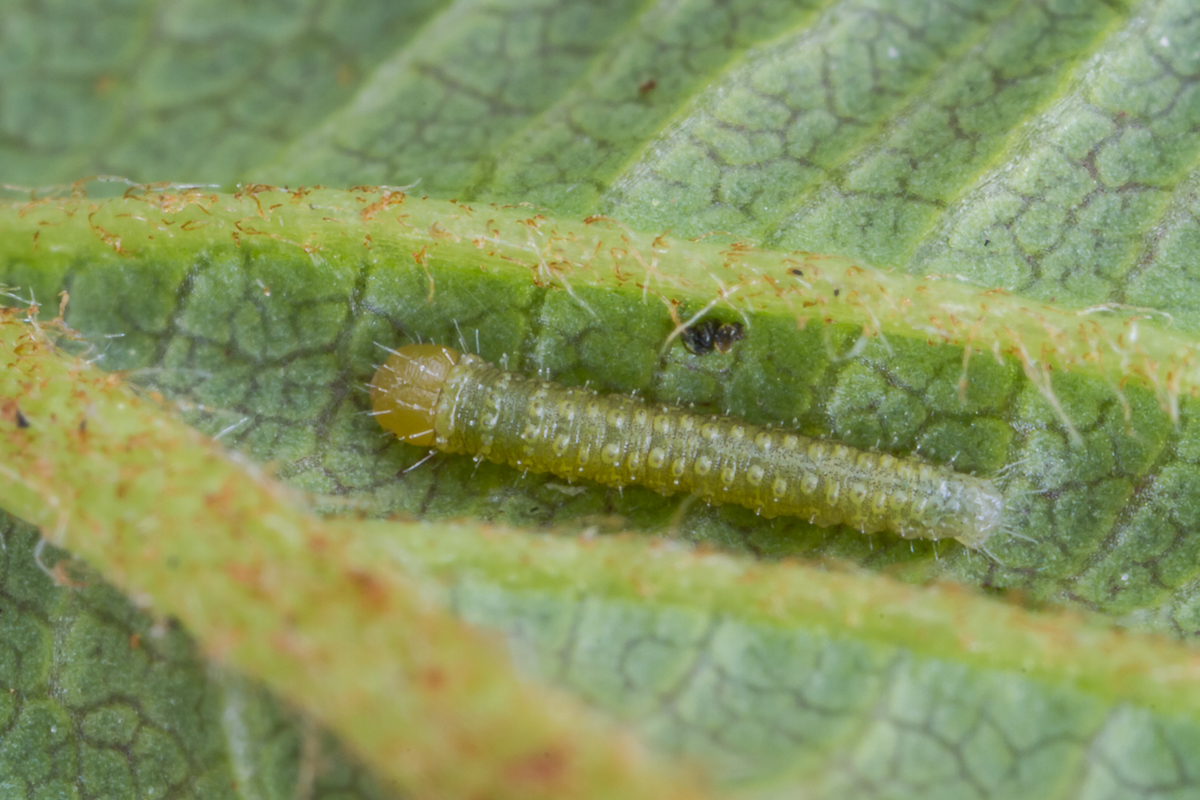


"First moult June 22nd. After first moult, eight days old, it measures 6.31 mm. long; it is entirely of a clear green colour, and similar in general structure to the previous stage, excepting additional small black tubercles scattered over the body. The surface surrounding the base of each is devoid of the black points which are elsewhere scattered densely over the surface. The dorsal hairs are dark and clubbed, and exude tiny beads of liquid. The head is green, beset with white hairs similar to the first stage. It still rests and feeds on the under surface." - Frohawk (1924)
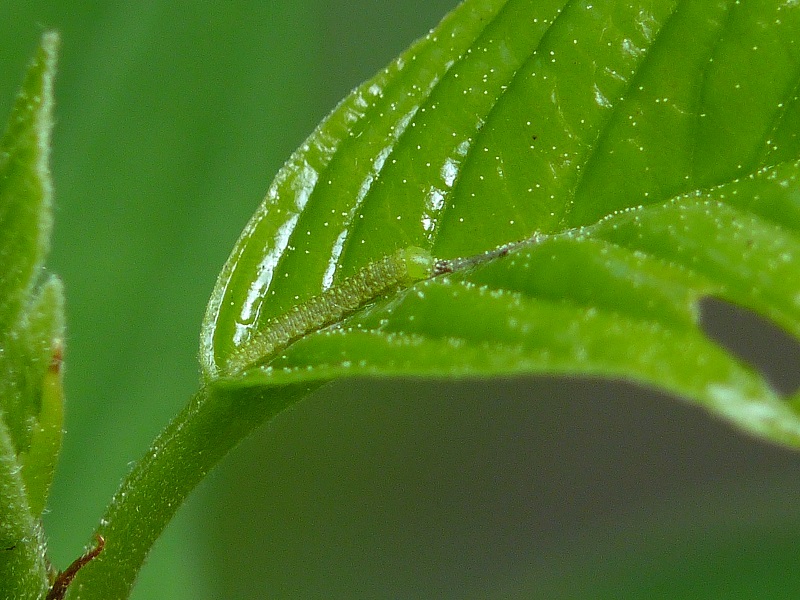
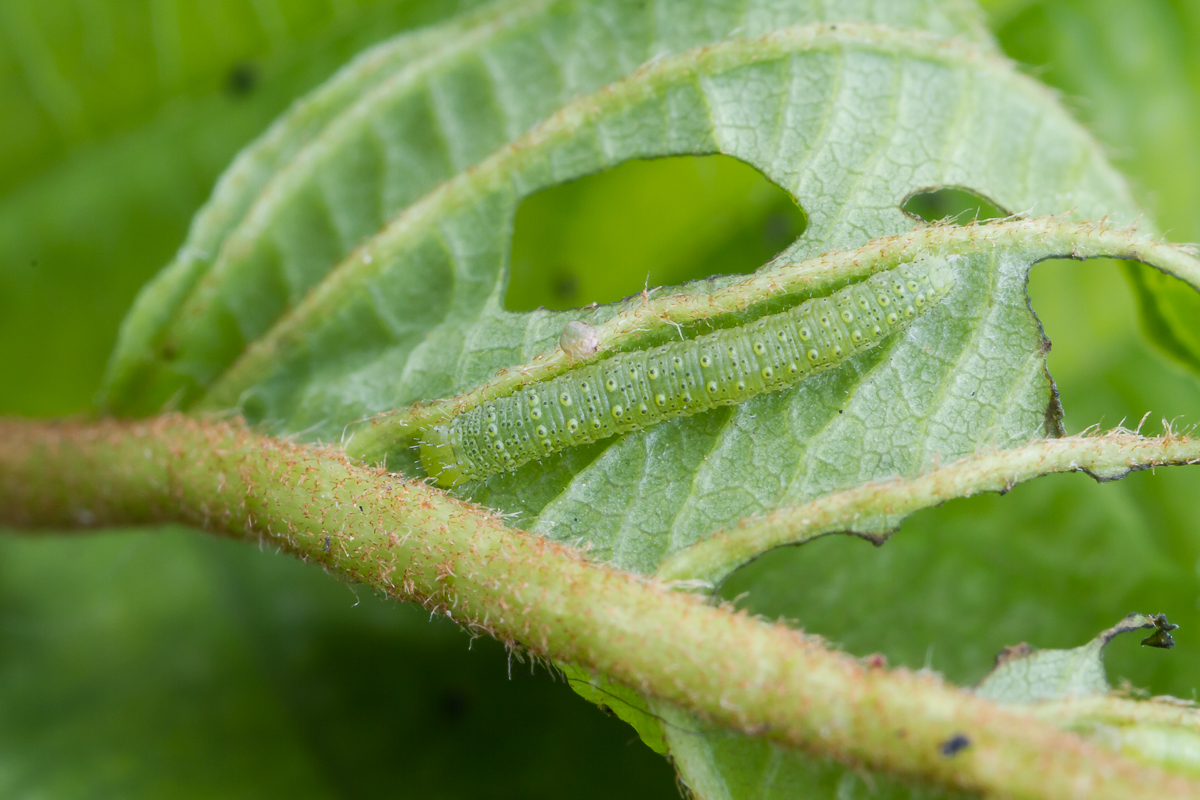
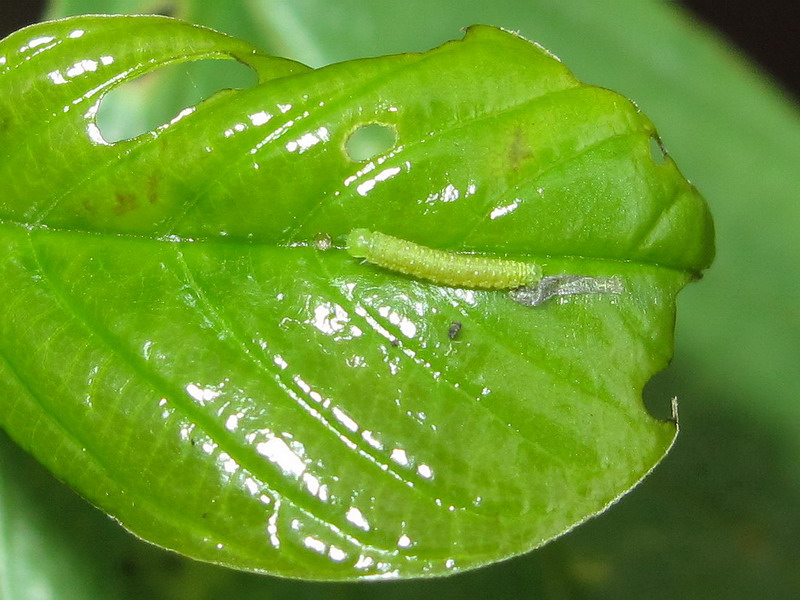

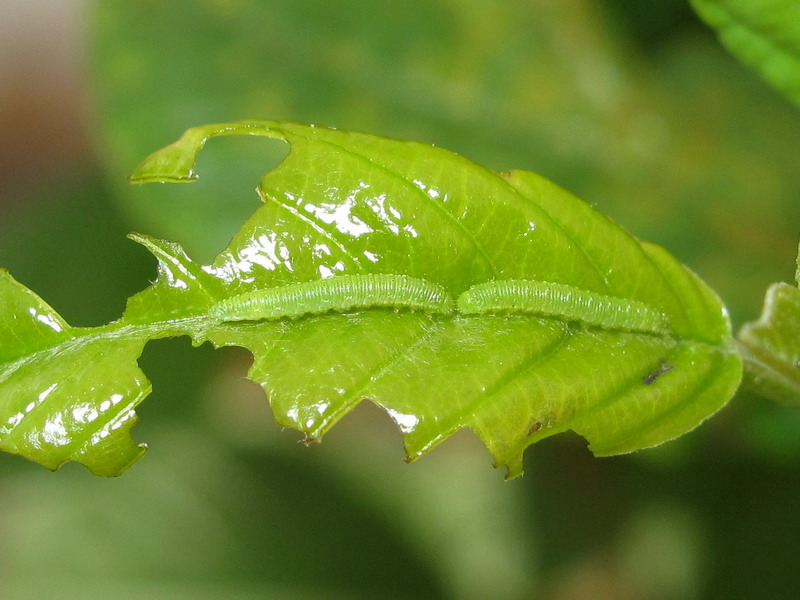
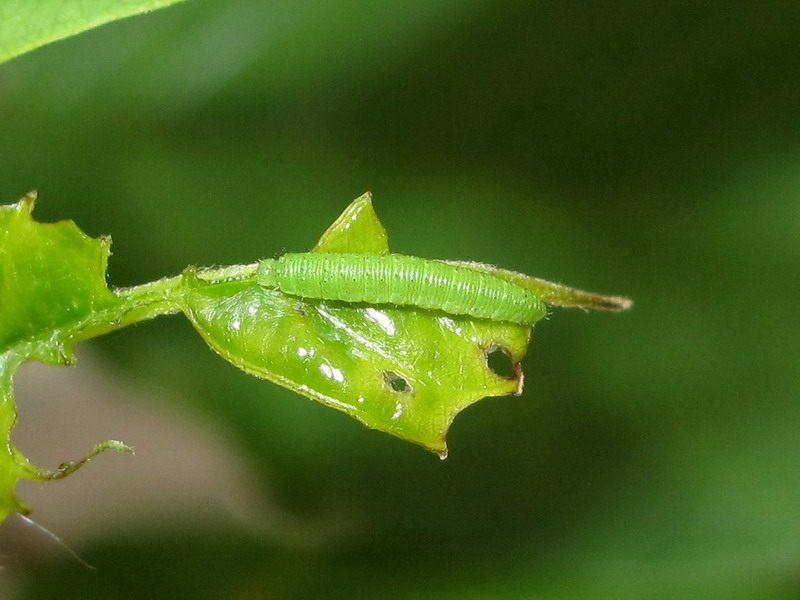
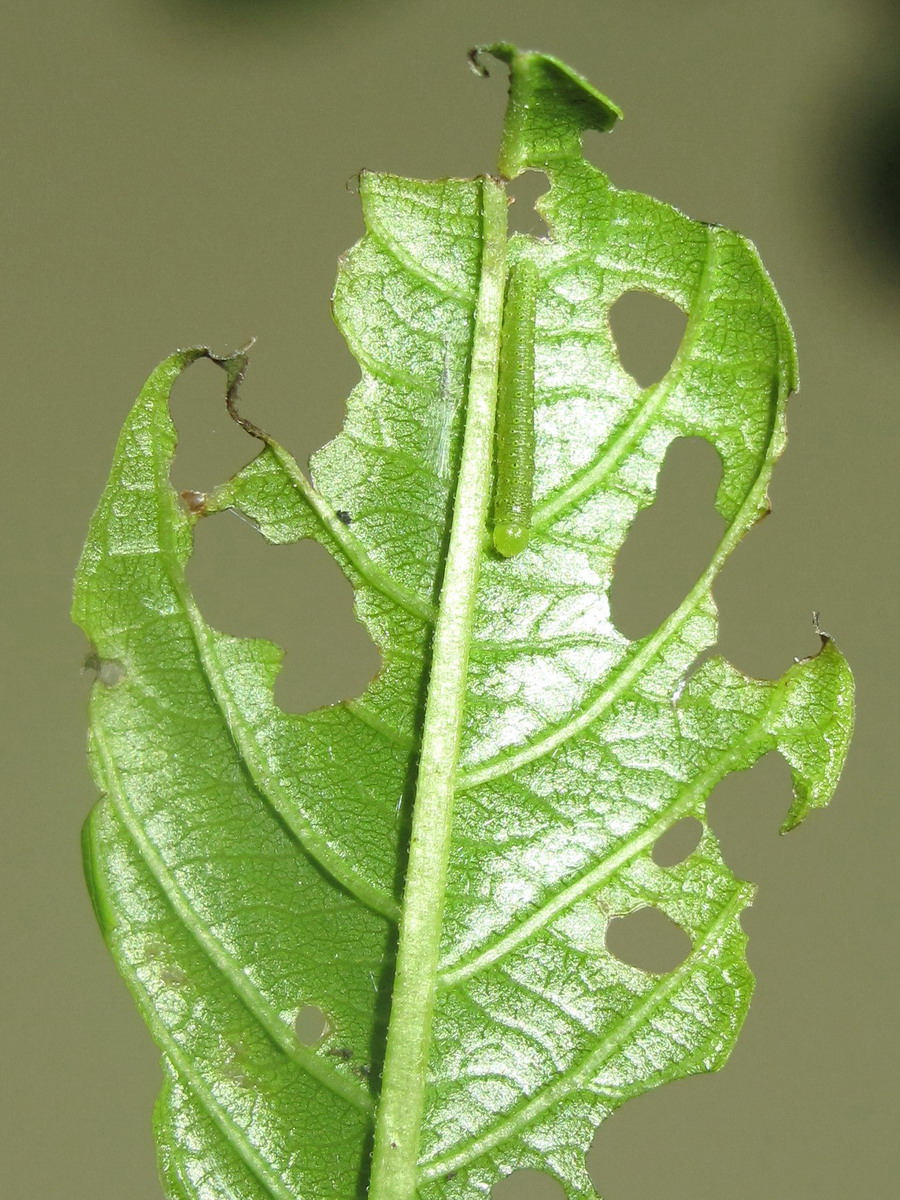
"Second moult June 26th, 1907, remaining only four days in the second stage. After second moult, and shortly before third, it is 12.7 mm. long; it is similar to previous stage, excepting the white hairs on the head are more numerous and each with a black bulbous base, and all the body hairs exude tiny beads of amber-coloured fluid. It rests in a straight attitude along the midrib near the base on the upper surface of the leaf, returning to the same spot after each meal." - Frohawk (1924)
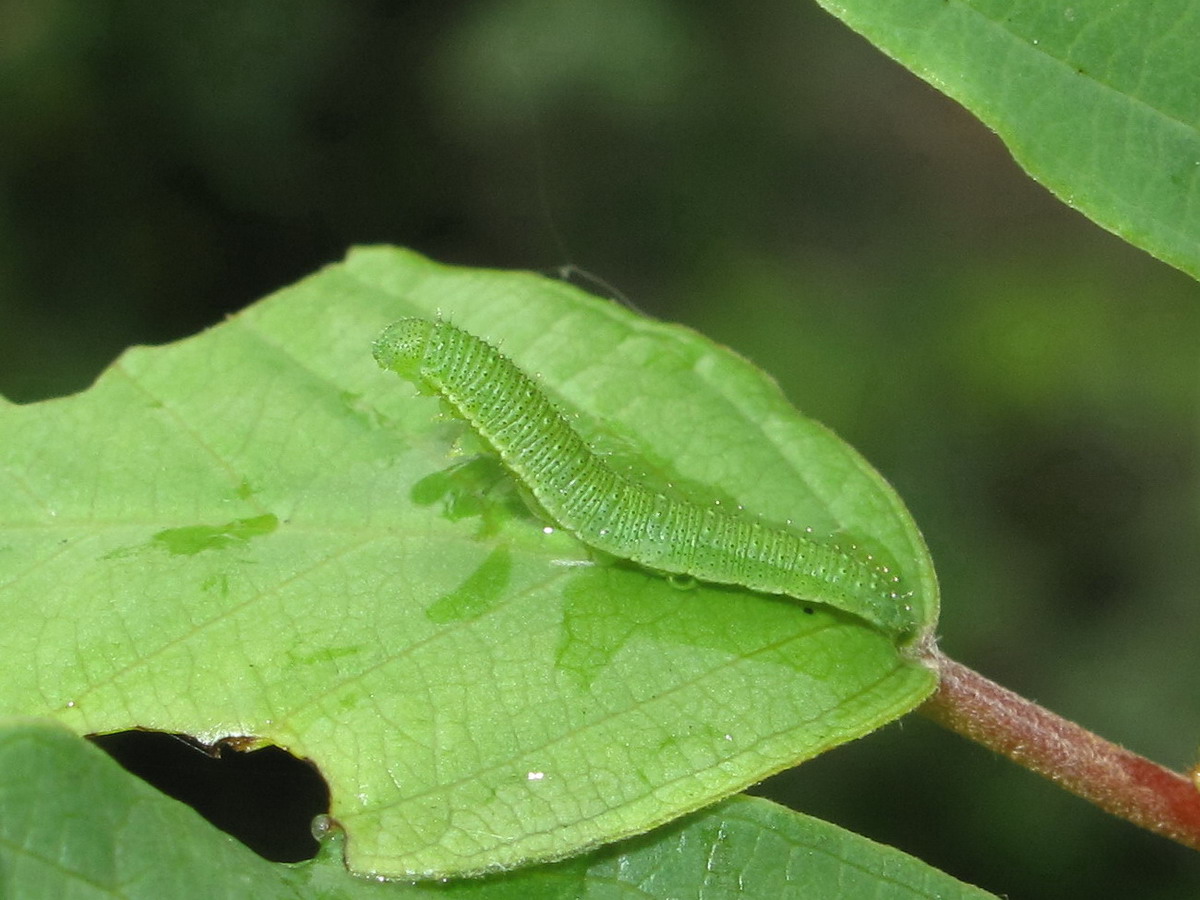

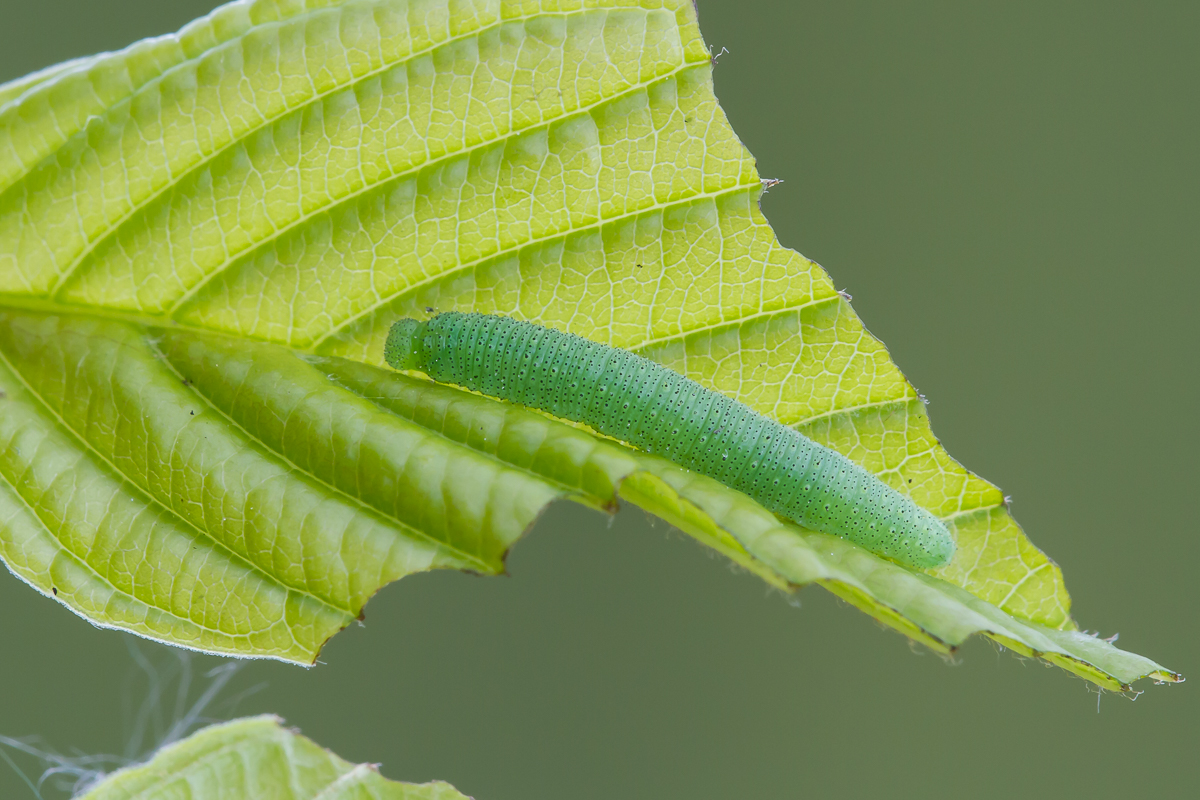
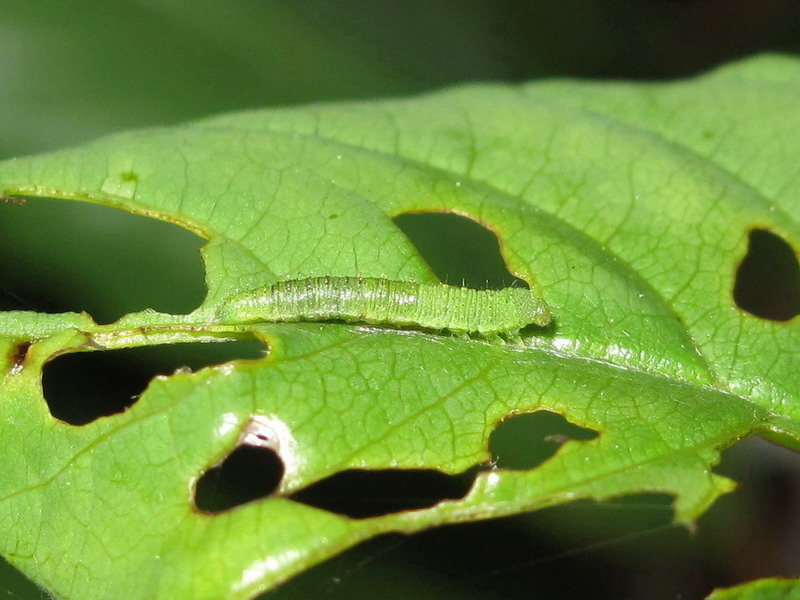
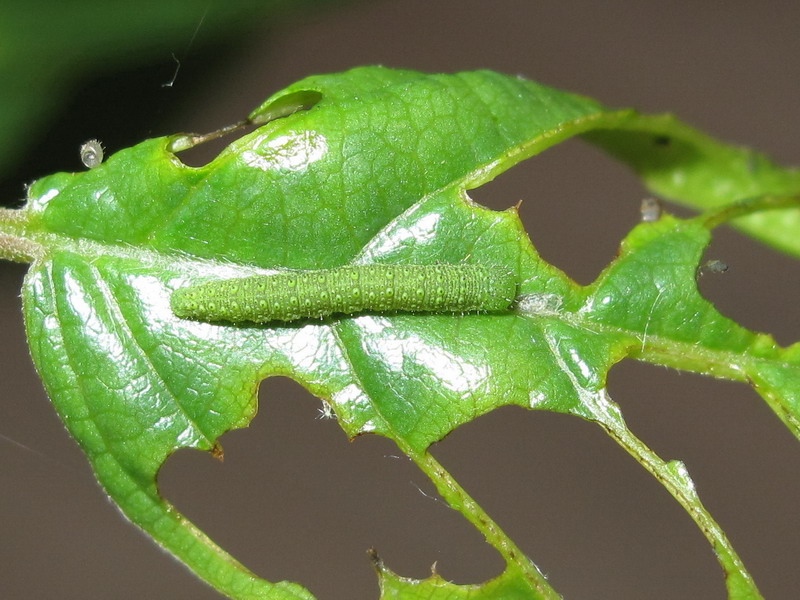
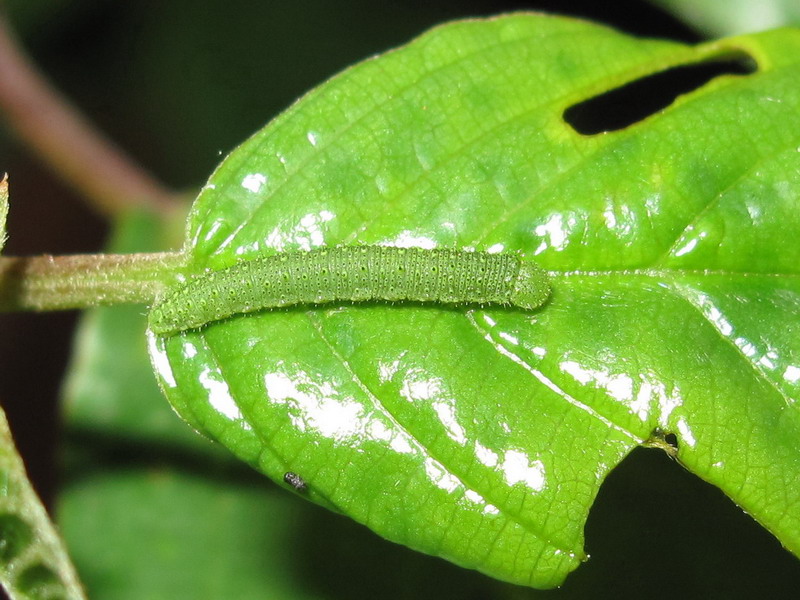
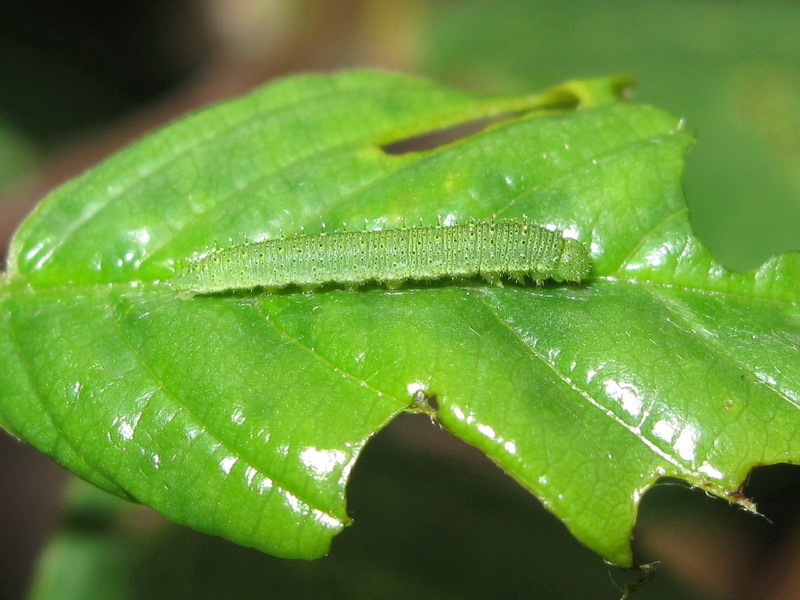
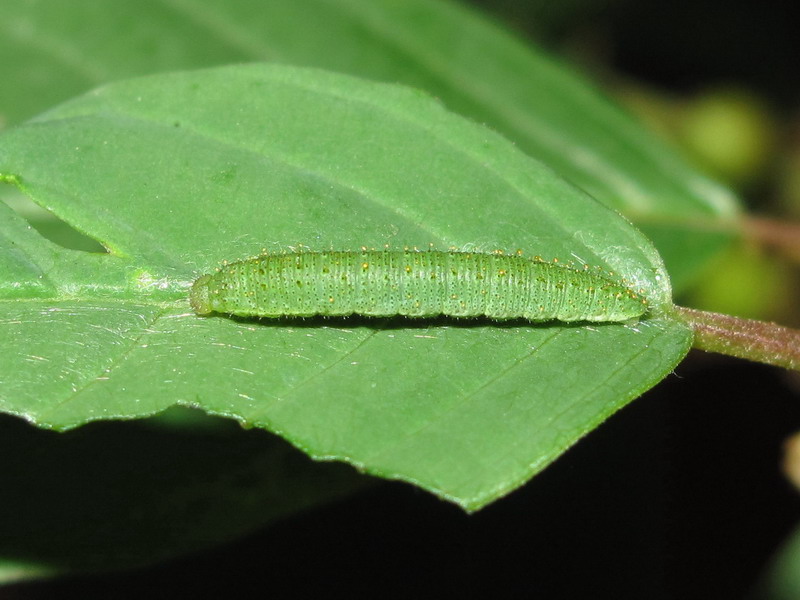
"Third moult July 1st, 1907, remaining five days in the third stage. After third moult, seventeen days old, it is 19 mm. long. The segments are strongly sub-divided and densely covered with minute black warts of various sizes, each bearing a short black bristle. Those on the smallest are mere black points. The larger ones exude an amber-coloured bead of fluid, as in the previous stage; along the spiracular region all the warts and bristles, as well as the spiracles, are white; the head is covered with black warts bearing white hairs; the whole surface is finely granular. The colouring of the head and dorsal surface is green, blending into greenish blue on the side and finally into the whitish lateral sub-spiracular line; the ventral surface, legs and claspers are wholly yellowish-green, sprinkled with warts and fine short hairs. It rests along the midrib of the leaf on the upper surface in a straight position, as in the previous stage." - Frohawk (1924)
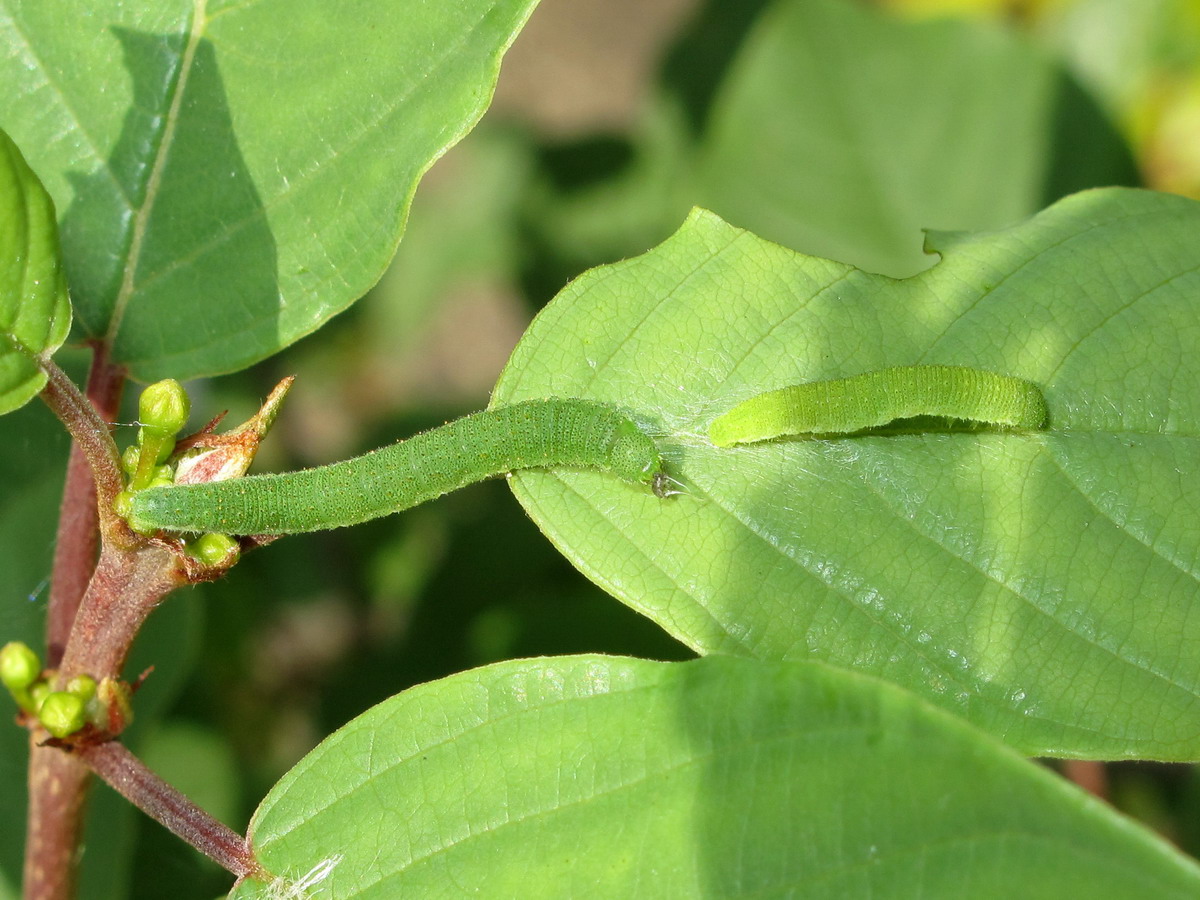
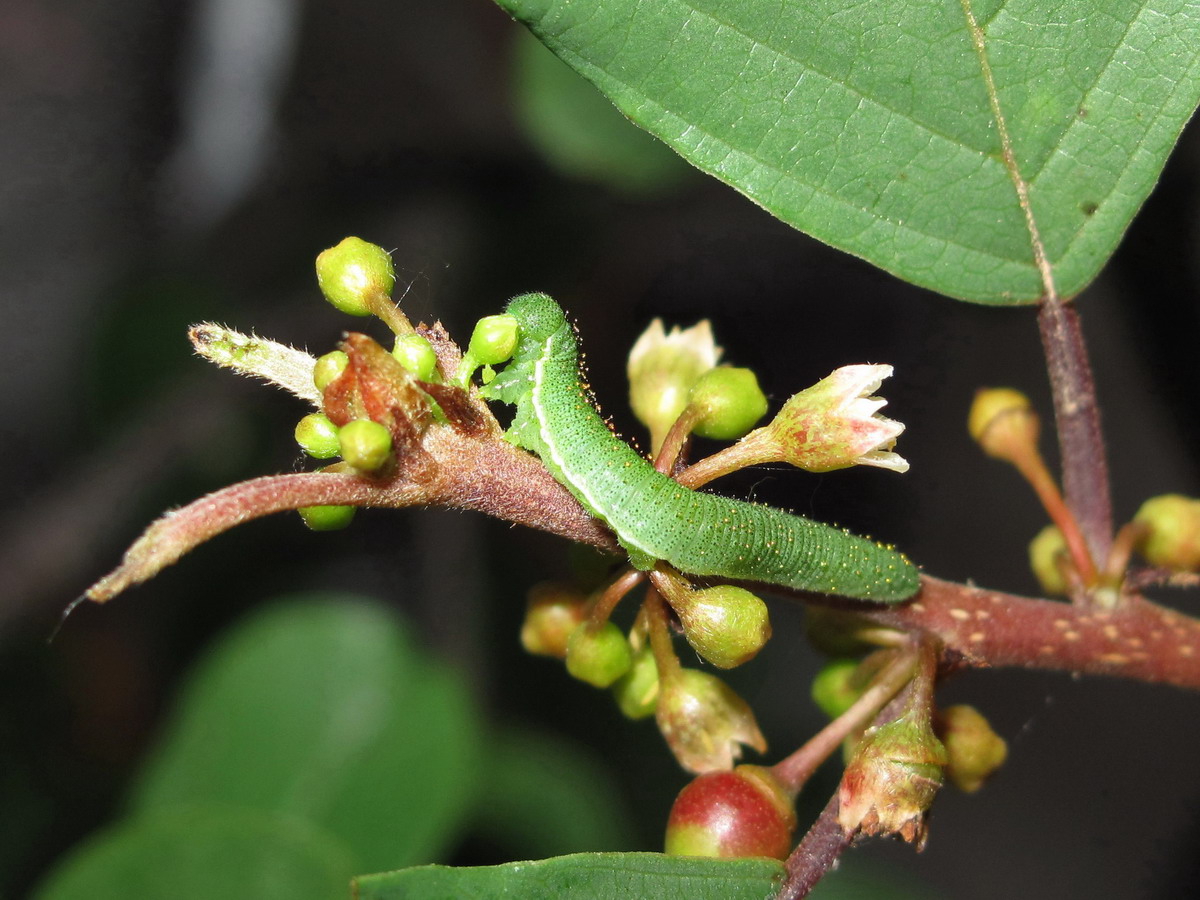
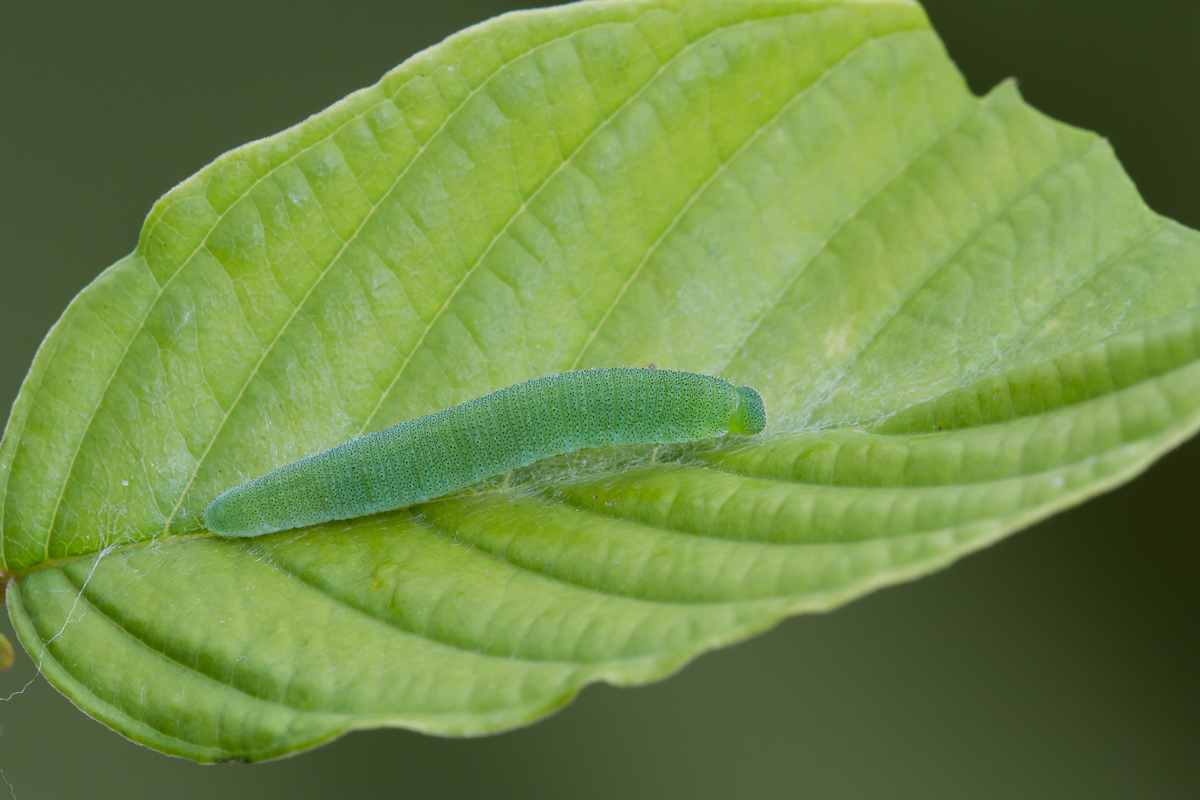
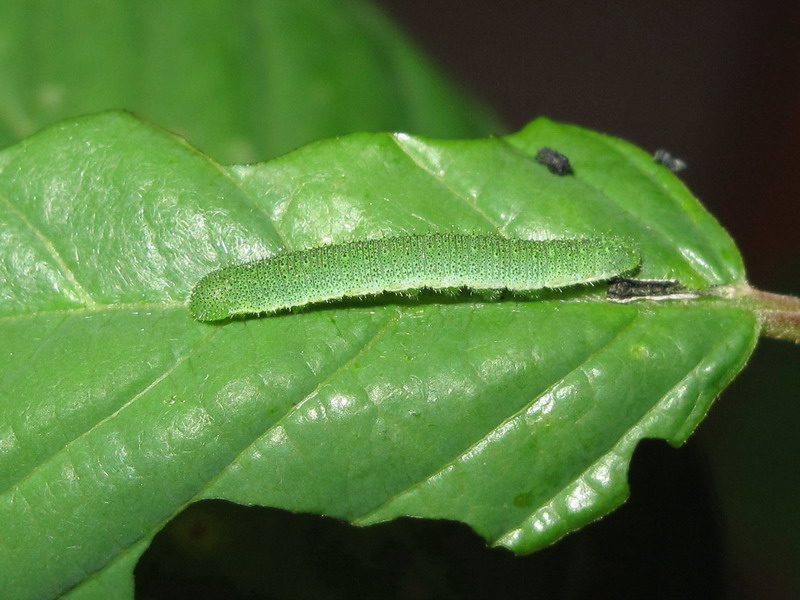
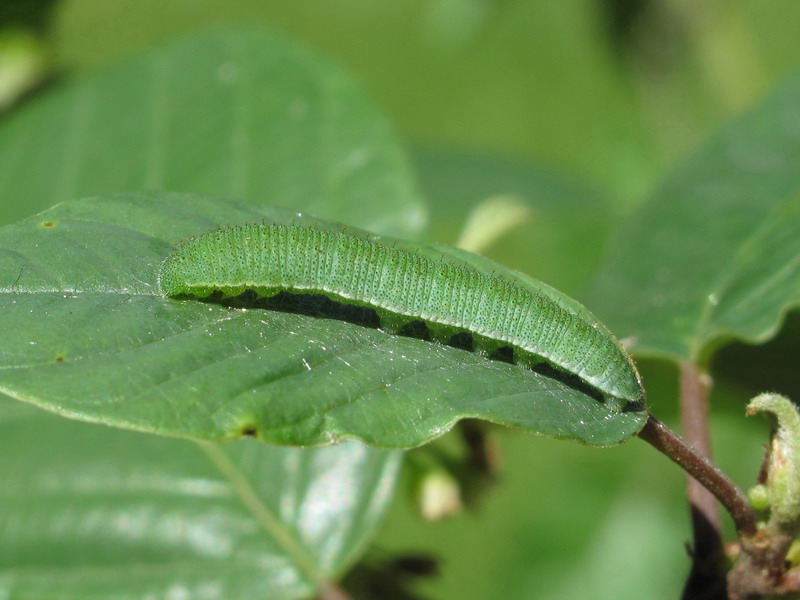
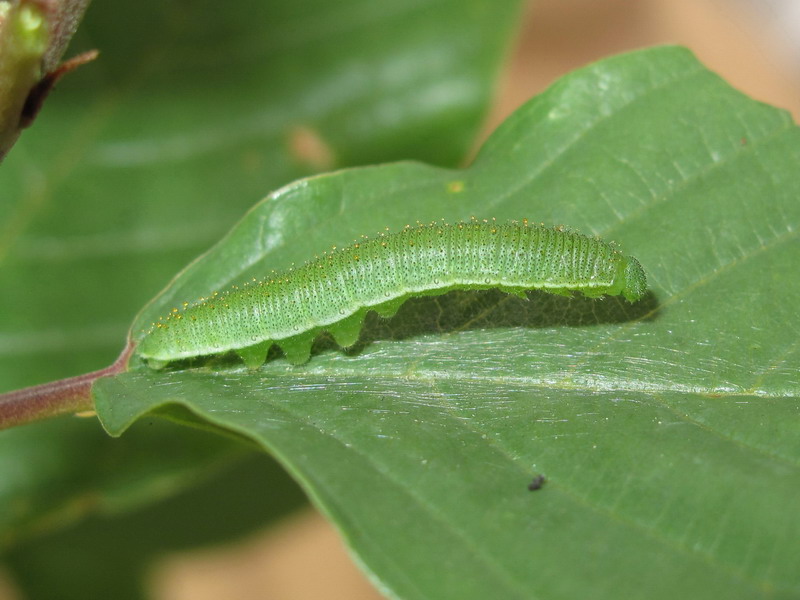
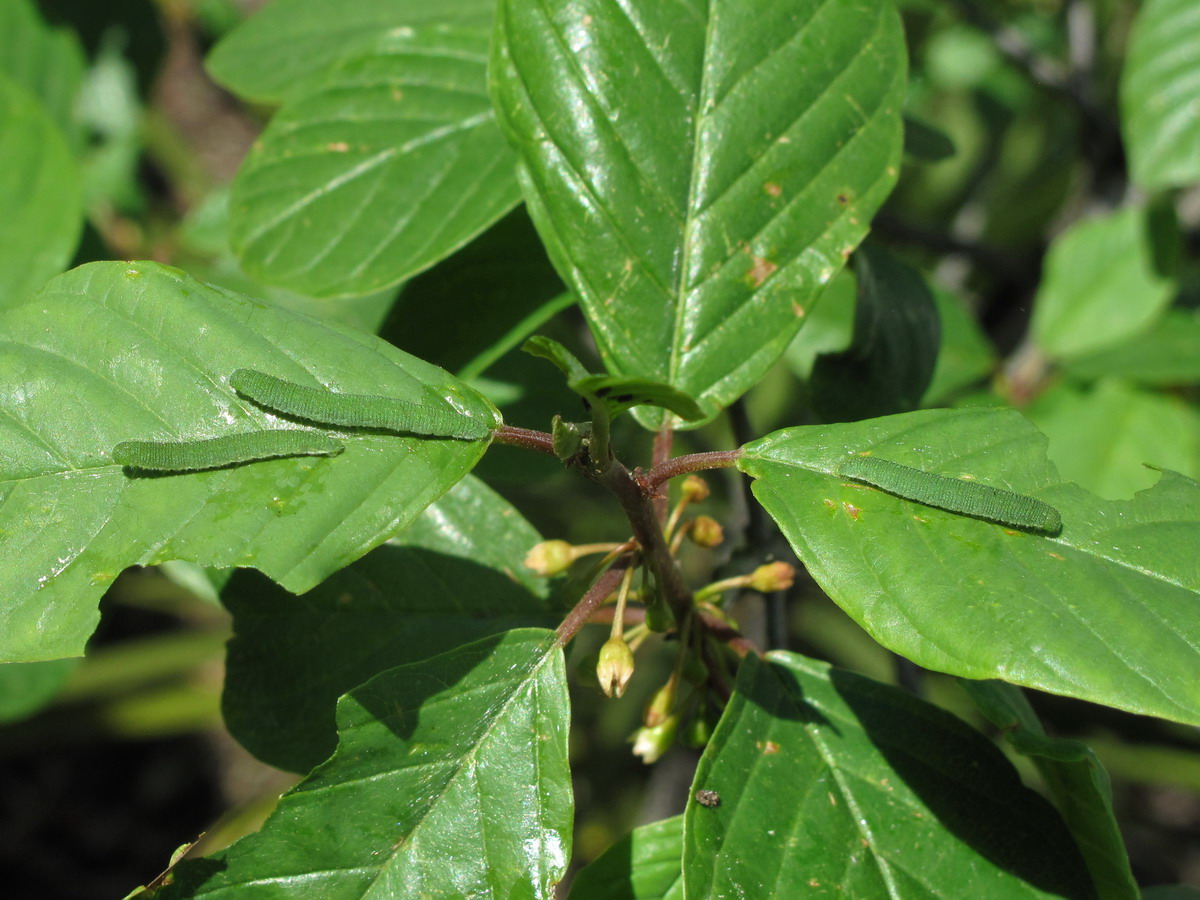
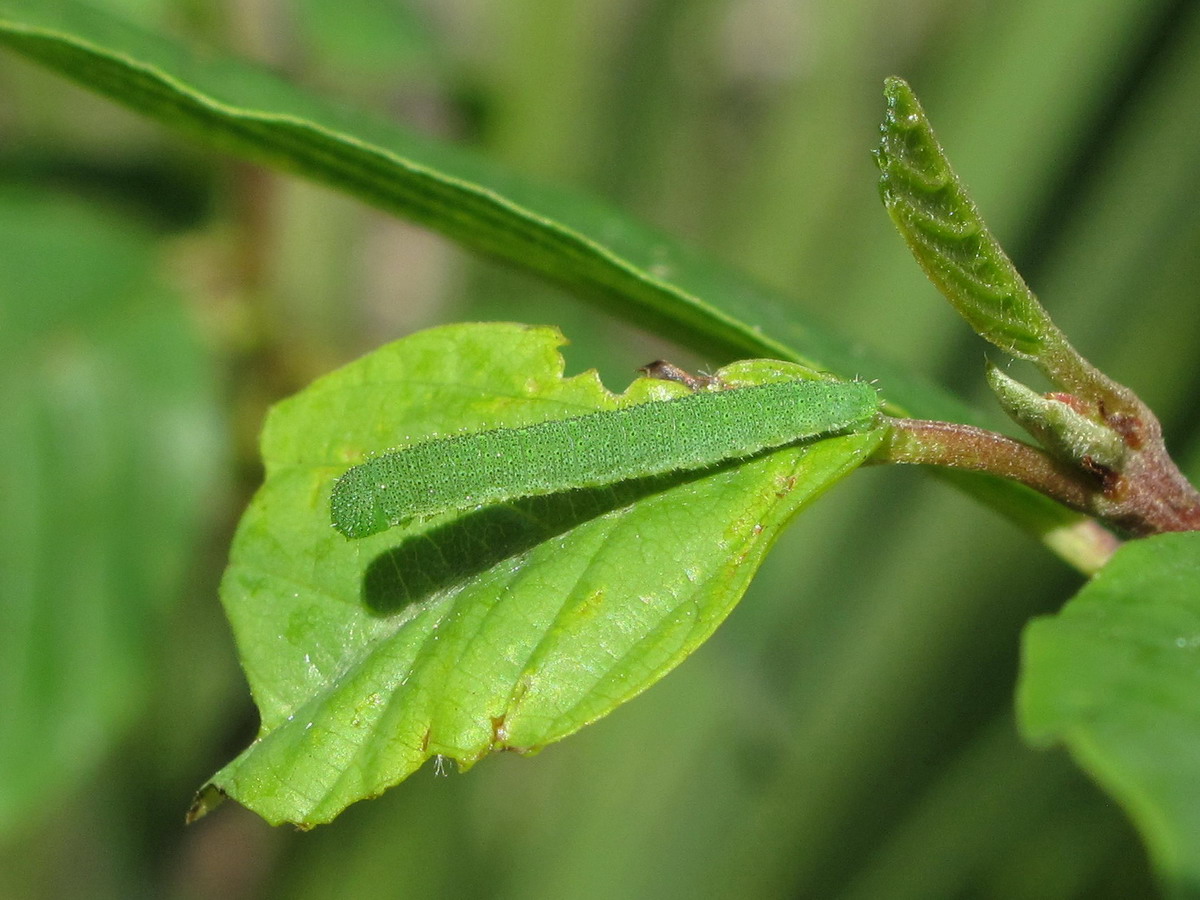
"Fourth moult July 7th, 1907, remaining six days in the fourth stage. After fourth and last moult, fully grown, it measures from 31.8 mm. to 34.9 mm. long. The segments are deeply wrinkled transversely; the second and third segments are considerably larger than the first; the chin has two glandular swellings. The general colouring of the upper surface, including the head, is glaucous-green, darkest on the dorsal region, with a slightly darker medio-dorsal line. The dorsal colouring gradually blends into bluish to the white spiracular stripe, which is somewhat dilated along the lower edge. The central portion of the stripe is tinged with pearl-grey; the spiracles are also whitish, slightly tinged with whitish-yellow apertures; the under surface, including the legs and claspers, is a clear yellowish-green; the whole surface of the head and body, down to the spiracular stripe, is densely covered with black, pedestal-shaped tubercles, each having a minute black spike, and a few on each segment, corresponding with those on the young larvae, bear longer bristles, which are dusky over the basal half, the remainder whitish, and the apex is clubbed, to which adheres a tiny bead of amber-coloured fluid. The entire under surface, including the white spiracular stripe, is beset with white bristles. The last stage occupies six days. It rests on the upper surface of the leaf, lying along the midrib, with the anal claspers fixed to the stalk at the base of the leaf. Just previous to spinning up for pupation the whole colouring becomes paler. Several pupated during the second week of July." - Frohawk (1924)
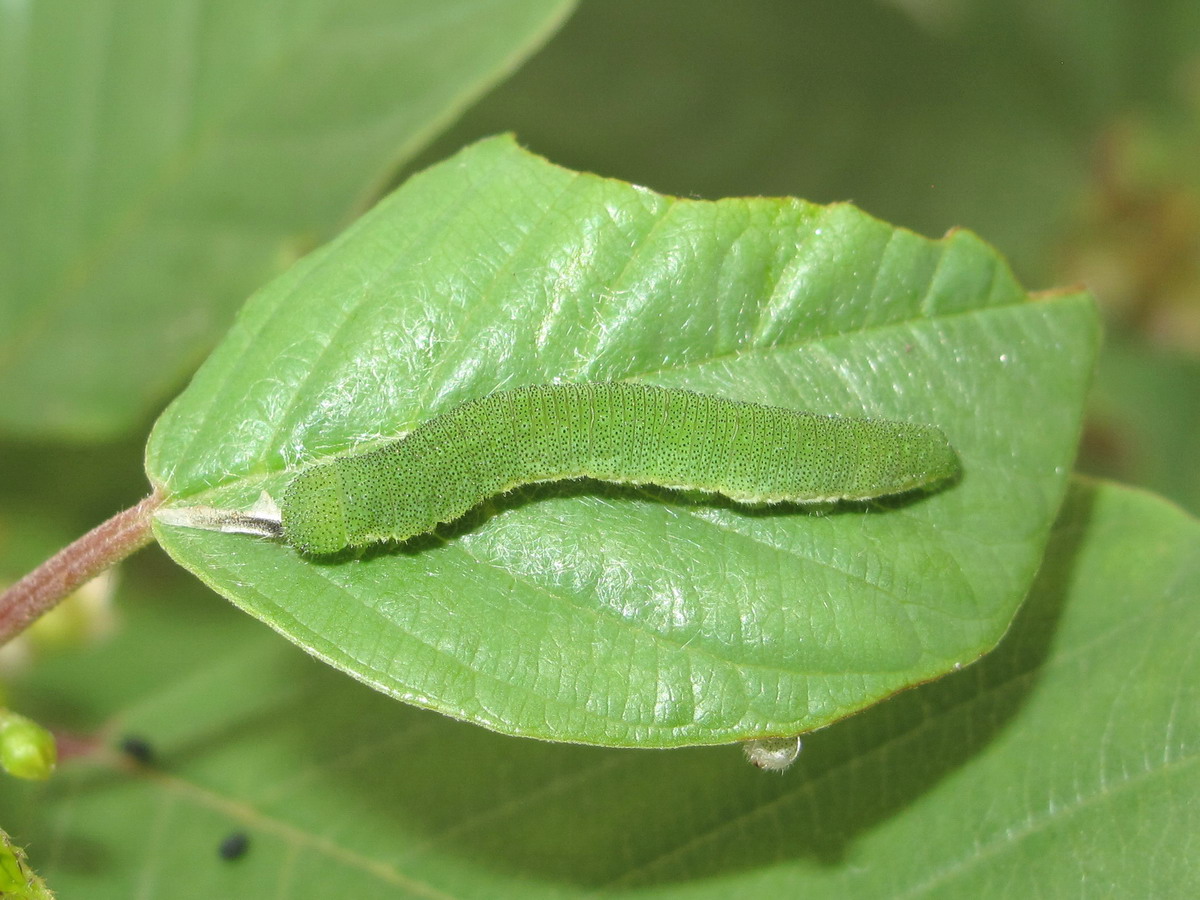

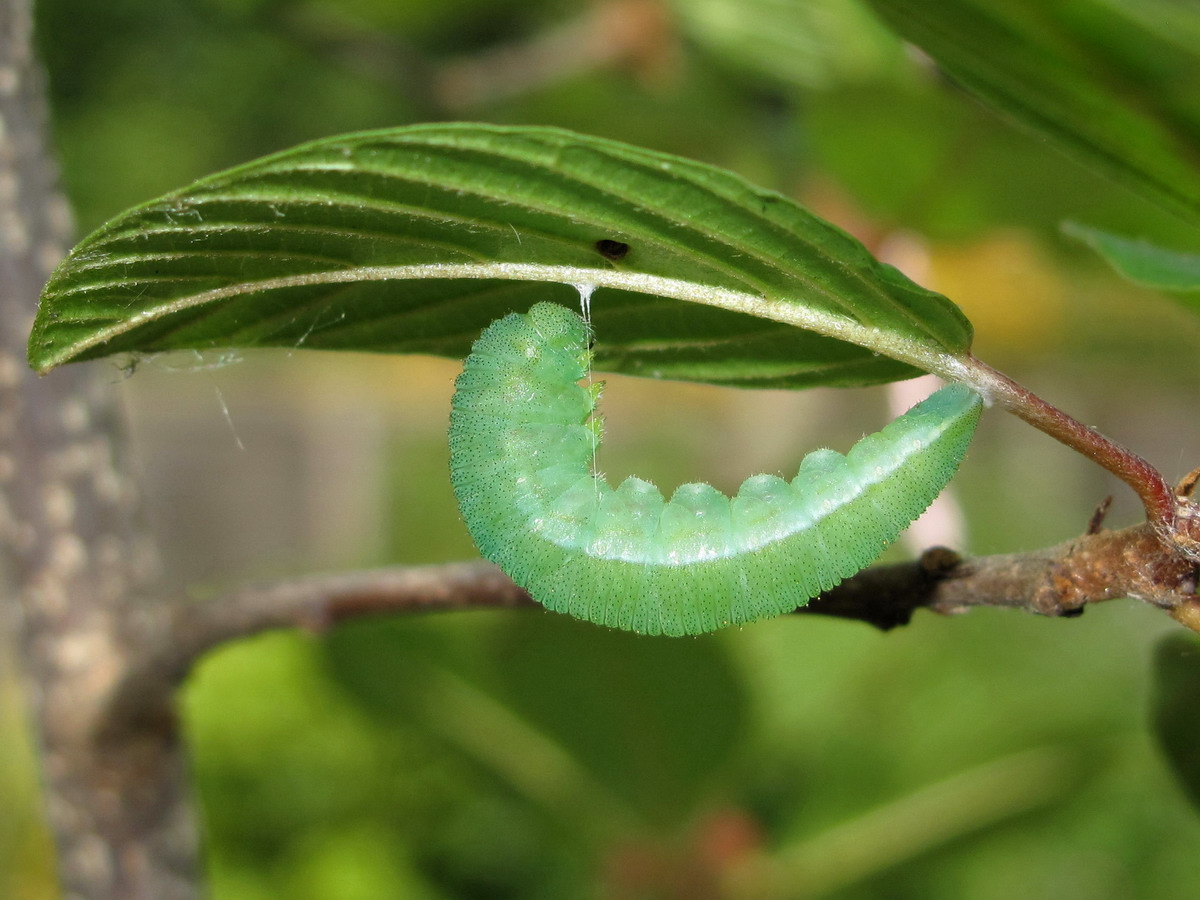
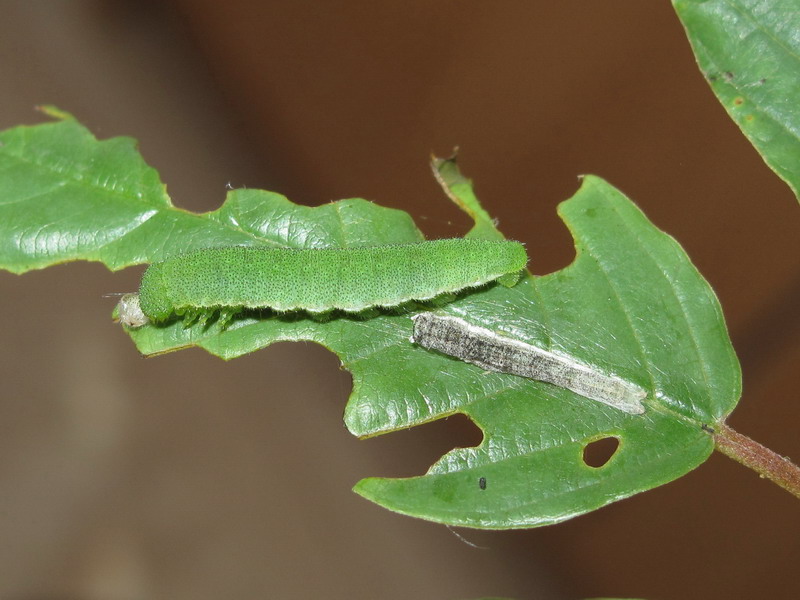
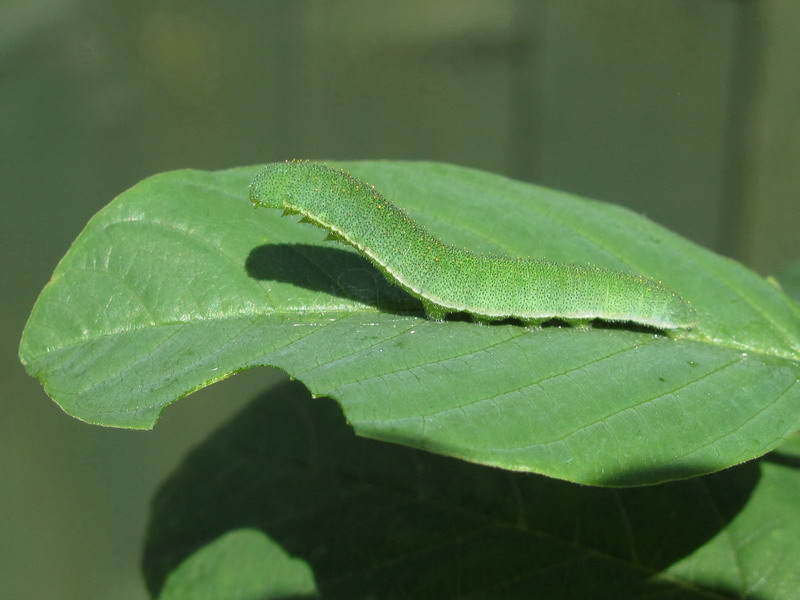
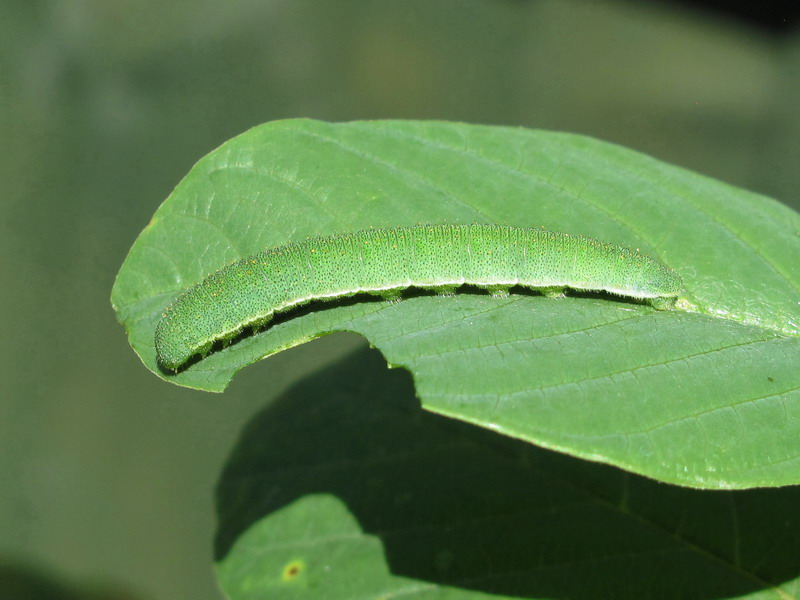
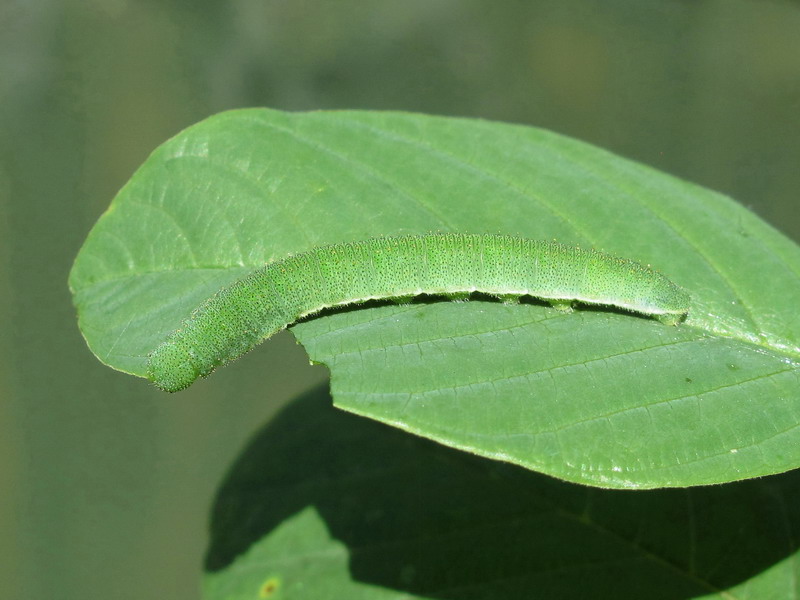
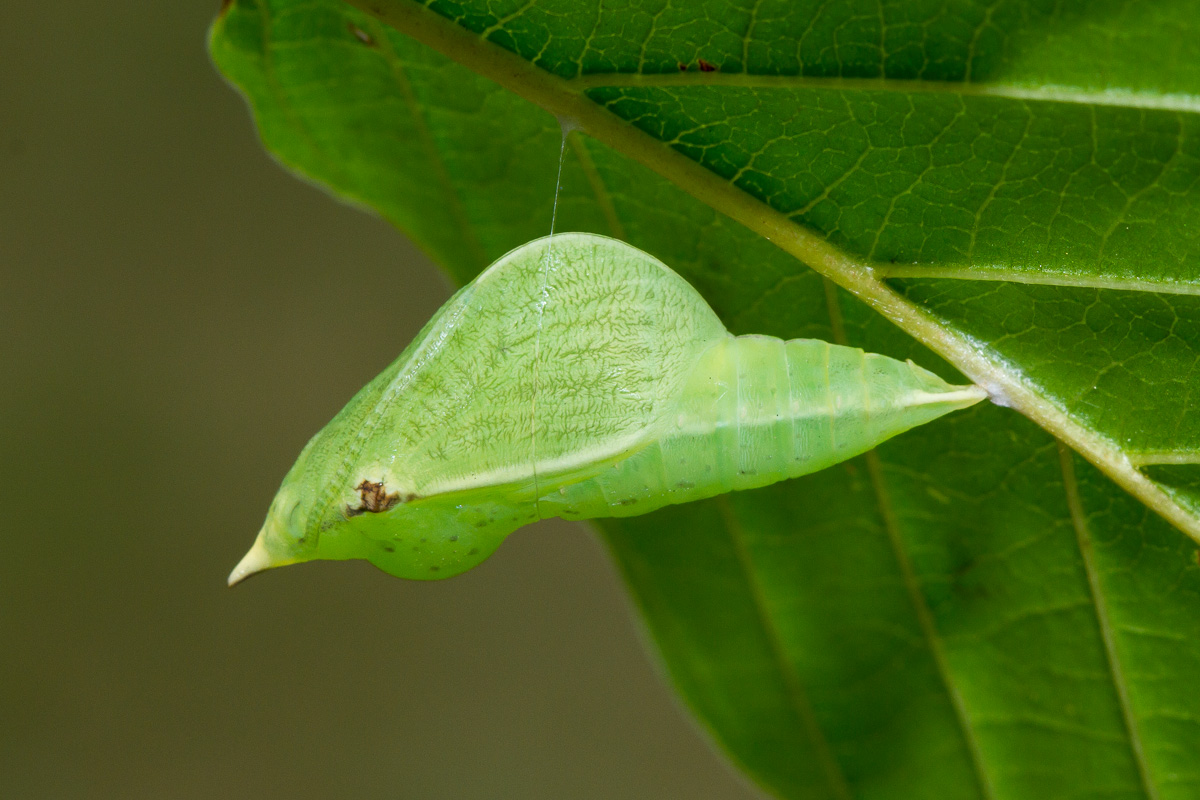
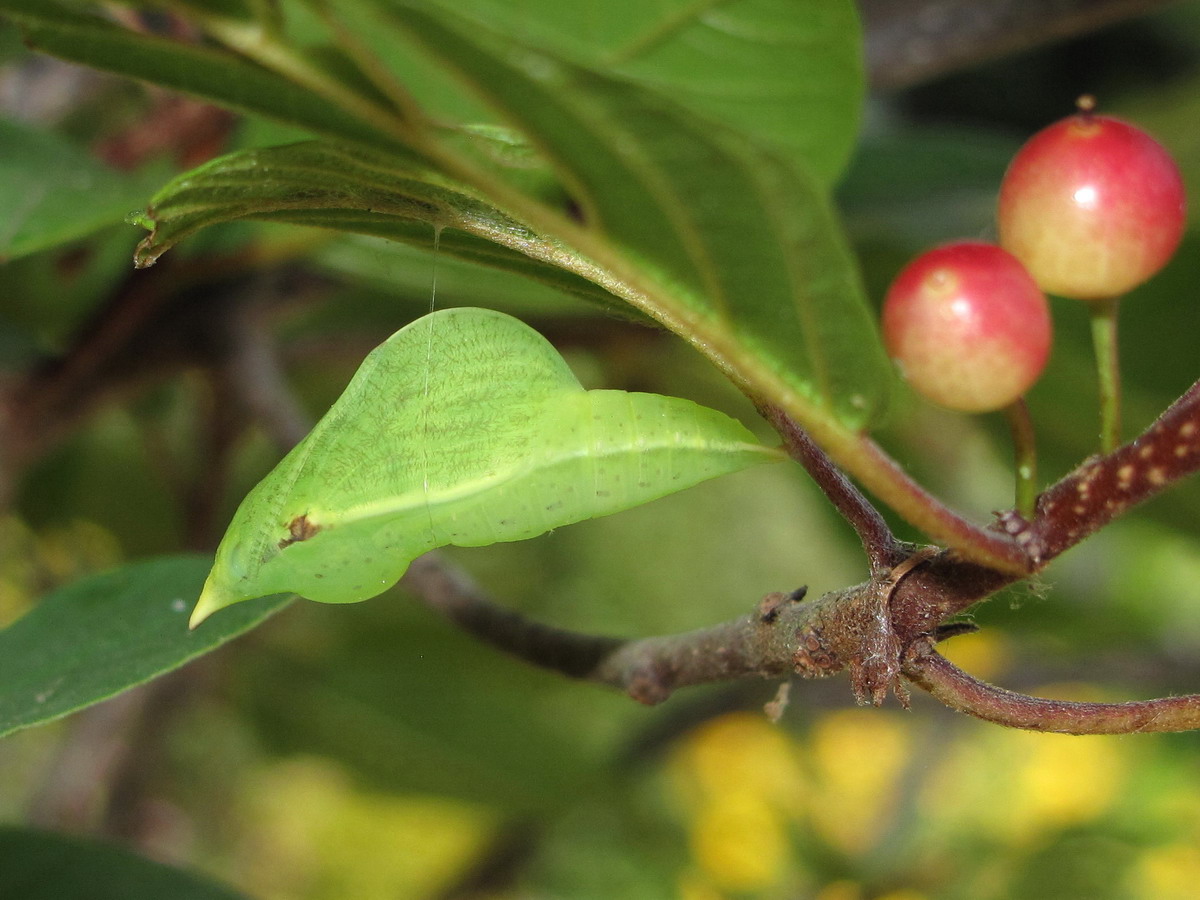
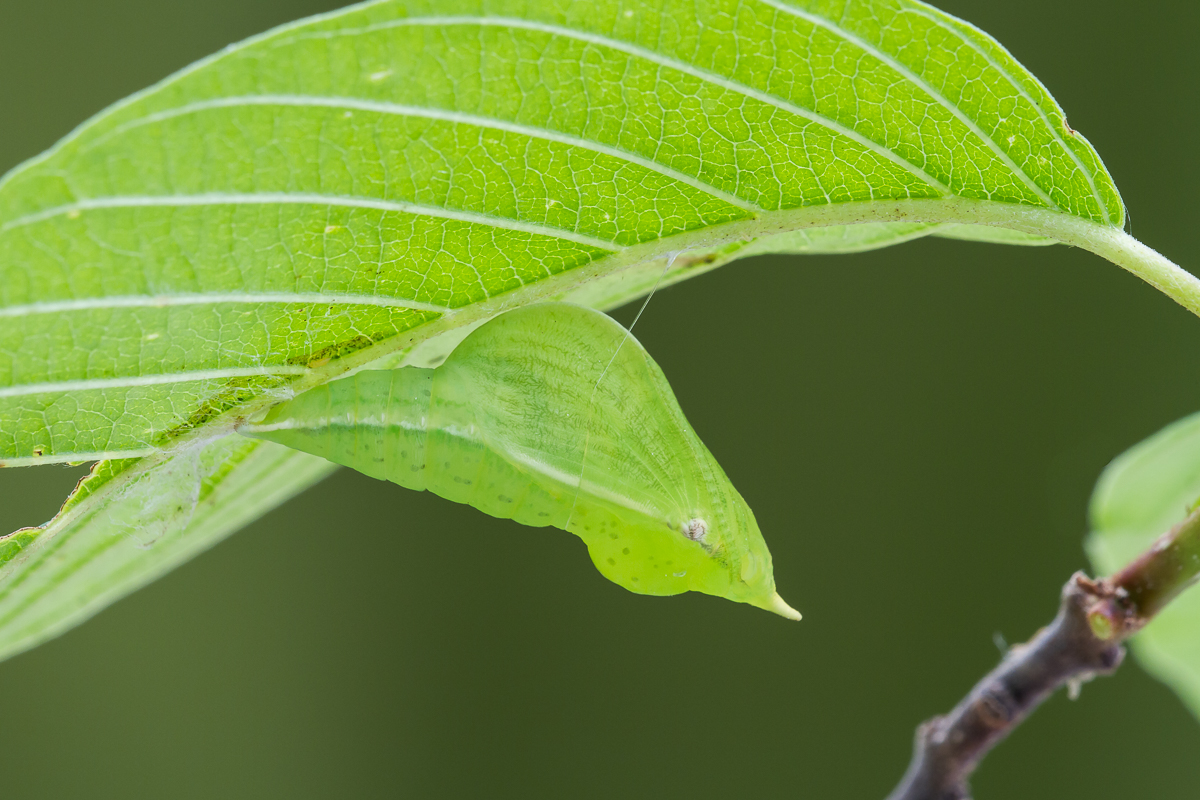
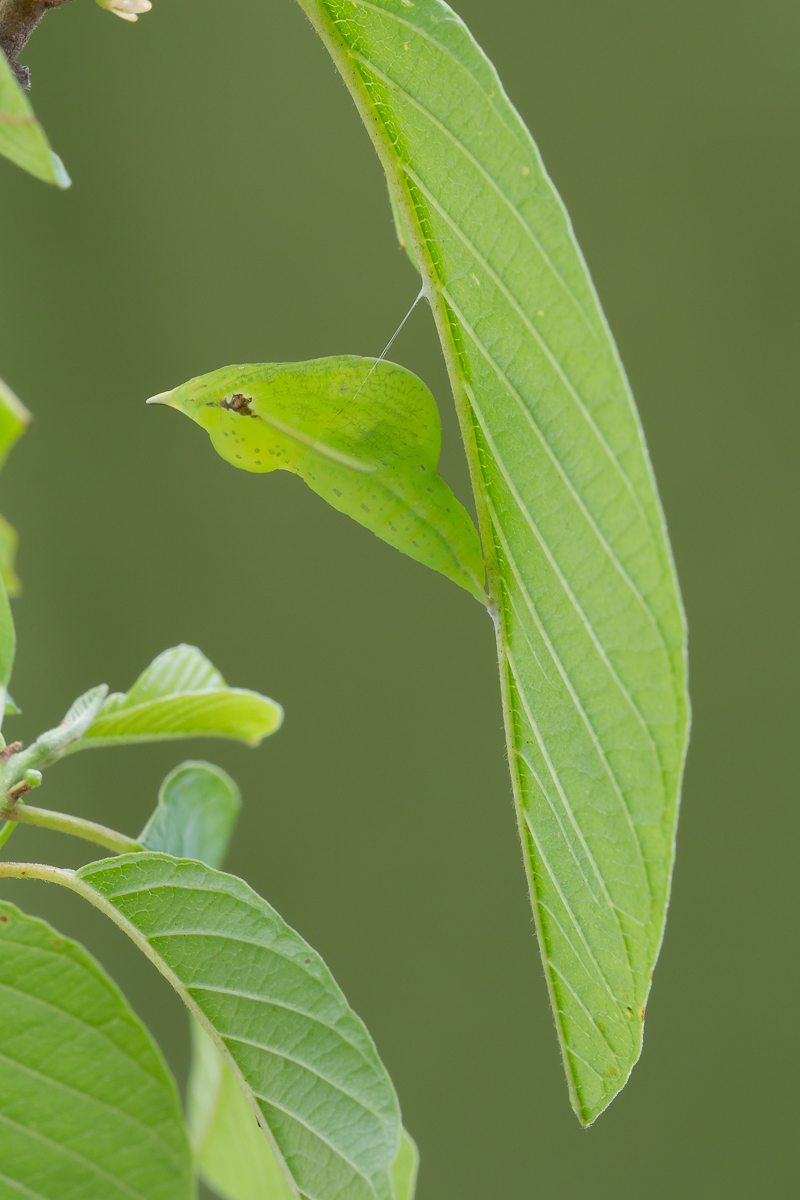
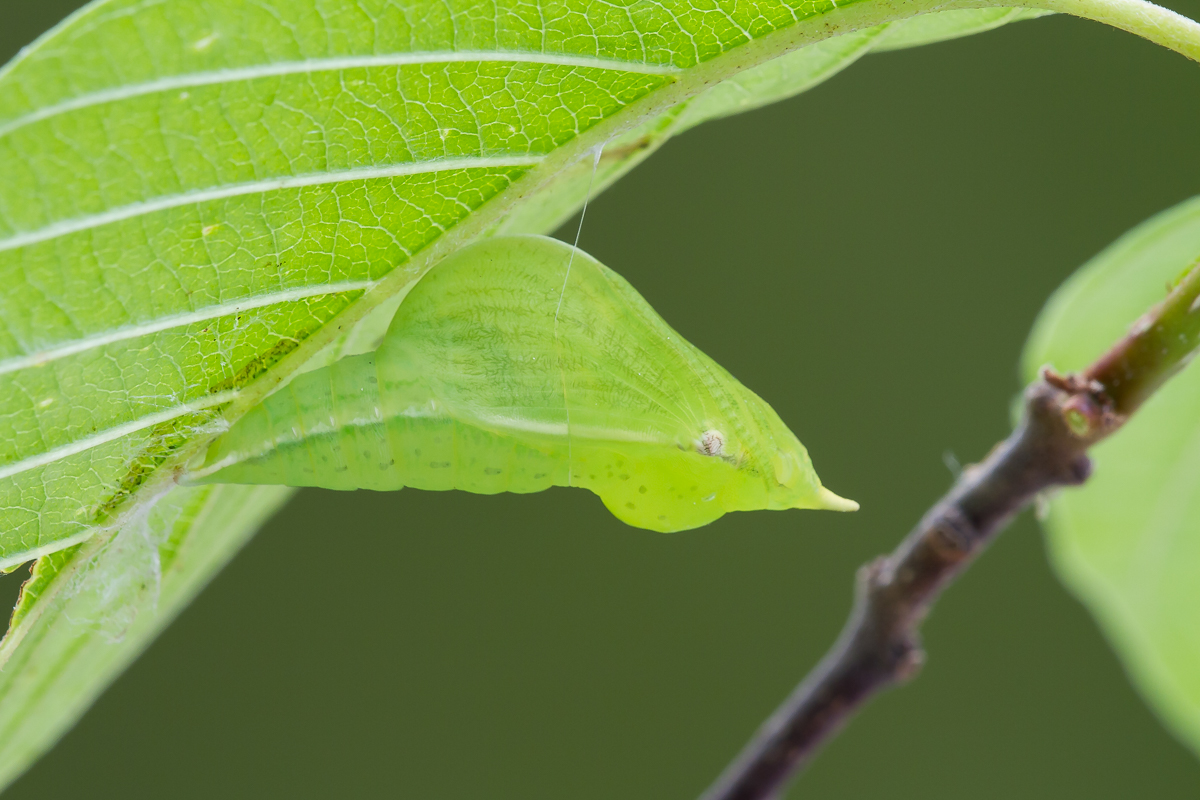
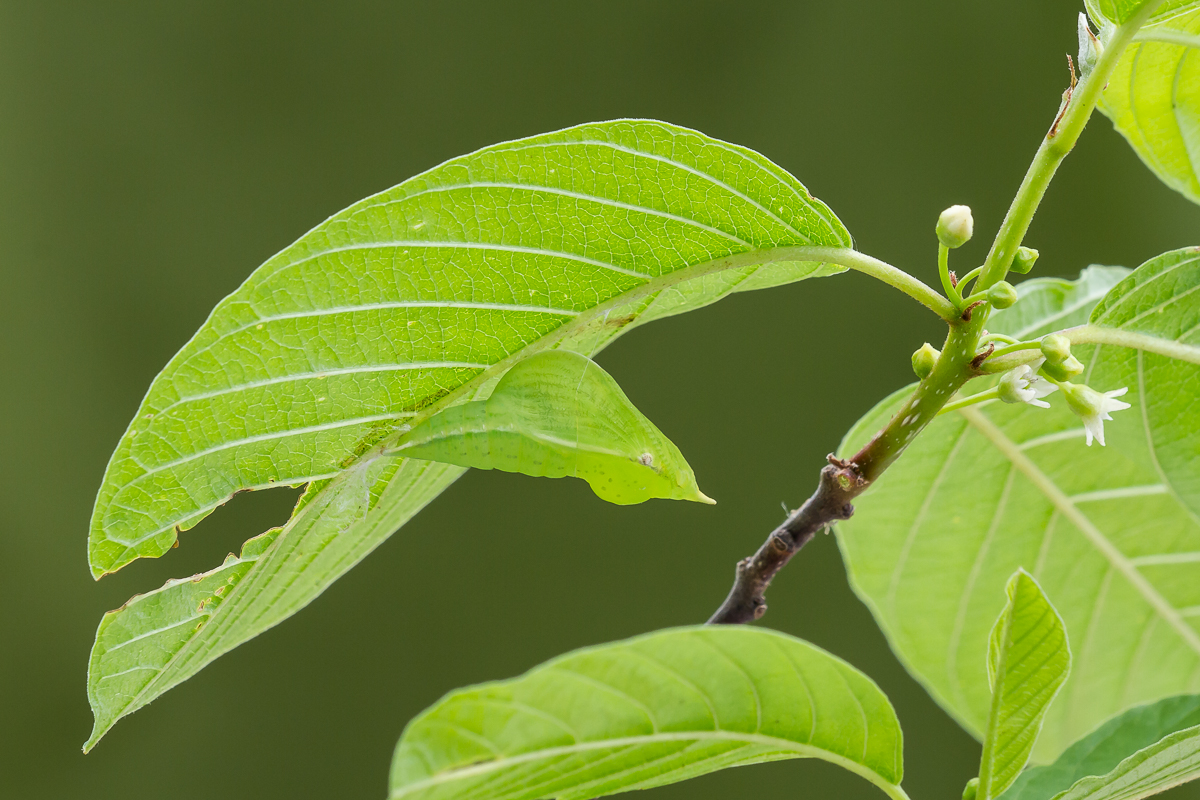
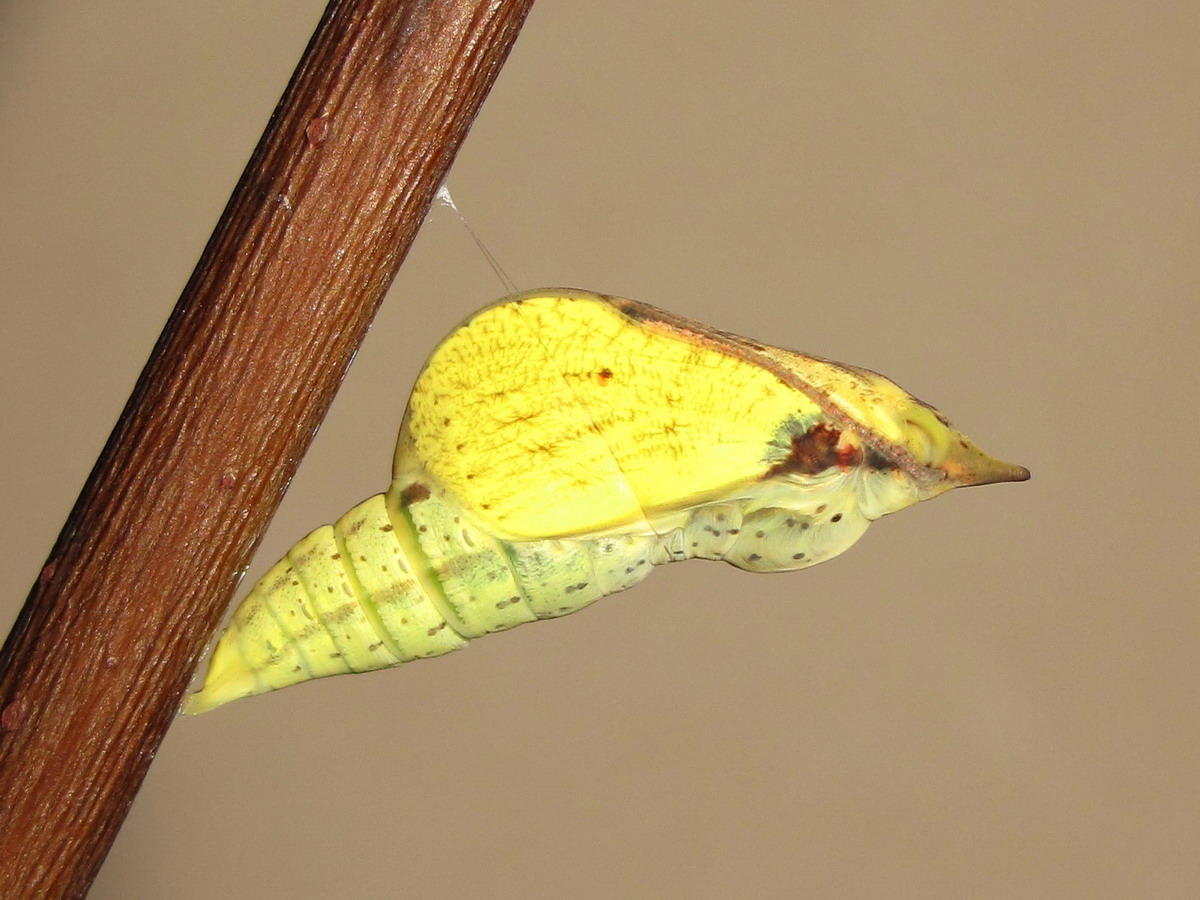
The fully-grown larva usually pupates away from the foodplant and, like the adult butterfly, the pupa is a curious shape, looking like a curled leaf. It is secured to the underside of a leaf or plant stem by a silk girdle and the cremaster. Before the adult butterfly emerges, the yellow spot found in the centre of the forewing can be clearly seen through the pupal case. The pupal stage lasts about 2 weeks.
"The pupa measures from 22.2 mm. to 23.8 mm. long and 9.5 mm. wide across the middle. Dorsal view: The head is strongly beaked in front and slopes to the centre of the meso-thorax, which is angular, and projecting at the base of wings. It is contracted at the first abdominal segment and slightly swollen at the third and fourth abdominal segments, then tapering to the anal segment, which terminates in a bifid point furnished with anchor-like cremastral hooks. Side view: Head sharply pointed, meso-thorax rounded and somewhat keeled dorsally and strongly concave, convex at the meta-thorax and first abdominal segment, over which the silken cincture passes; abdomen swollen at the third segment and gradually attenuated at extremity; wings very prominent and curved along the costal margin, apex pointed. Surface wholly smooth. Colour, a clear, bright green; beak and blotch at wing base purple, discoidal dot and sub-spiracular and ventral marks purplish-brown. The thorax and abdomen are faintly spotted with drab, a dark green medio-dorsal line and super-spiracular line, which is bordered below by a yellow line running along the inner margin of the wing; wings very finely reticulated with olive. In front and on each side of the meso-thorax is a minute puncture which exudes colourless fluid, very bitter to the taste, but apparently odourless. The pupa is attached to the stem by the cremastral hooks to a pad of silk, and a fine but lengthy silken cincture round the middle of the body. When the imago is maturing, and shortly before emergence, the male pupa becomes very brilliant in colour; the wings assume a beautiful rich yellow with vermilion marginal spots and red antenna. A large number of specimens (sexes about equal in number) emerged during the last four days of July, 1907. The pupal state occupies about a fortnight." - Frohawk (1924)


The following links provide additional information on this butterfly.