UK Butterflies
Building a Community of Responsible Butterfly Enthusiasts in Britain & Ireland
Building a Community of Responsible Butterfly Enthusiasts in Britain & Ireland
Wingspan
♂ 76 - 83 mm, ♀ 86 - 93 mm
Checklist Number
56.003
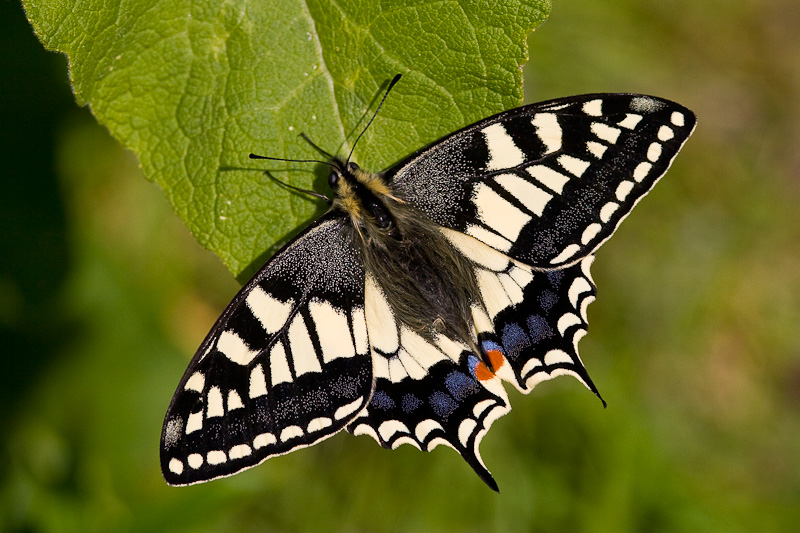
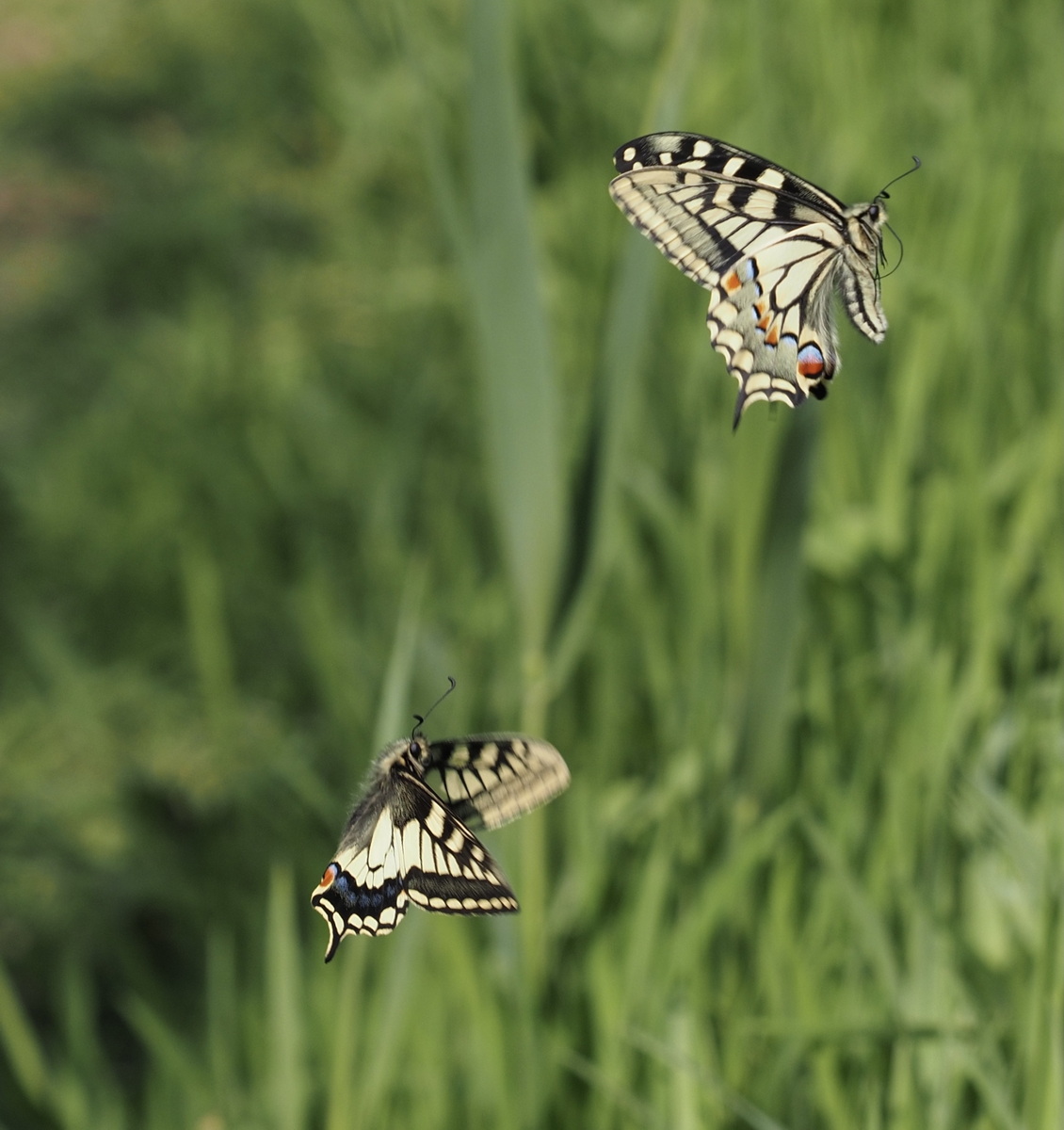
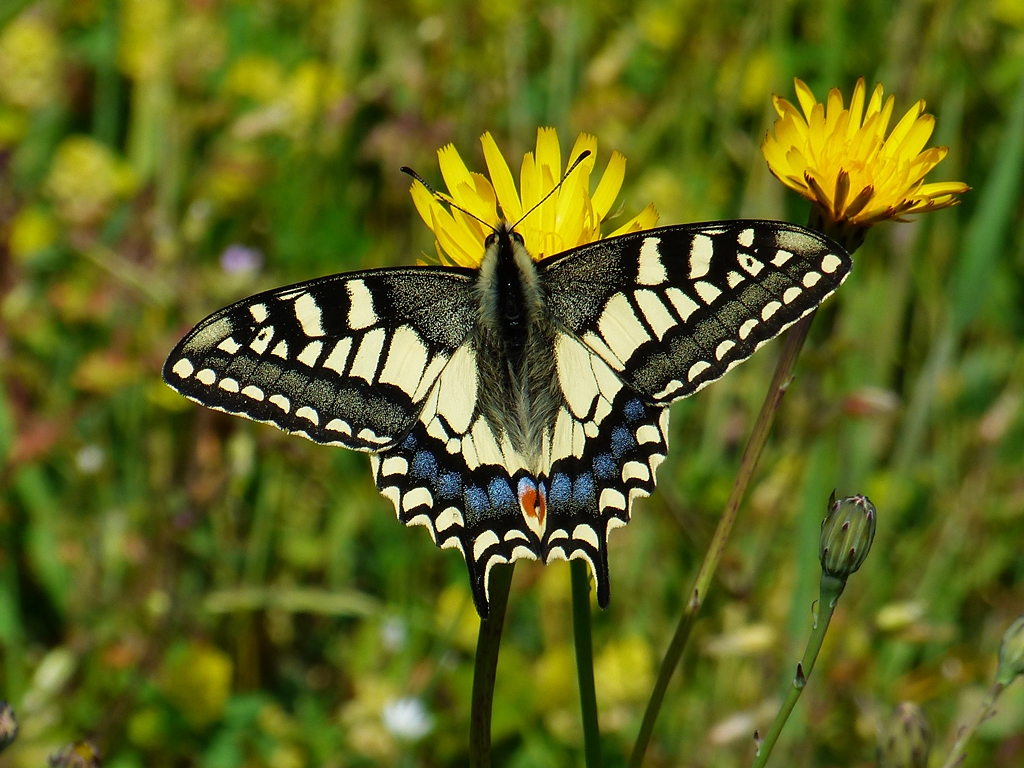
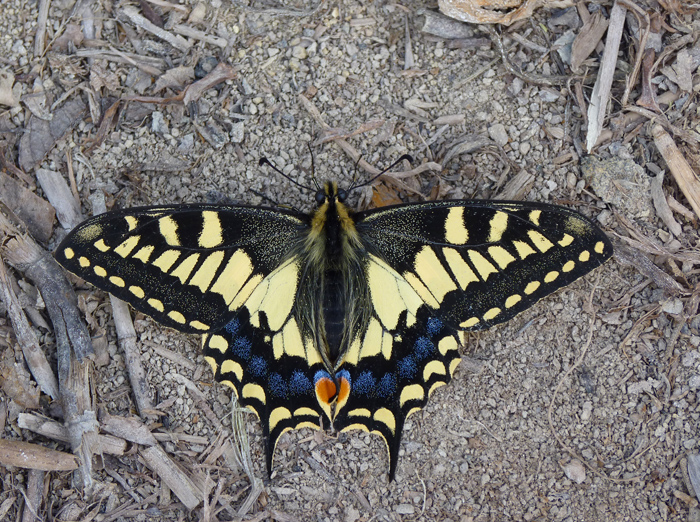
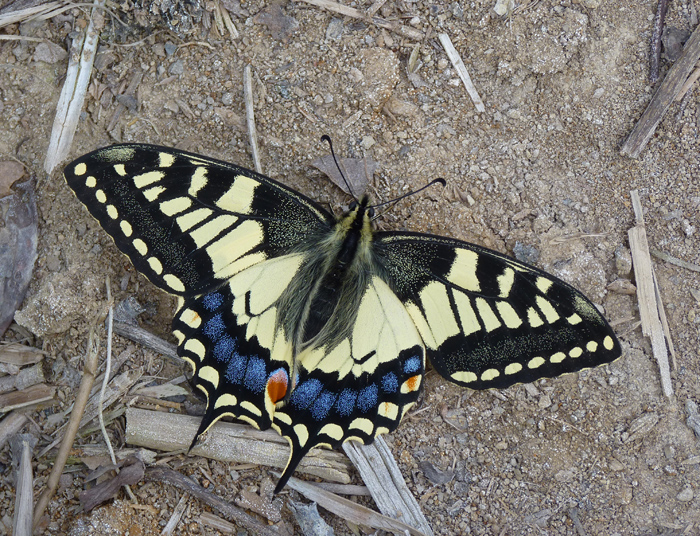
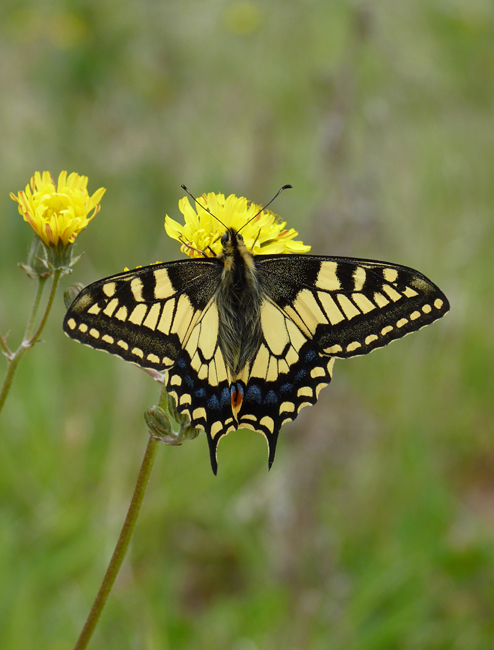
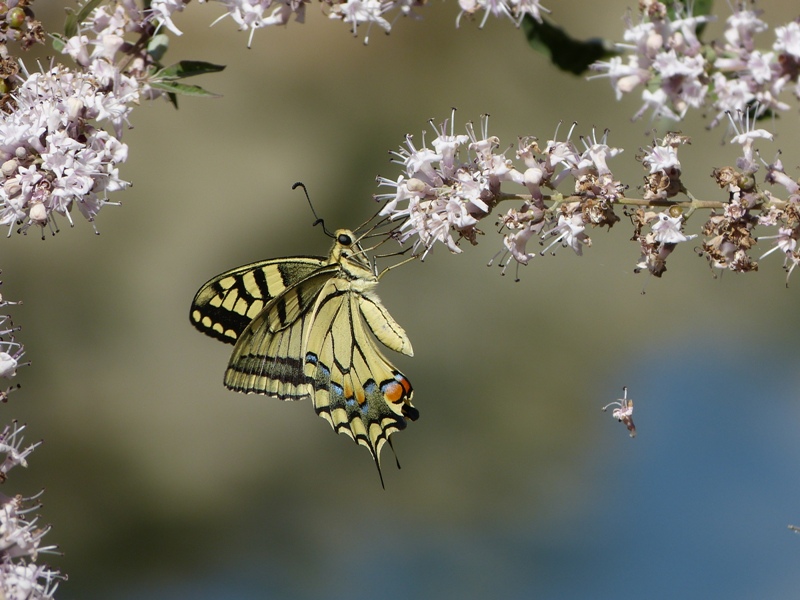
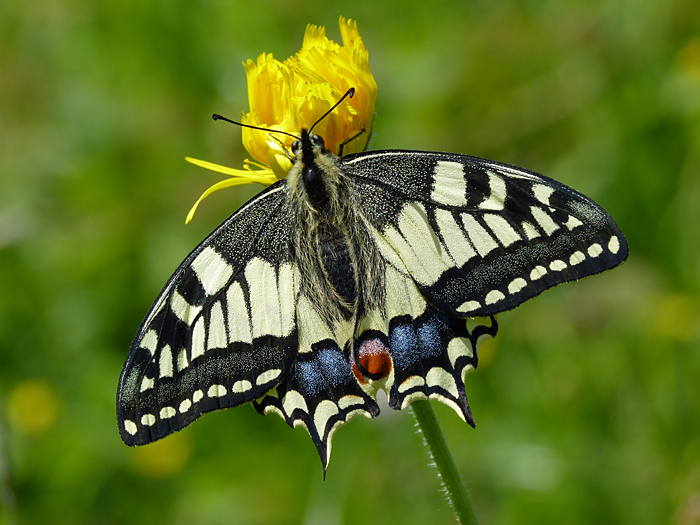
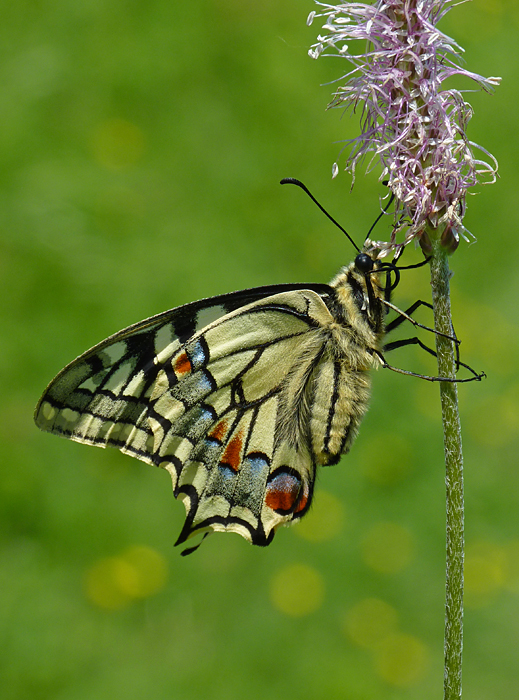
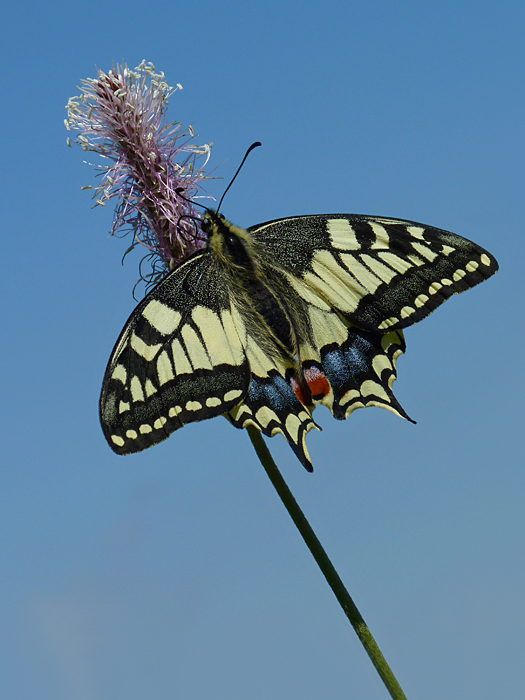
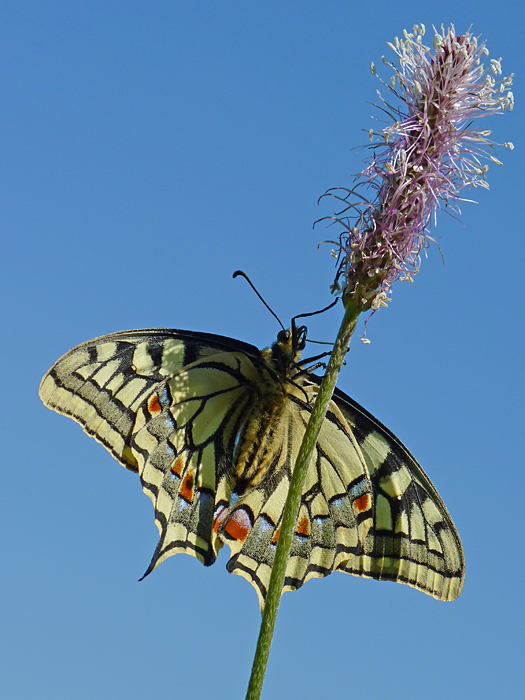
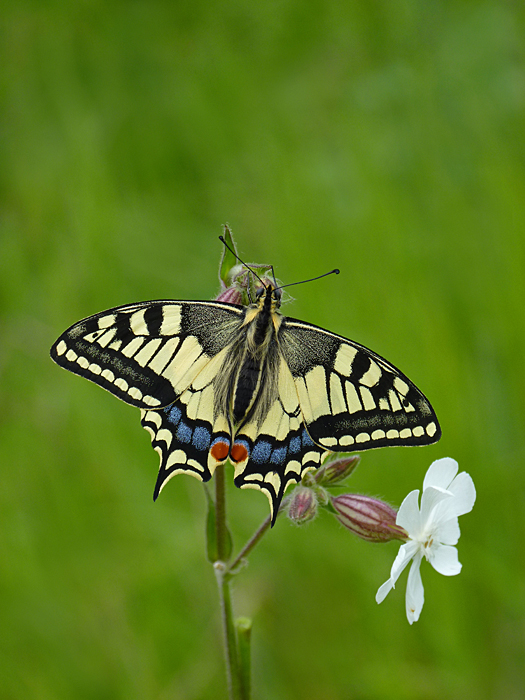
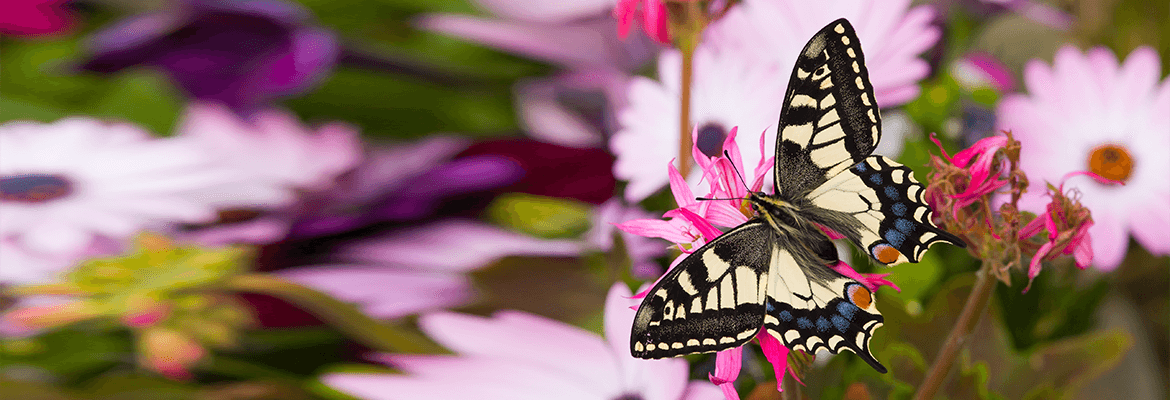
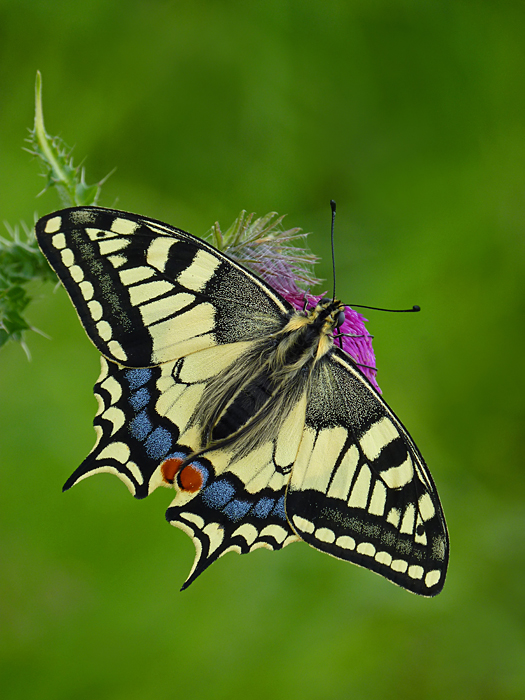
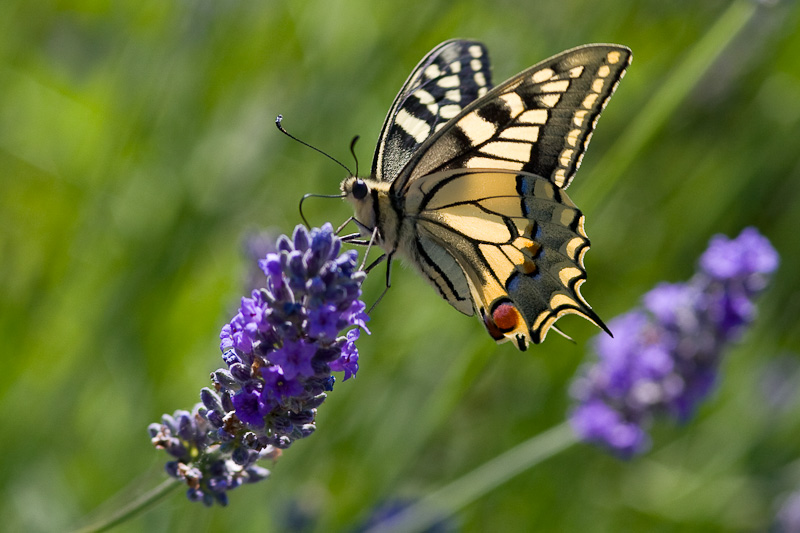
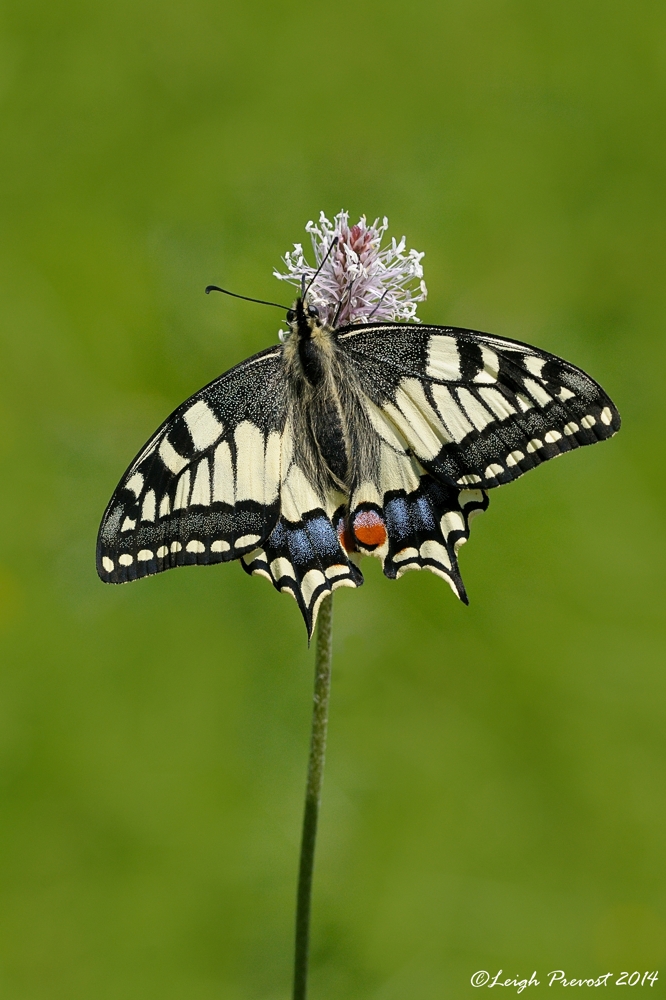
The Swallowtail is our largest native butterfly, and also one of our rarest. This spectacular insect is our only resident butterfly of the Papilionidae family, which is one of the largest butterfly families in the world. The British race is the subspecies britannicus which is confined to the fens of the Norfolk Broads in East Norfolk. This is partly due to the distribution of the sole larval foodplant, Milk-parsley. Seeing the adult butterflies flying powerfully over the Norfolk Broads is a sight to behold, and one near the top of the list of most British butterfly-watchers.
In some years, there are reports of the gorganus subspecies arriving from the continent. This subspecies is less fussy and will use many kinds of Umbellifer, such as Wild Carrot, as the larval foodplant. 2013 was an exceptional year for this subspecies, with sightings from 13 sites across Hampshire, Sussex and Kent, and a single site in Buckinghamshire. These sightings included evidence of egg-laying and the resulting larvae and pupae have been followed through to spring 2014. On April 14th 2014 a single continental Swallowtail was seen and photographed at the Magdalen Hill Down Butterfly Conservation reserve near Winchester in Hampshire.
The species was first defined in Linnaeus (1758) as shown here (type locality: Sweden). The nominate subspecies has not been recorded in Britain or Ireland.
This subspecies was first defined in Seitz (1907) as shown here and as shown in this plate (type locality: Norfolk, England).
This subspecies is indigenous to the British Isles and differs from ssp. gorganus not only in terms of its appearance but also its ecology. Specifically, ssp. britannicus is a fenland butterfly, its main foodplant is Milk-parsley (Peucedanum palustre) and it is mainly univoltine, with only a small percentage of adults going on to produce a second brood. Dennis (1977) suggests that this is genetically controlled since, according to Gardiner (1963), "A day-length of 18 hours does not prevent diapause in P. machaon".
In terms of appearance, this subspecies differs from its European counterpart, ssp. gorganus, as follows:
Original (German)
britannicus ist ein breit und tief schwarz gezeichneter machaon, mit besonders breiter, samtschwarzer Submarginalbinde; er kommt in England vor, wo machaon früher weit verbreitet war, jetzt aber auf die Sumpfdistrikte von Norfolk und Cambridgeshire beschränkt ist.
Translation
britannicus is a [form of] machaon with broad, deep black markings, with particularly wide, jet black submarginal bands. It occurs in England where machaon was once widespread, but is now restricted to the fens of Norfolk and Cambridgeshire.
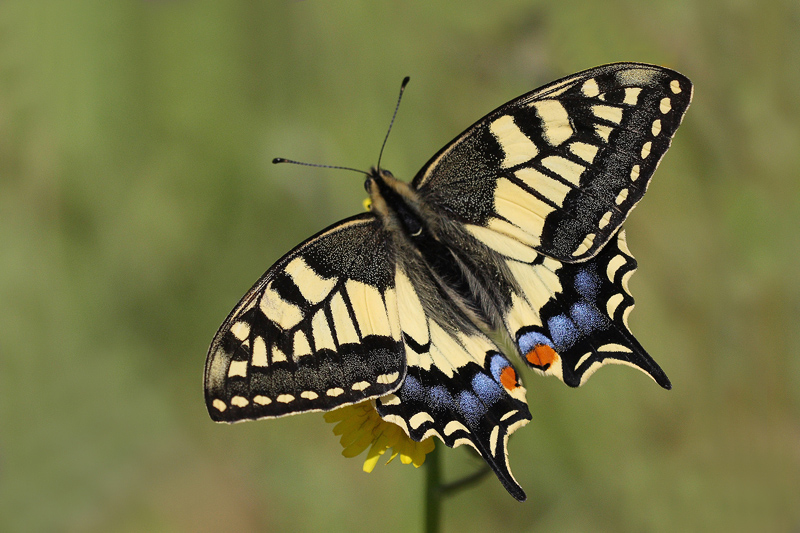
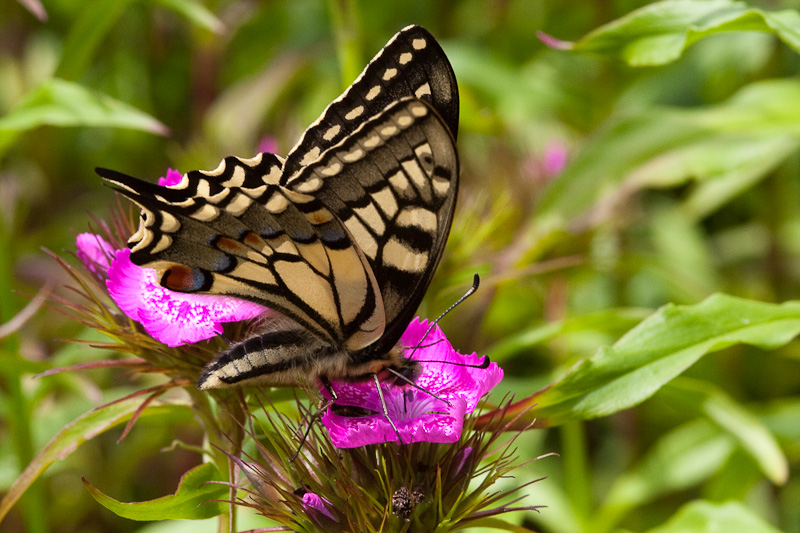
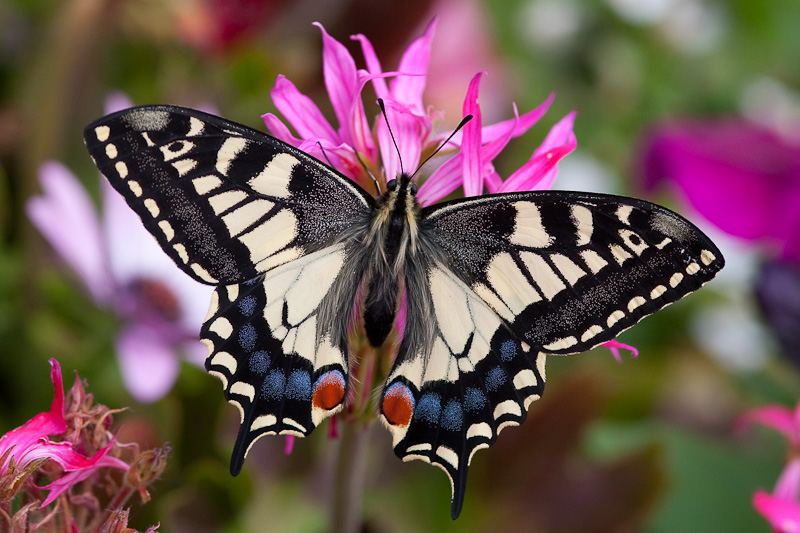
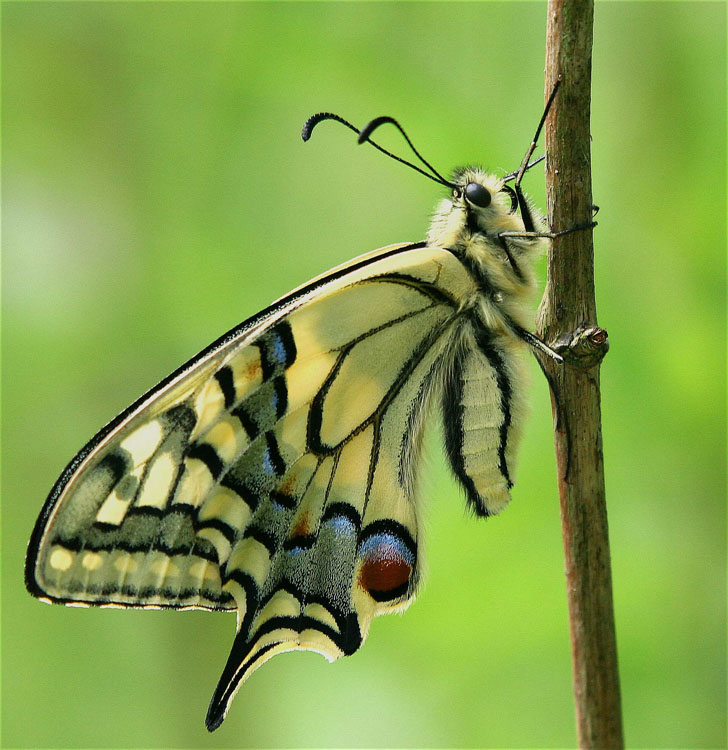
This subspecies was first defined in Fruhstorfer (1922) as shown here (type locality: Central Europe).
This subspecies is a rare migrant from the continent. Differences between this subspecies and ssp. britannicus are given under the description of the latter. The original description in Fruhstorfer (1922) makes reference to Seitz (1907), Berge & Rebel (1910) and Spuler (1910).
Original (German)
P. machaon gorganus nom. nov. (Gorganus , Bruder des Machaon) nicht nur bedeutend kleiner als die schwedische Nominatform bleibt, sondern auch durch kaum halb so breiten gelben Zellfleck und die um ein Drittel schmälere gelbe Region der Vorderflügel charakterisiert wird. Auf den Hinterflügeln nimmt die gelbe diskale Zone bei schwedischen machaon jenseits der Zelle einen fast 10 mm breiten Raum ein, noch ausgedehnter als sie auf der prächtigen Abbildung im SEITZ, Taf. 6c, dargestellt wird. Es ist nicht ausgeschlossen, daß Seitz einen machaon nordischer Herkunft vorgeführt hat. Eine weniger breite Gelbzone der Hinterflügel zeigt schon das Bild REBELS im BERGE, ein sehr schmales das Bild von SPULER. Ein ♀, das mit SPULERS Figur in der Enge der gelben Binde harmoniert, besitze ich aus Holland.
Translation
As a commentary on this - which is almost superfluous - it should be noted that P. machaon gorganus nom. nov. (Gorganus, brother of Machaon) is not only significantly smaller than the Swedish nominate form but also characterised by the yellow cell spot, which is barely half the width, and the yellow region of the forewing, which is up to one third narrower. On the hindwings the yellow discal zone of Swedish machaon takes up almost 10mm of the space beyond the cell, even more extensive than is shown in the magnificent illustration in SEITZ, Plate 6c. It is not impossible that Seitz has shown a machaon of northern origin. REBEL's picture, in BERGE, already shows a narrower yellow zone on the hindwing and SPULER's a very narrow one. I have a female from Holland that matches SPULER's in the narrowness of the yellow band.
| Family: | Papilionidae | Latreille, 1802 |
| Subfamily: | Papilioninae | Latreille, 1802 |
| Tribe: | Papilionini | Latreille, 1802 |
| Genus: | Papilio | Linnaeus, 1758 |
| Subgenus: | ||
| Species: | machaon | Linnaeus, 1758 |
| Subspecies: | britannicus | Seitz, 1907 |
| gorganus | Fruhstorfer, 1922 |
Description to be completed.
The distribution data (2000-2009) has been made available through the generosity of Butterfly Conservation and any subspecies distribution is taken from Riley (2007). Click here to see the distribution of this species together with site information overlaid.
The status of the Swallowtail is considered to be stable, although the resident race is highly dependent on appropriate management of its fenland habitat.
The table below shows the occurrence (distribution) and abundance (population) trends, using information from The State of the UK's Butterflies 2015 (Fox, 2015). Any UK BAP status is taken from the UK Biodiversity Action Plan (UK BAP) (2007 review).
1976-2014 (%) | 1976-2014 (%) | 2005-2014 (%) | 2005-2014 (%) |  -56 -56 |  +88 +88 |  -13 -13 |  +30 +30 |
|---|
The butterfly is on the wing from late May until early July. There is usually a single generation each year although, in some years, there is a small 2nd generation.

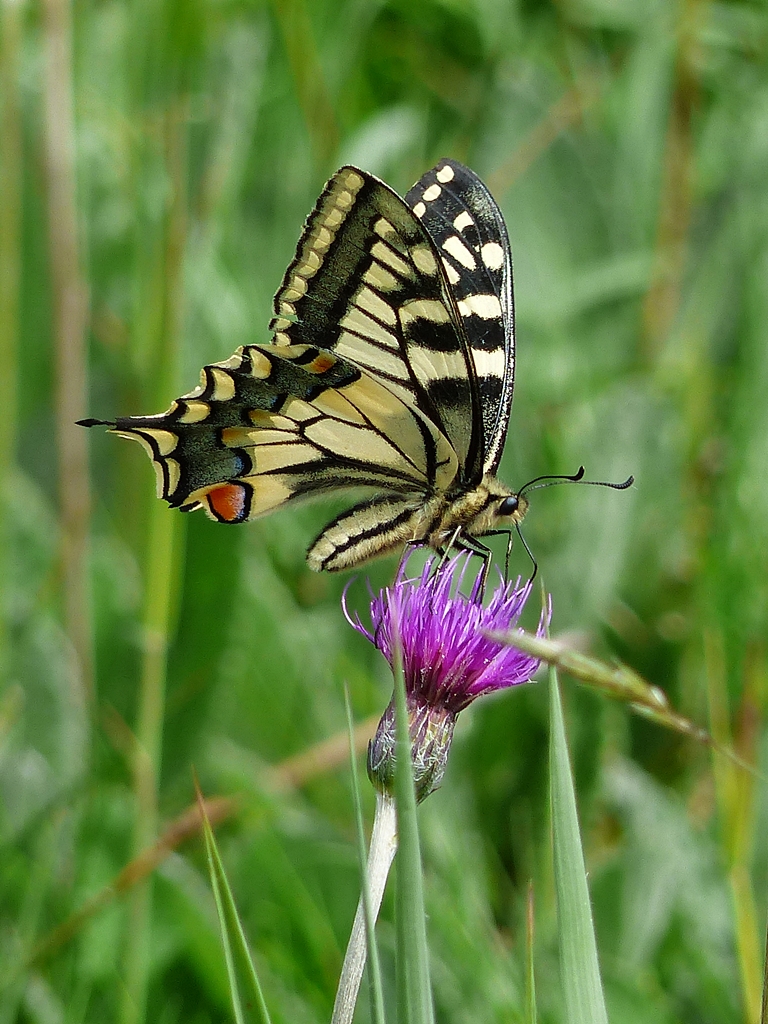
This butterfly is often seen flying strongly over the fens. Even when feeding, the butterfly will typically continue to beat its wings as it takes nectar. Females generally mate on the day of their emergence, normally in the morning, and the pair remains coupled for several hours. When egg-laying, the female will fly low over vegetation looking for suitable plants on which to lay. Both sexes rely on nectar, and have a preference for pink or mauve flowers, such as Ragged Robin and Thistle.
Adults feed primarily on Bluebell (Hyacinthoides non-scripta), Devil's-bit Scabious (Succisa pratensis), Ragged-Robin (Silene flos-cuculi), Red Clover (Trifolium pratense), thistles (Carduus spp. and Cirsium spp.), Wild Teasel (Dipsacus fullonum) and Yellow Iris (Iris pseudacorus).
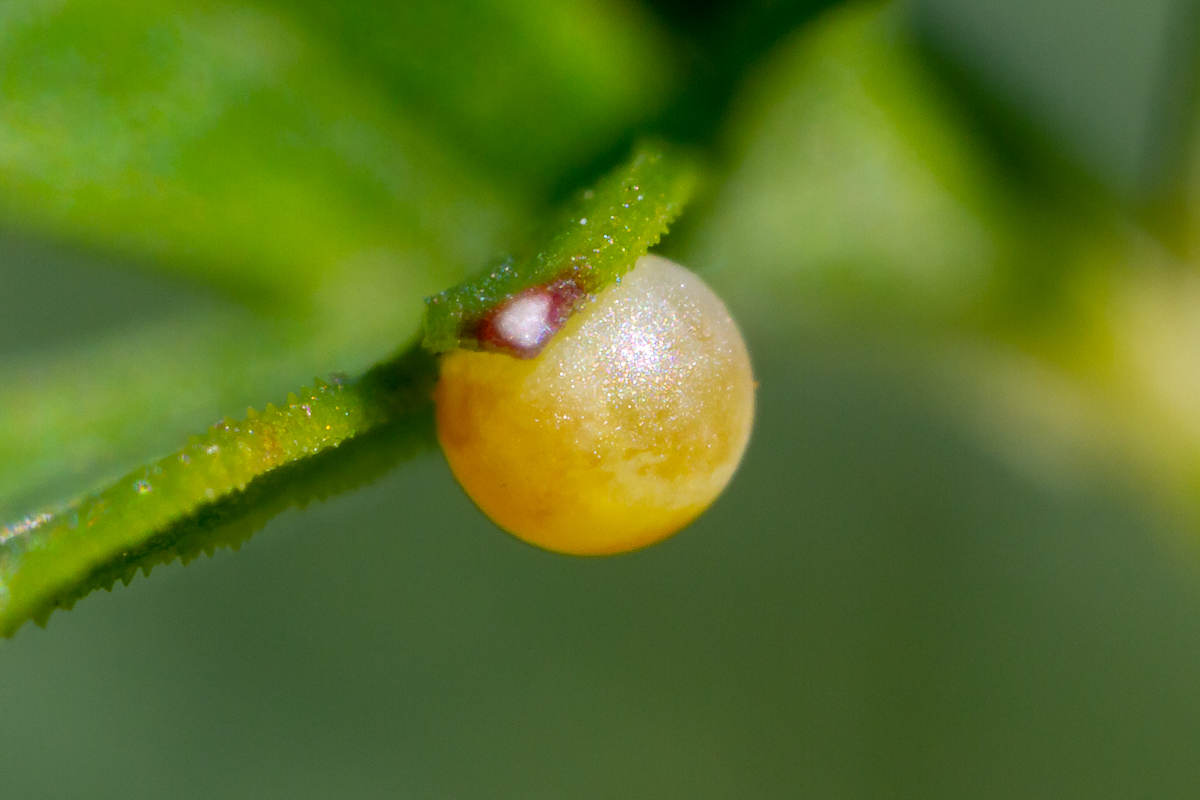
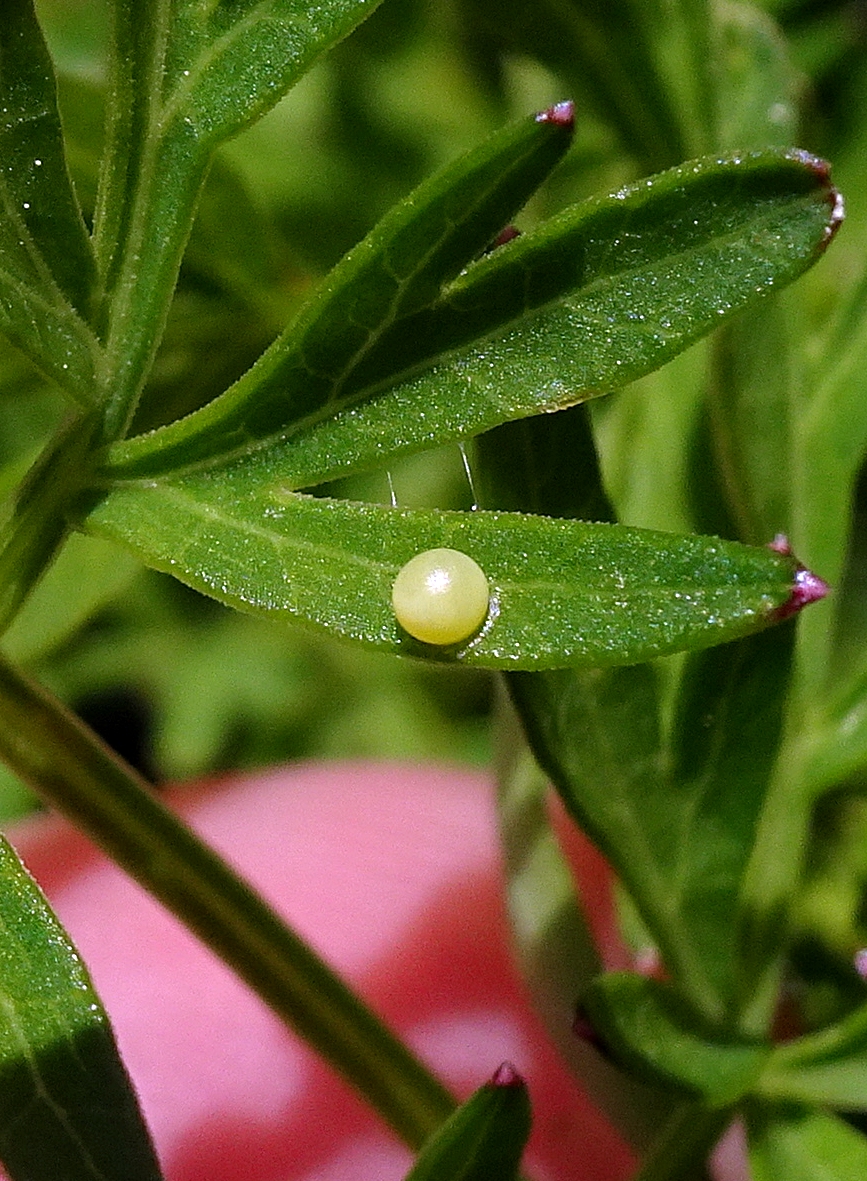
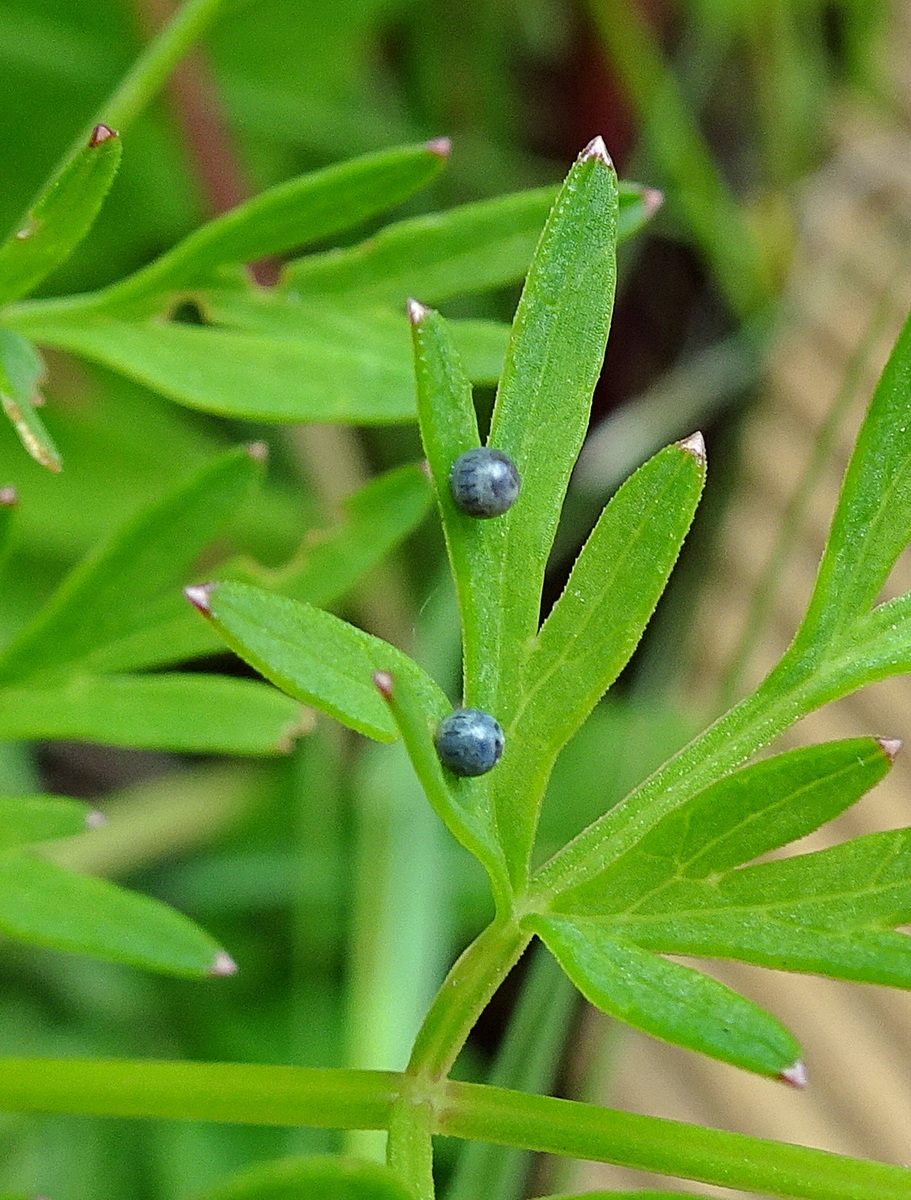
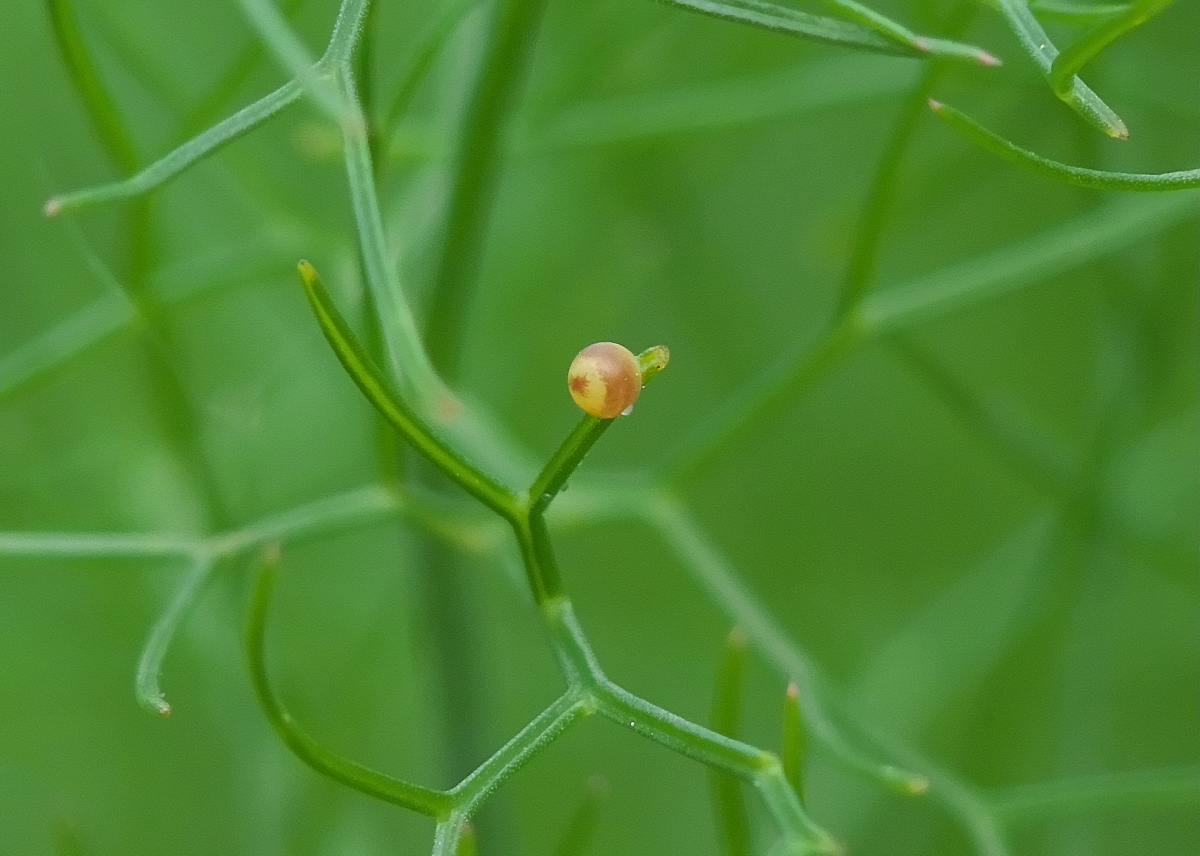
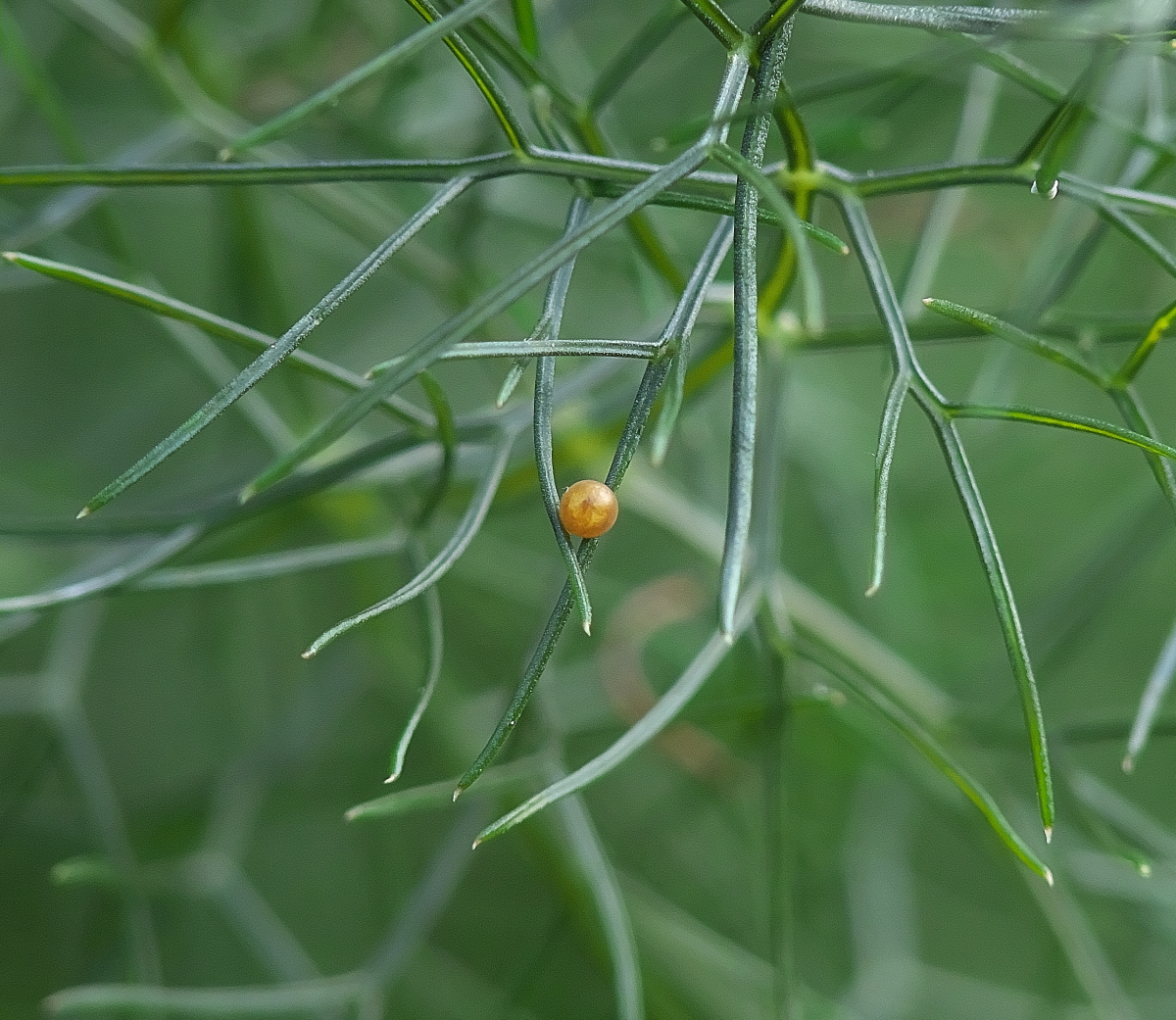
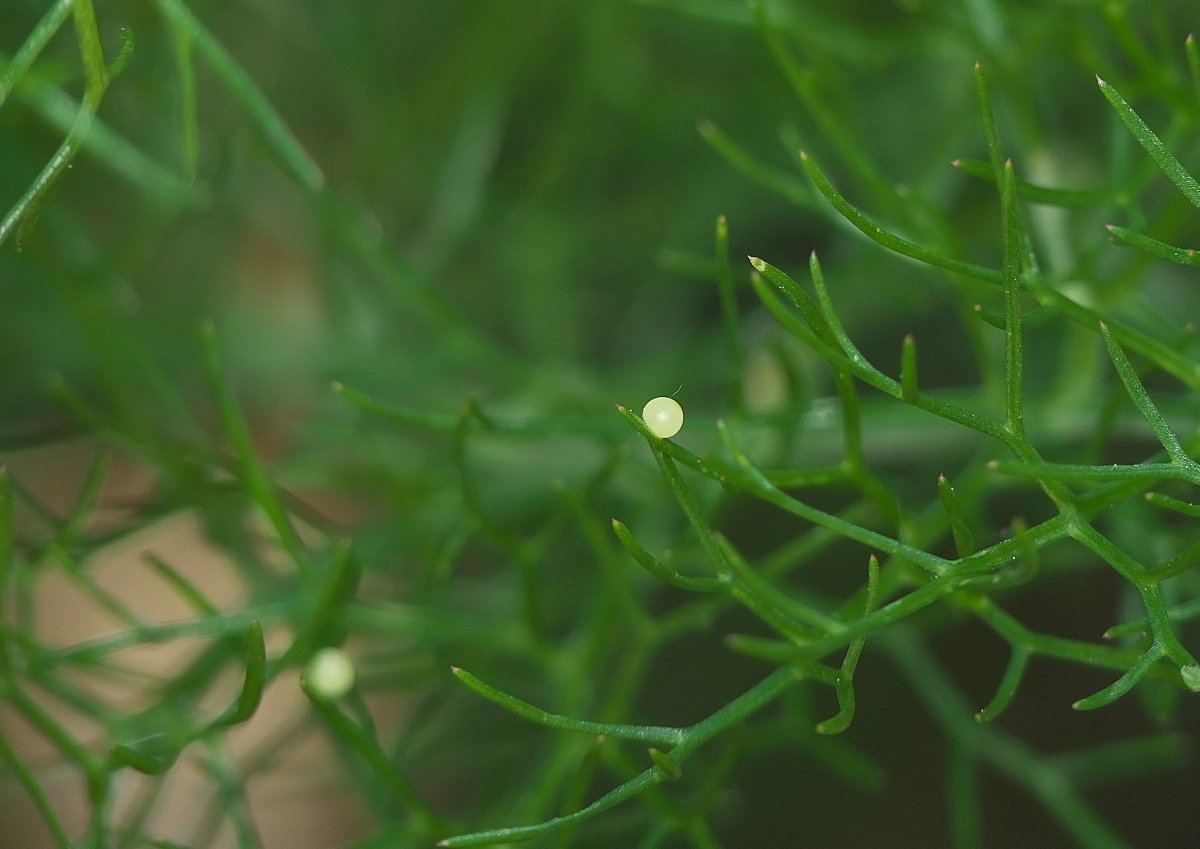
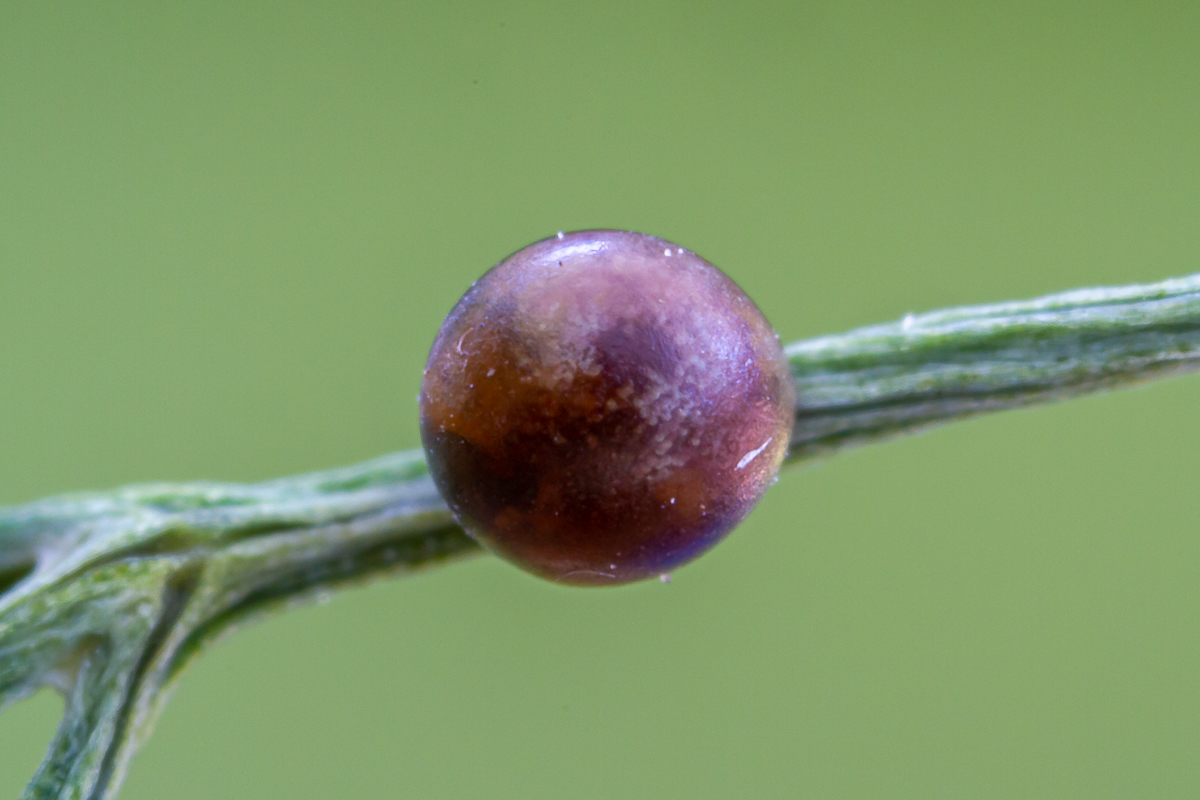
Eggs are laid singly on tall flowering Milk-parsley plants. The spherical egg is yellow when first laid, but darkens as the larva inside it develops. The female tends to select exposed plants, rather than those growing among vegetation. Eggs hatch in just over a week.
"When machaon is intent on depositing, it flies rather leisurely over the spot where the food plants grow, and should the plants have been recently mown, the flight is only a few inches above the ground. When the female has selected a plant, she settles upon it with the wings held over the back, but slightly open, always with the antennae towards the top of the plant, and the abdomen towards the ground. It then curves the abdomen and deposits an egg. Apparently each female only deposits one egg on a plant at the same time; when each of the plants in any one spot has received an egg, the butterfly flies rapidly away in search of plants in a fresh situation. Sometimes as many as five or six eggs may be found laid on the same leaf of the food plant, usually all of different ages, denoting that they have been deposited by separate females." - Frohawk (1924)
"On July 1st, 1893, at Wicken Fen, Cambridgeshire, the author found about three dozen eggs of machaon laid singly on the under surface of the leaves of the Hog's fennel [Milk-parsley] (P. palustre) ... Some of the eggs were recently laid, as they were of a pale yellow colour. Most of the eggs hatched during the following seven or eight days. The egg is globular, with a flattened base and a smooth surface; it is 9 mm. high, the diameter is slightly wider. When first laid it is a pale yellow colour; when a week old it is zoned irregularly or broadly blotched with warm coppery-brown. It finally changes to a purplish-grey with about a dozen longitudinal dark stripes." - Frohawk (1924)
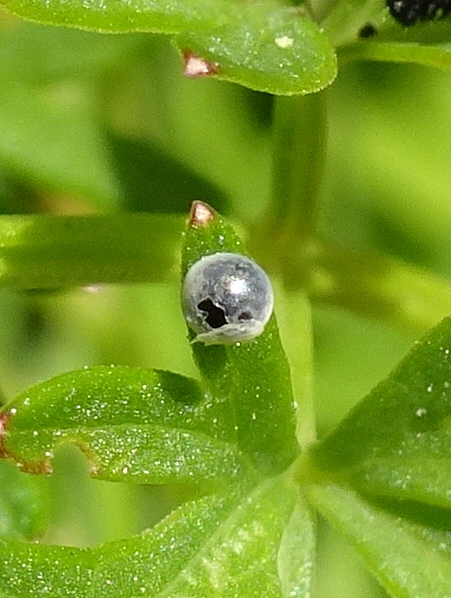
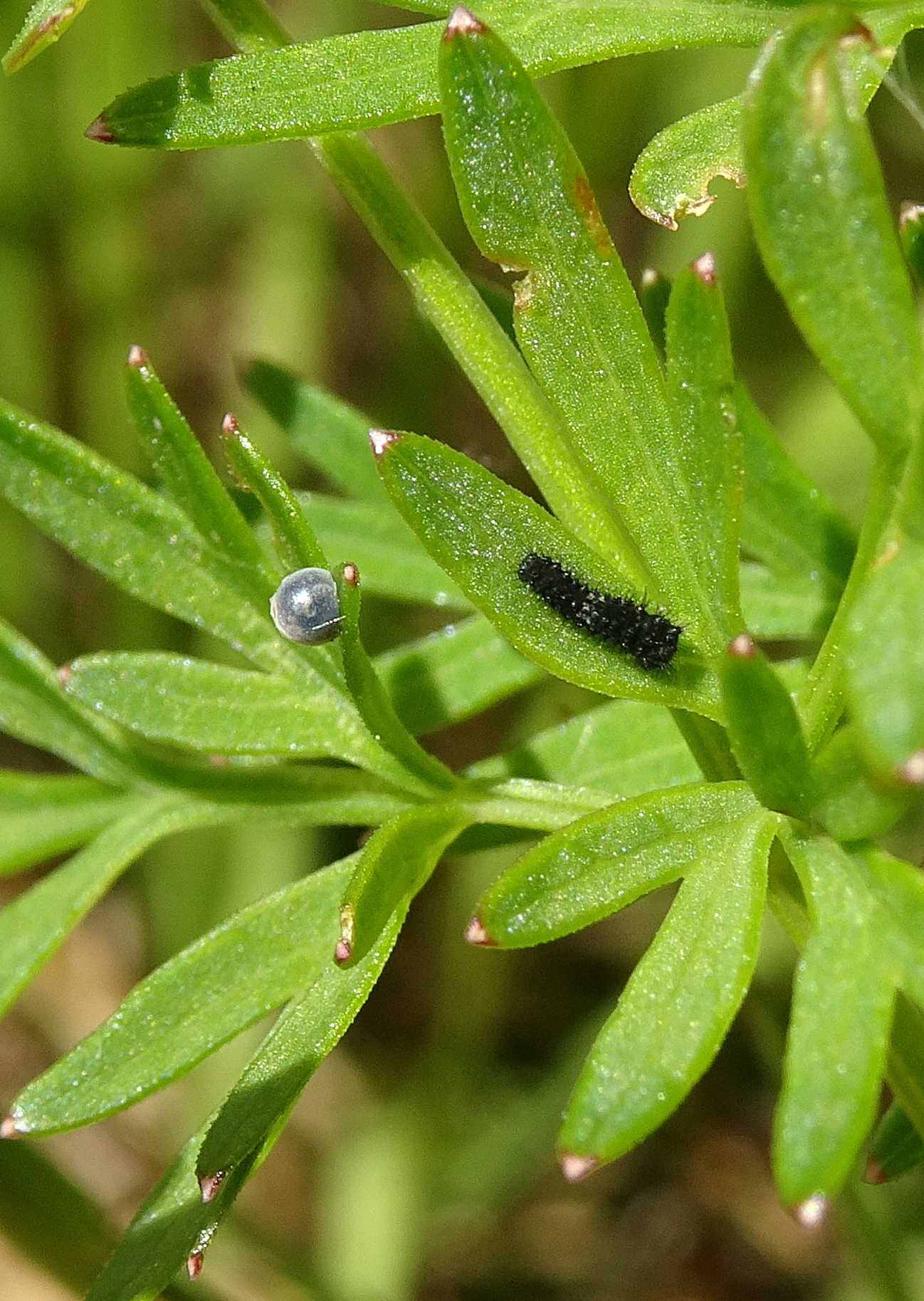
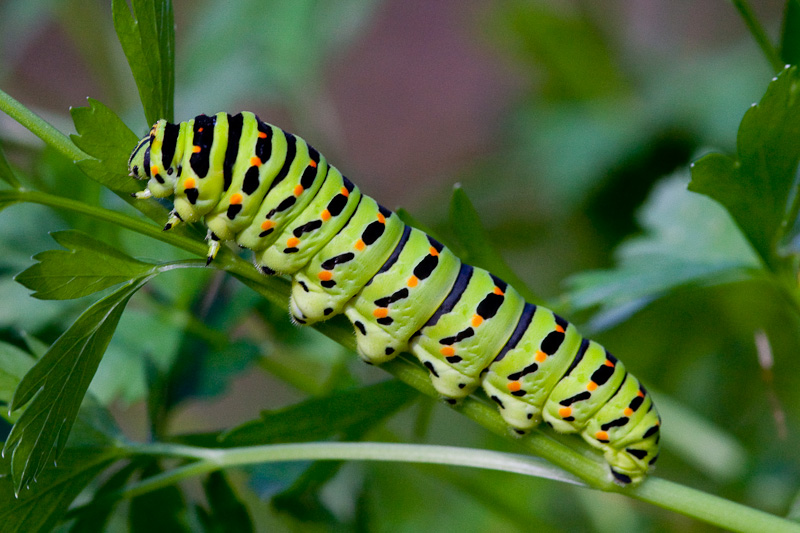
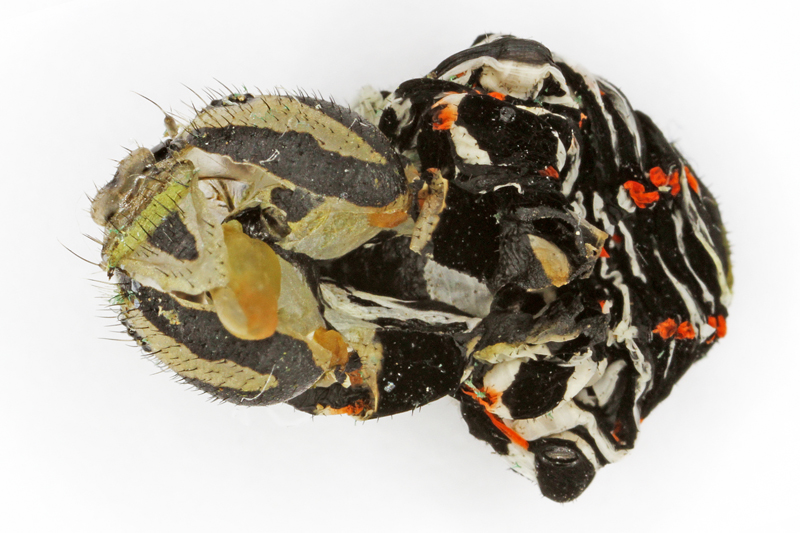
The larva eats some of the eggshell on hatching, and its appearance changes as it grows; it closely resembles a bird dropping in the early instars but, after the 3rd moult, displays much brighter warning colouration. The larva has a curious bright-orange organ called an "osmeterium" that is situated behind the first segment. This organ is used as a defence mechanism, and is protruded when the larva is threatened, giving off a pungent smell similar to rotting pineapple. This stage lasts approximately 4 weeks.
The primary larval foodplant is Milk-parsley (Thyselium palustre).
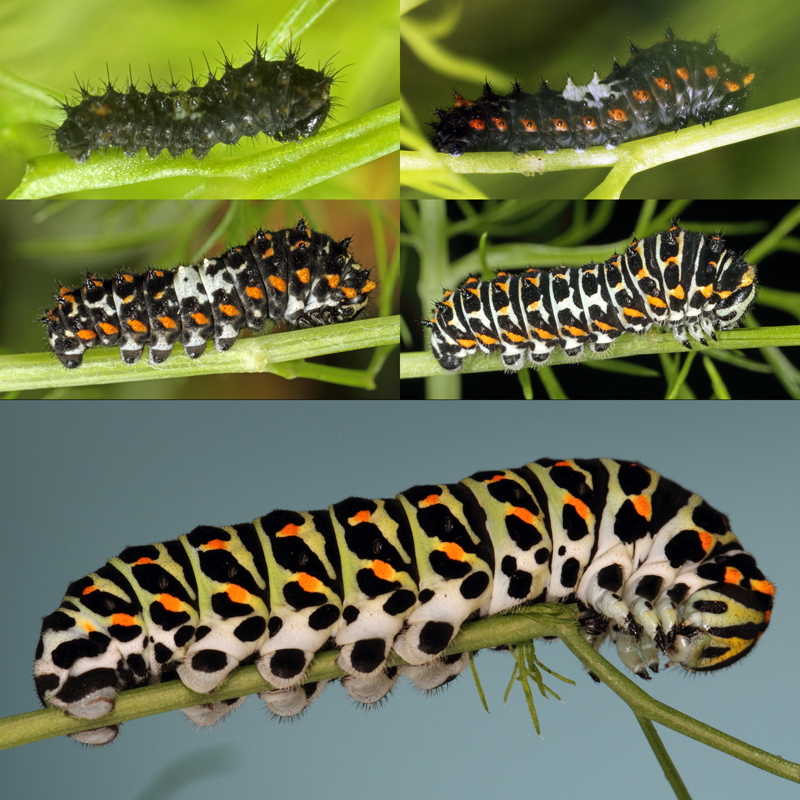
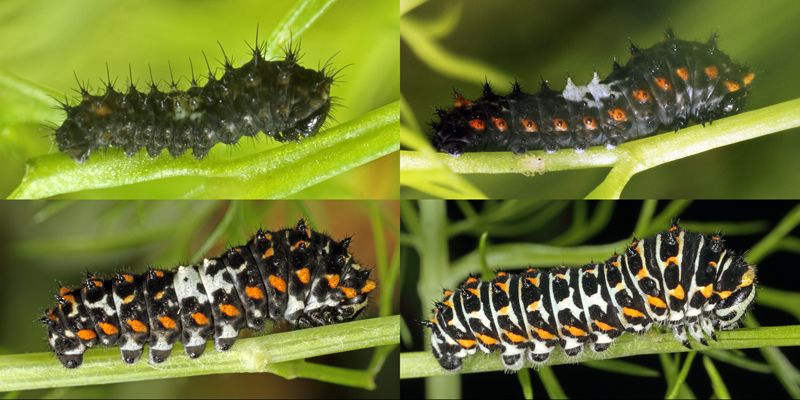
"Directly after emergence from the egg the larva eats a large portion of the shell; it then measures 3 mm. long, and is of a leaden-grey colour. There are six longitudinal rows of large olive bulbous tubercles, three on each side of each segment situated sub-dorsally, super-spiracular and sub-spiracular; these are all furnished with a number of shining black spines radiating in different directions and varying in length; they are straight, attenuated, but terminate in a white glassy-like knob; the base of each is swollen and set on a short pedestal. There is also a sub-lateral series of bulbous formations bearing similar spines; the under surface, including the legs and claspers, is beset with simple spines of a light colour. The sixth and seventh segments are dorsally mottled with pale primrose-yellow; the claspers and ventral parts are variegated with greenish-olive; the head is shining black beset with bristles; the spiracles greenish, rimmed with black. If slightly touched, it has the power of protruding two short curved truncated tubercles from the anterior part of the first segment." - Frohawk (1924)
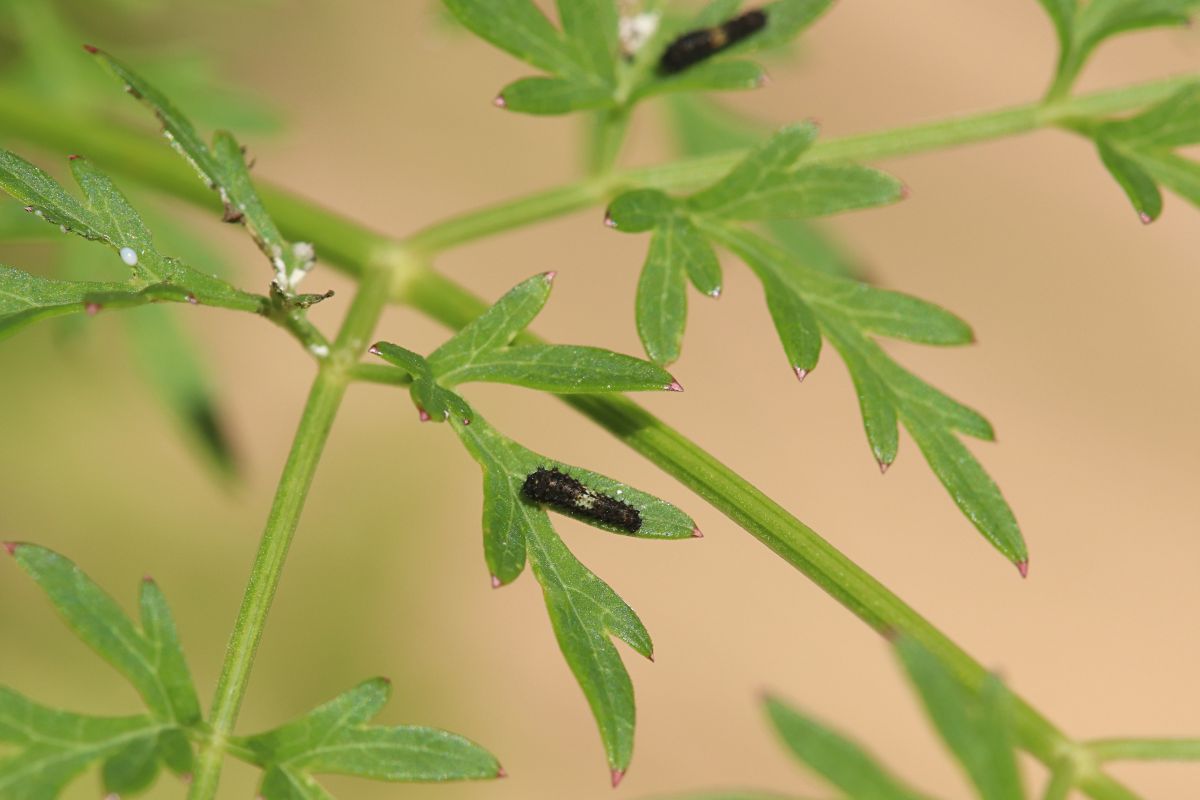
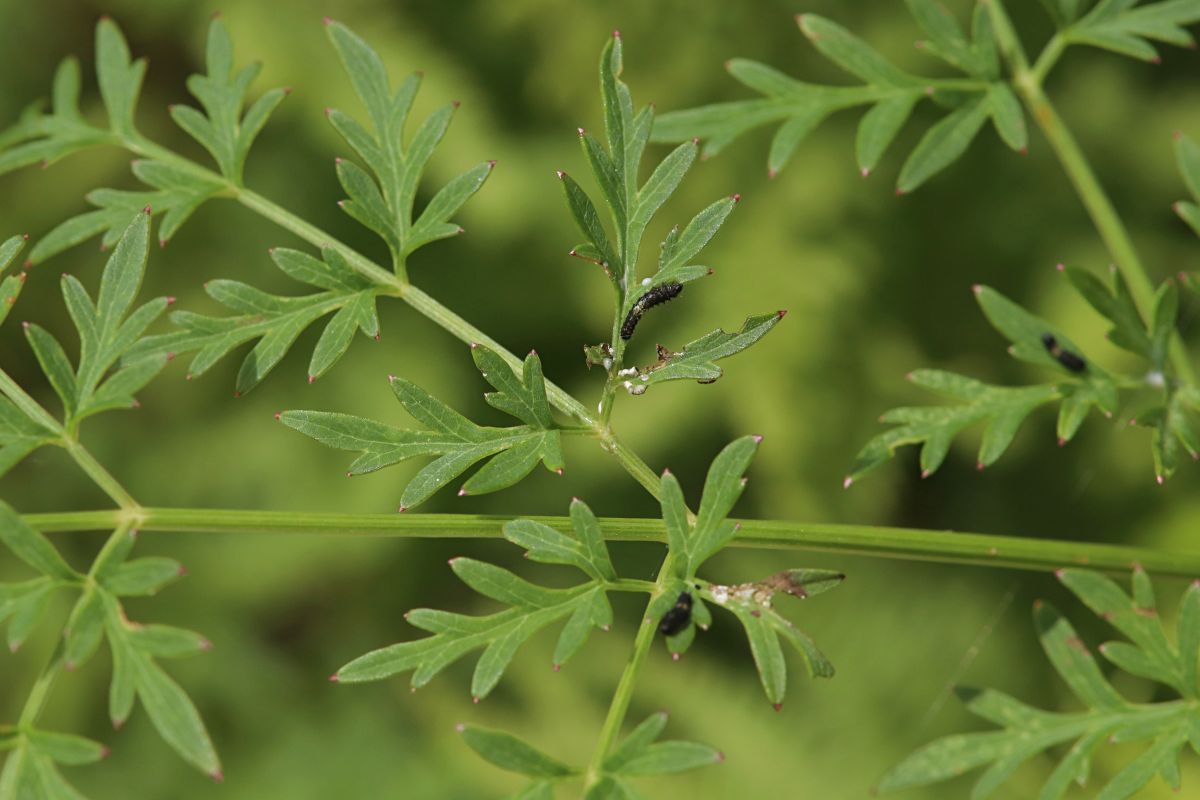
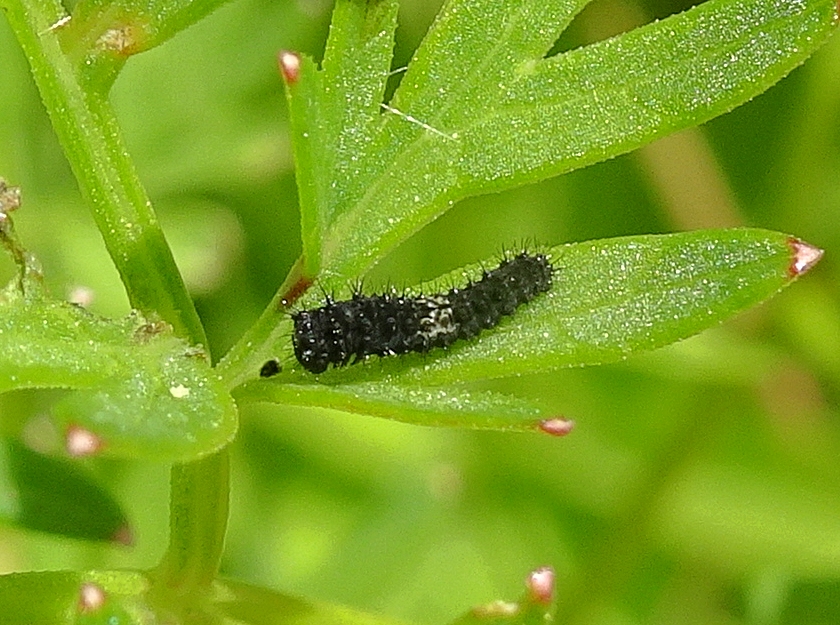
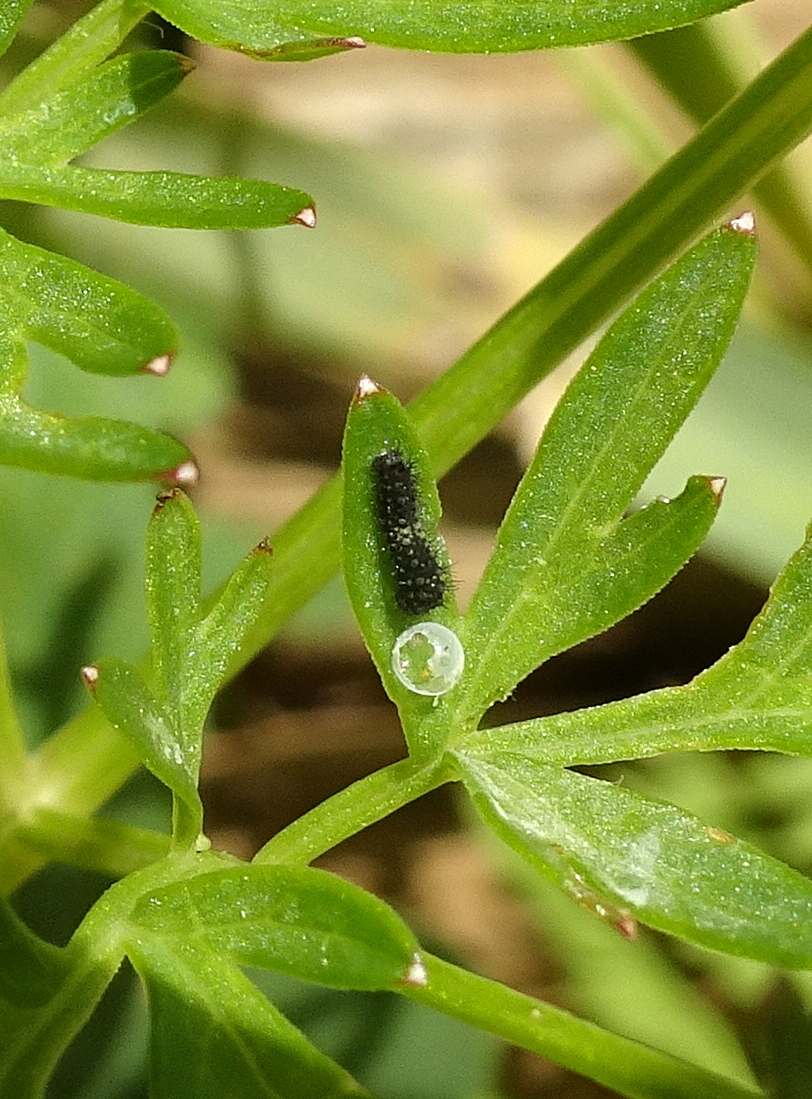
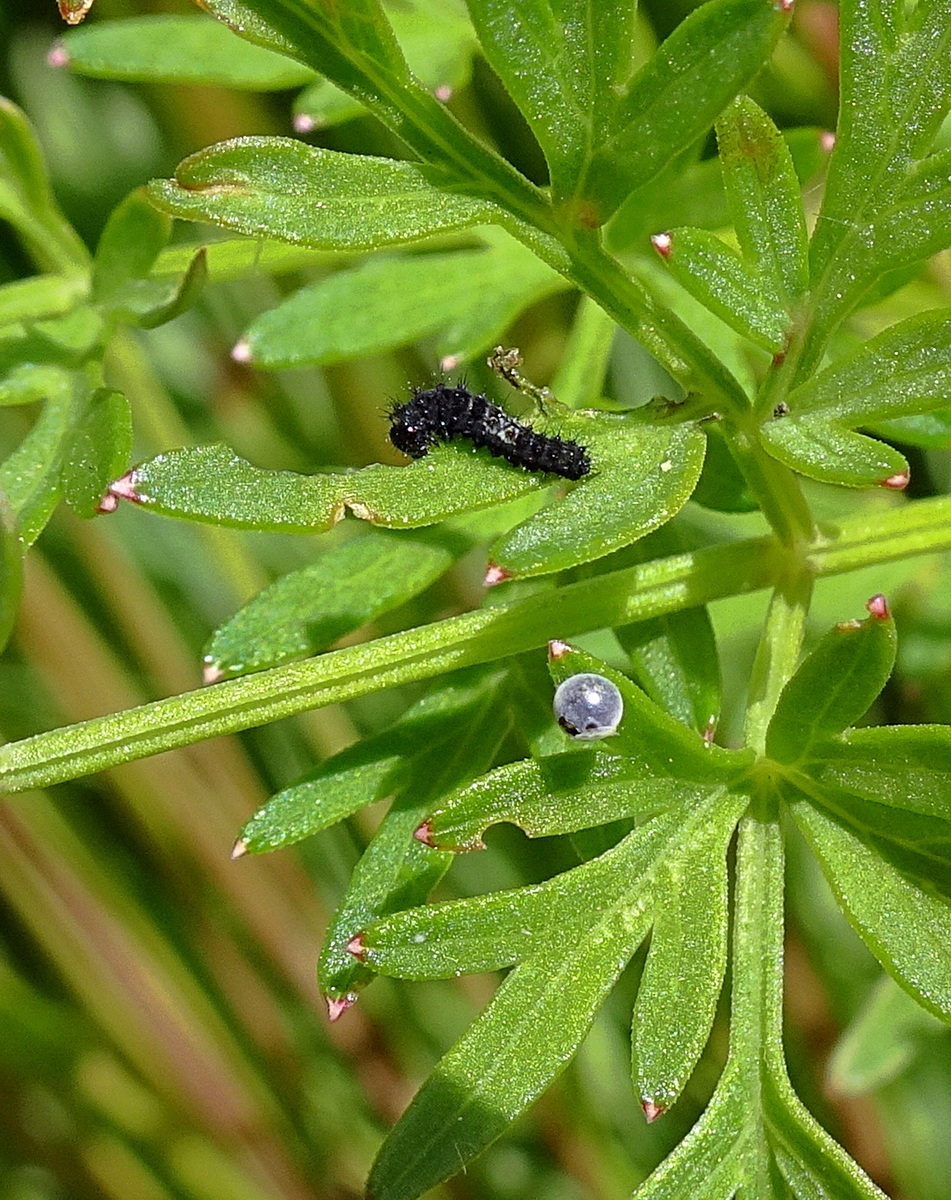
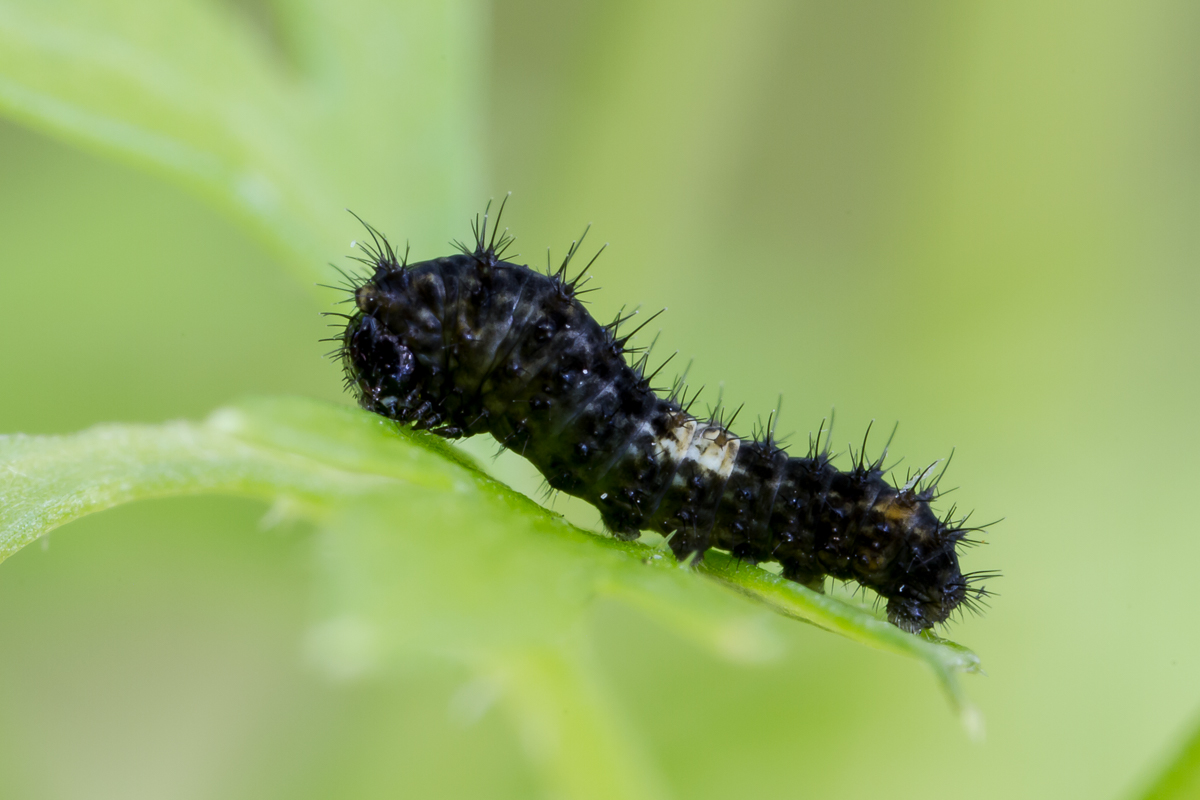
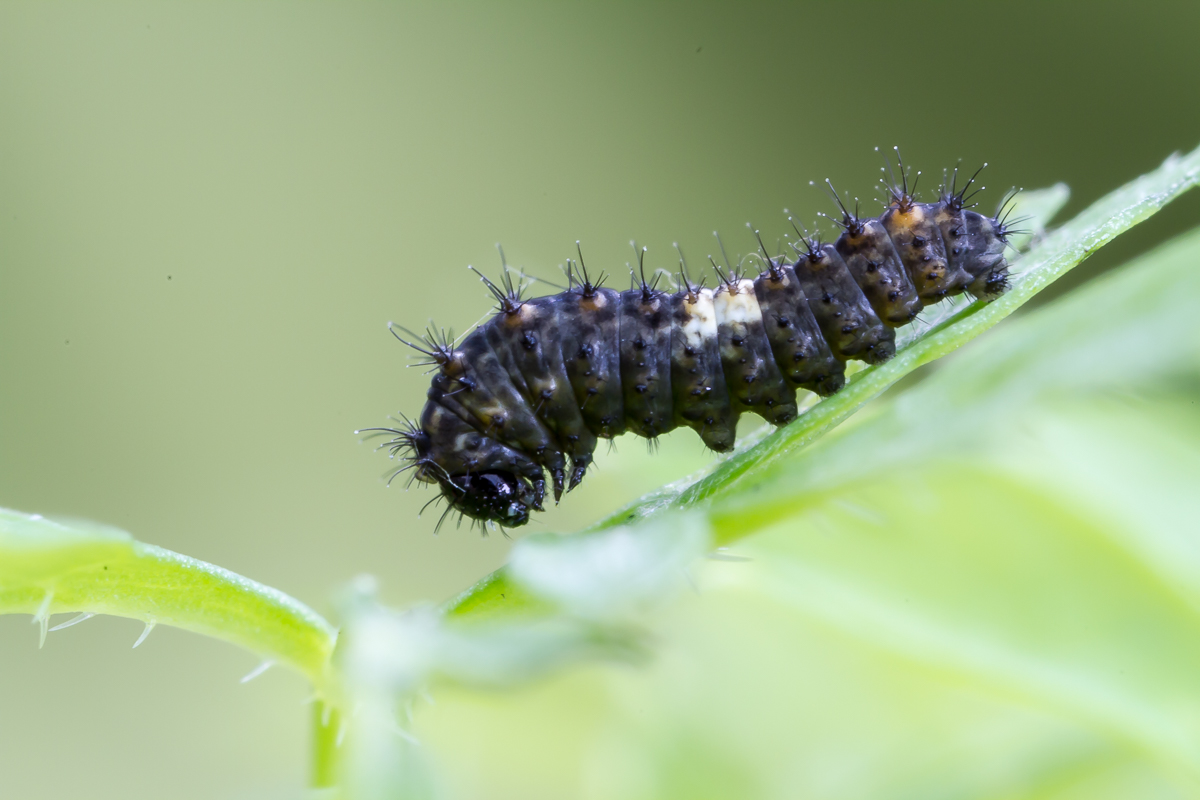
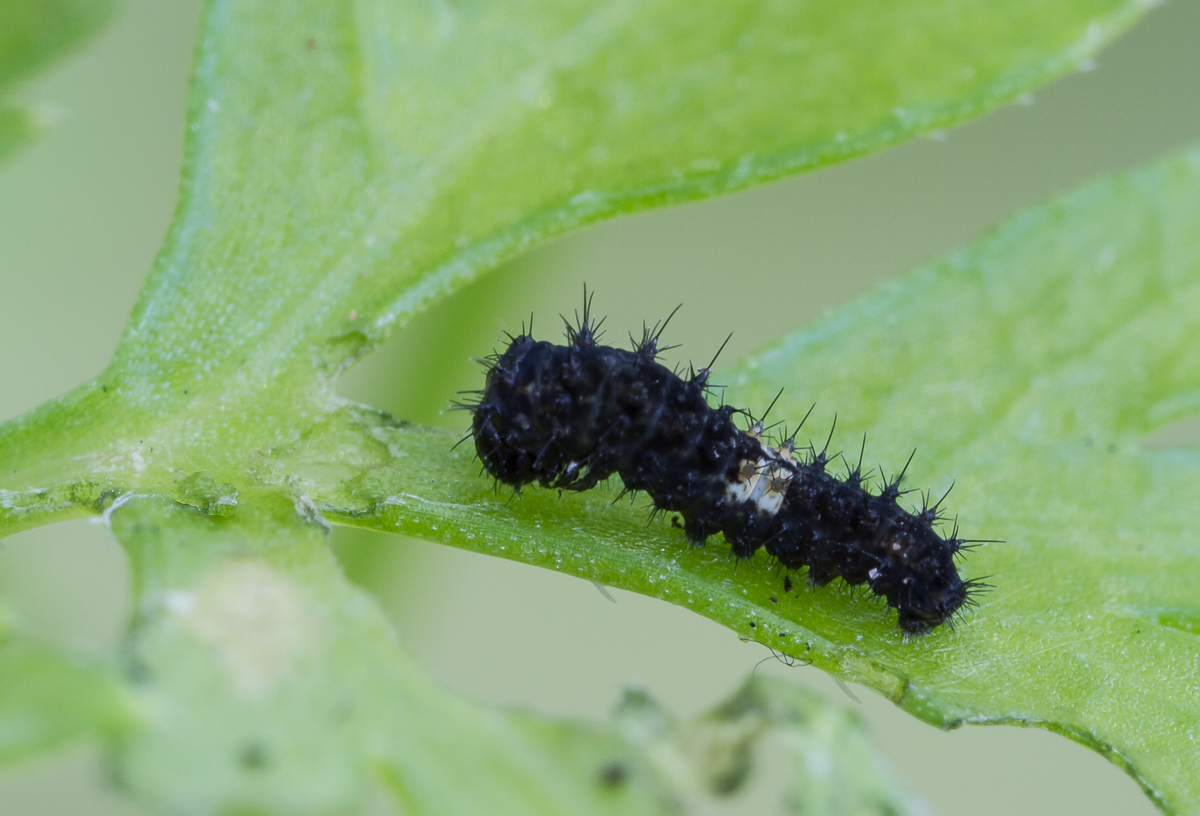
"The first moult occurred July 7th, 1890. After the first moult, nine days old, it measures while resting 6.3 mm. long. It is very similar to the first stage, but now has a lateral series of orange spots and a pale spot on the side of the first segment, and in front where the retractile tubercles are placed; the whitish markings on the sixth and seventh segments are more pronounced. If the larva falls off its food plant, it hangs suspended by a silken web. It rests with the frontal half of its body raised and curved, holding to the plant by its claspers only." - Frohawk (1924)
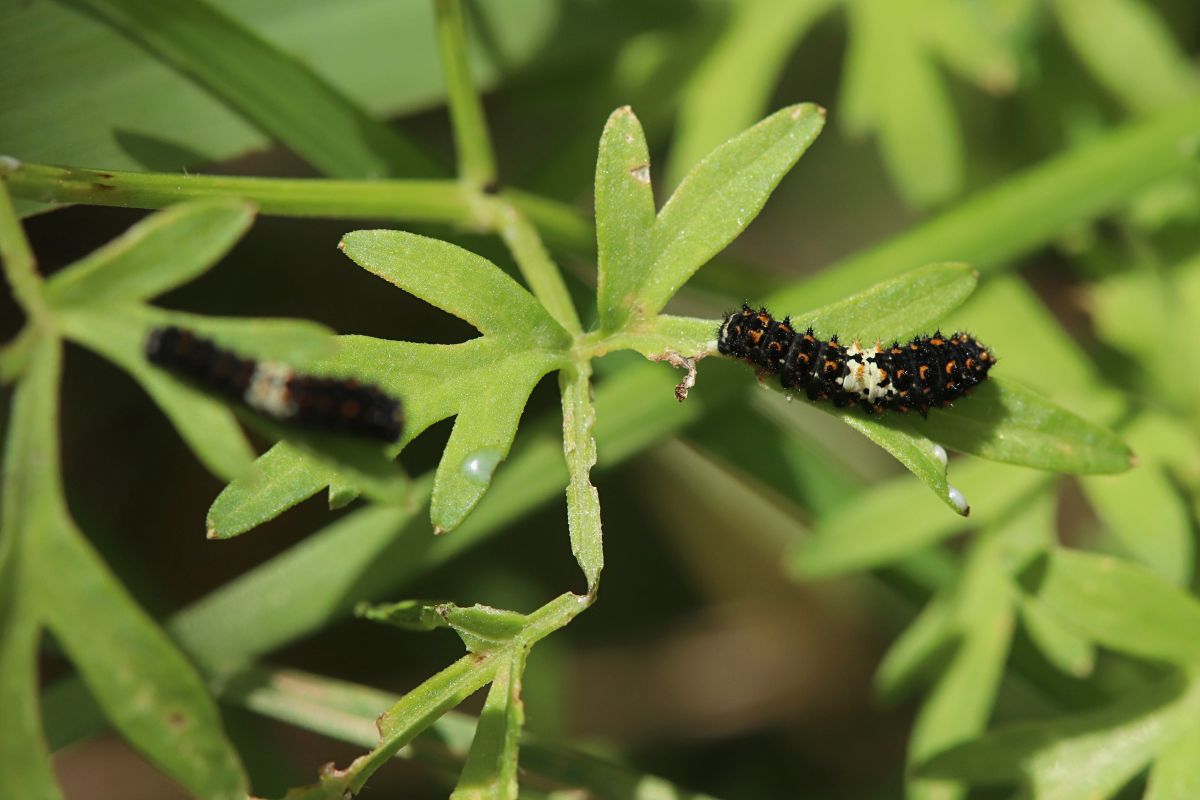
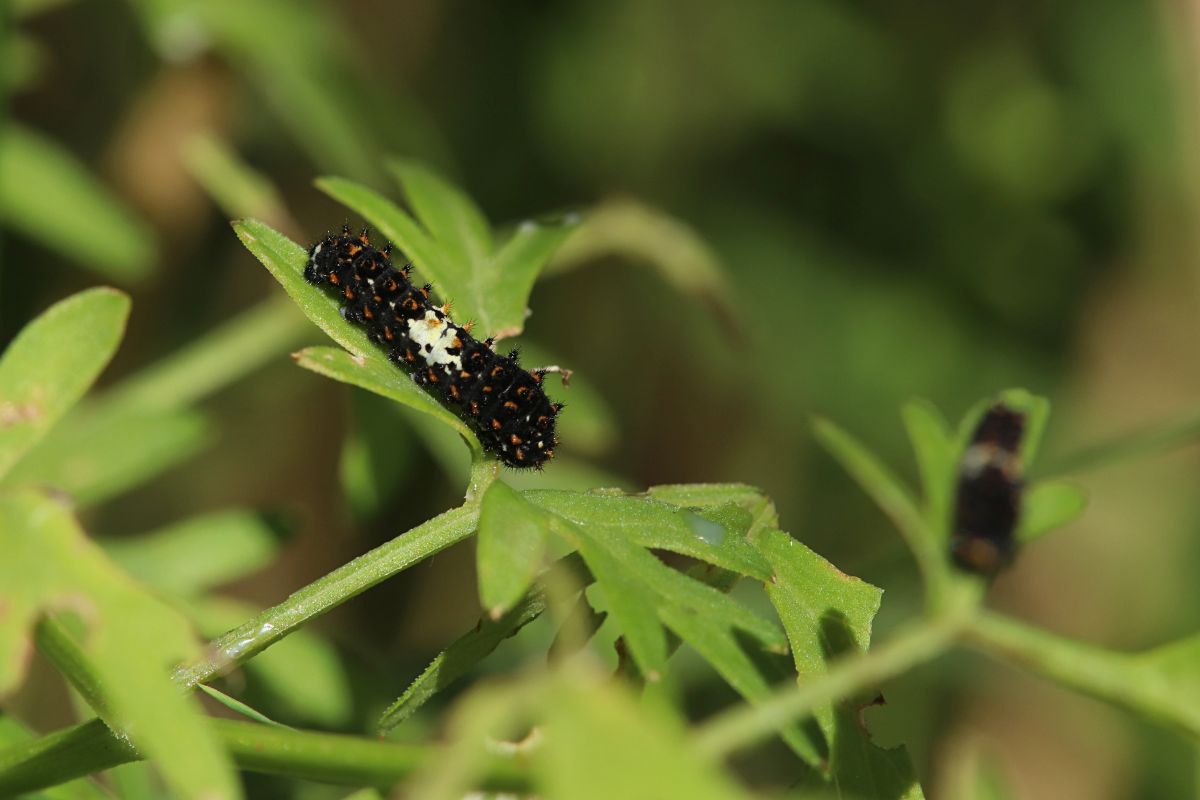
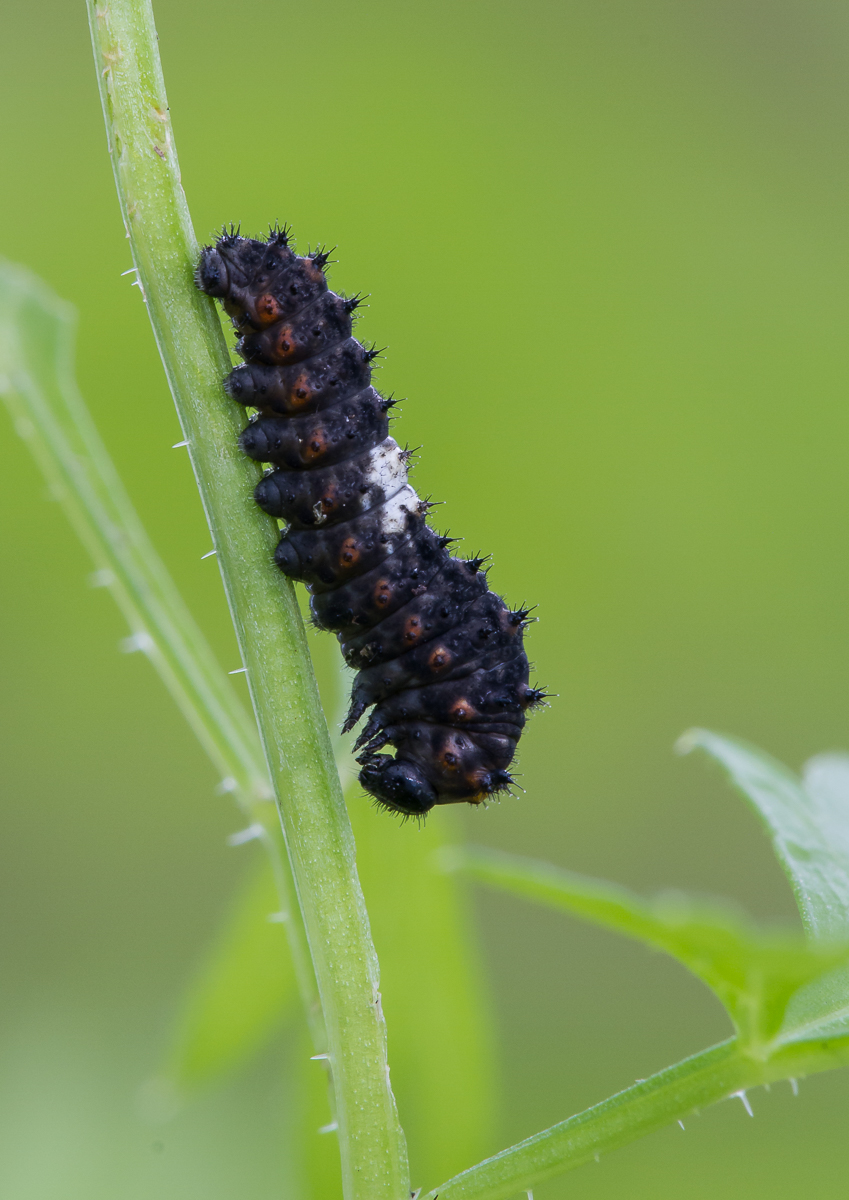
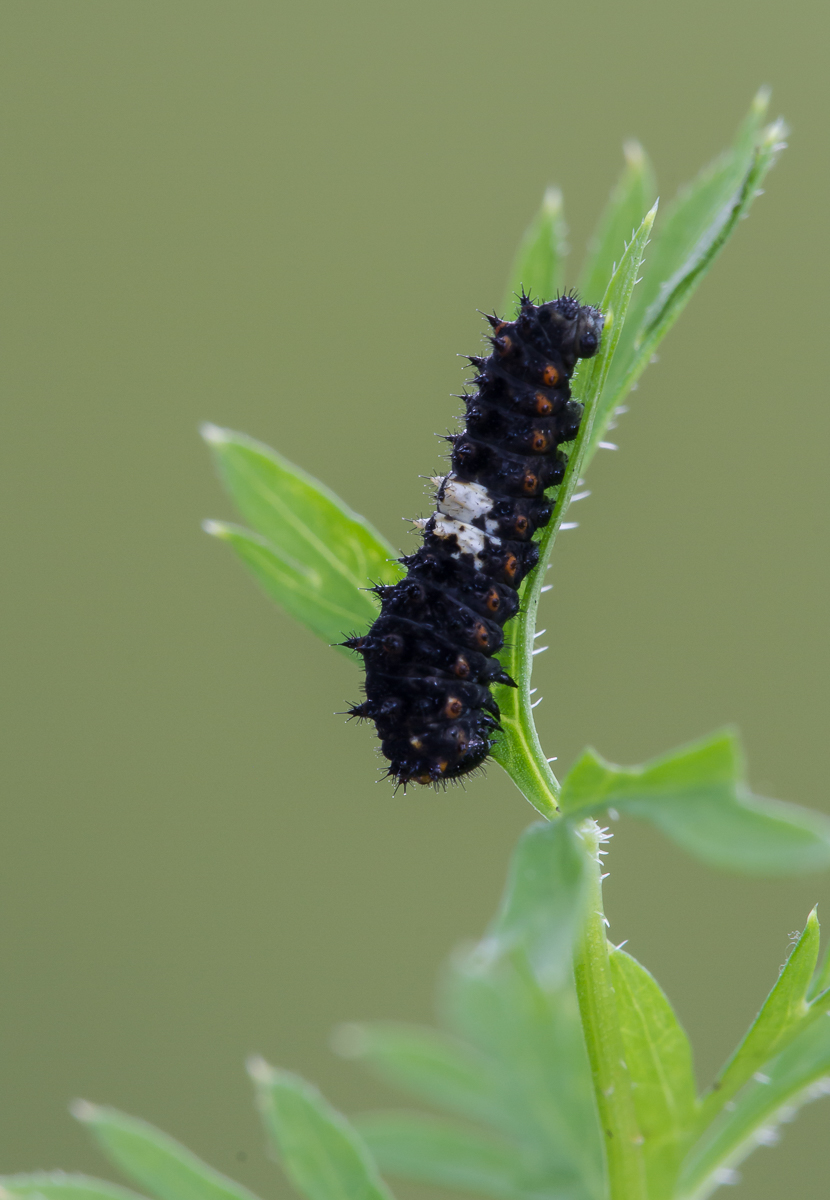
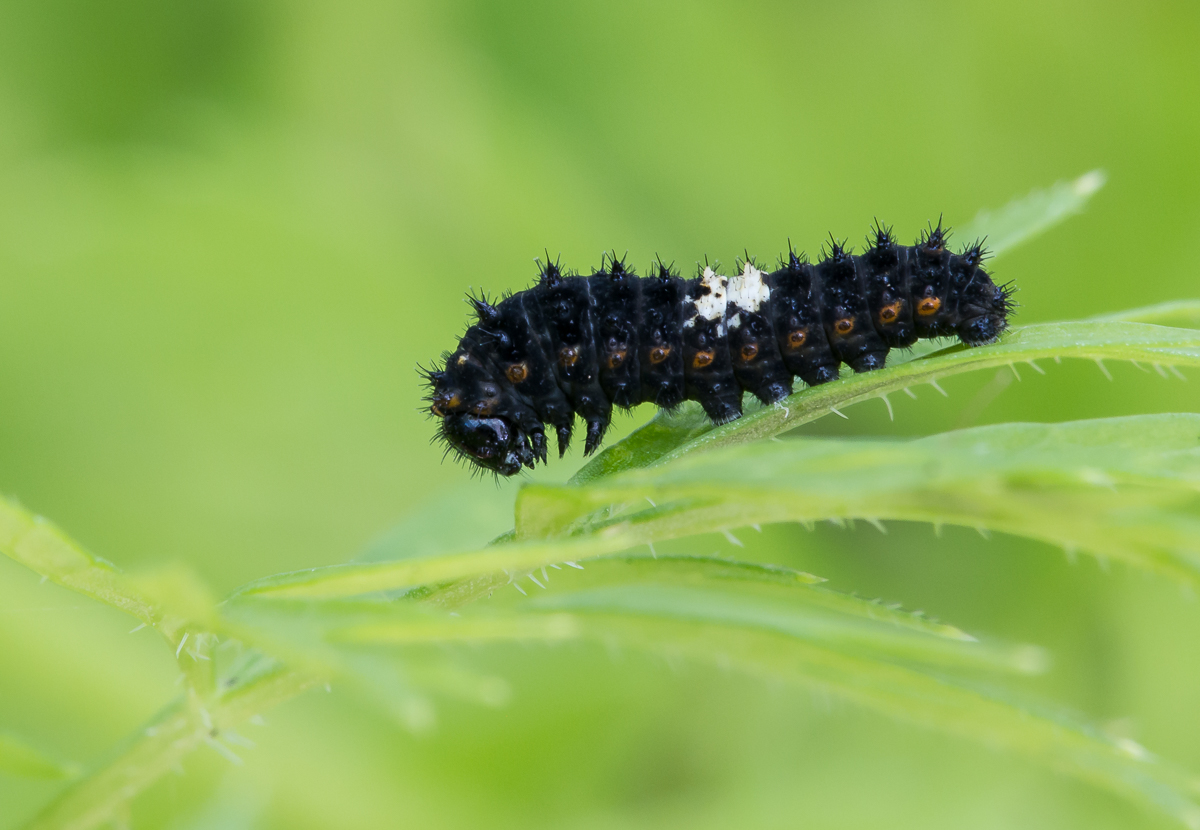
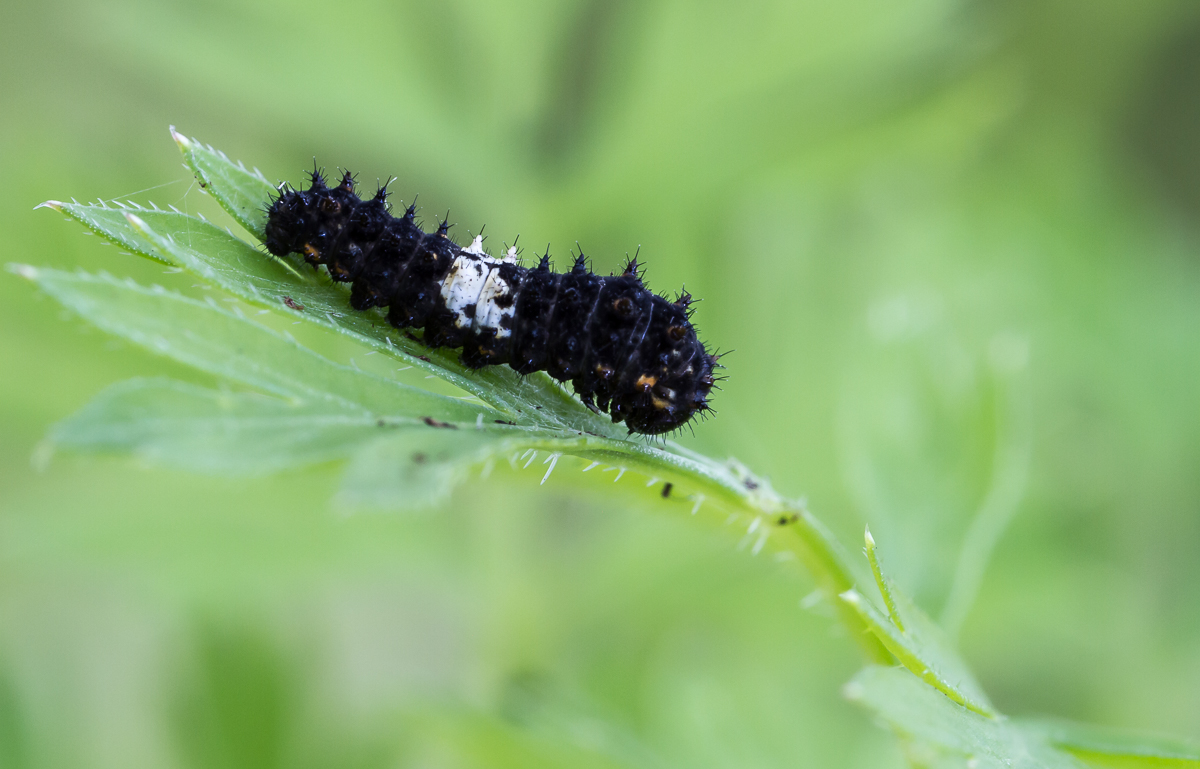
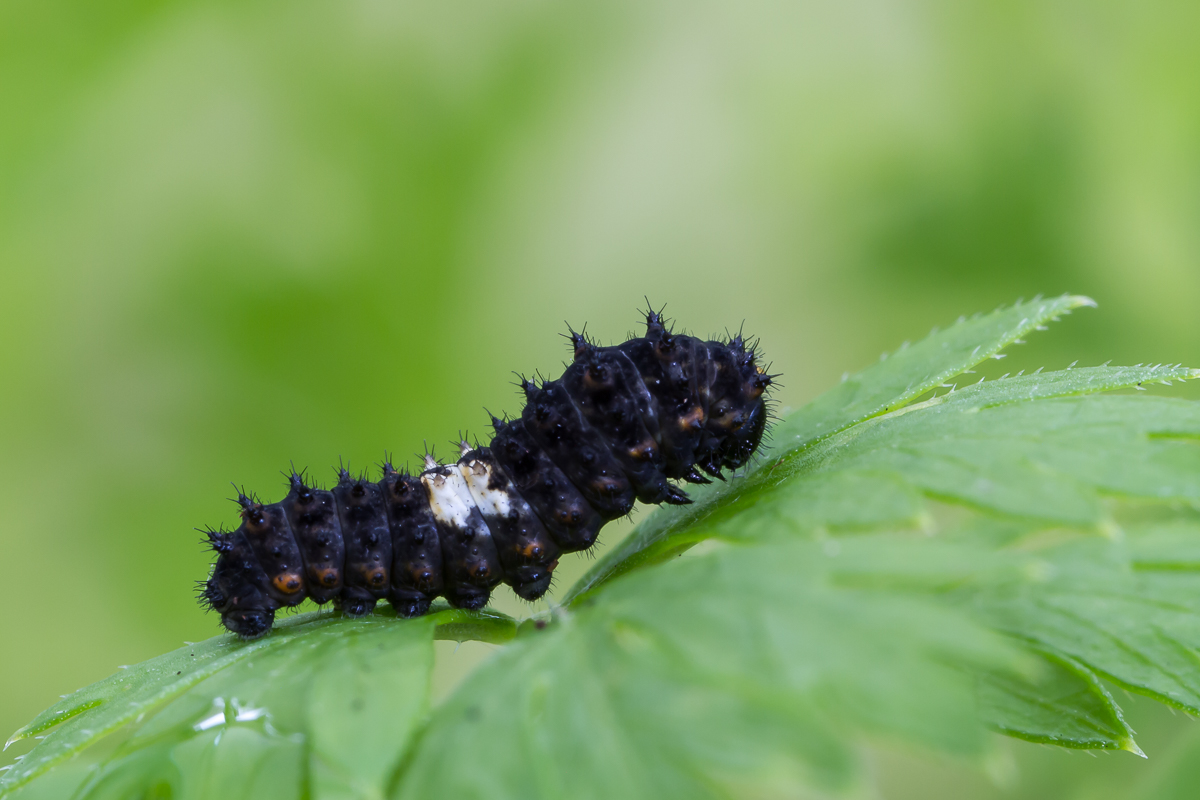
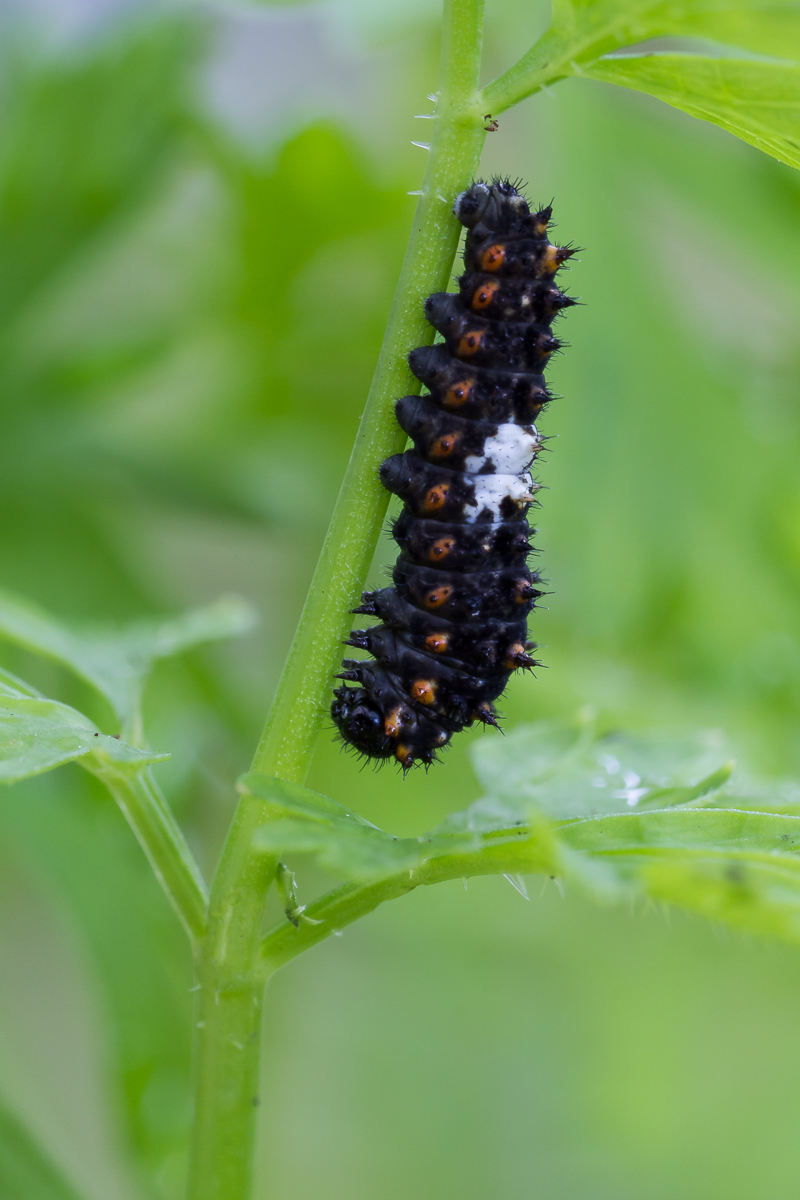
"Second moult July 20th, 1890. Shortly after the second moult it measures 8 mm. long. During very warm weather it quickly grows, and measures, when a fortnight old, 12.7 mm. long. It closely resembles the previous stage in all details, but now shows more white on the anal segment, and in some specimens a little white in the form of a spot or two on the ninth and tenth segments. In this, as in the previous stage, the whitish or pale yellow clypeus forms a A-shaped mark on the head, and the pale orange tubercles are protruded when it is irritated." - Frohawk (1924)
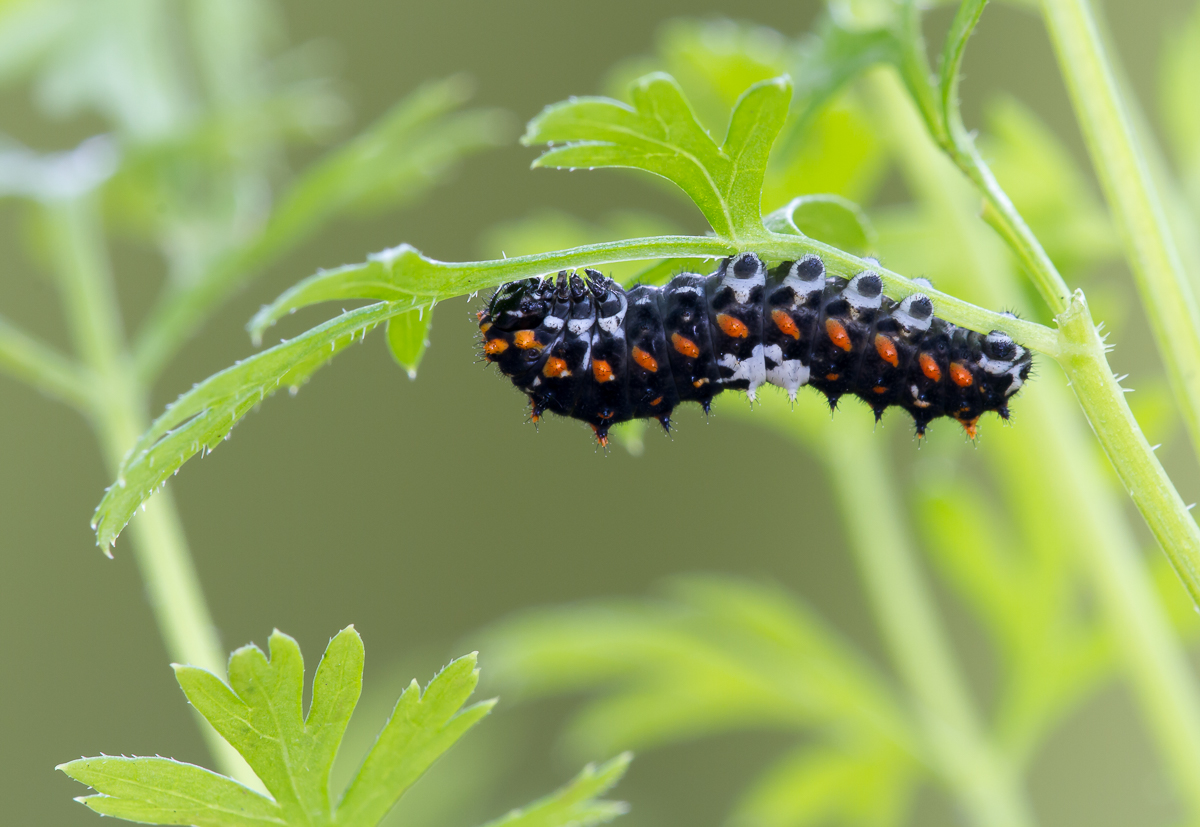
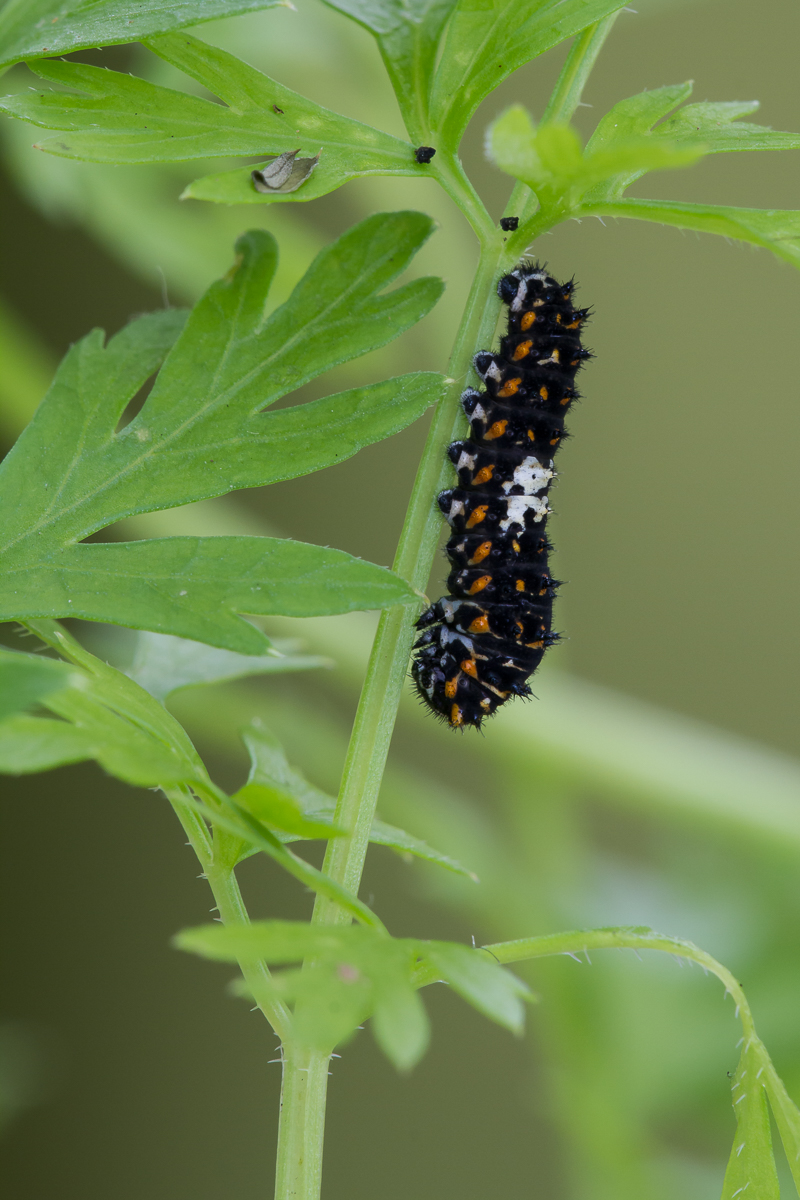
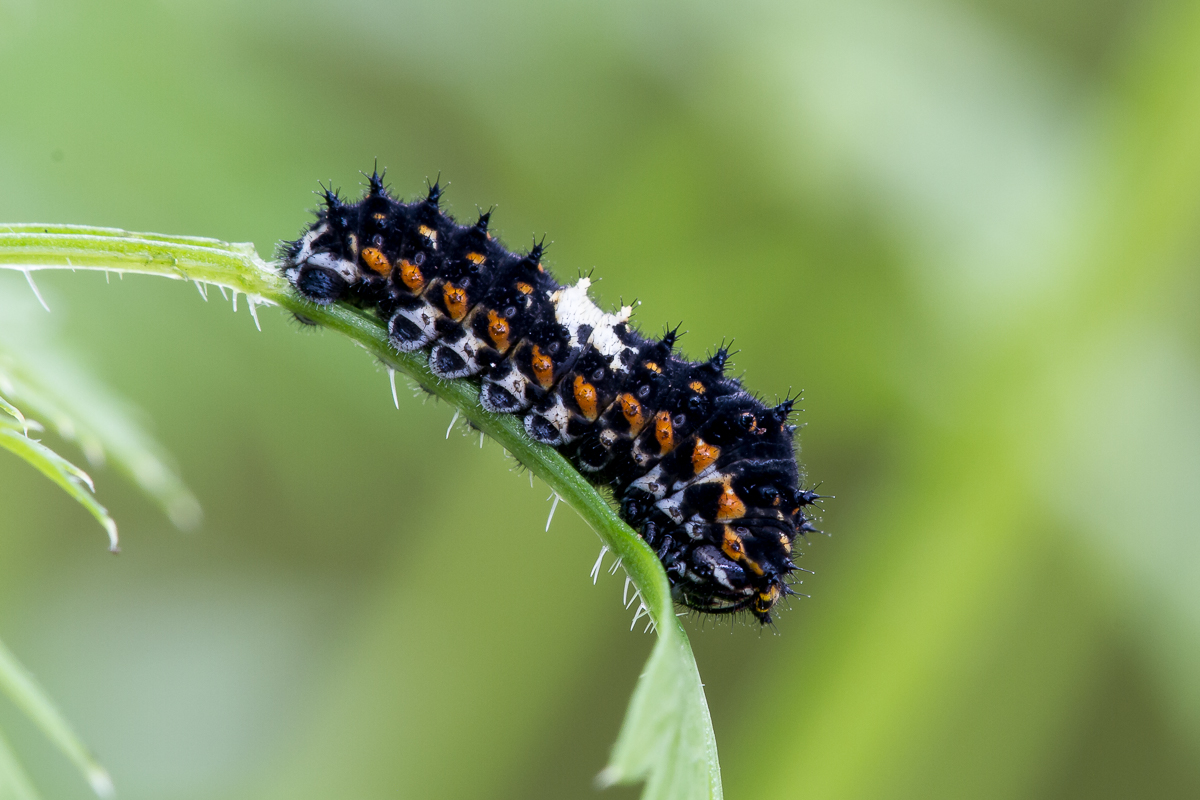
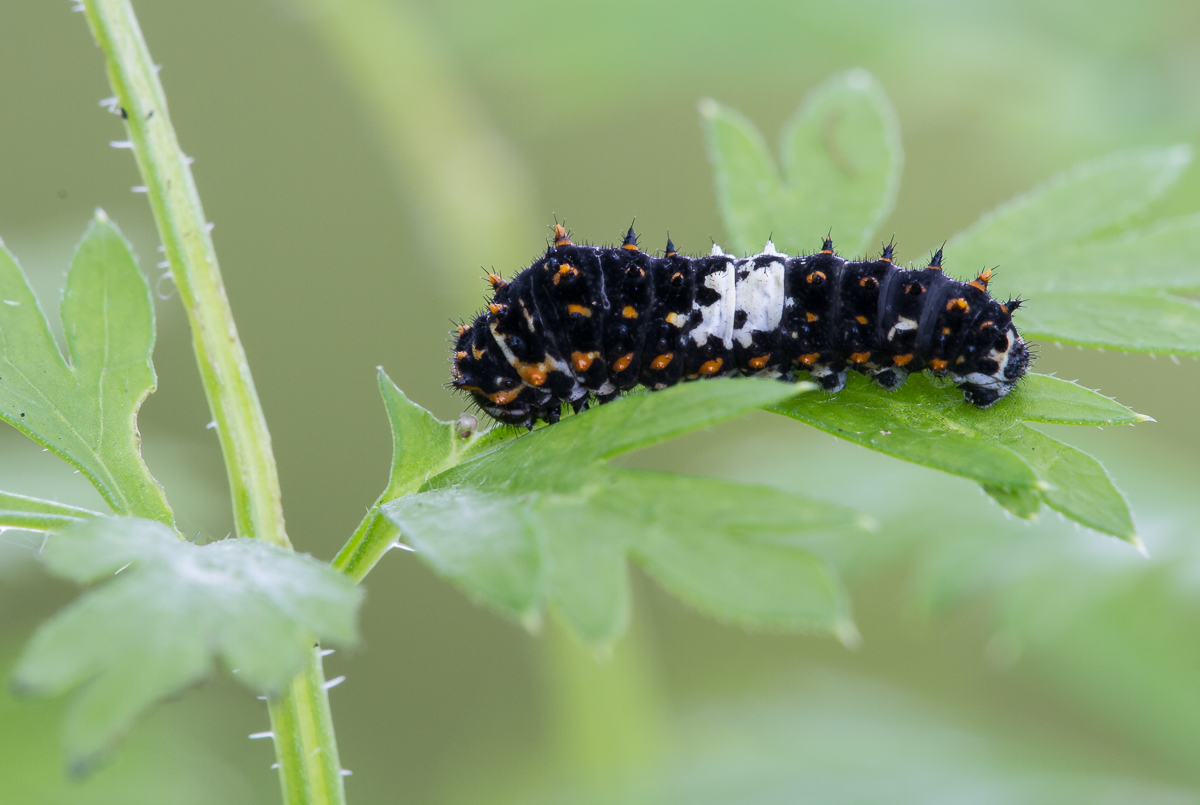
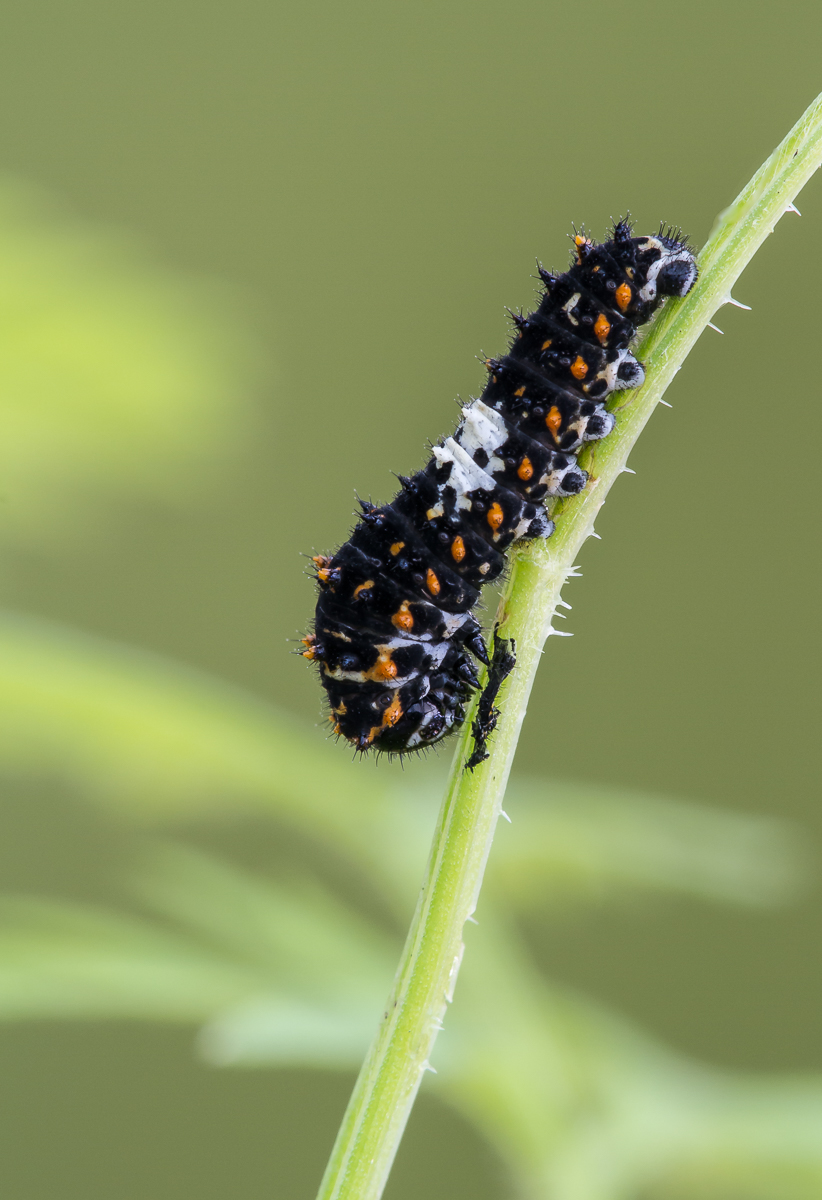
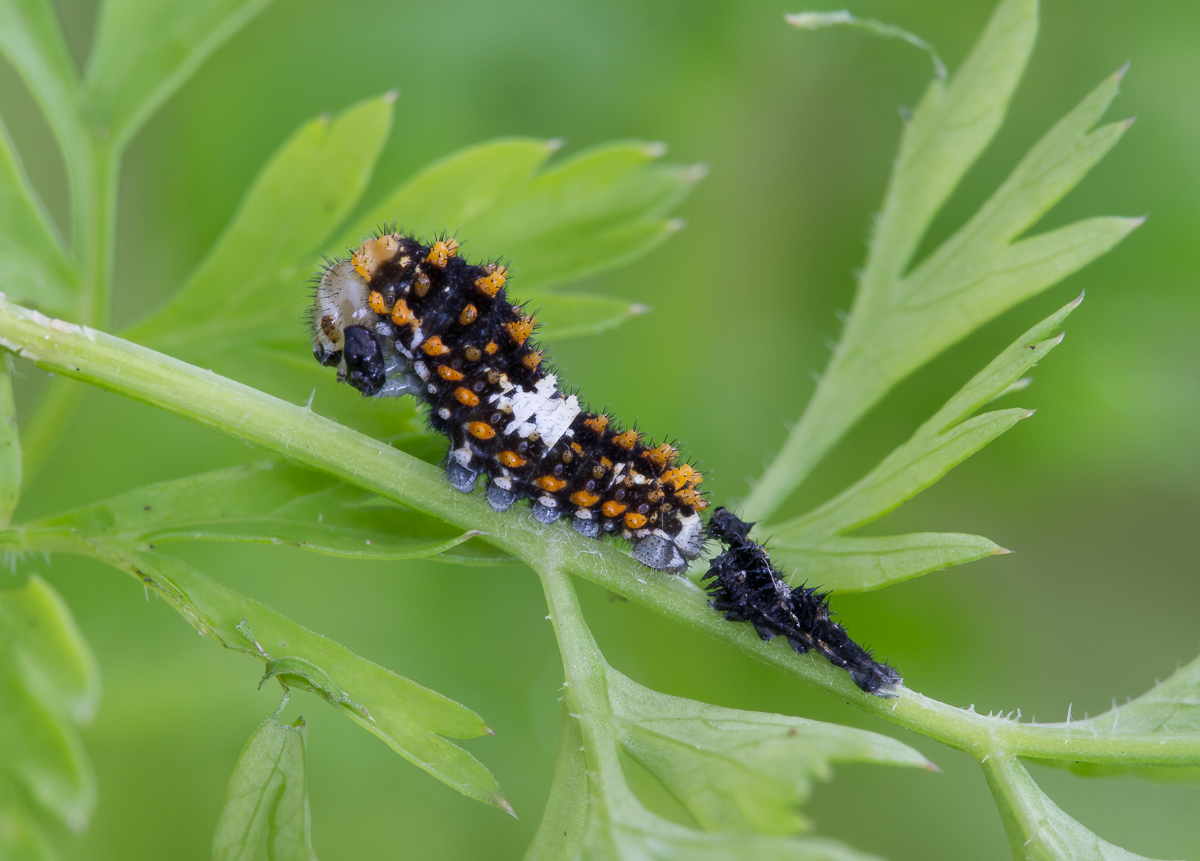
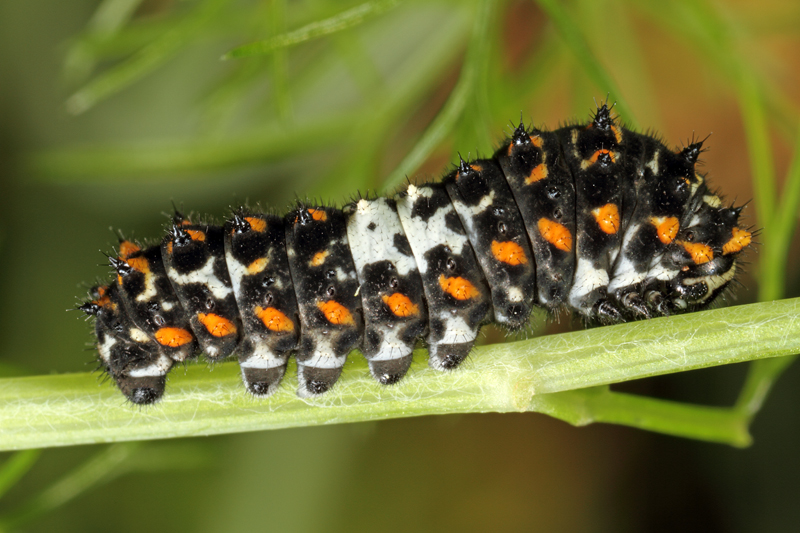
"Third moult July 25th, 1890. After the third moult, twenty-two days old, while resting it is 22.2 mm. long. While at rest it assumes the same attitude as in the former stages. The ground colour is a very pale greenish white; the anal segment is almost white, and the same colour also extends along the lateral region; the segmental divisions are velvety-black. There is a medio-dorsal series of oblong velvety-black spots, each connected by a very fine black line, and a sub-dorsal row of rounder spots; along the sides are two other rows of triangular markings. Between all these black markings is an orange mark, so that each segment is transversely banded by black and orange alternately. The sub-dorsal spots on the sixth and seventh segments are smaller than those on the rest of the body, thereby indicating the paler bands of the previous stage. There are two longitudinal rows of very small black warts between the sub-dorsal rows of black and orange spots, each wart emits a few short stiff bristles. The whole surface of the body is covered with similar bristles; the anal segment is without any orange markings. The head is shining black with a yellow clypeus and a whitish side line; the legs are black ringed with white." - Frohawk (1924)
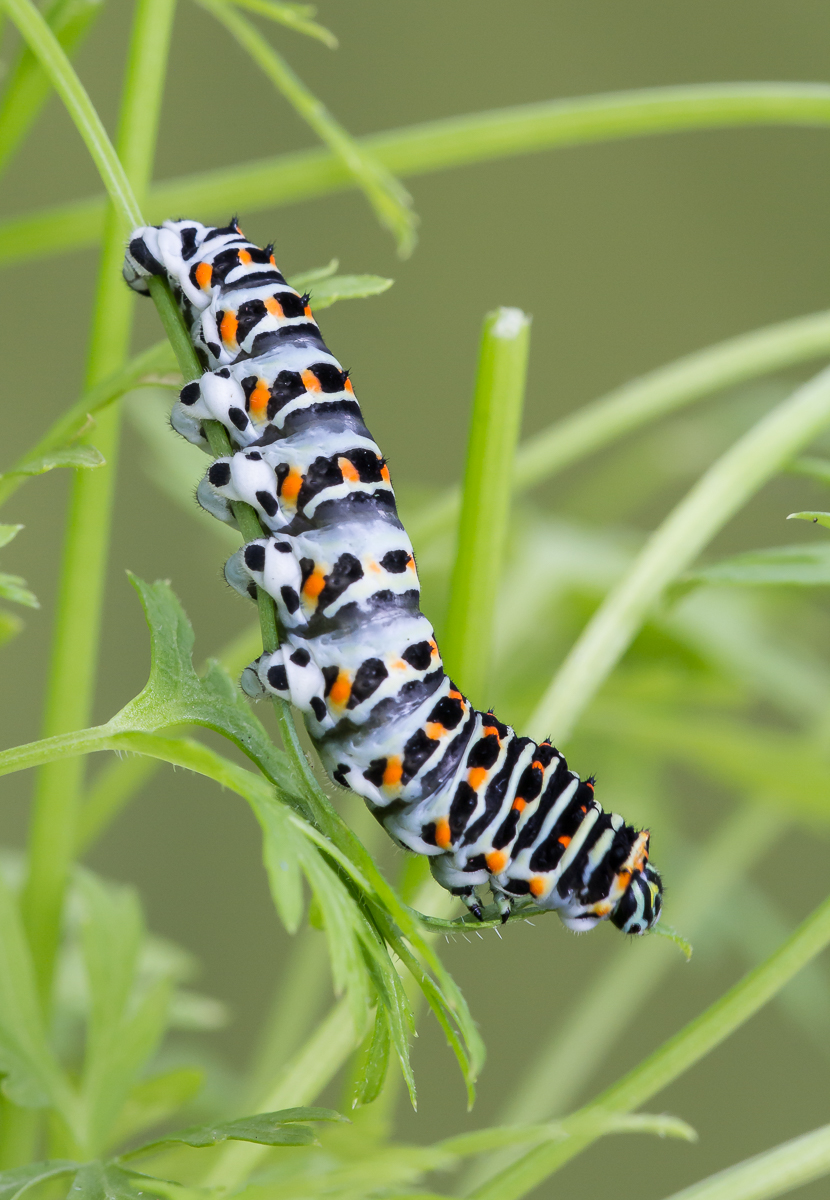
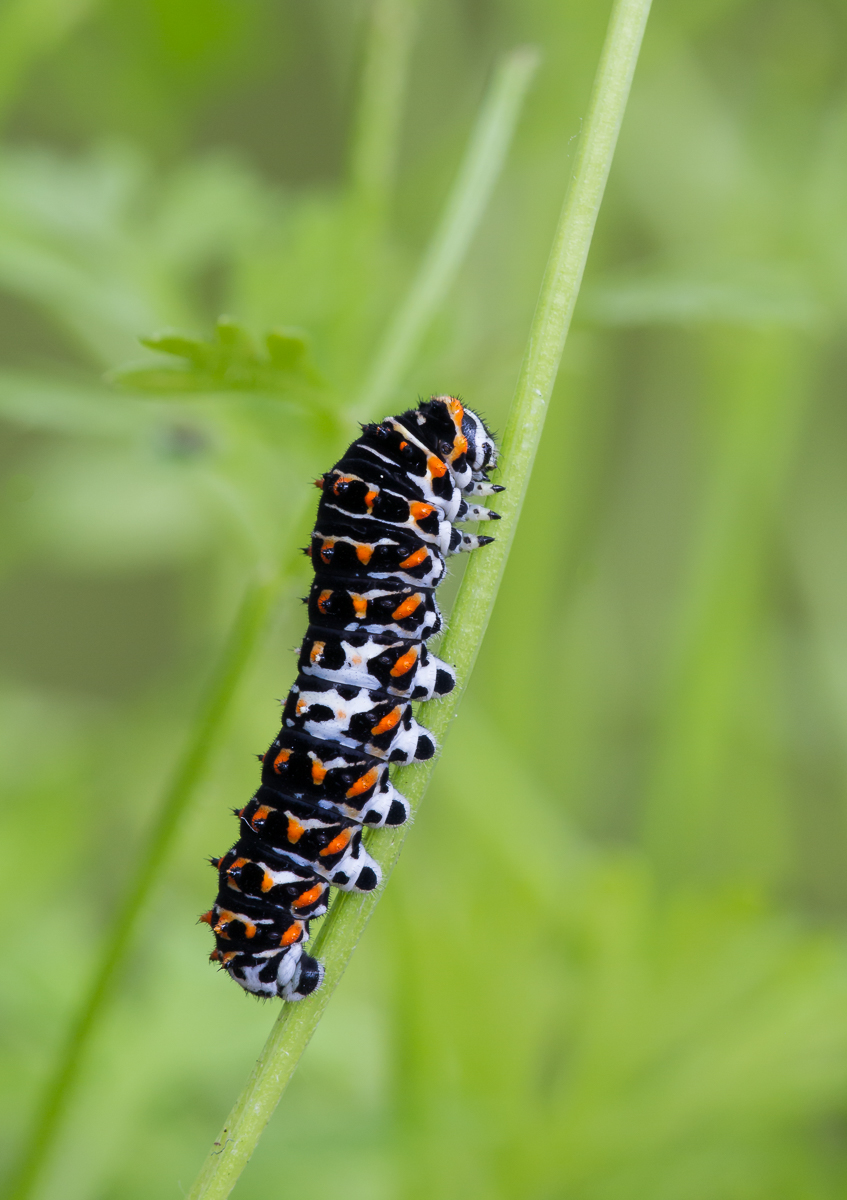
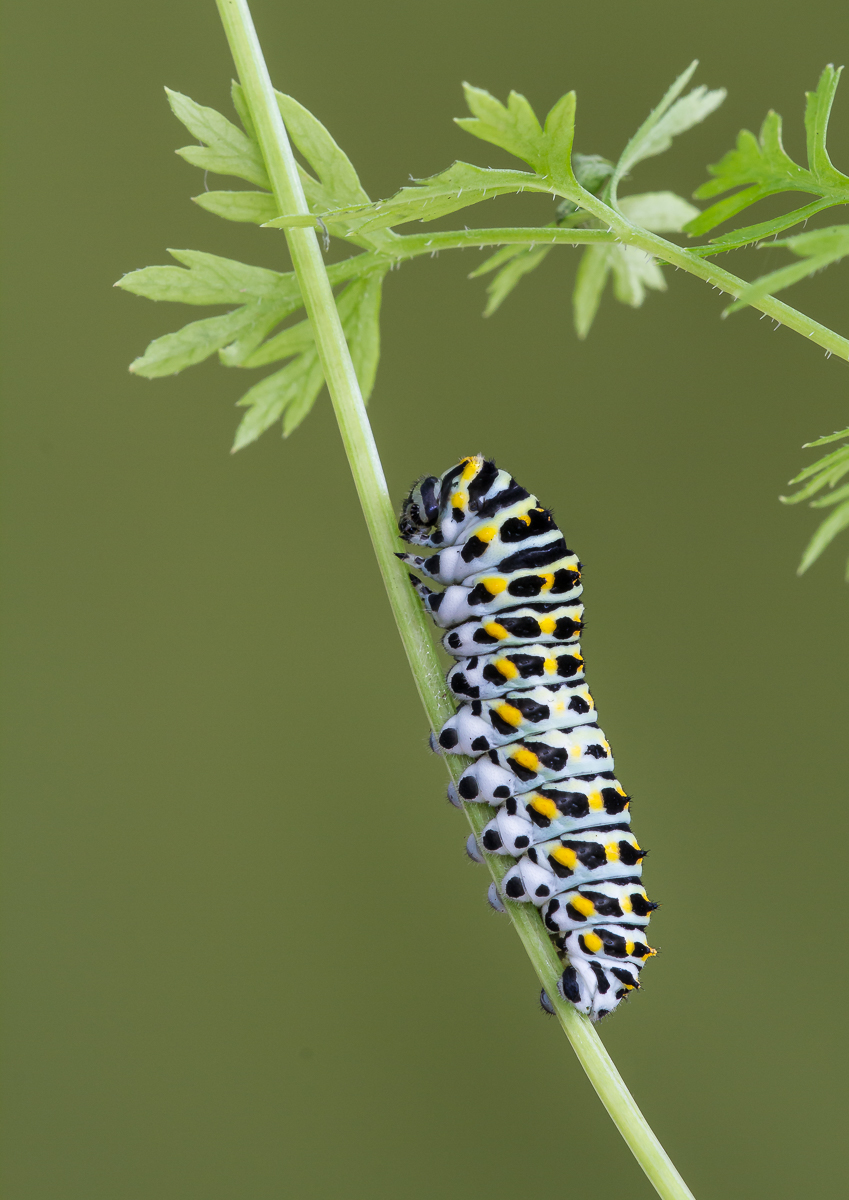
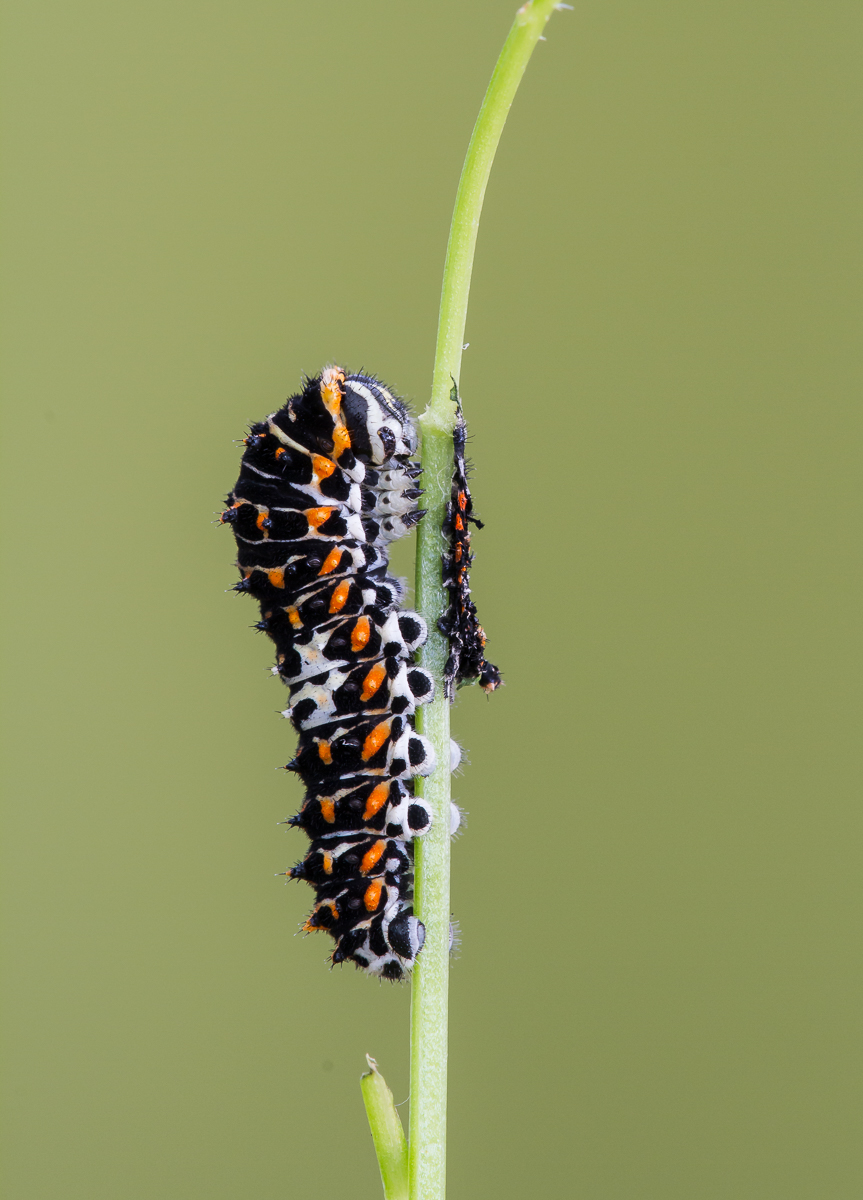
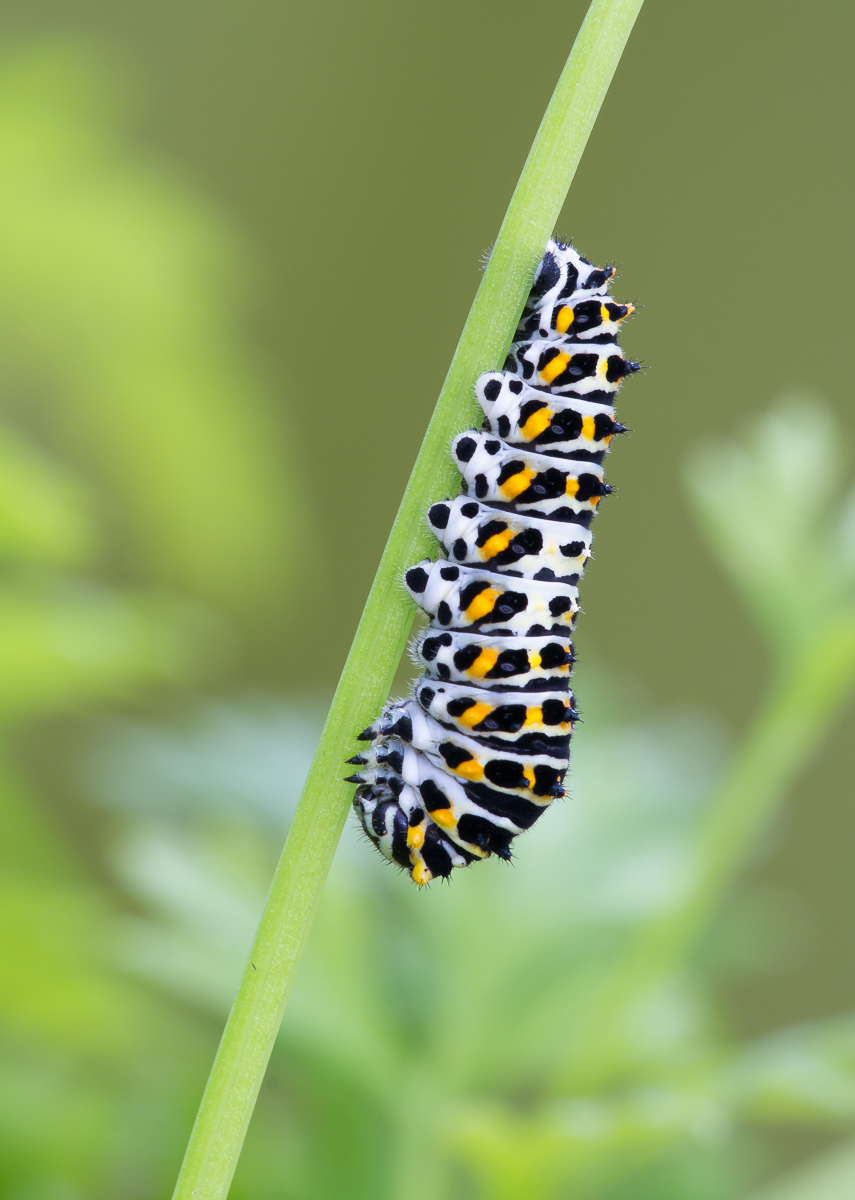
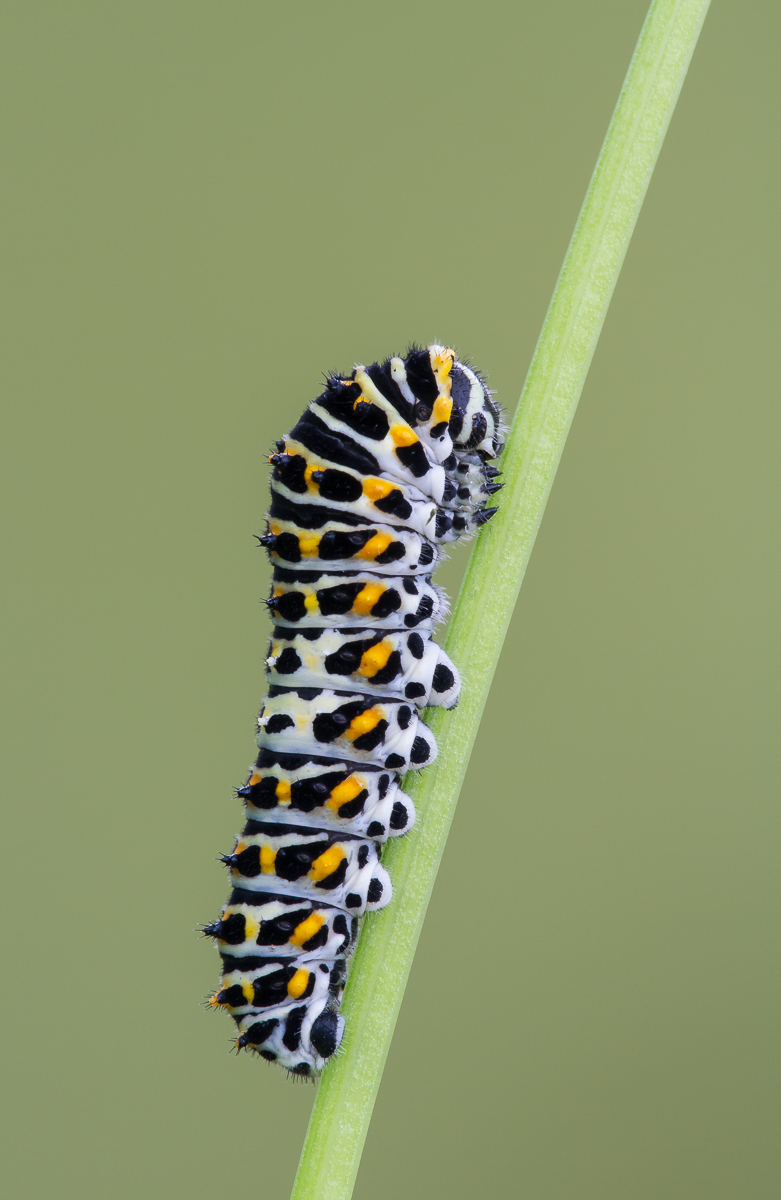
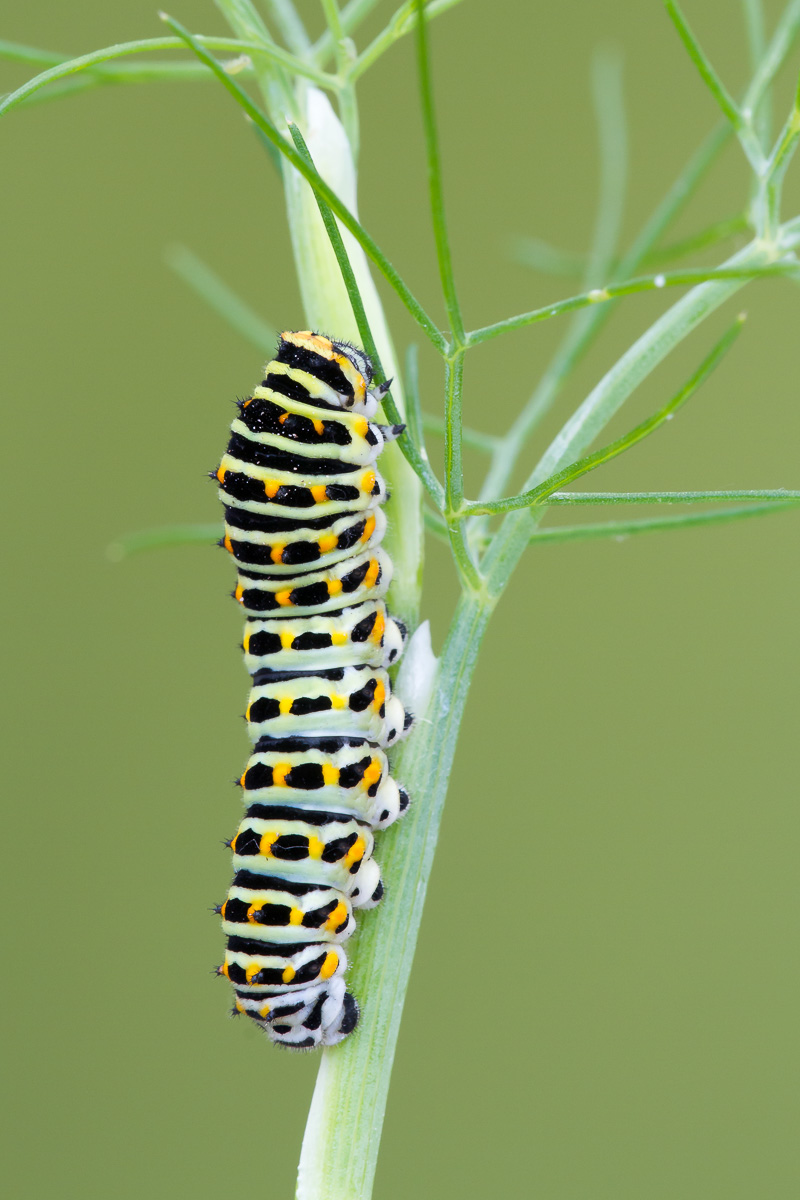
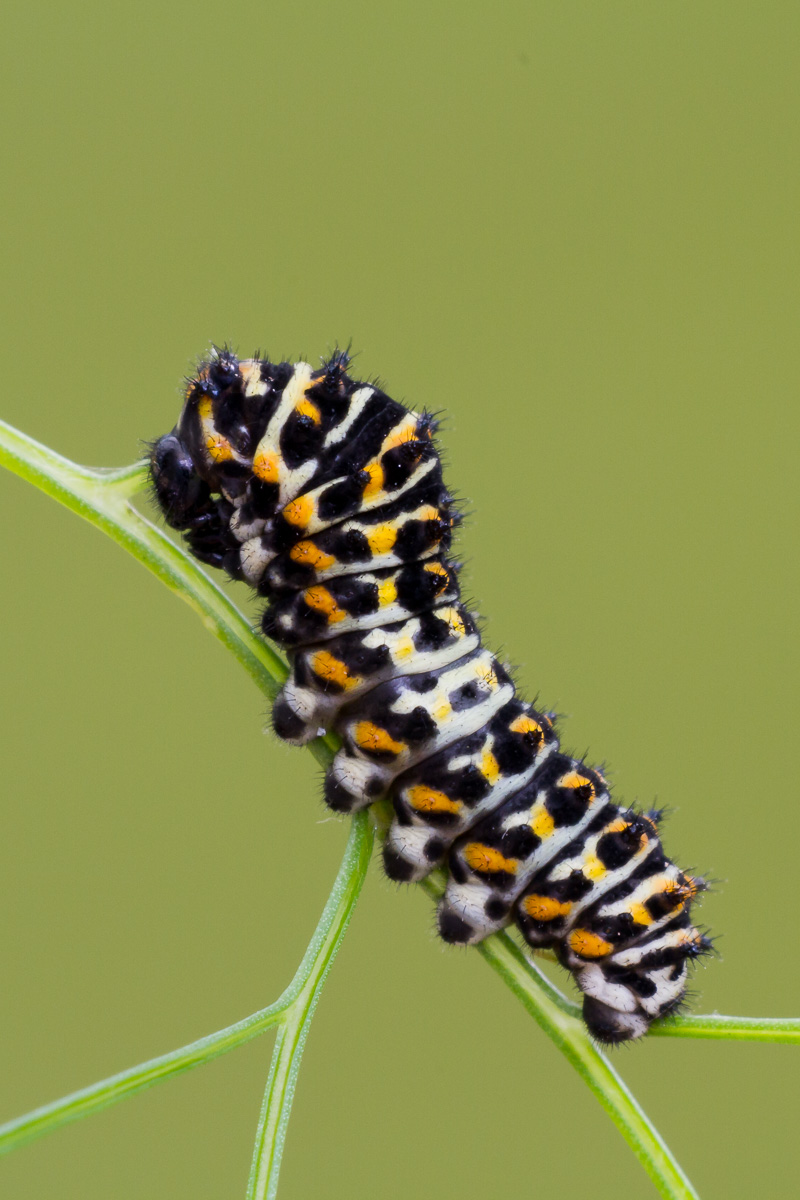
"Fourth moult July 31st, 1890. After each moult it devours the cast skin, which forms its first meal. After the fourth and last moult, thirty days old and fully grown, it measures 41.3 mm. long while resting, and from 50 mm. to 53.2 mm. when crawling. The body is slightly attenuated at each end. The ground colour is a beautiful bright green, inclining to bluish along the lateral lobes and claspers. The segmental divisions are banded with purple-velvety-black, which are widest on the dorsal surface, wavy in outline on the side and terminating in a fine line below the spiracles; in the centre of each segment is a transverse dorsal velvety-black band, broken up into three portions, excepting along the posterior edge, by two deep orange spots and one at each end. On the first segment this band has no orange spots. Then follows an oblique black marking enclosing the whitish spiracle, and a shorter oblique sub-spiracular black mark. Between these two markings is a large deep orange spot; all the orange spots are nearly round. Along the lateral surface is a series of black-velvety spots, two on each of the sixth, seventh, eighth and ninth segments, one on the others, and a large one on each clasper. The legs are pale and marked with black. The head is green, with two black streaks on each lobe and a central black spot above the mouth and black eye spots. The entire surface, including the head, is densely sprinkled with very minute short bristles, each being of the same colour as the surrounding ground. On the dorsal surface of the first segment are retractile tubercles united at the base in the form of the letter V, of an orange or apricot colour, which produce a strong acrid scent; this organ is only protruded when the larva is irritated." - Frohawk (1924)
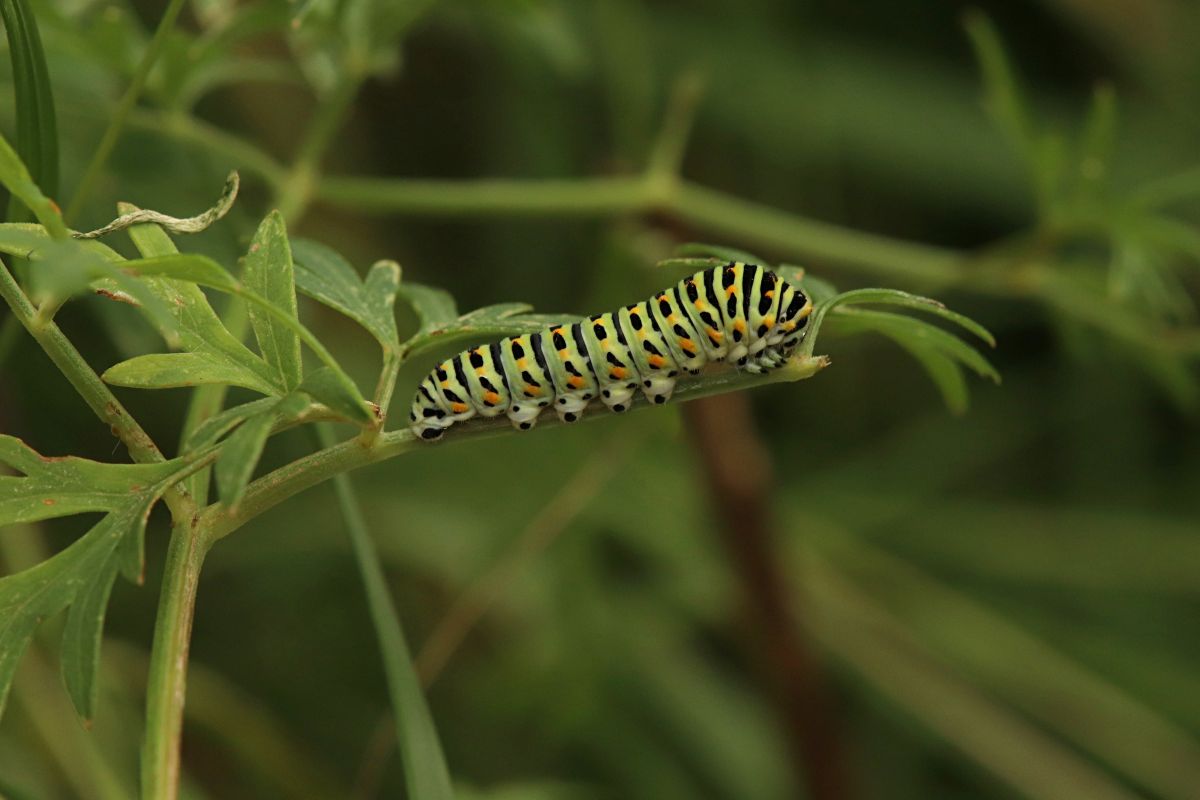
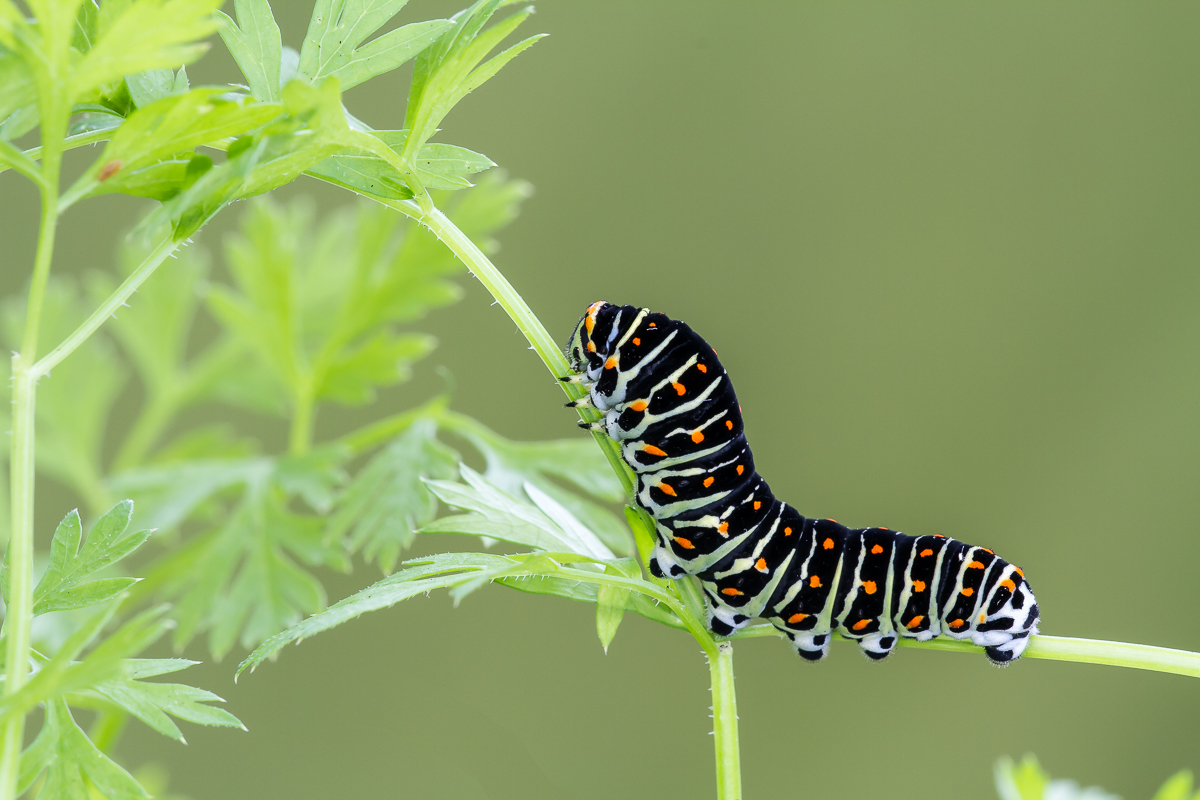
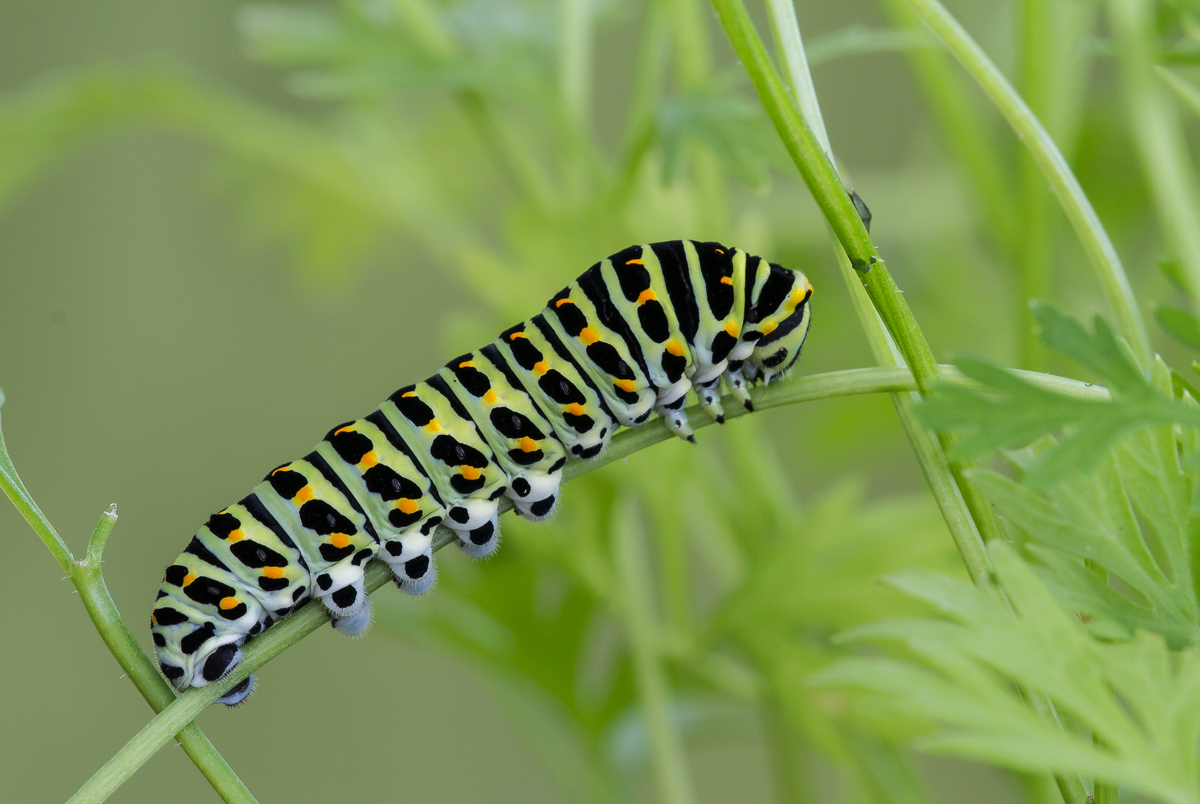
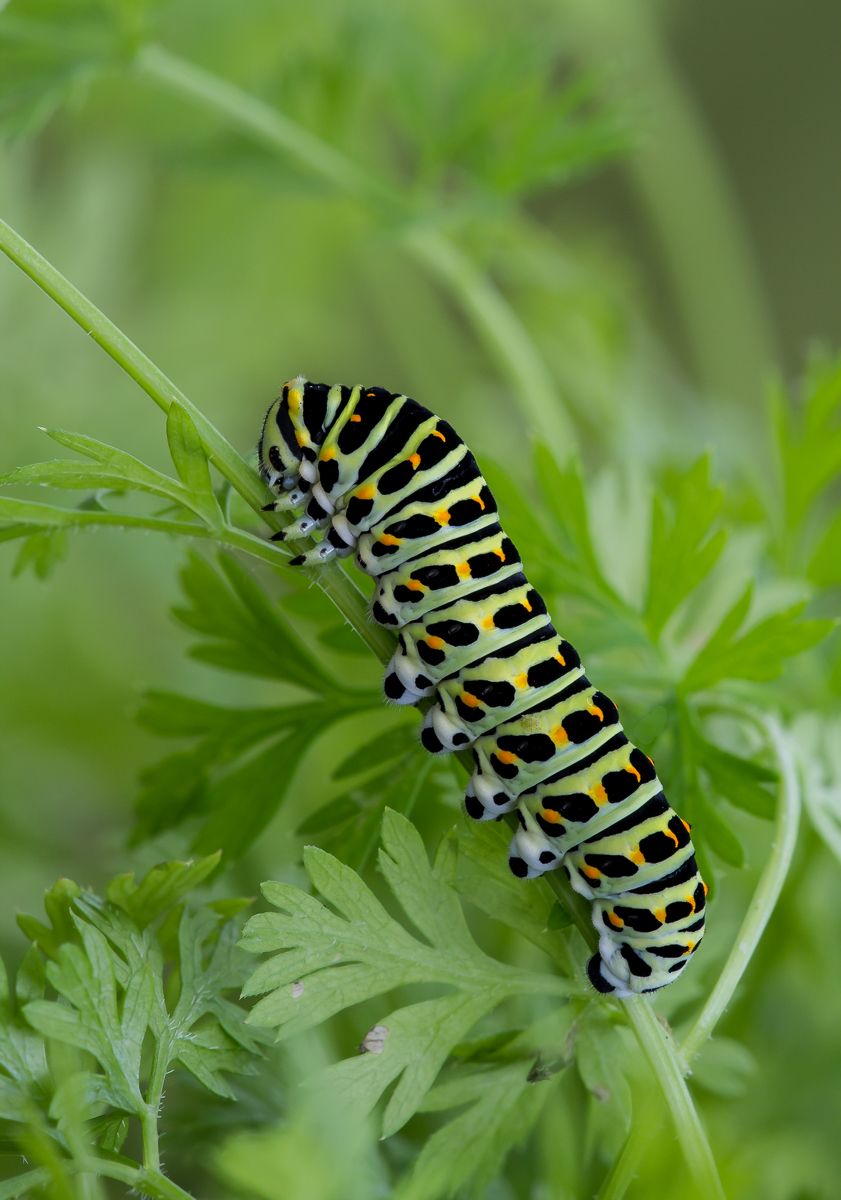
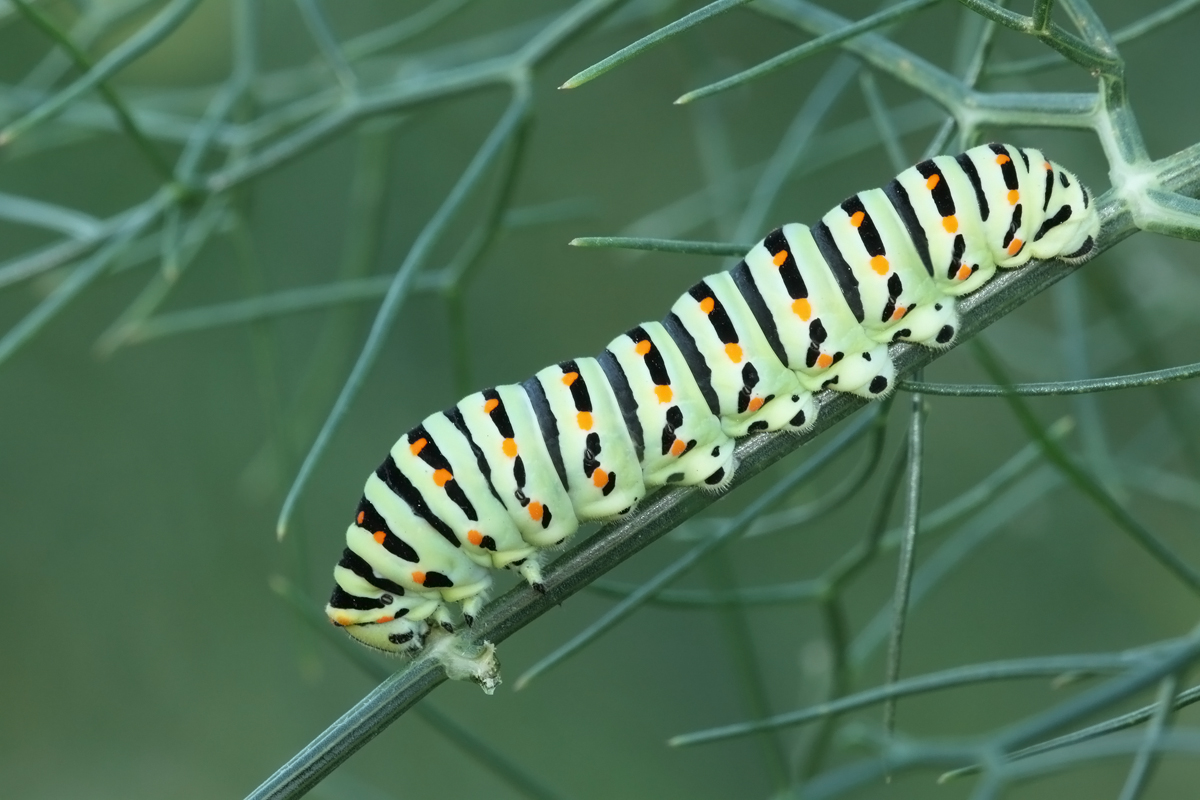
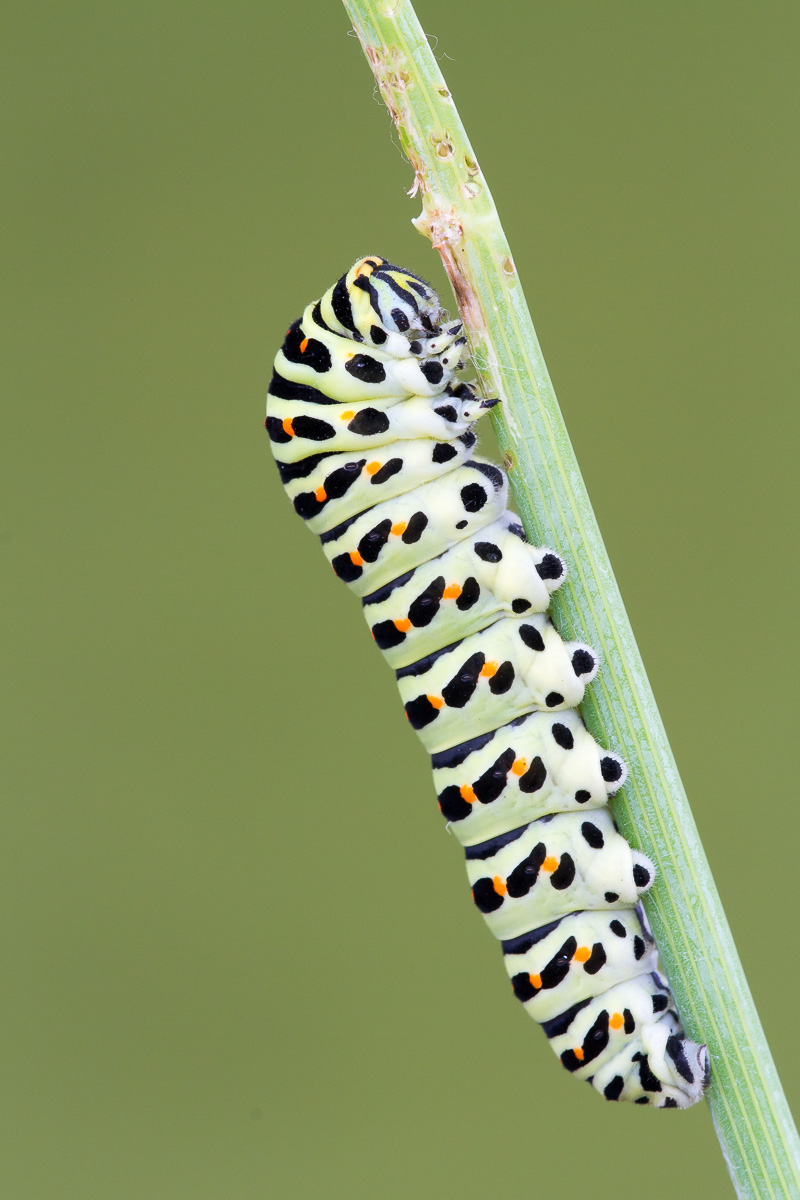
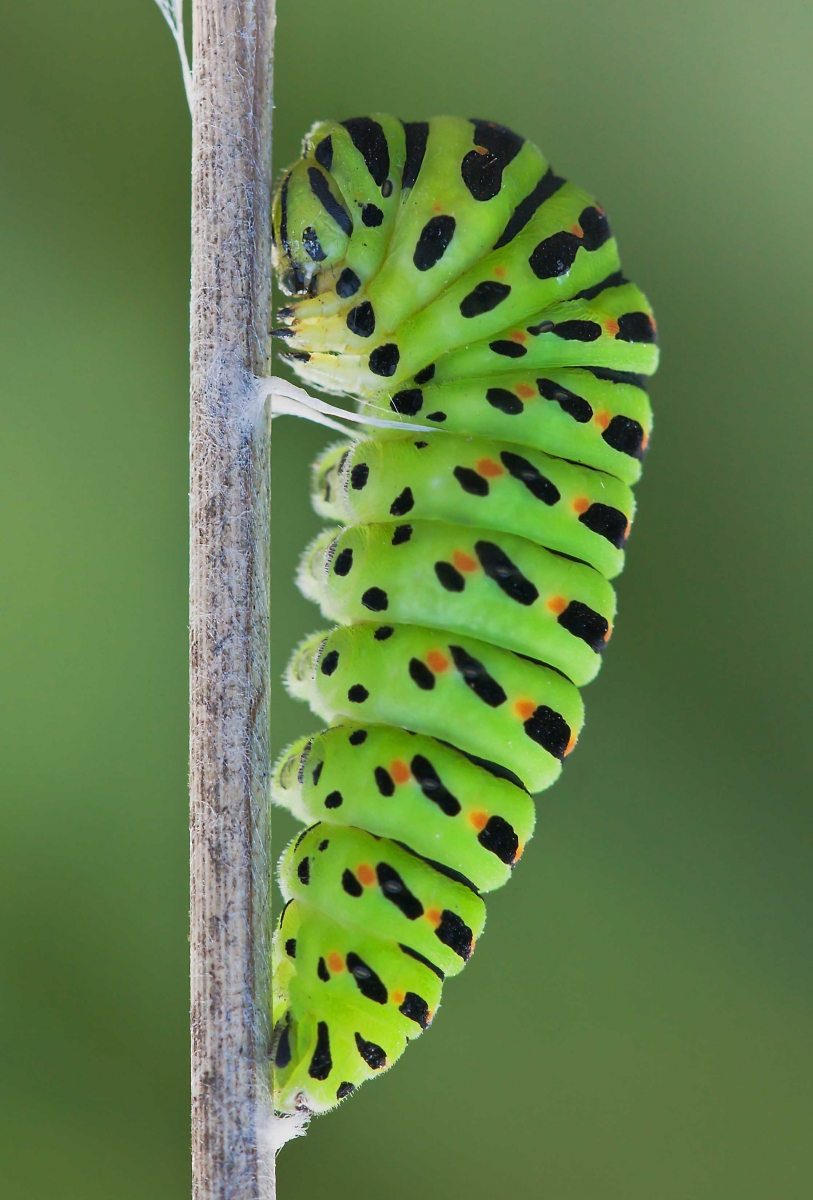
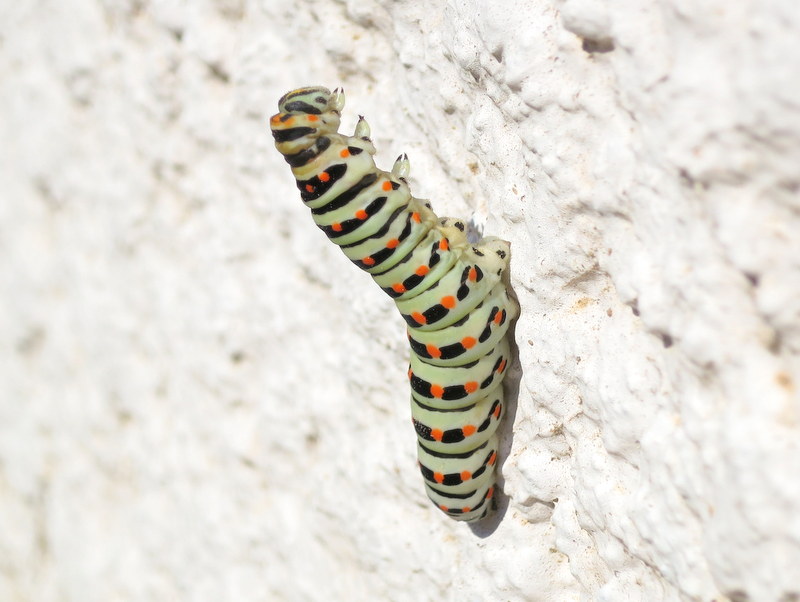
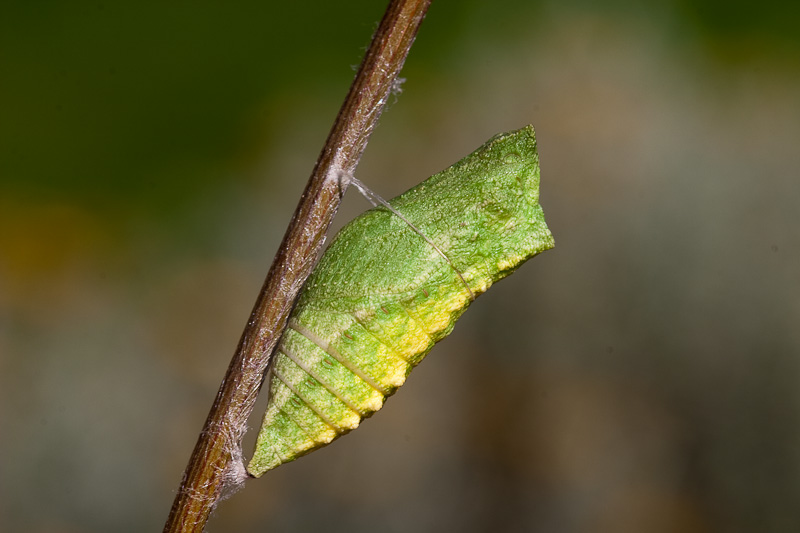
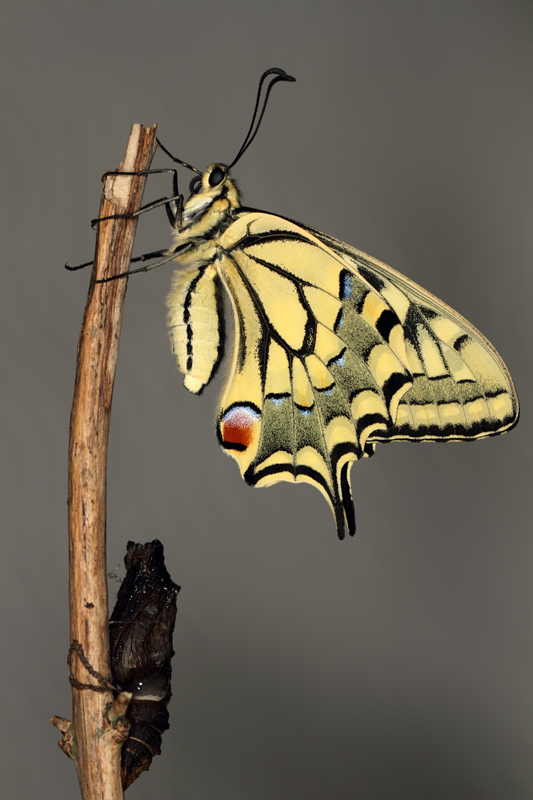
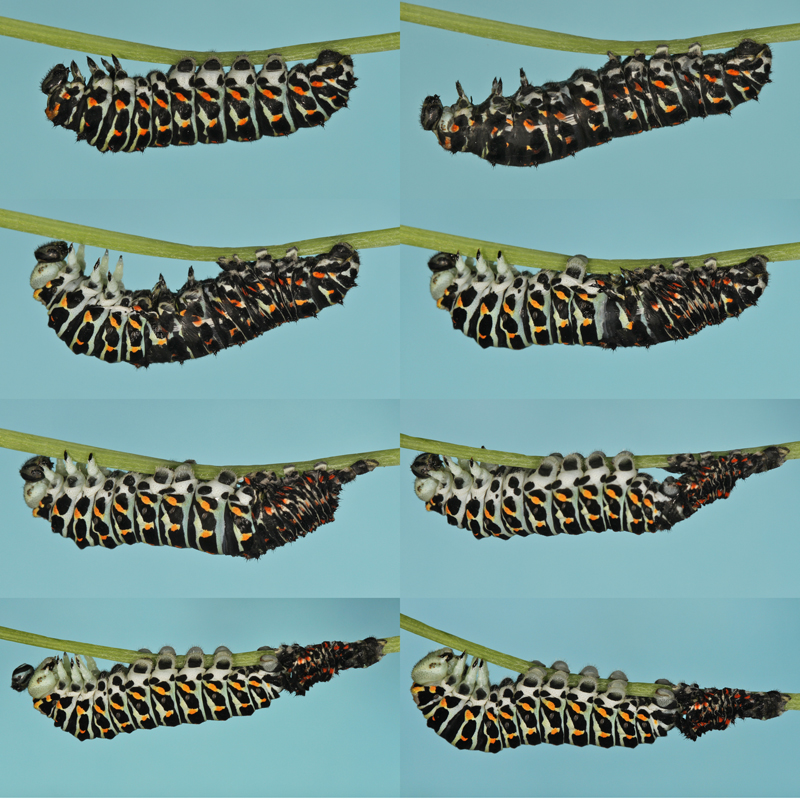
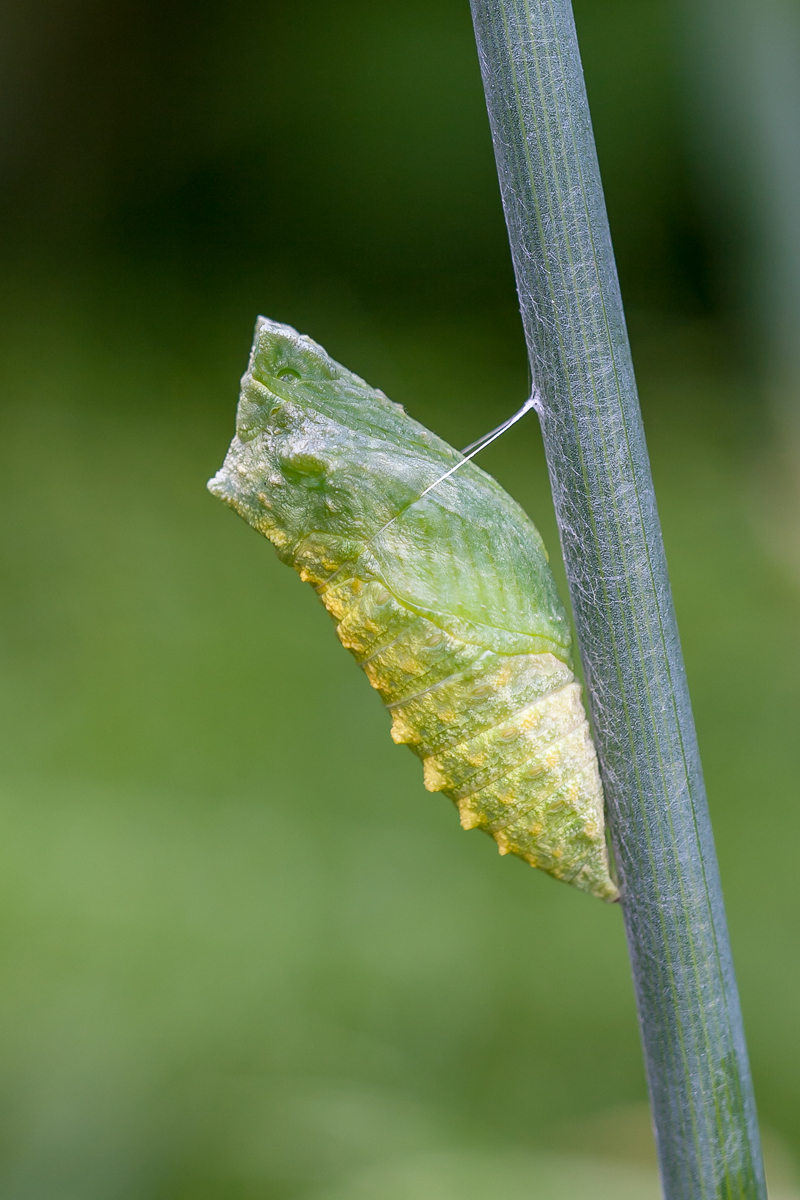
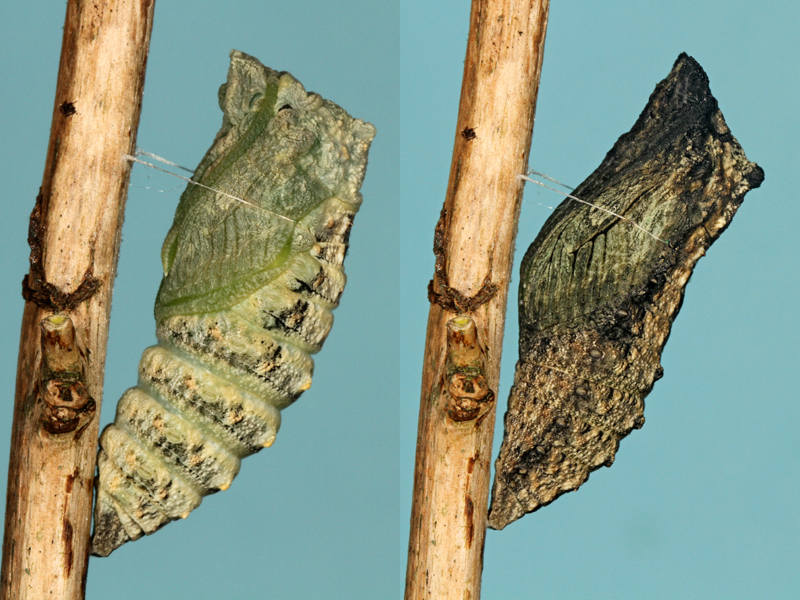
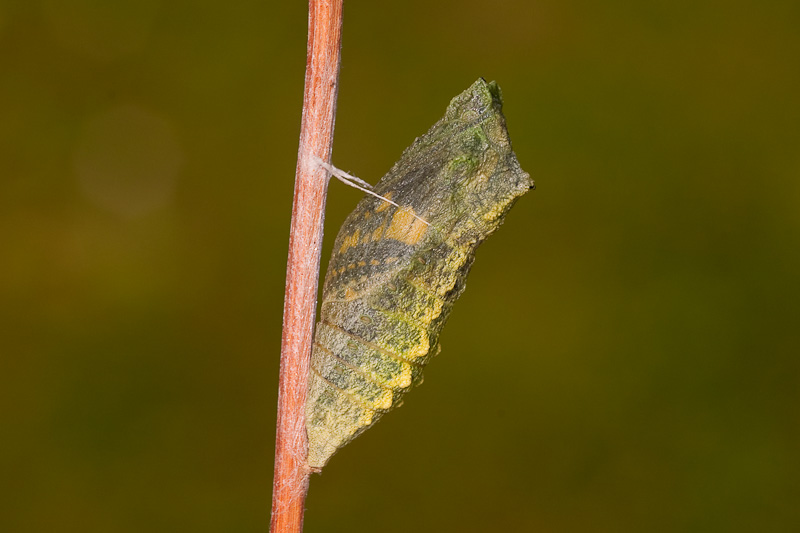
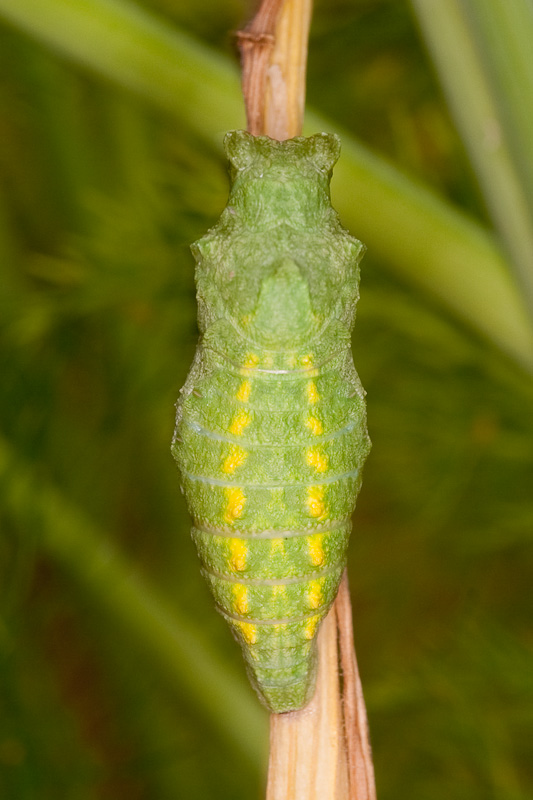
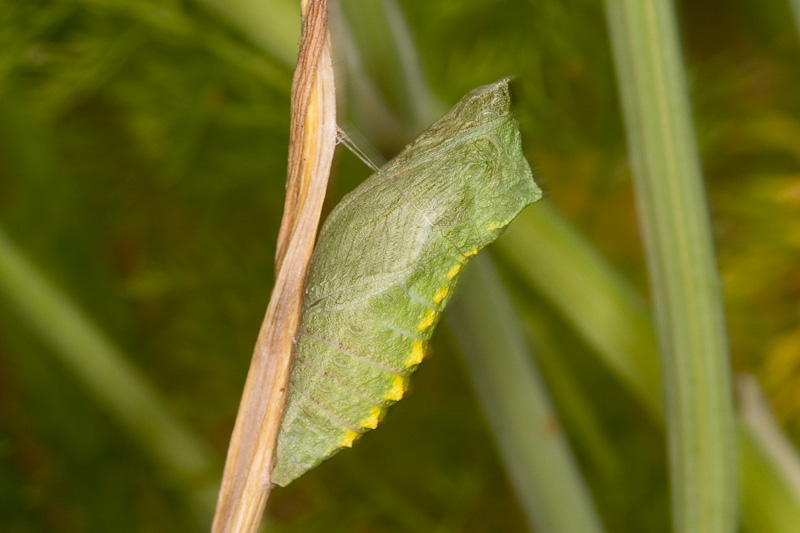
The fully-grown larva leaves its foodplant to pupate low down on any reed or woody stem within 10m from the foodplant. The pupa is attached upright to a plant stem by a silk girdle and the cremaster, and overwinters. Two main colour forms of the pupa exist, to blend into the surroundings as appropriate. One form is greenish-yellow, the other is brown with black markings.
"The pupa measures from 28.6 mm. to 31.8 mm. long. The head has two triangular diverging projections forming a central cleft; the meso-thorax has a dorsal conical point; the meta-thorax is sunken; the abdomen gently curves dorsally and attenuates to the anal segment, which is slightly bilobed, compressed and furnished with anchor-like hooks filling up the angle of the cremaster. The ventral surface of the abdomen and apical third of the wings form almost a straight line. This portion of the pupa rests on, or almost touches, the stem of the food plant upon which it is attached; the remaining ventral outline runs off at an angle, so that the anterior part of the pupa is much elevated. On the dorsal surface are two rows of blunt conical points, those on the meta-thorax are very small, a pair on each of the fourth, fifth and sixth segments about equal in size; those on the seventh segment are much smaller. On the remaining segments they are represented merely by a slight granular ridge. The base of the wing is angular and projecting. The entire surface is roughly granulated, resembling toad-skin. The colour of the pupa varies considerably. There are two distinct forms, both apparently equally common. One has the whole of the abdomen and dorsal surface of a more or less intense lemon-yellow, with the head and wings yellowish-green, and a yellowish-green spiracular stripe and fainter green longitudinal streaks on the ventral abdominal surface. Some are more heavily checkered and mottled with green over the dorsal surface, forming in some a longitudinal dorsal band; the spiracles are flesh coloured. Others have the ground colour varying from milk-white to pinky-buff, and are more or less variegated with brown and black, which covers the head and runs down the centre of the thorax and abdomen; the conical points are shining black, and a spiracular band extends from the black anal segment to the base of the wing, which is also broadly margined with black, which shades through brown into whitish towards the base; the discoidal cell and basal portion of the neuration is outlined with black, as are the limbs, antennae and spiracles. The pupa is firmly attached to a stem or other suitable support (in a wild state it is found on the stems of sedges and other fen plants) by the black cremastral hooks and a silk cincture round the waist." - Frohawk (1924)


The following links provide additional information on this butterfly.