UK Butterflies
Building a Community of Responsible Butterfly Enthusiasts in Britain & Ireland
Building a Community of Responsible Butterfly Enthusiasts in Britain & Ireland
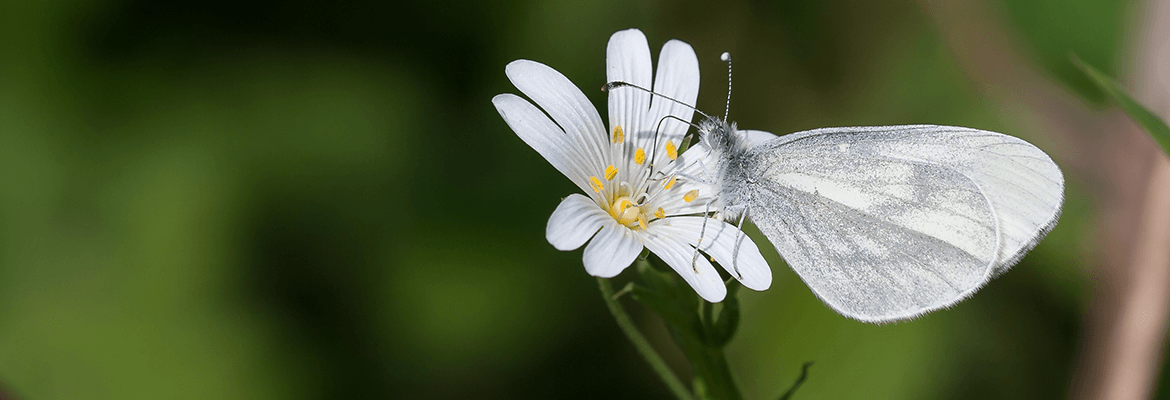
Wingspan
42 mm
Checklist Number
58.001
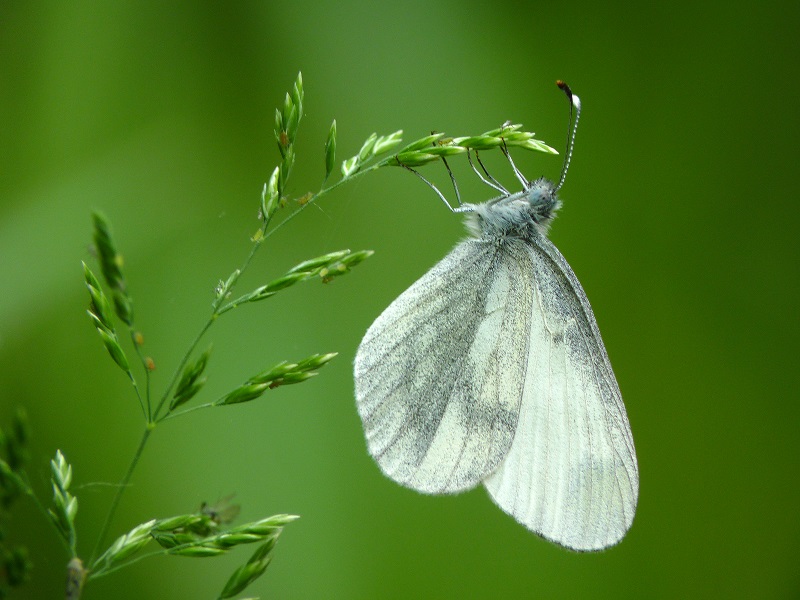
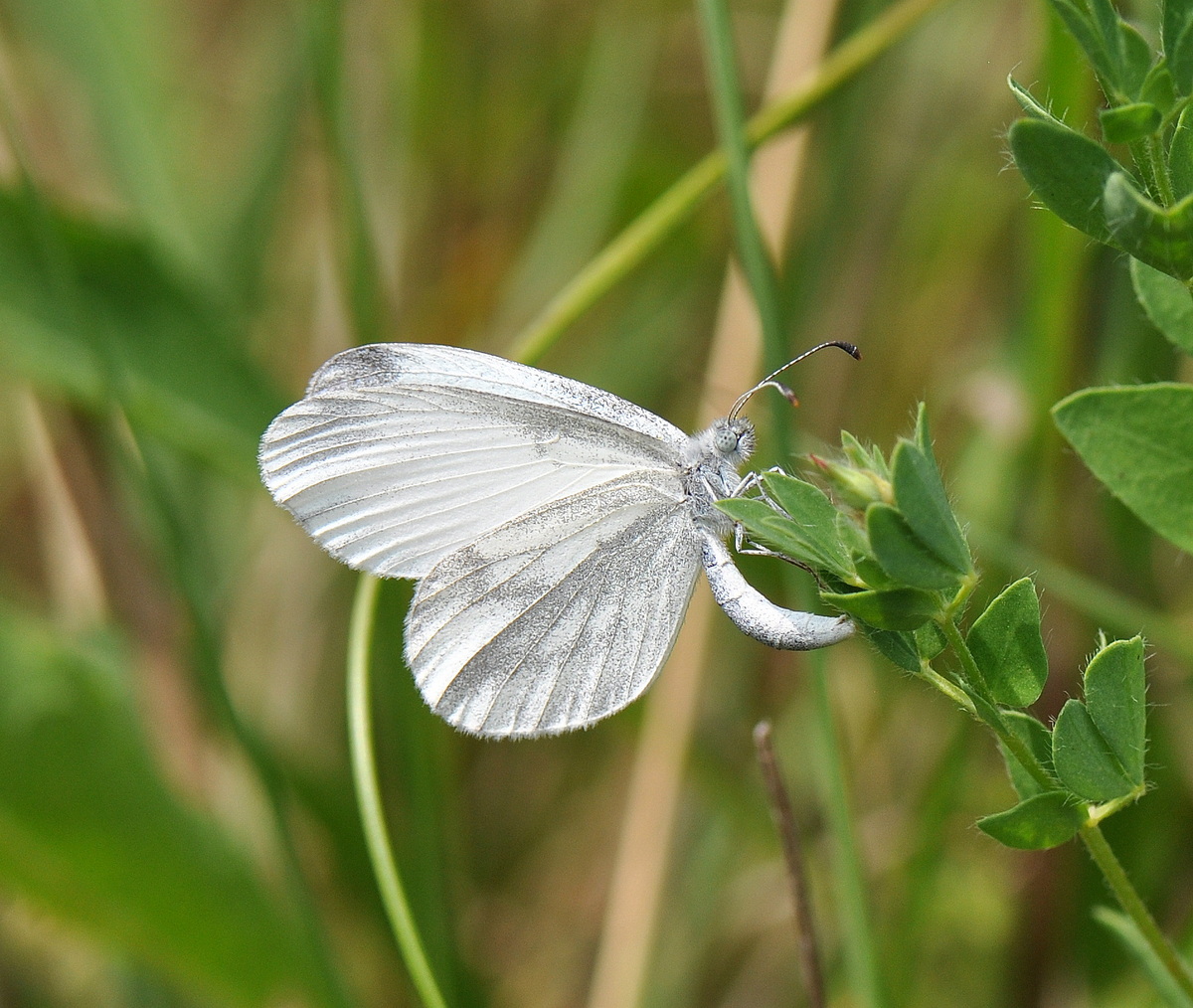
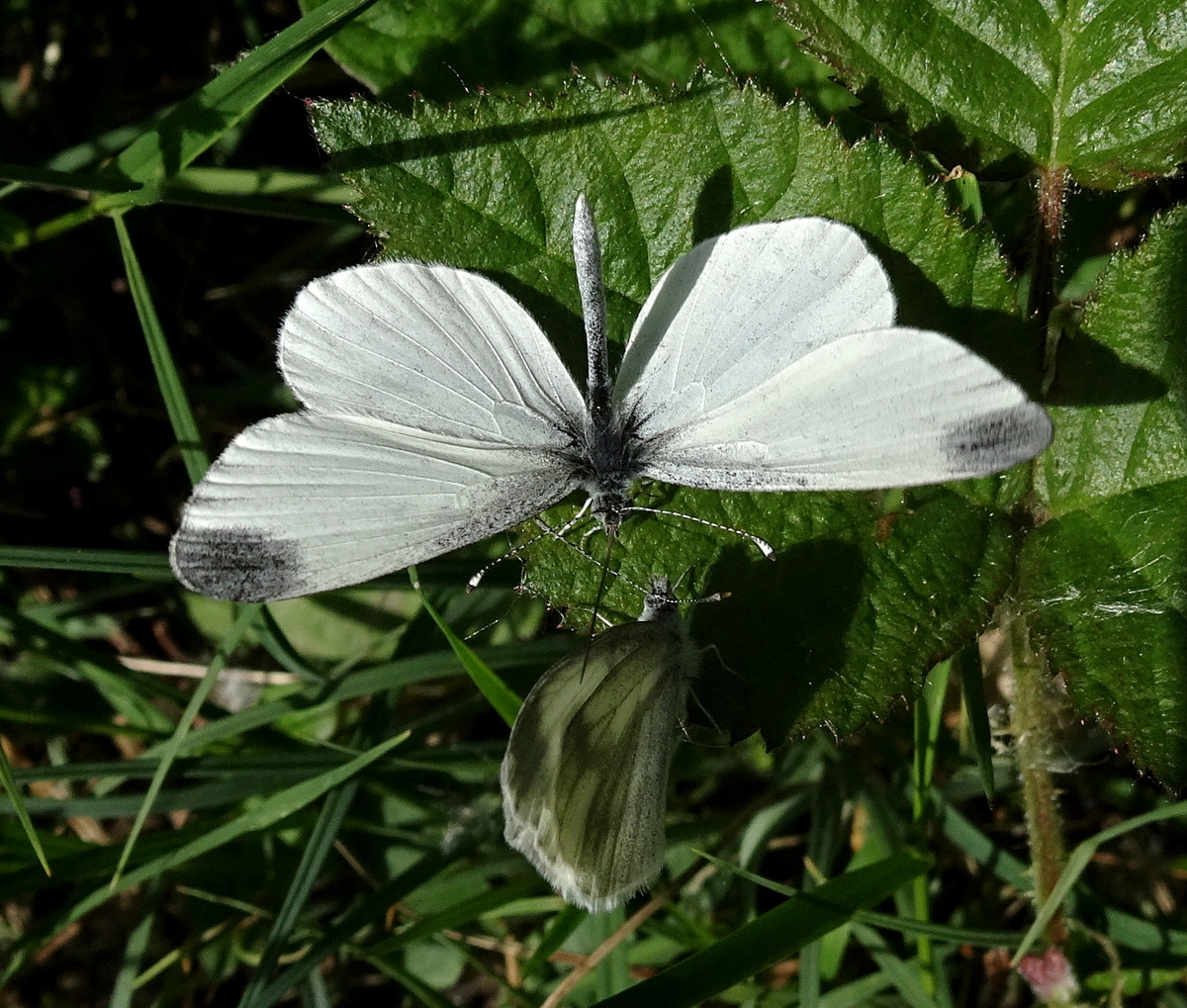
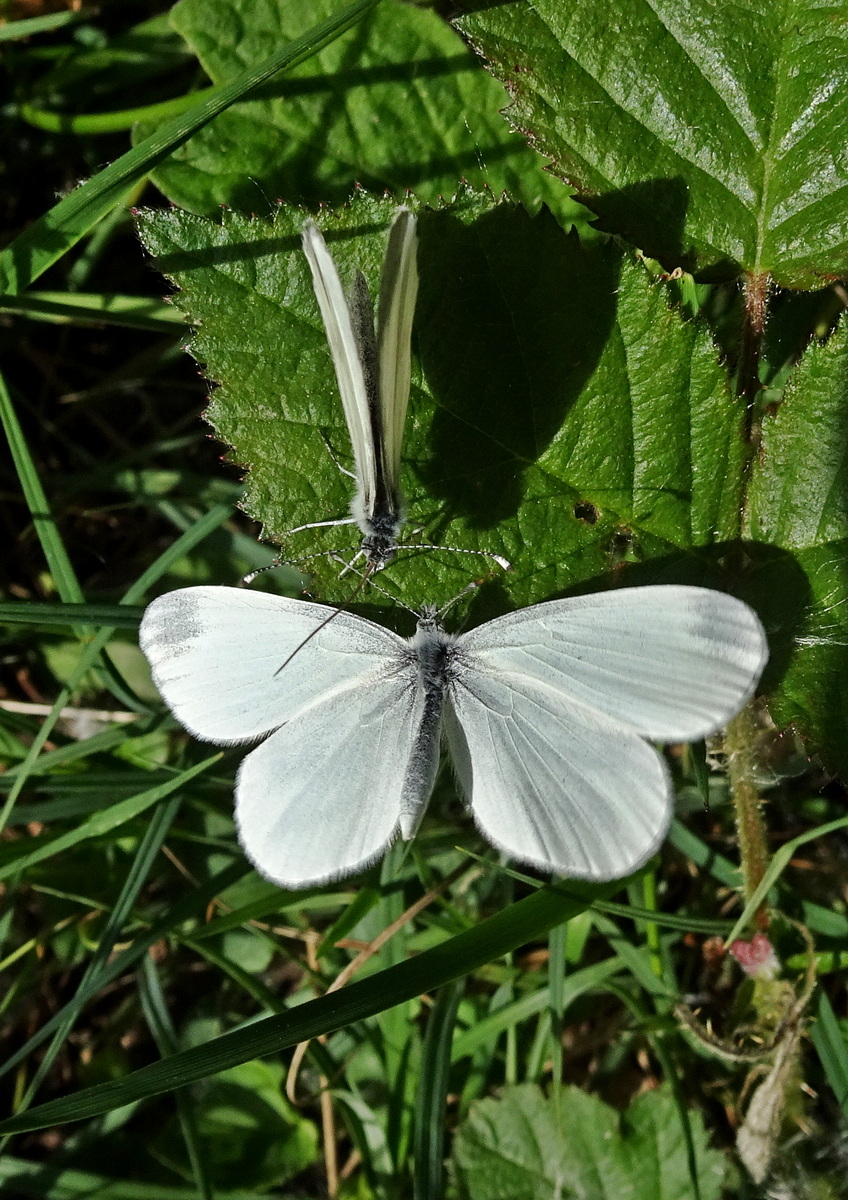
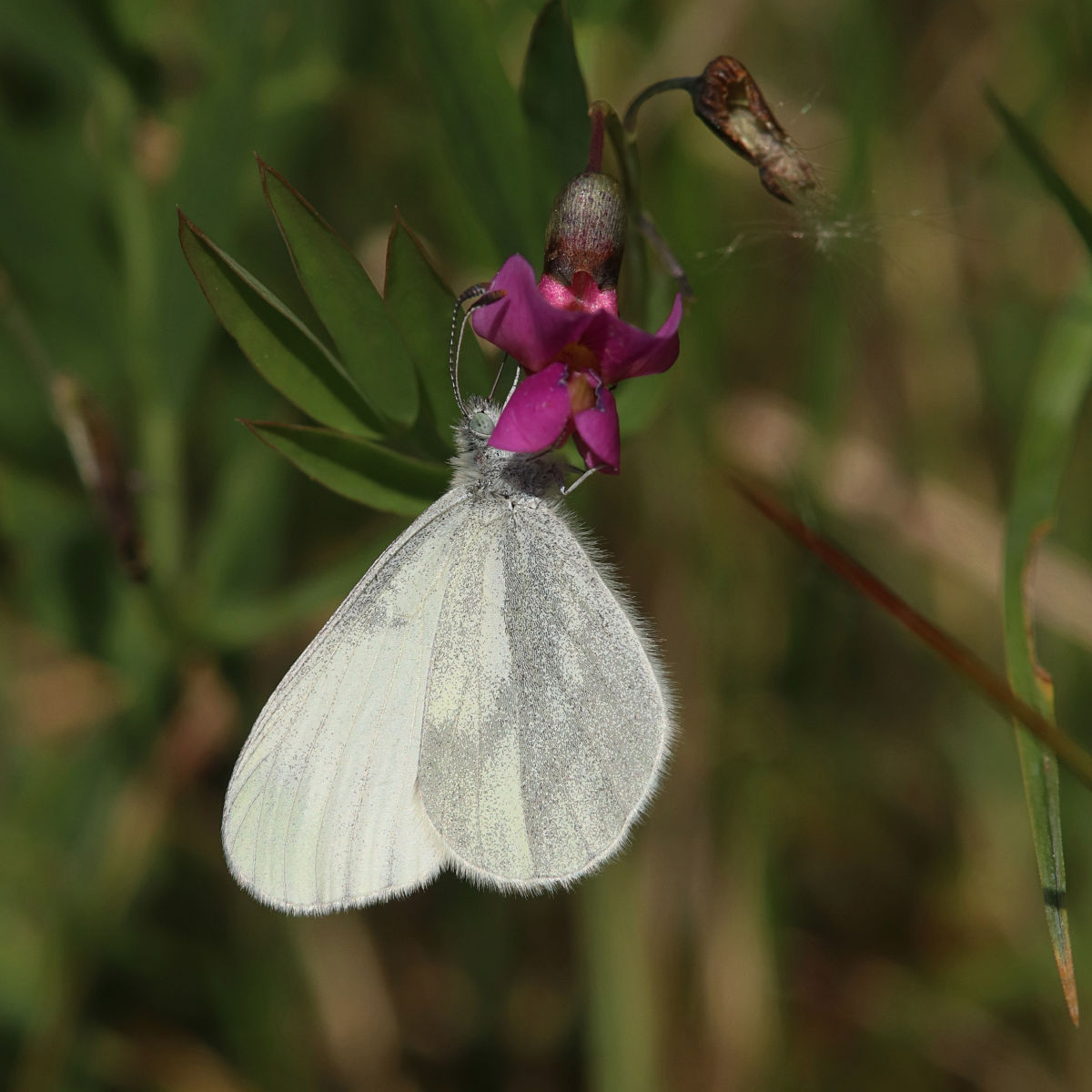
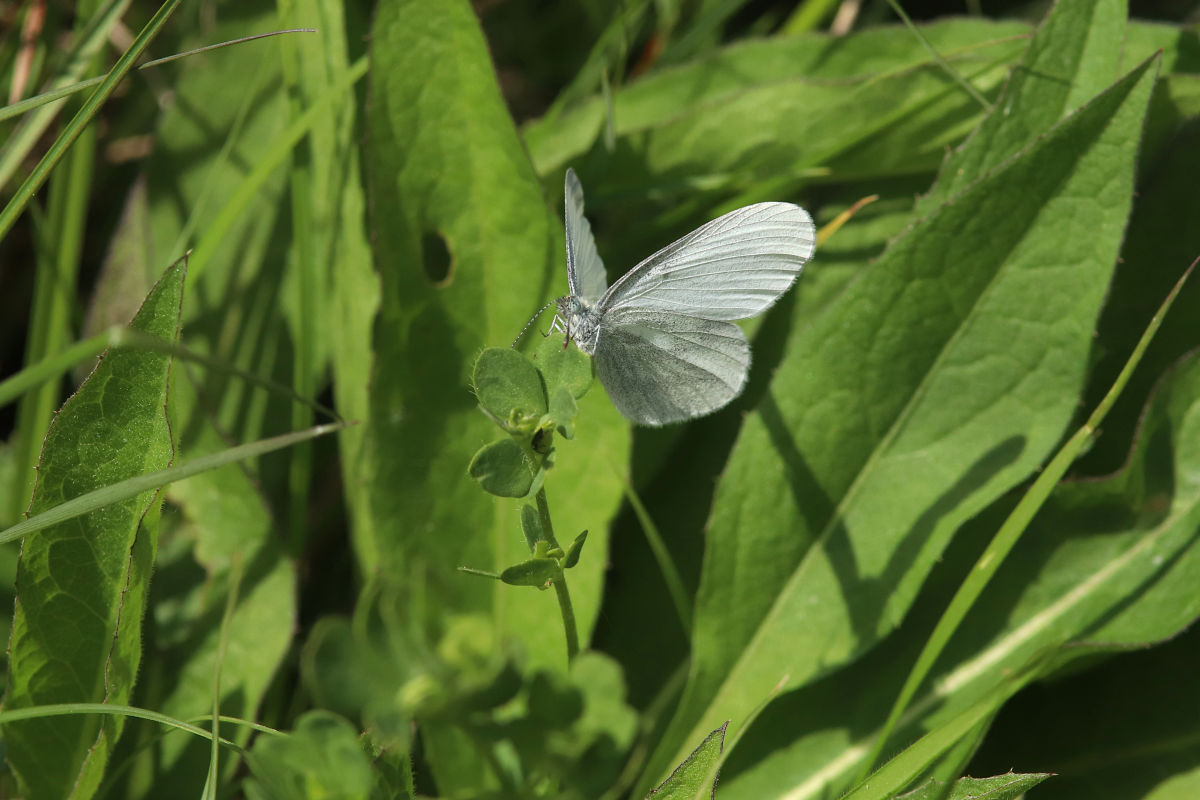
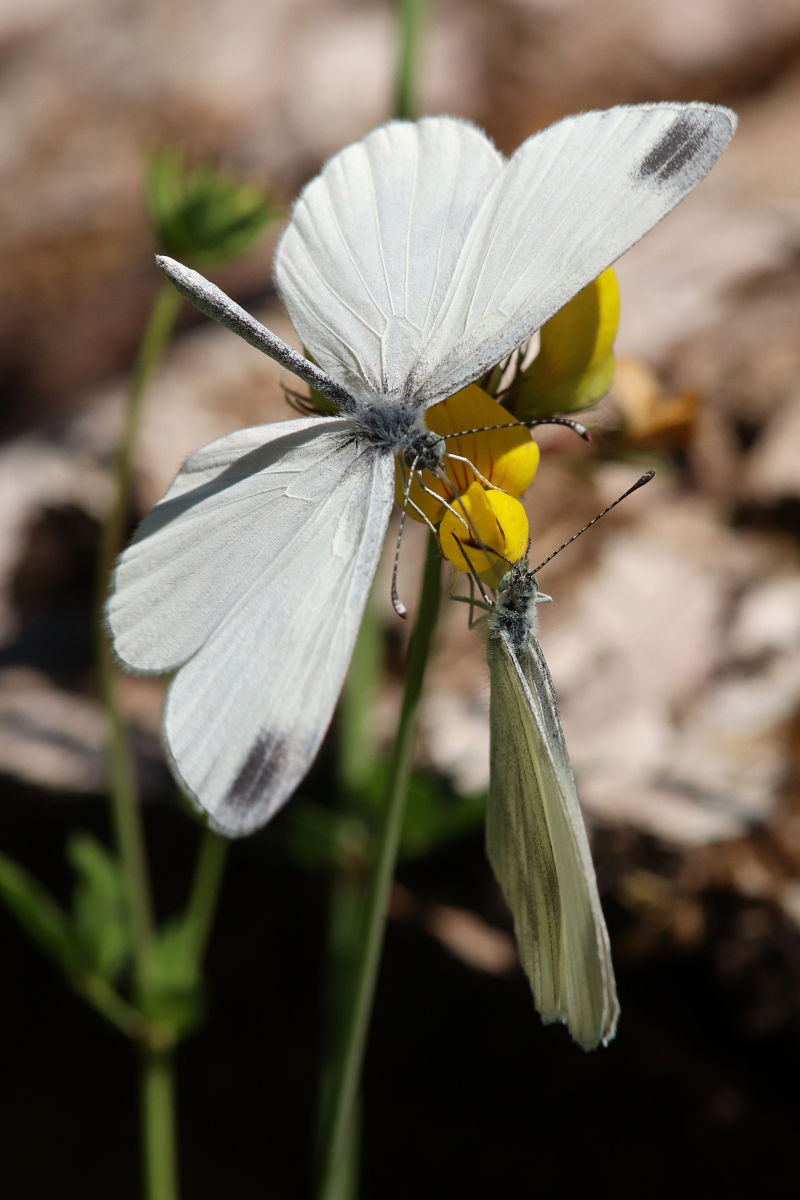
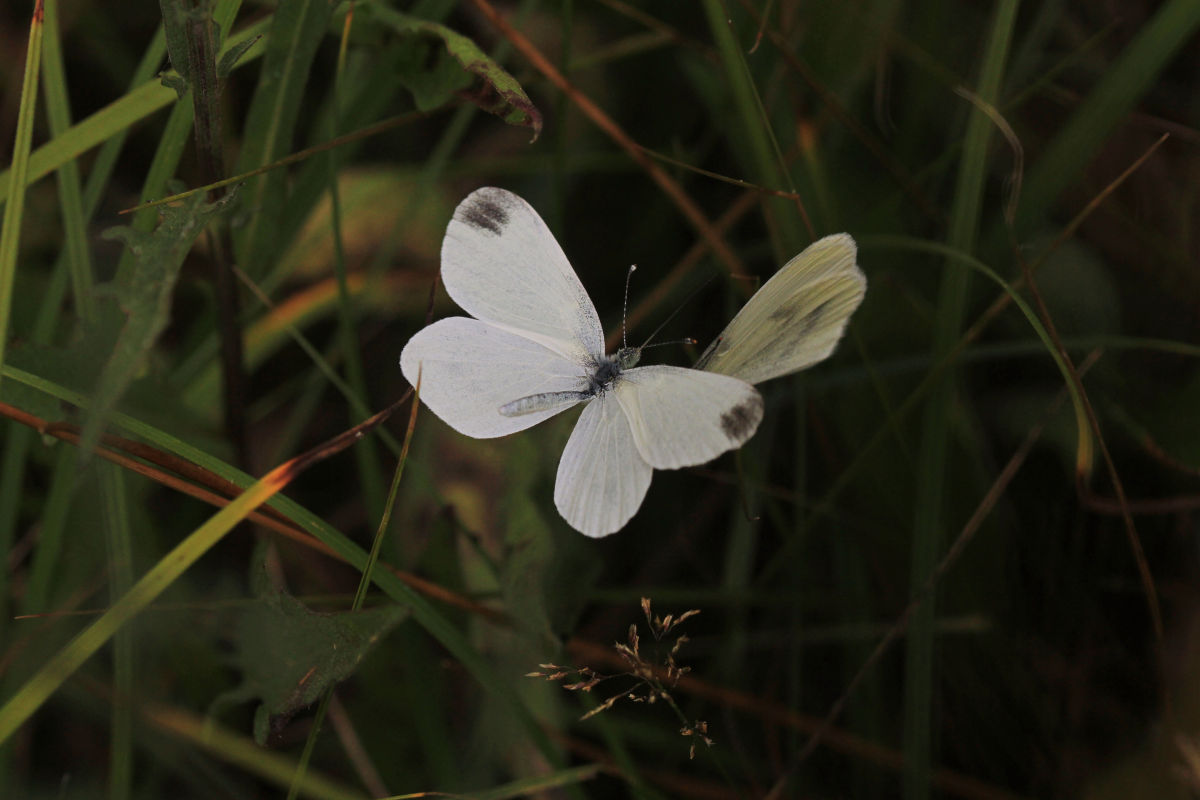
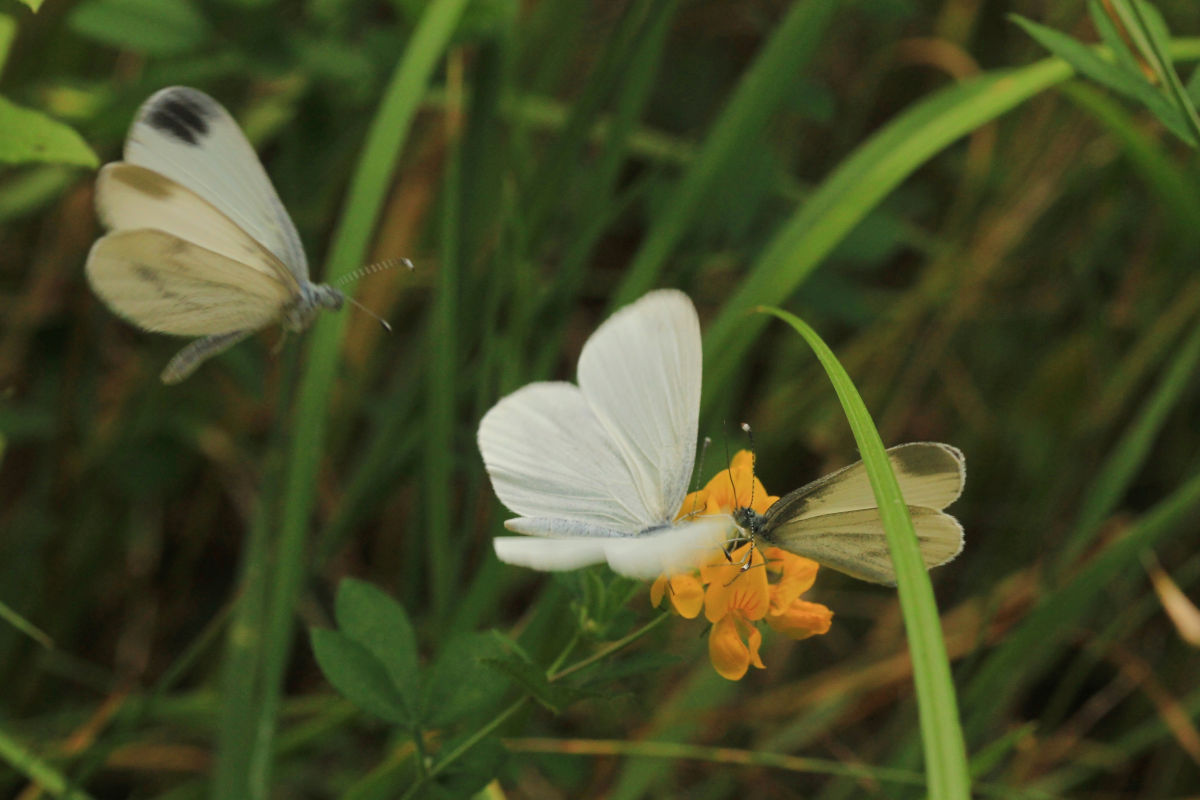
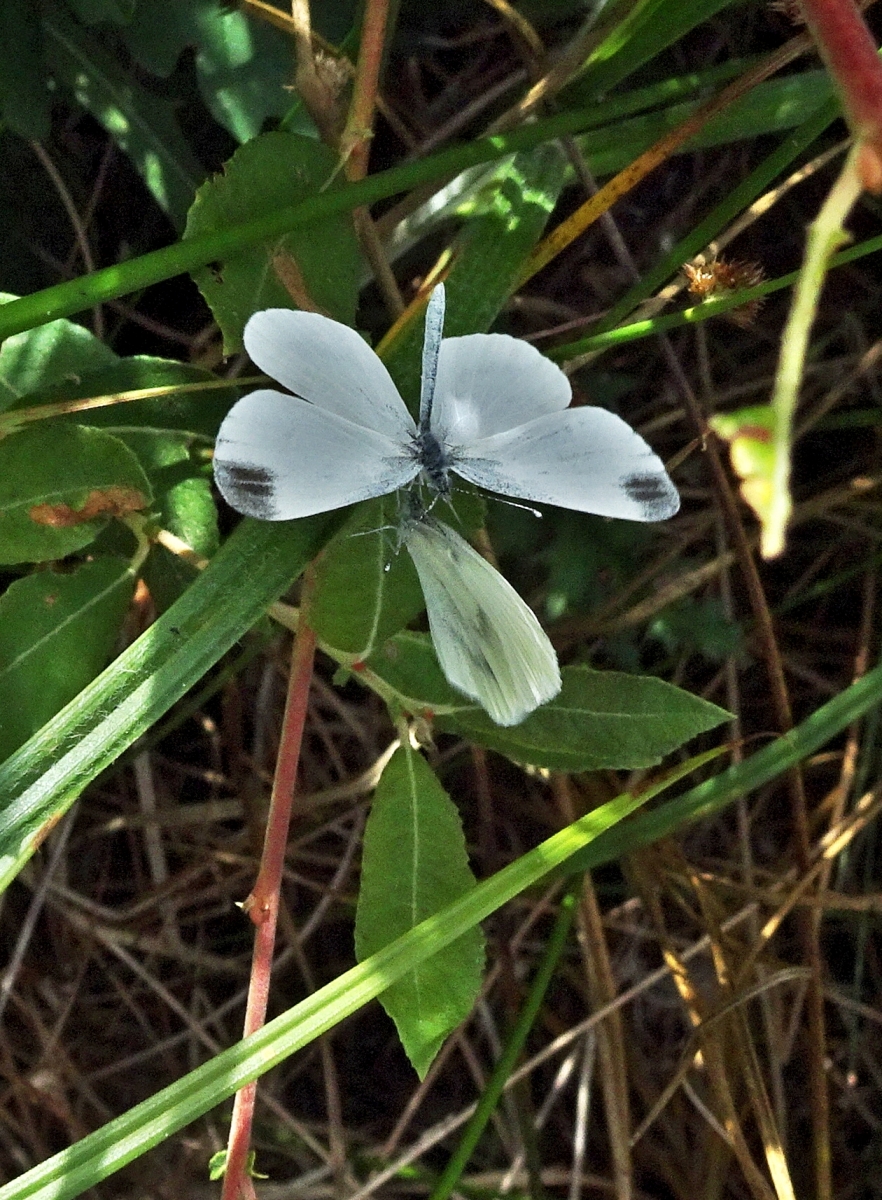
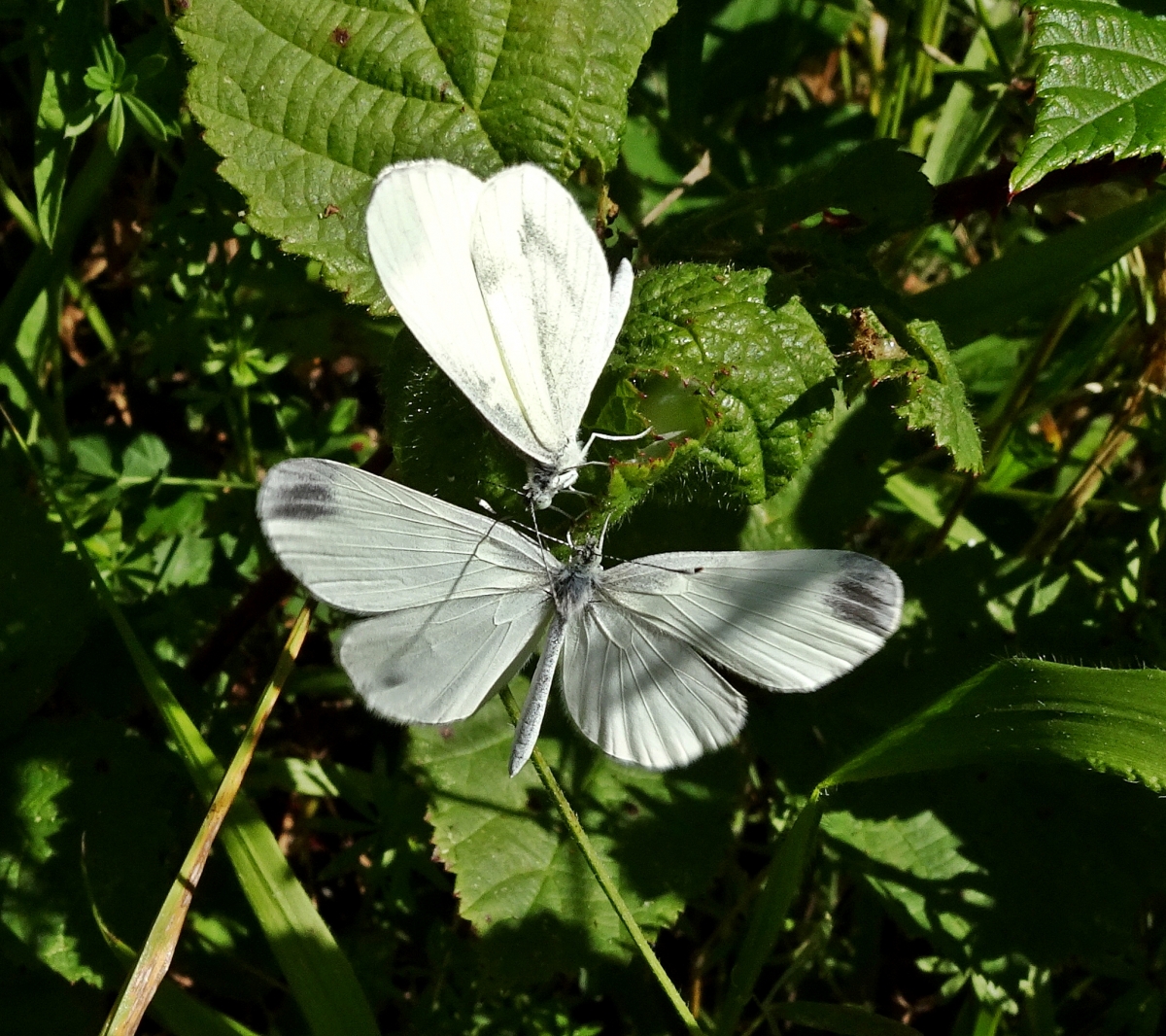
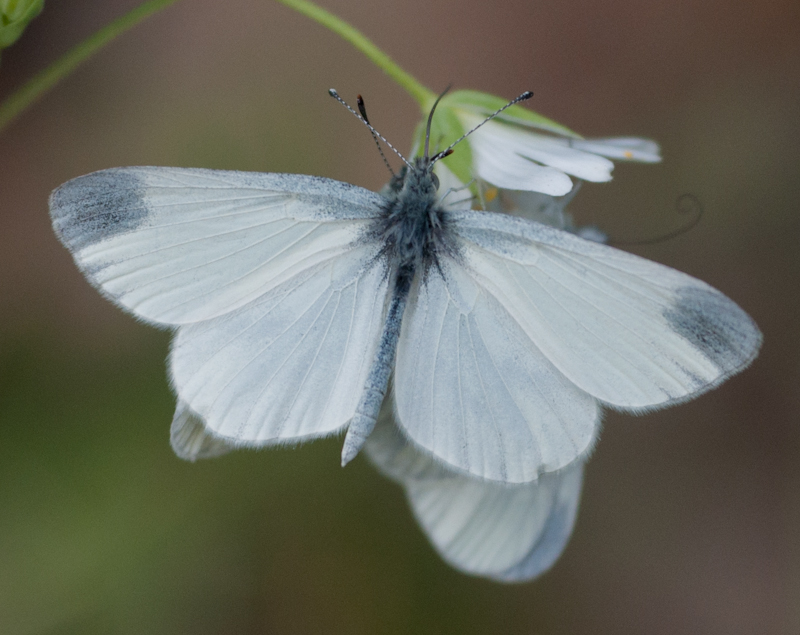
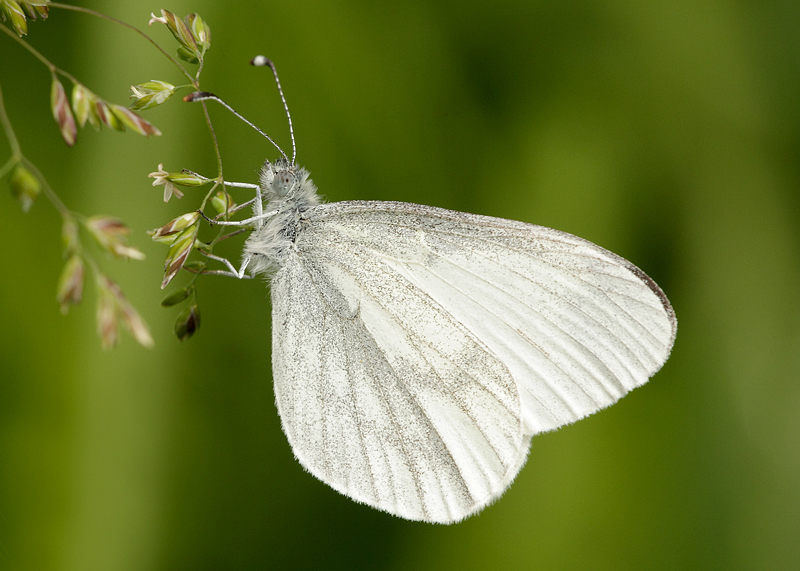
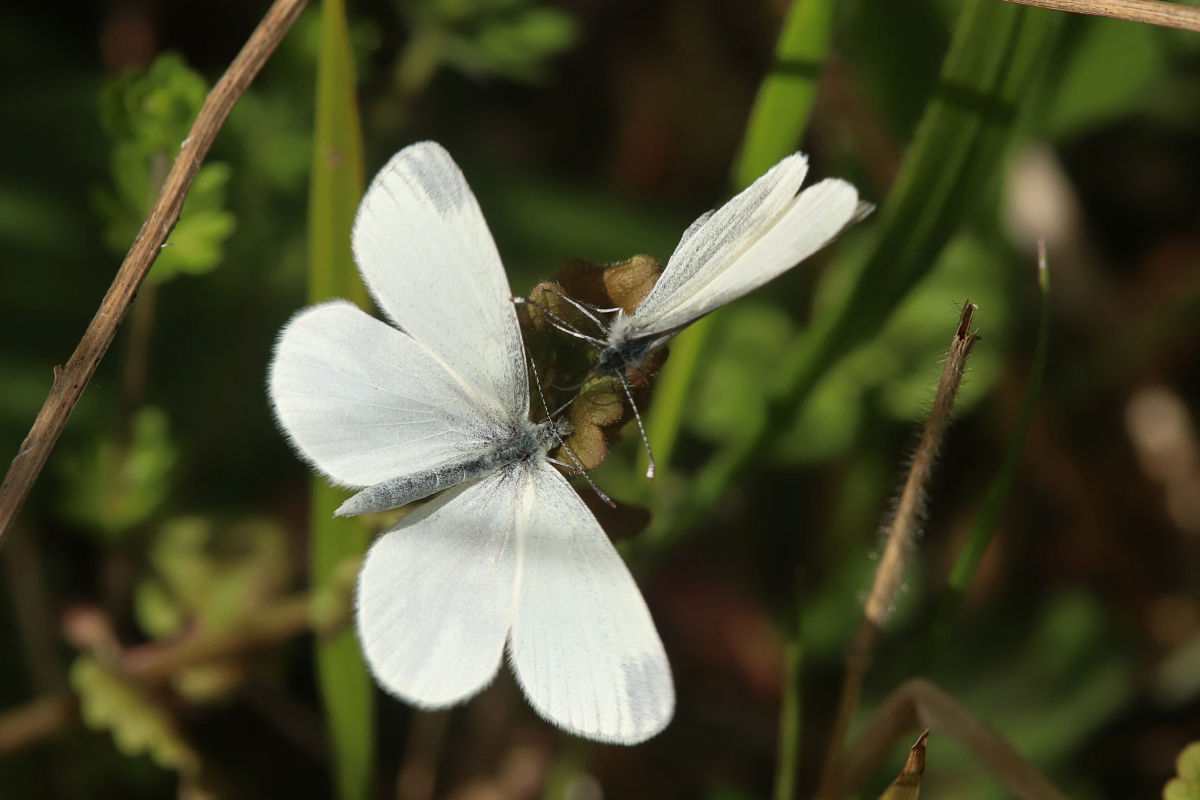
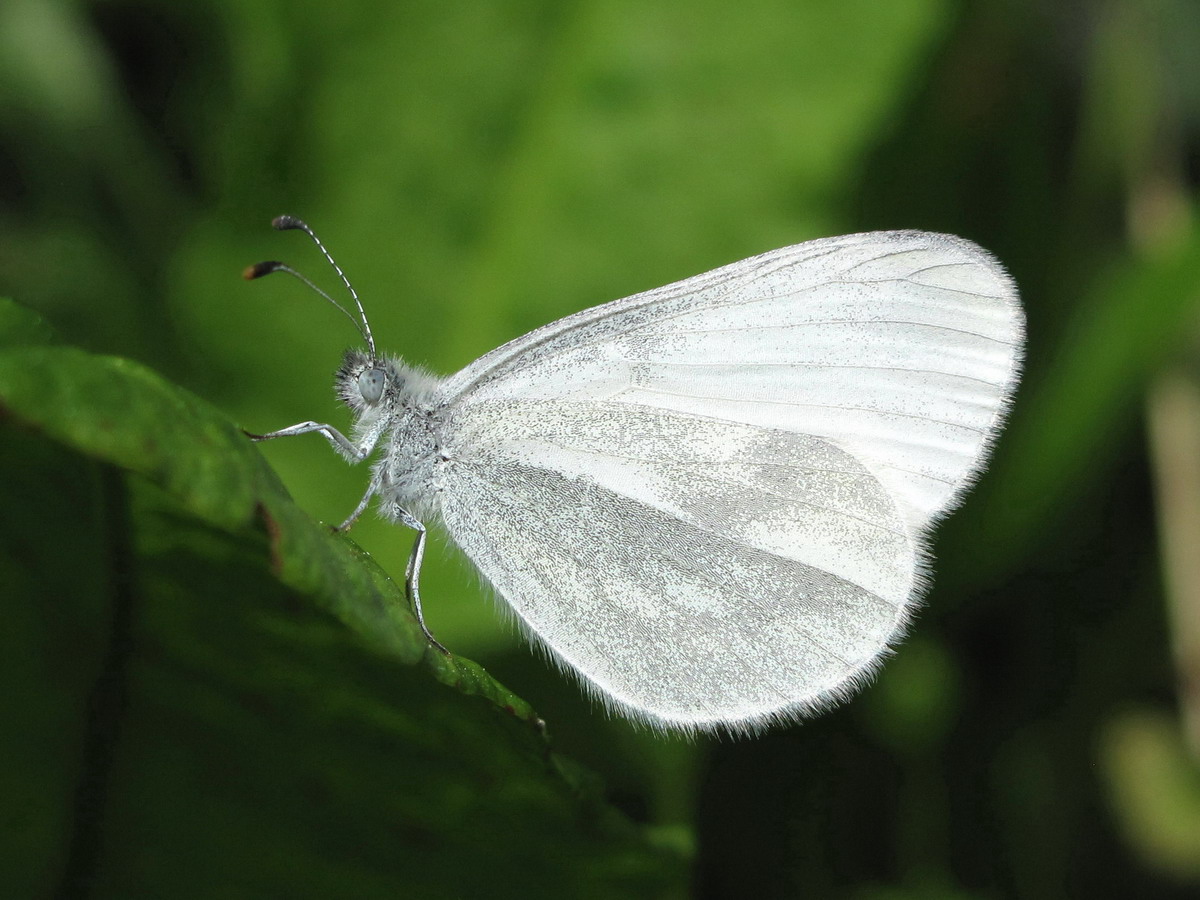
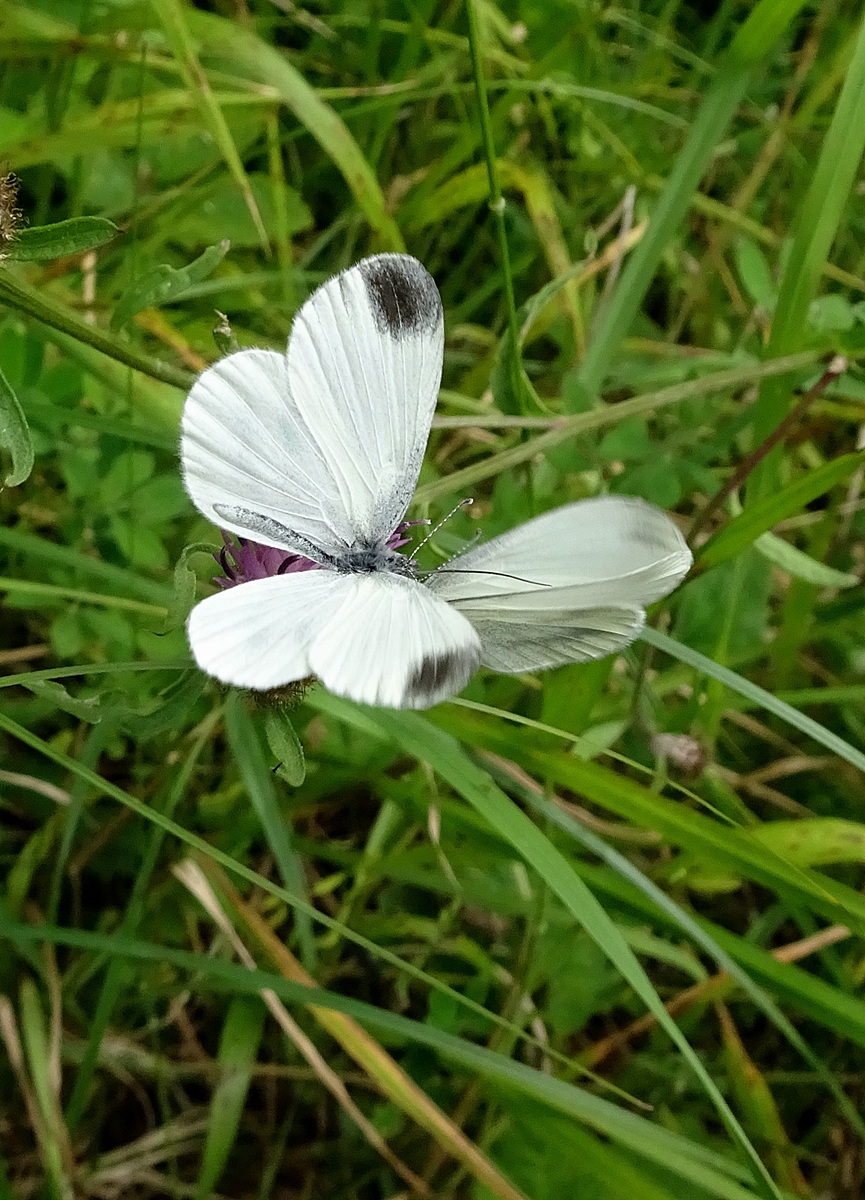
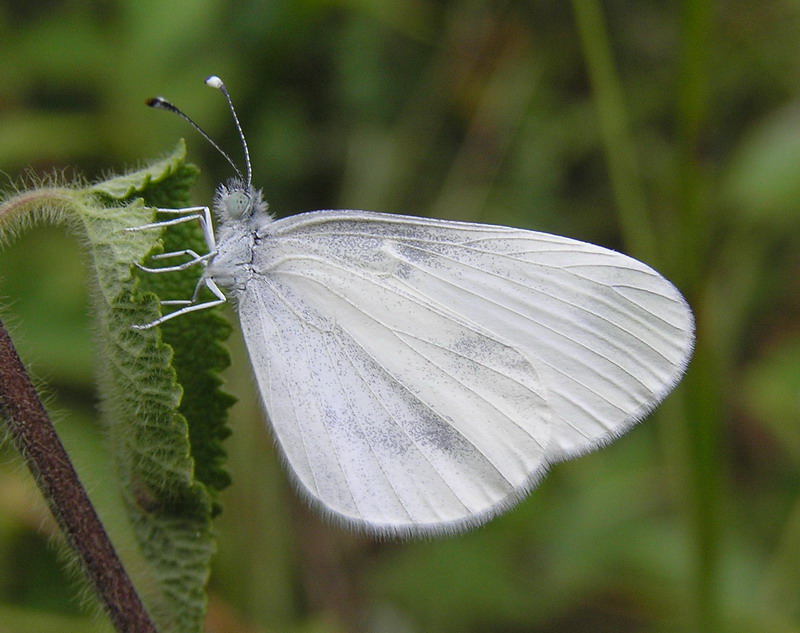
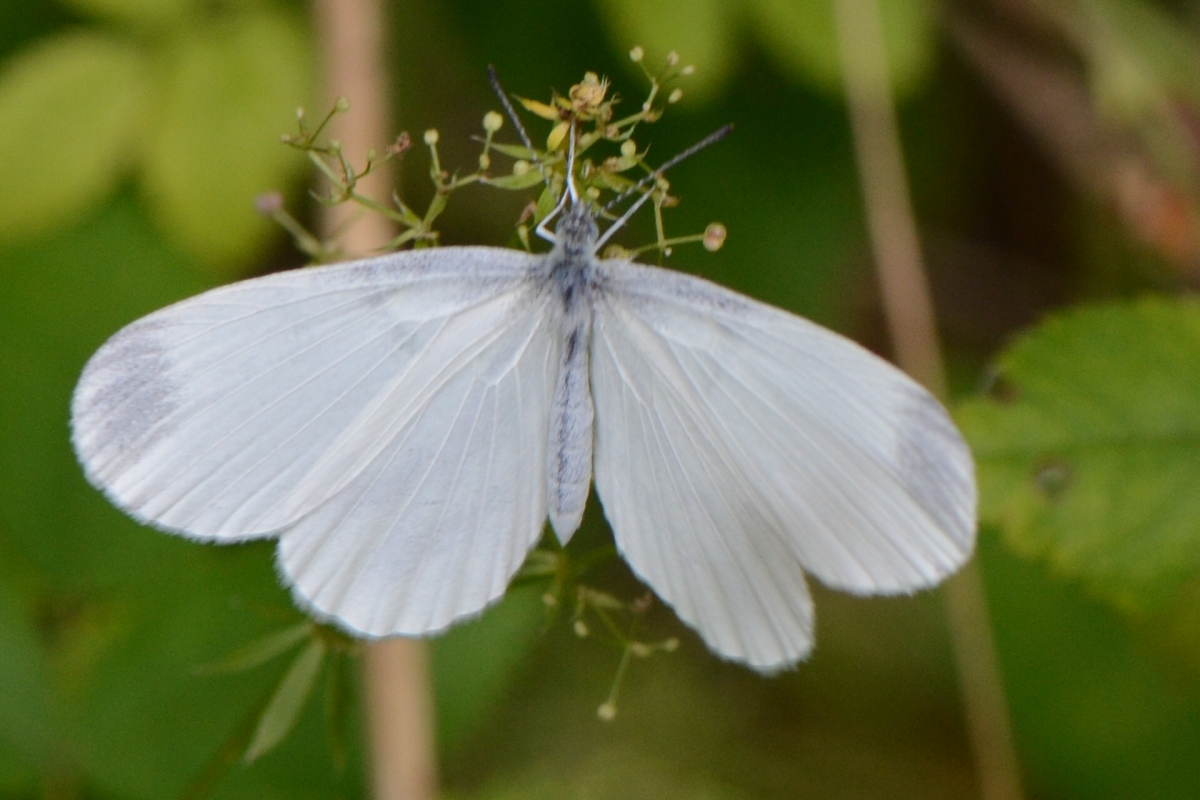
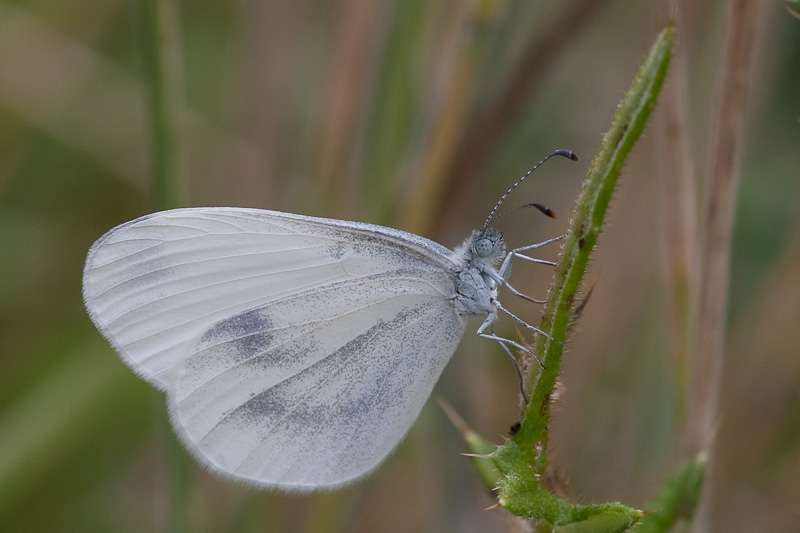
The Wood White is one of our daintiest butterflies with one of the slowest and delicate flights of all the British butterflies. When at rest, the rounded tips of the forewings provide one of the main distinguishing features between this butterfly and other "whites". Adults always rest with their wings closed. In flight, the male can be distinguished from the female by a black spot at the tip of the forewings that is greatly reduced in the female. This butterfly lives discrete colonies and was only recently separated from the visibly-identical Cryptic Wood White. This local species can be found in central and southern England and also in Ireland on the limestone pavements of Clare and South-east Galway. This species is absent from Scotland, the Isle of Man and the Channel Islands.
This species was first defined in Linnaeus (1758) as shown here (type locality: Sweden).
Males of the summer brood have darker wing spots than those of the spring brood, whose spots are greyer in colour. Females of the summer brood are slightly smaller than those of the spring brood.
| Family: | Pieridae | Swainson, 1820 |
| Subfamily: | Dismorphiinae | Schatz, 1887 |
| Tribe: | Leptideini | Verity, 1947 |
| Genus: | Leptidea | Billberg, 1820 |
| Subgenus: | ||
| Species: | sinapis | (Linnaeus, 1758) |
Description to be completed.
The distribution data (2000-2009) has been made available through the generosity of Butterfly Conservation and any subspecies distribution is taken from Riley (2007). Click here to see the distribution of this species together with site information overlaid.
As its name implies, this species is found in woodland rides and margins. However, colonies in the south west of its range can be found in more-open areas such as disused railway cuttings and meadows. Suitable habitat is characterised as being warm, sheltered and damp, where both larval foodplants and nectar sources are in abundance. Foodplants include various vetches and trefoils. Nectar sources include a variety of flowers, favourites being Bramble, Bugle, Ragged Robin and Birds-foot Trefoil. In hot weather, males can also be found taking mineral salts from puddles.
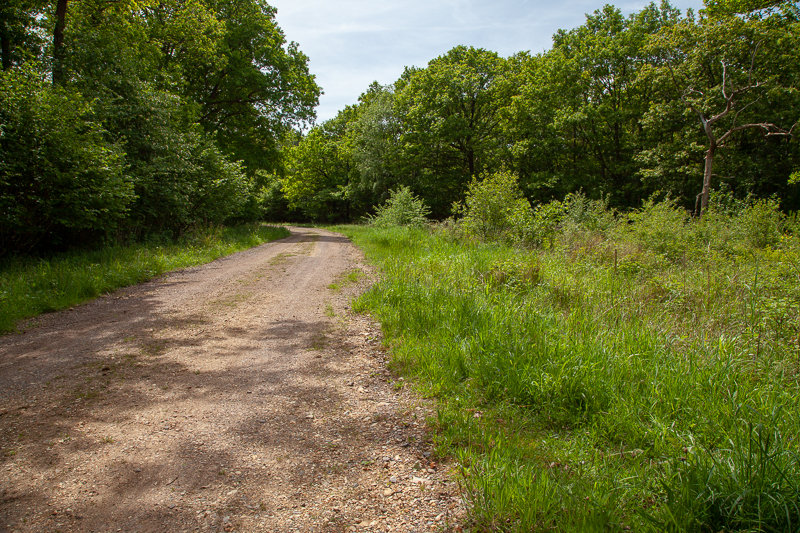
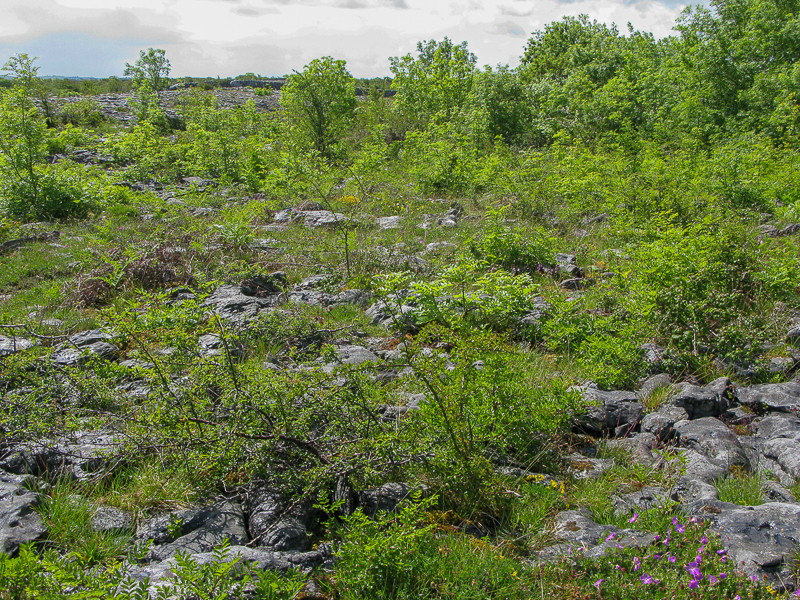
Despite relatively short-term increases, the long-term view is that this butterfly is in decline and is therefore a priority species for conservation efforts. This butterfly has suffered due to a change in woodland management and, in particular, the reduction in coppicing that allows new woodland clearings to develop that provides the conditions suitable for this species. Even improvements in habitat management will not guarantee that the species will reappear from areas where it has been lost, since it is not a very mobile species and may not, therefore, be able to recolonise naturally.
The table below shows the occurrence (distribution) and abundance (population) trends, using information from The State of the UK's Butterflies 2015 (Fox, 2015). Any UK BAP status is taken from the UK Biodiversity Action Plan (UK BAP) (2007 review).
1976-2014 (%) | 1976-2014 (%) | 2005-2014 (%) | 2005-2014 (%) | Click here to access the Biodiversity Action Plan (BAP). |  -89 -89 | -88 |  -25 -25 | -18 |
|---|
The English colonies emerge in early May and fly until the end of June. In Ireland, the emergence starts a little later in late May and the adults fly until the middle of July. Some sites, especially those in Surrey and Sussex, typically experience a 2nd brood and this can be more substantial than the 1st brood in good years.

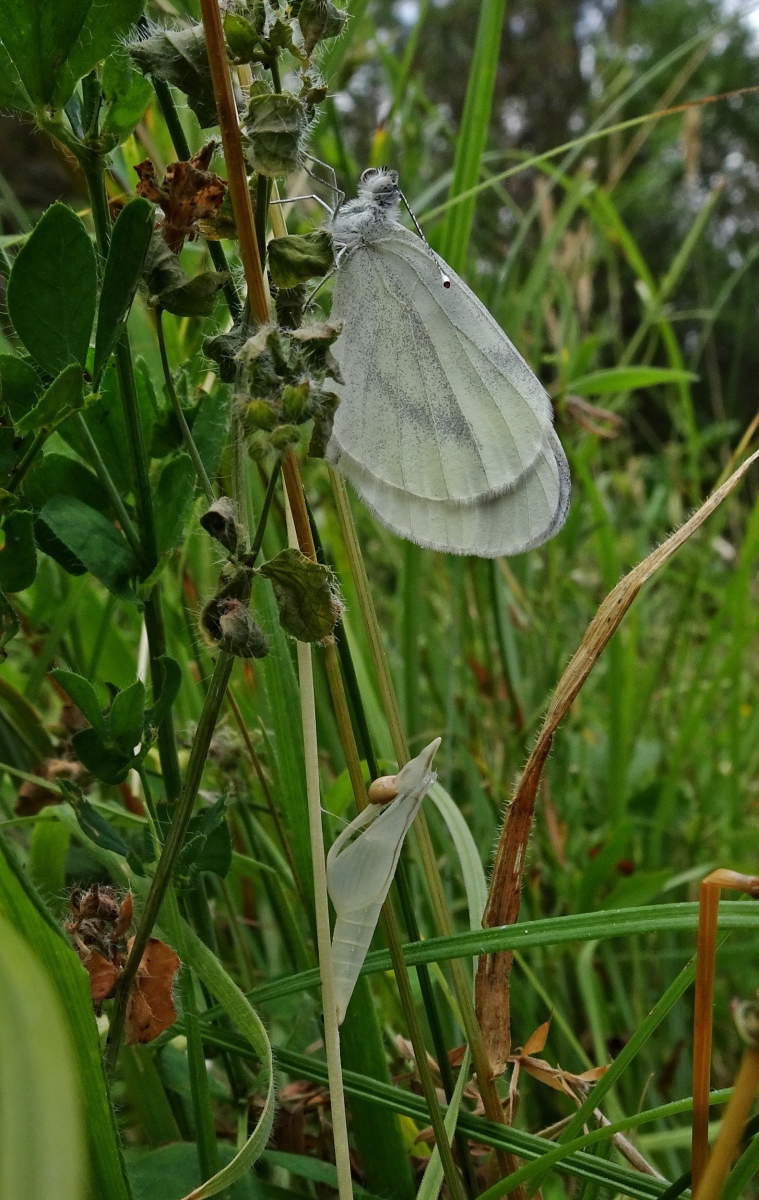
Males are the more active of the two sexes and can be found patrolling for females, rarely stopping to rest or feed, especially in sunny weather. On dull days, the butterfly will rest on the underside of a leaf with its wings closed and, when disturbed, the butterfly will fly into thick undergrowth.
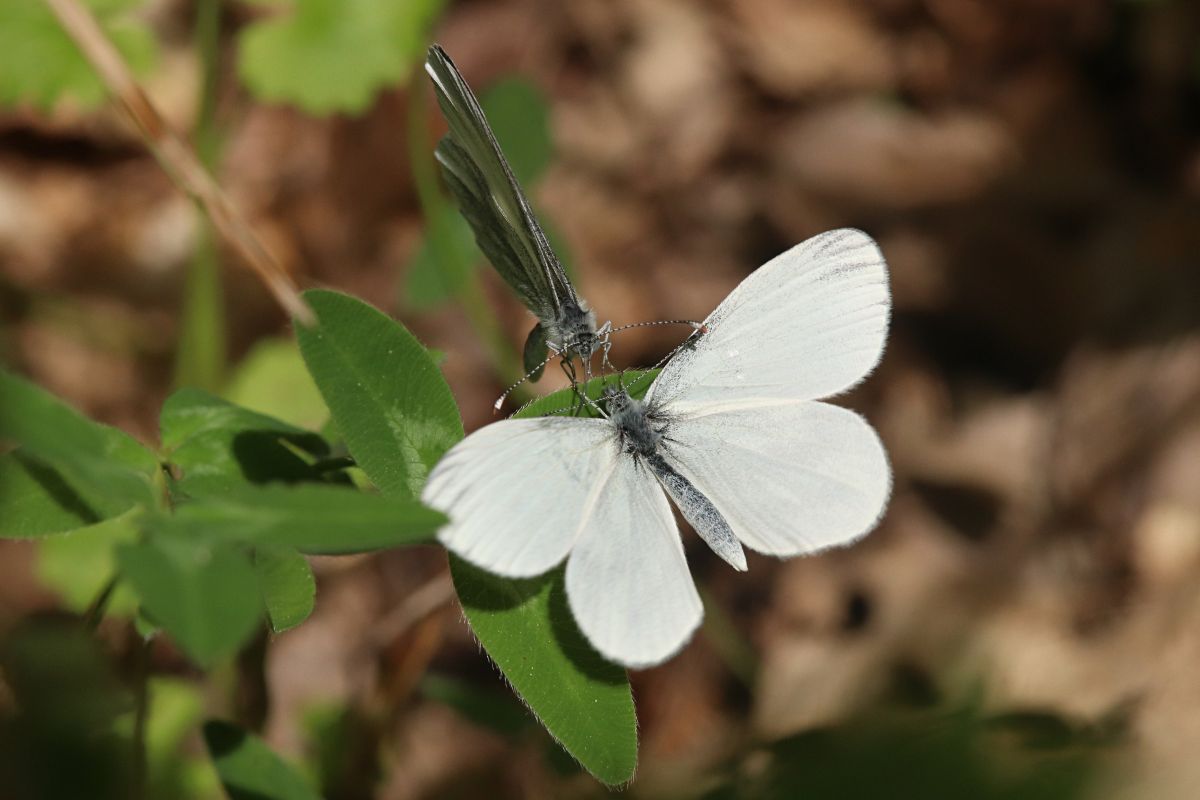
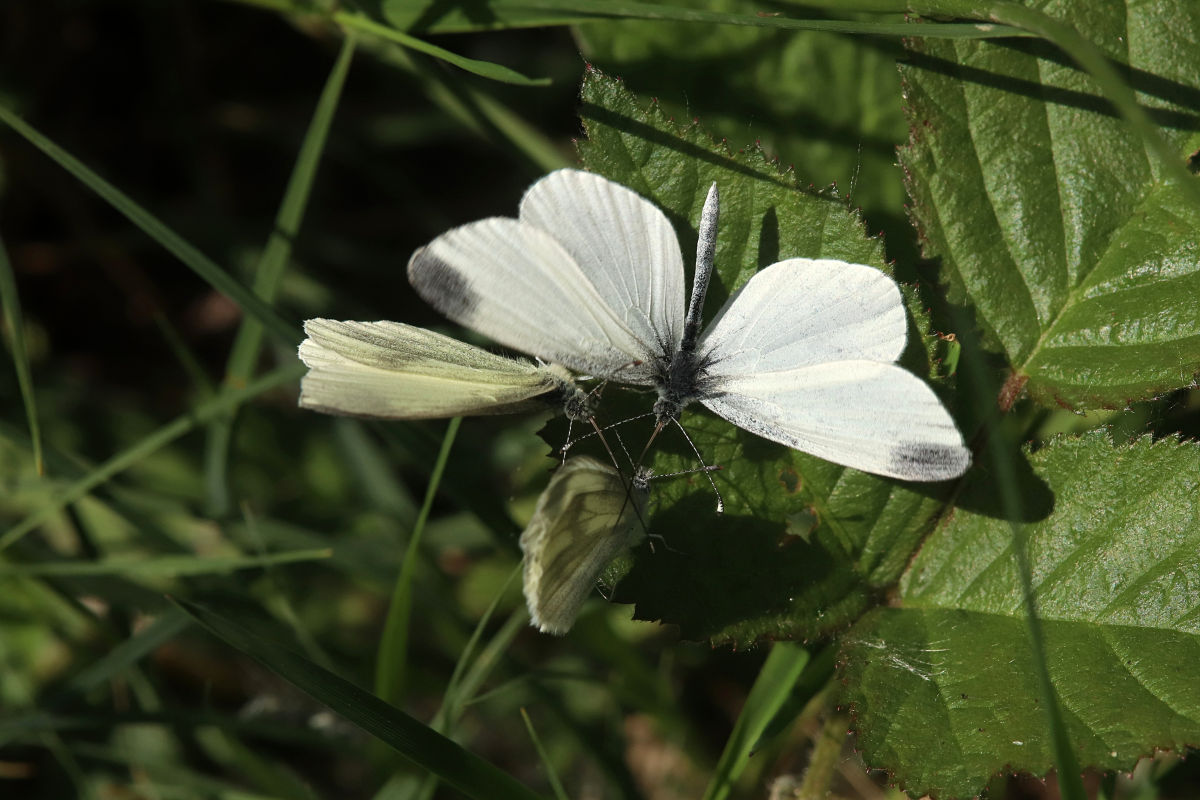
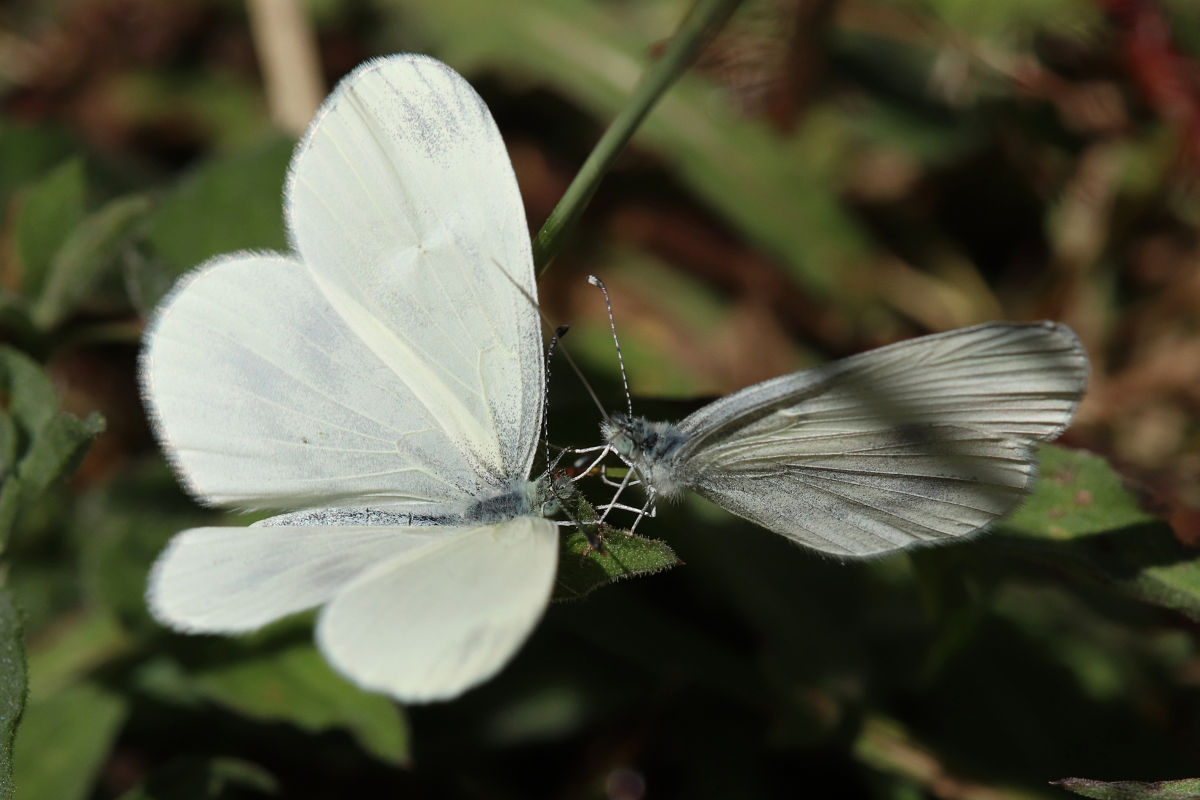
The courtship of this butterfly is an amazing spectacle. Male and female face each other with wings closed and intermittently flash open their wings. At the same time, the male waves his proboscis and white-tipped antennae either side of the female's head. If the female is receptive to these signals, the female bends her abdomen toward the male and the pair mate, staying coupled for around 30 minutes.
Adults feed primarily on bird's-foot-trefoils (Lotus spp.), Bitter-vetch (Lathyrus linifolius), Bugle (Ajuga reptans), Greater Stitchwort (Stellaria holostea), Herb-Robert (Geranium robertianum), knapweeds (Centaurea spp.), Meadow Vetchling (Lathyrus pratensis), Selfheal (Prunella vulgaris) and Tufted Vetch (Vicia cracca).
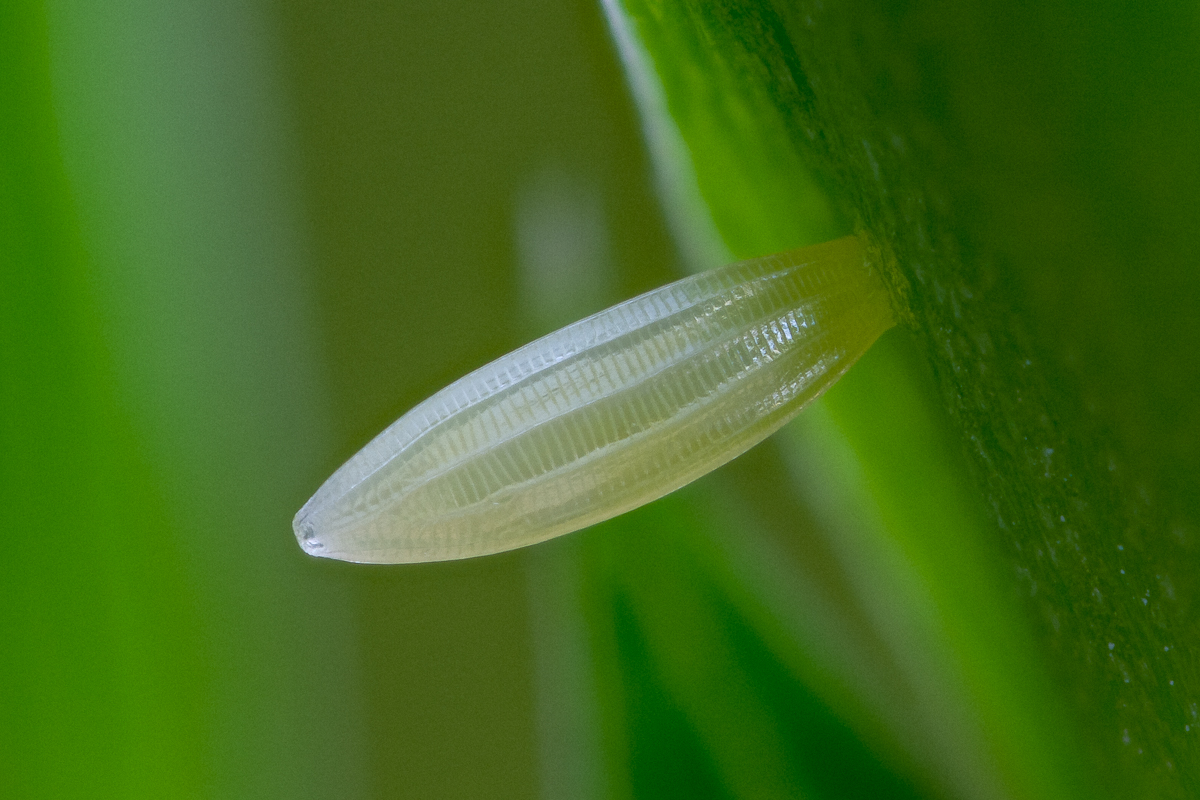
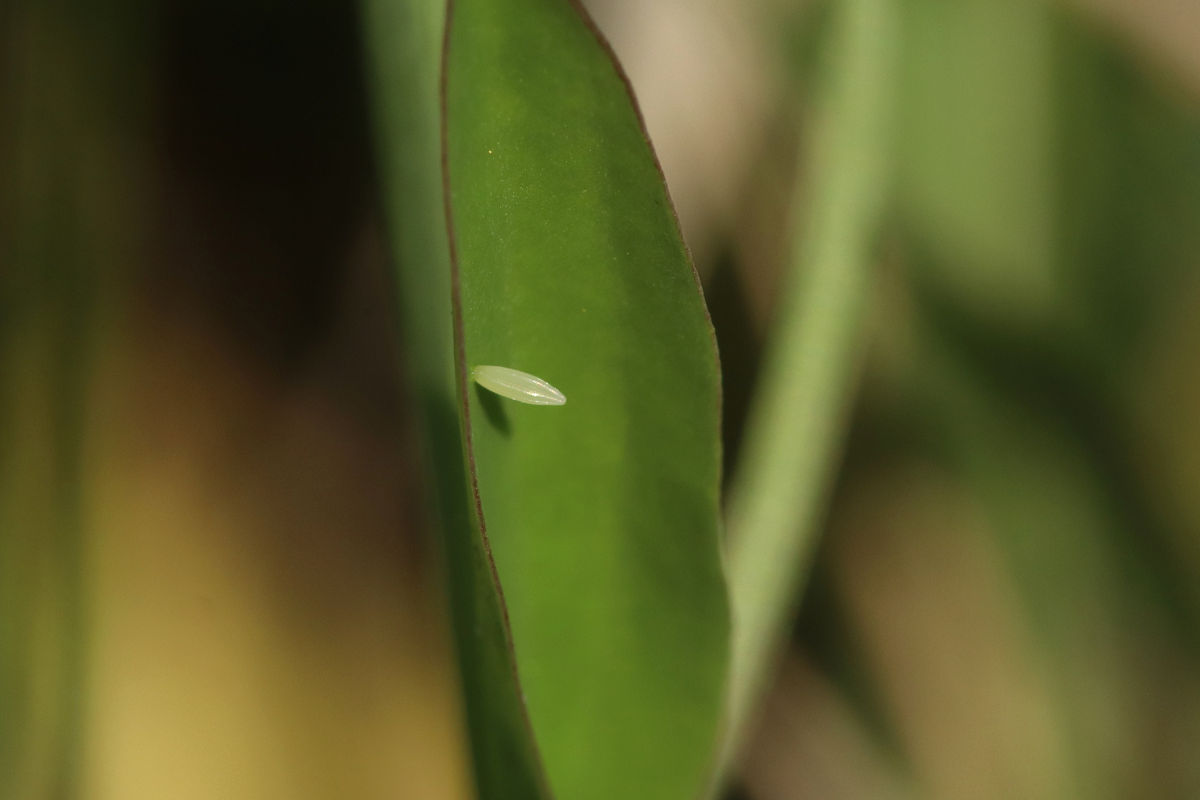
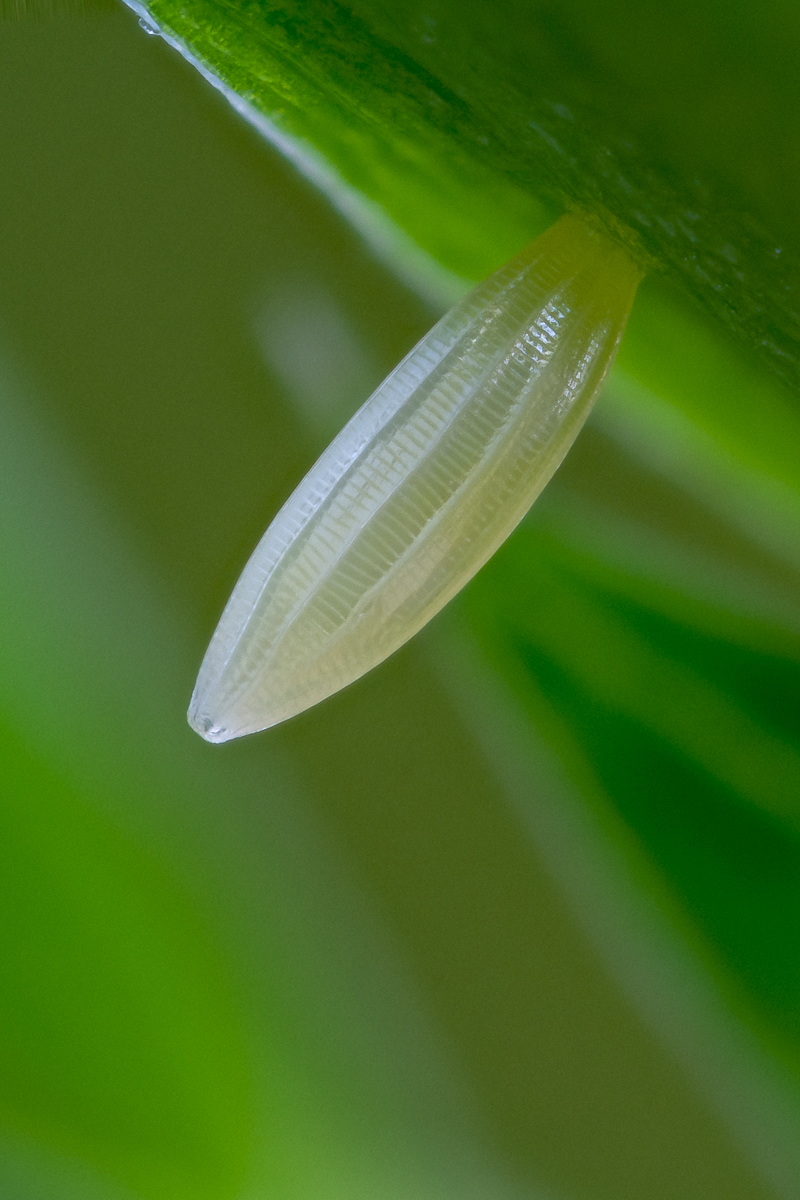
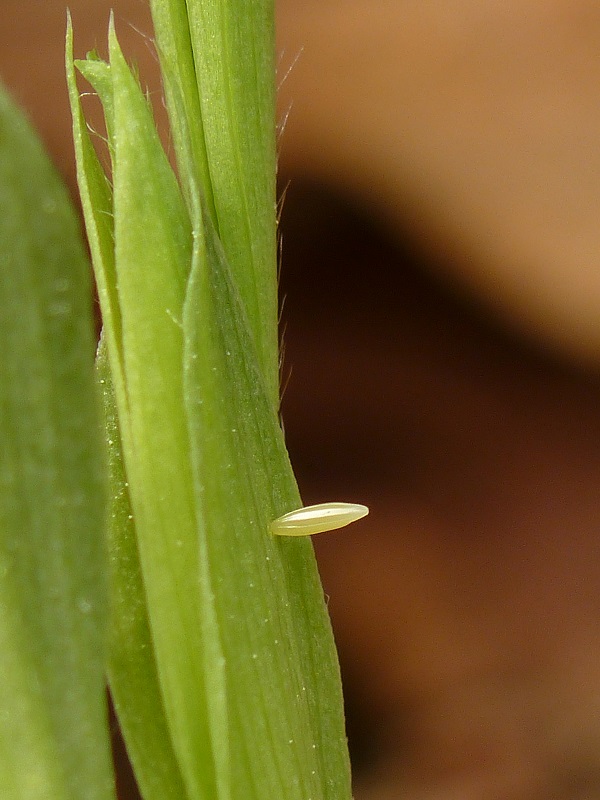
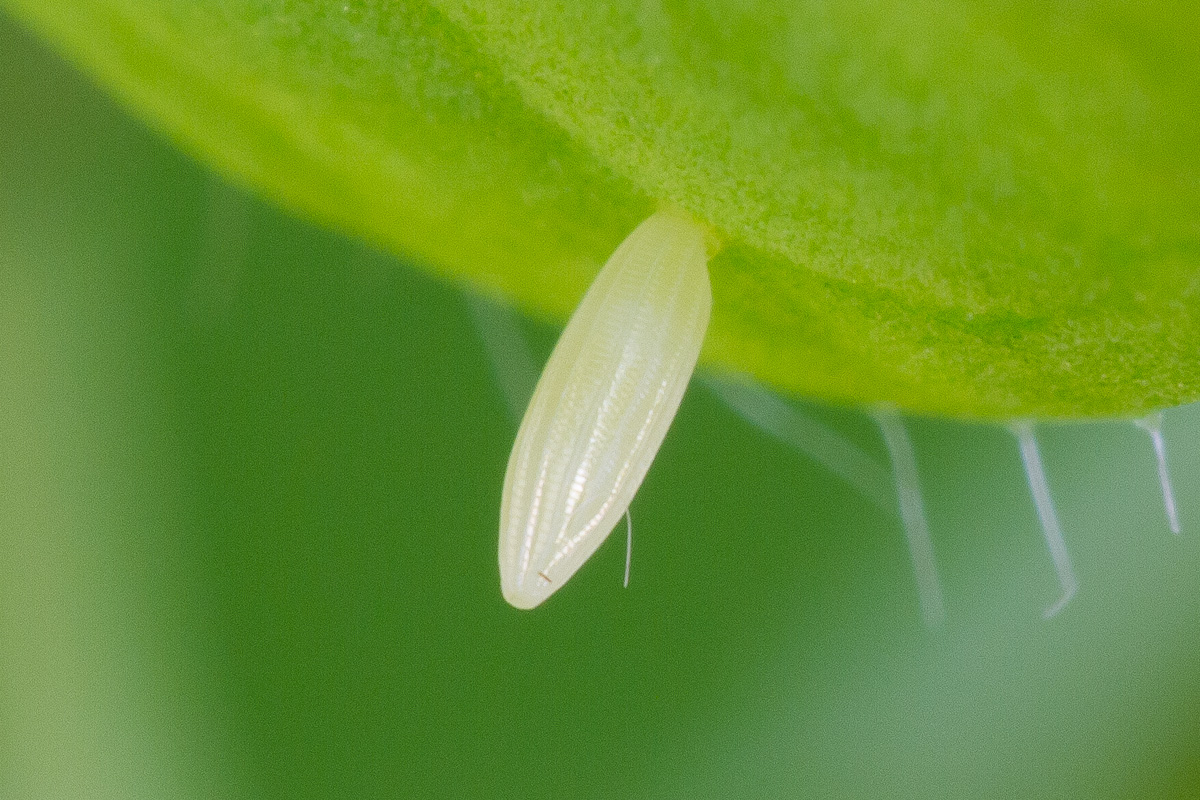
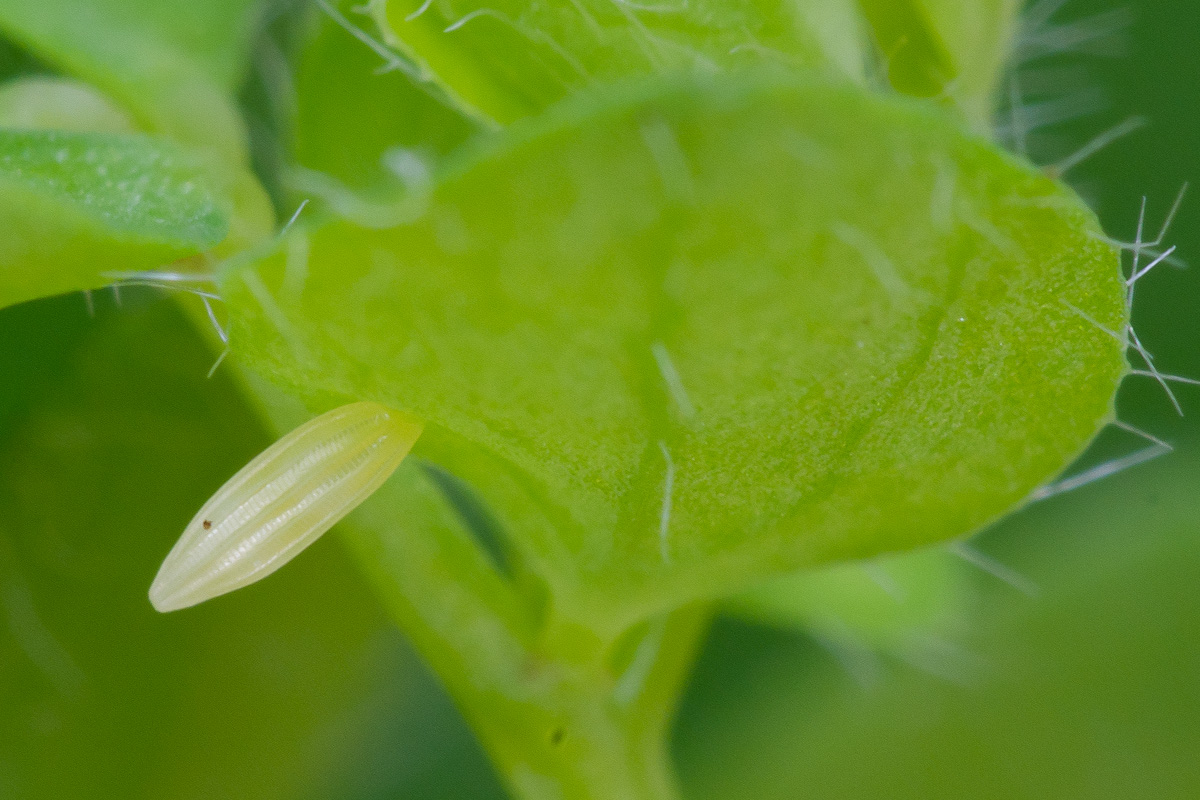
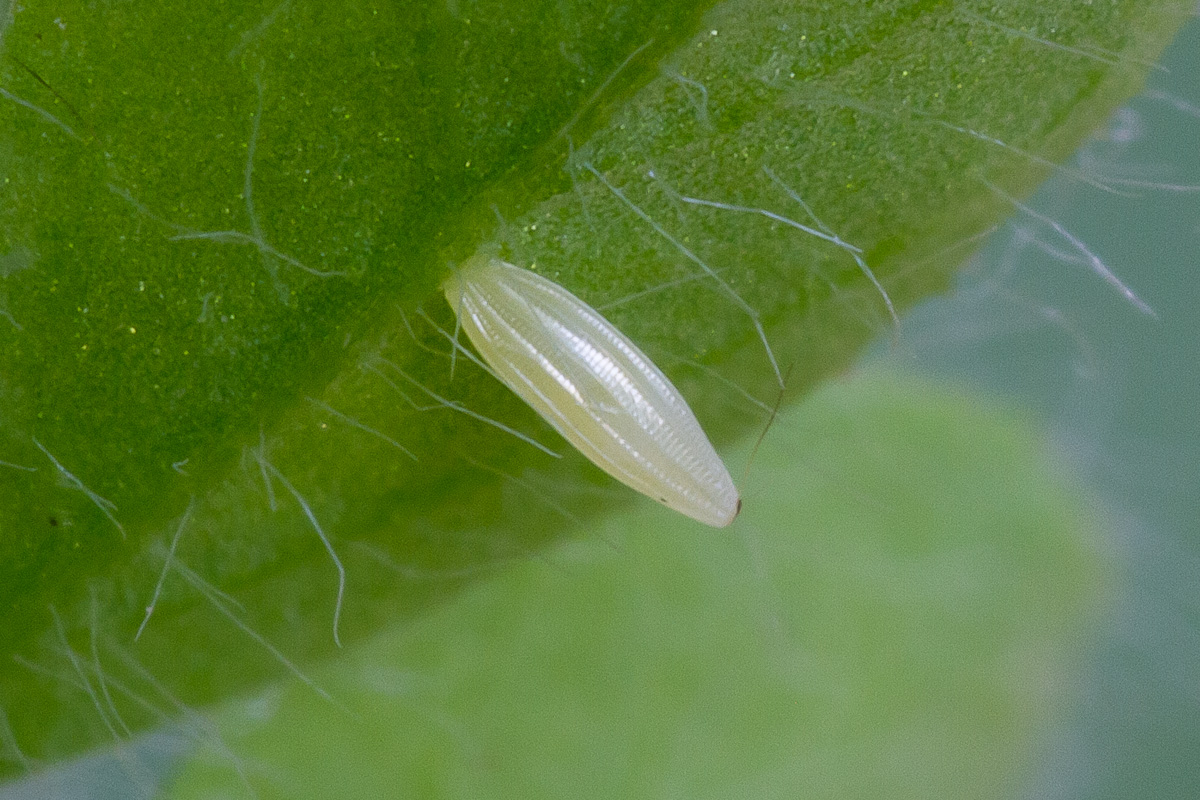
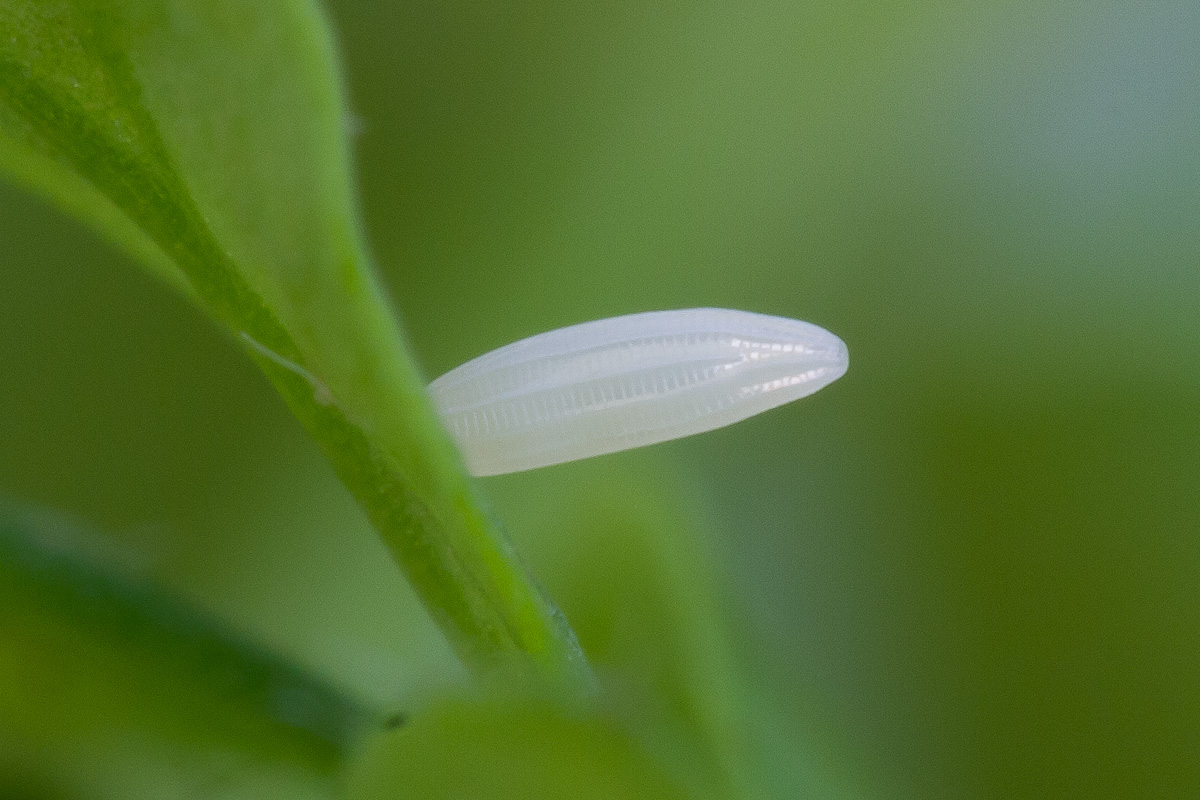
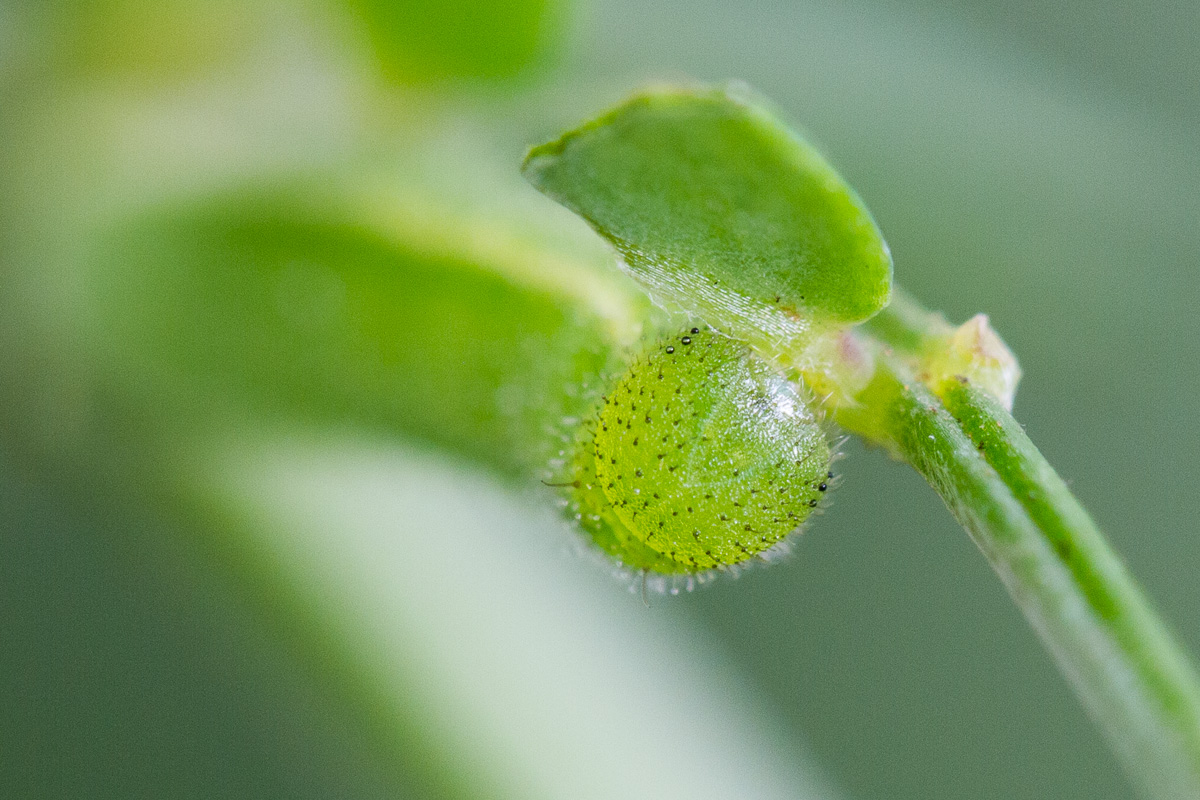
The yellowish-white and skittle-shaped eggs are laid singly on the underside of a leaf, on sheltered plants. They hatch after about 2 weeks.
"The eggs are laid singly and mostly on the under surface of the leaves of the tuberous pea (Orobus tuberosus) [synonym of Lathyrus linifolius, Bitter Vetch]. Eggs laid June 6th, 1900, hatched June 17th, remaining eleven days in the egg state. The egg as laid stands erect; it measures 1.3 mm. high and is of an elongated conical form, widest about the middle and attenuated at each end, but mostly so at the summit, which terminates in a point; the base is rounded and firmly attached to the leaf by a short pedestal of glutinous substance. The egg is not symmetrical in shape, as it curves slightly to one side, so that in a certain view it forms a figure with one side convex and the other almost straight. It has eleven longitudinal keels; generally nine of these run the entire length, while the remaining two start a little below the summit; the spaces between the keels are delicately and finely ribbed transversely, each space having about forty-two ribs. The colour of the egg is a clear pale lemon-yellow and remains unchanged until just before hatching, when it becomes tinged with ochreous." - Frohawk (1924)
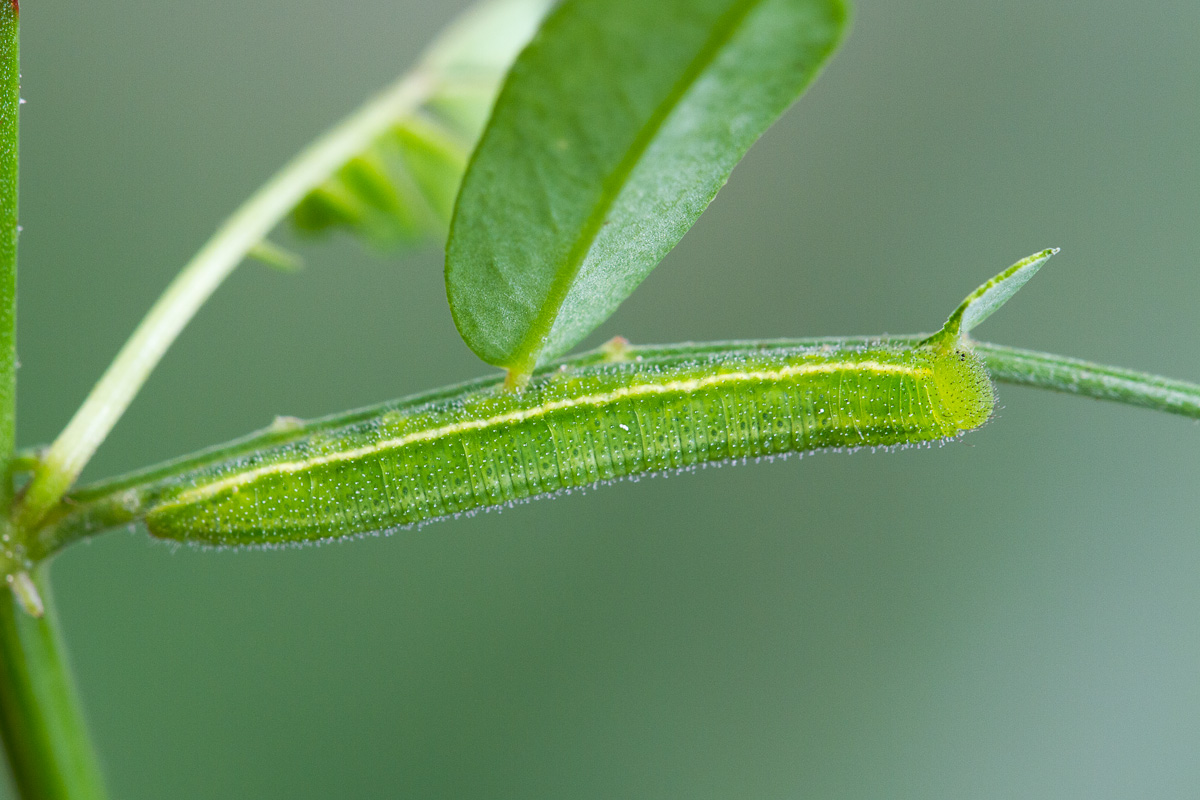
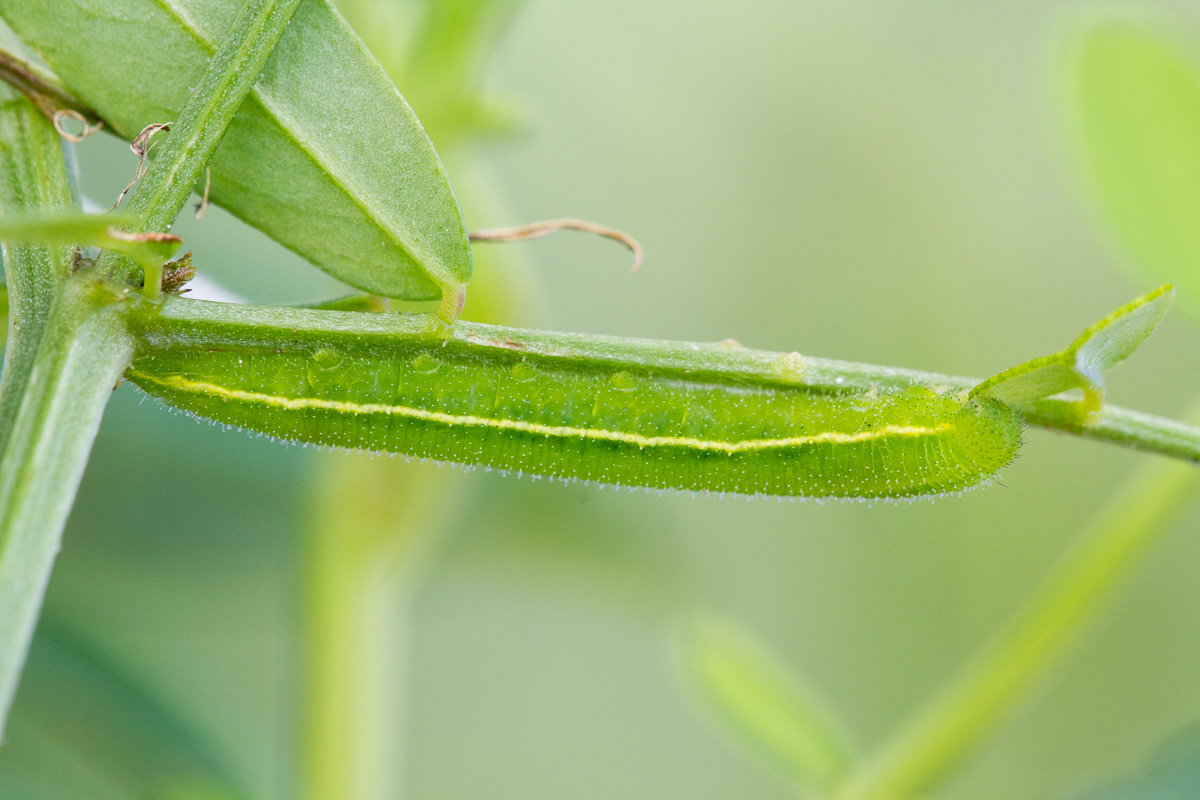
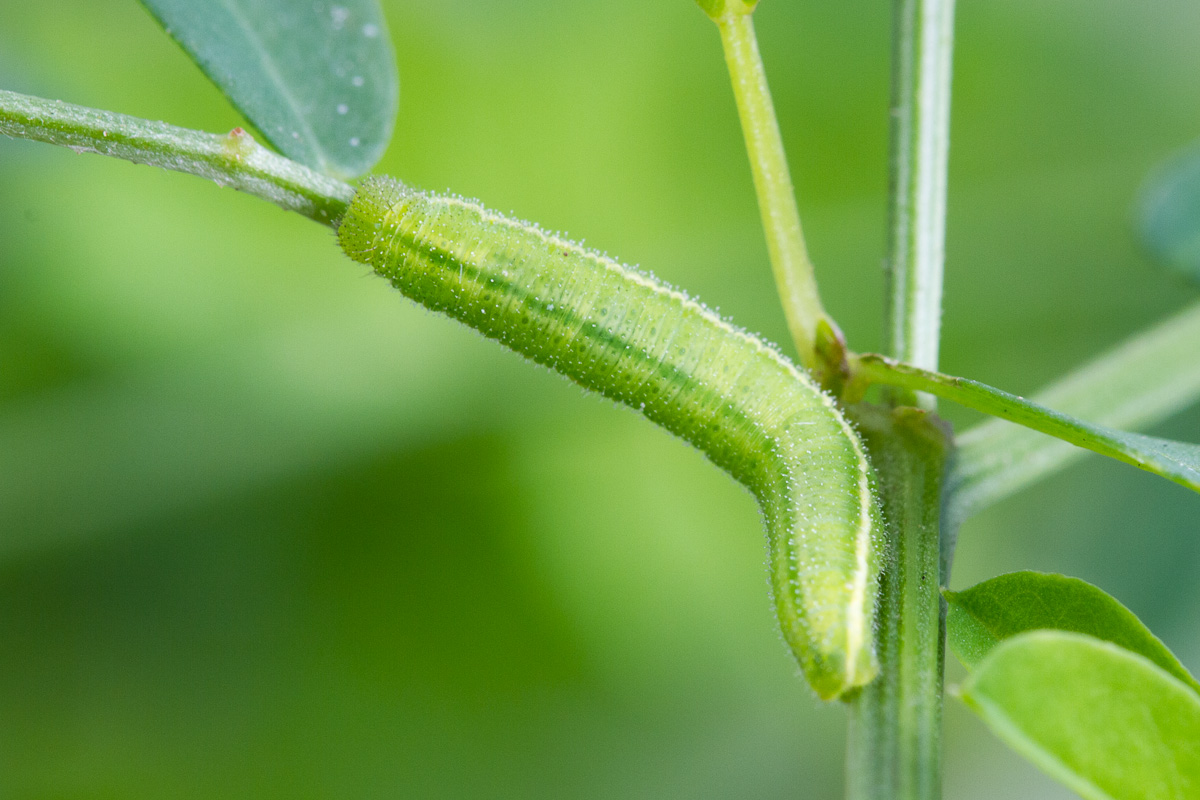
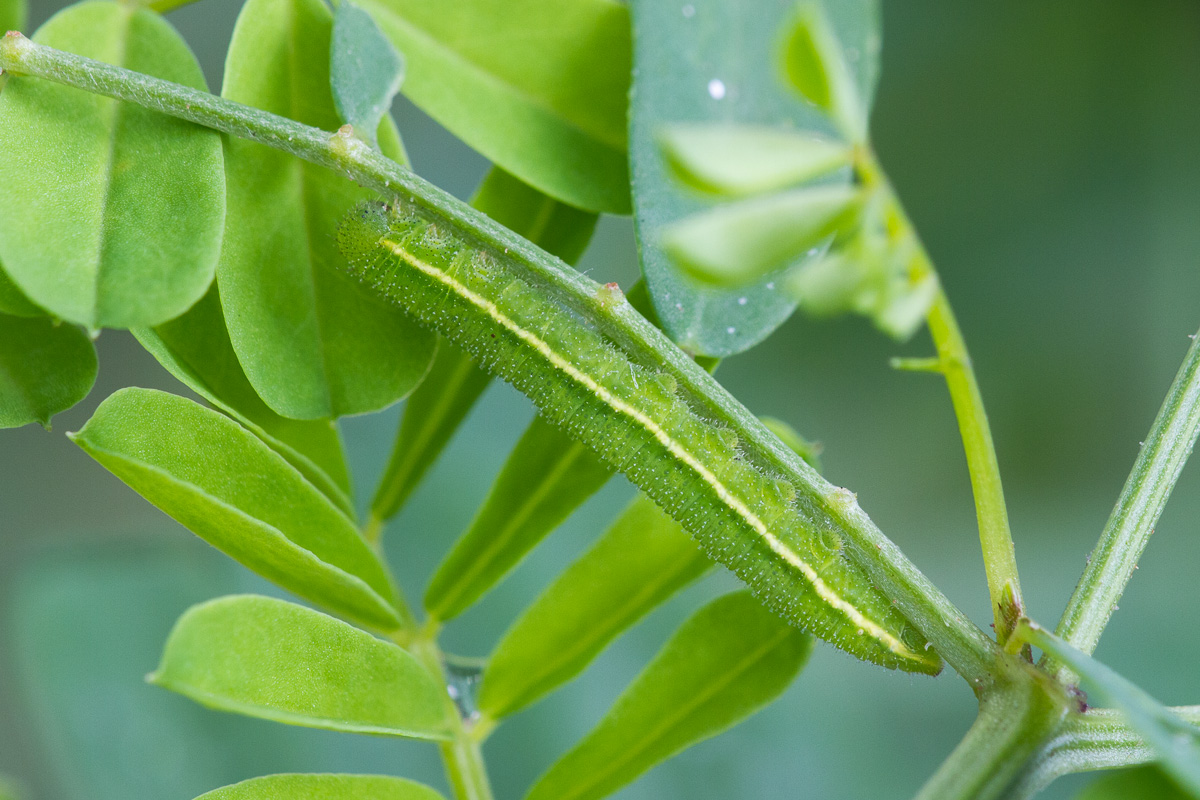
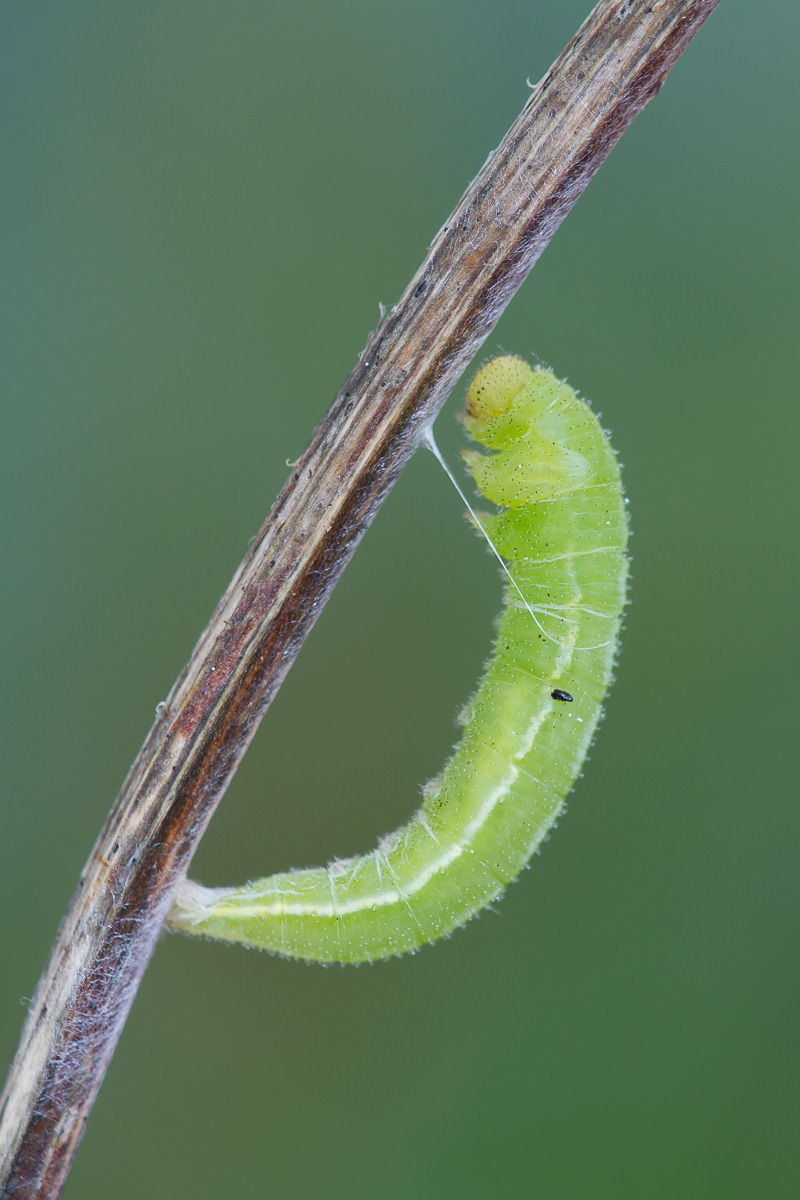
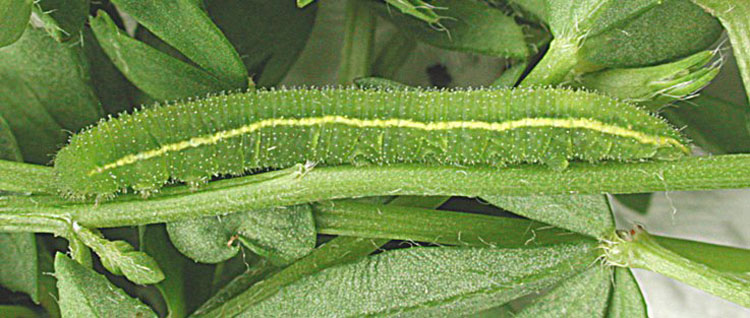
The superbly-camouflaged larva feeds by first eating the tips of the finest shoots, before working its way down the plant. There are 5 instars in total.
The primary larval foodplants are Bitter-vetch (Lathyrus linifolius), Common Bird's-foot-trefoil (Lotus corniculatus), Greater Bird's-foot-trefoil (Lotus pedunculatus), Meadow Vetchling (Lathyrus pratensis) and Tufted Vetch (Vicia cracca).
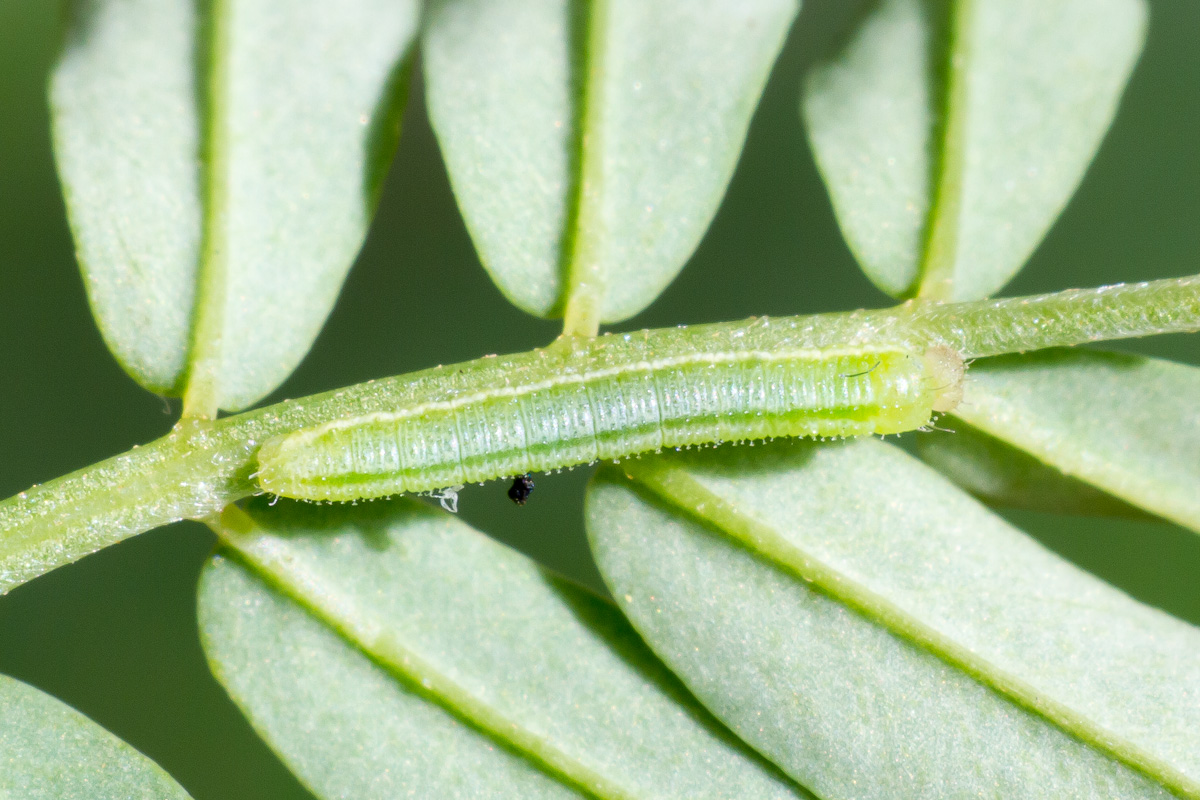
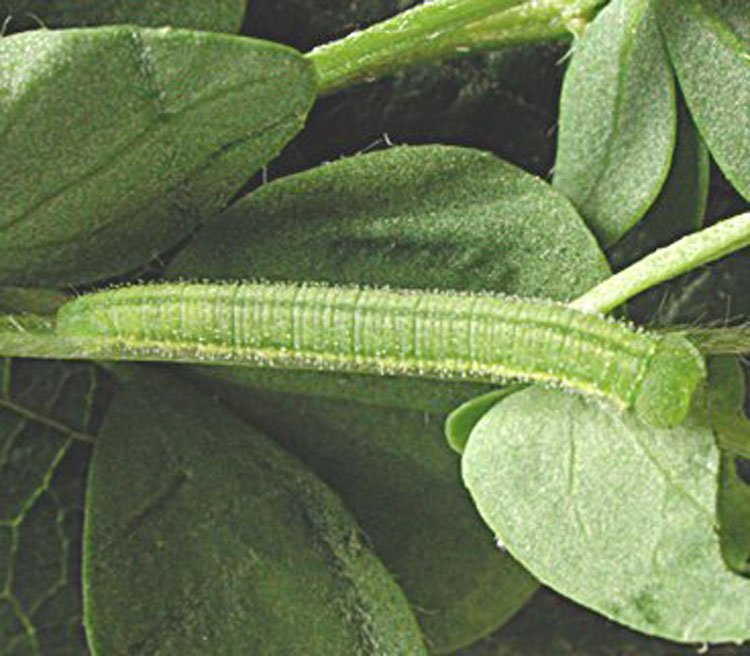
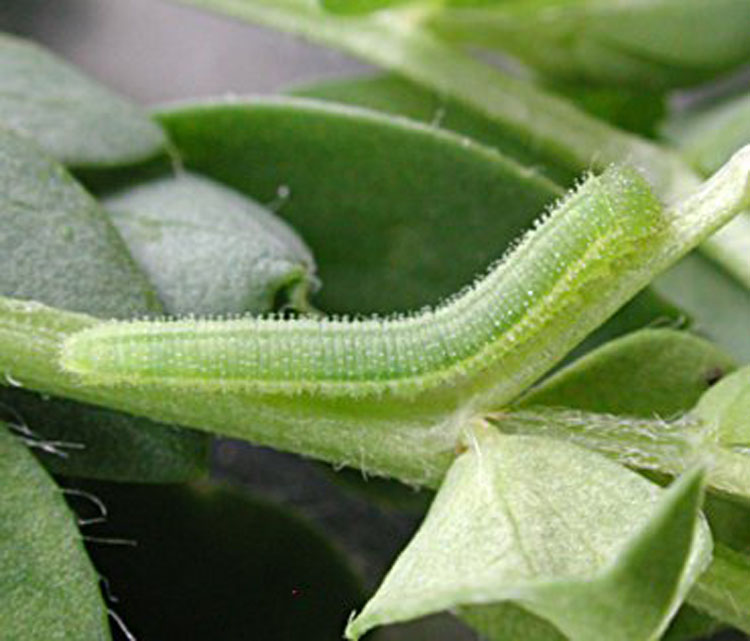
"The young larva eats its way out of the side of the egg and shortly after emerging it consumes part of the empty shell. Directly after emergence the larva measures 1.5 mm. long; it is uniformly cylindrical, with a large globular head. The entire colouring is a pale primrose-yellow. Each segment has six sub-divisions; there are six longitudinal rows of curiously formed glassy-like processes (T of this formation), three rows on each side; those of the sub-dorsal pair are the largest, the anterior one is placed slightly higher up than the posterior one, a single one is central above the spiracle, and two others, very small, are placed on the lateral ridge just a trifle lower than the spiracle; on each clasper are two simple spines directed downwards. In addition to the T processes, the first and last segments bear long hairs, curving forwards on the former and backwards on the latter, the head also emits a number of hairs of various lengths curving forwards; the eye spots are black and mouth parts red, the head is the same colour as the body. It rests in a straight attitude and feeds along the edge of the leaf." - Frohawk (1924)
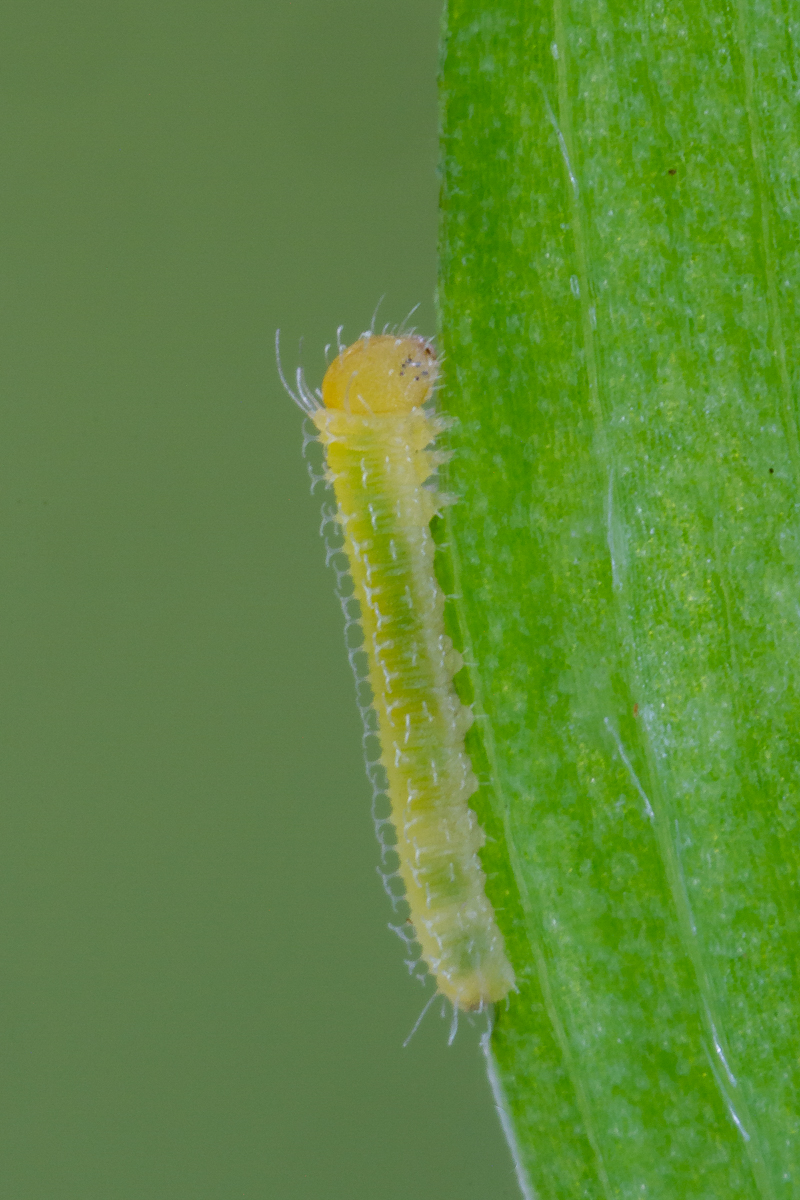
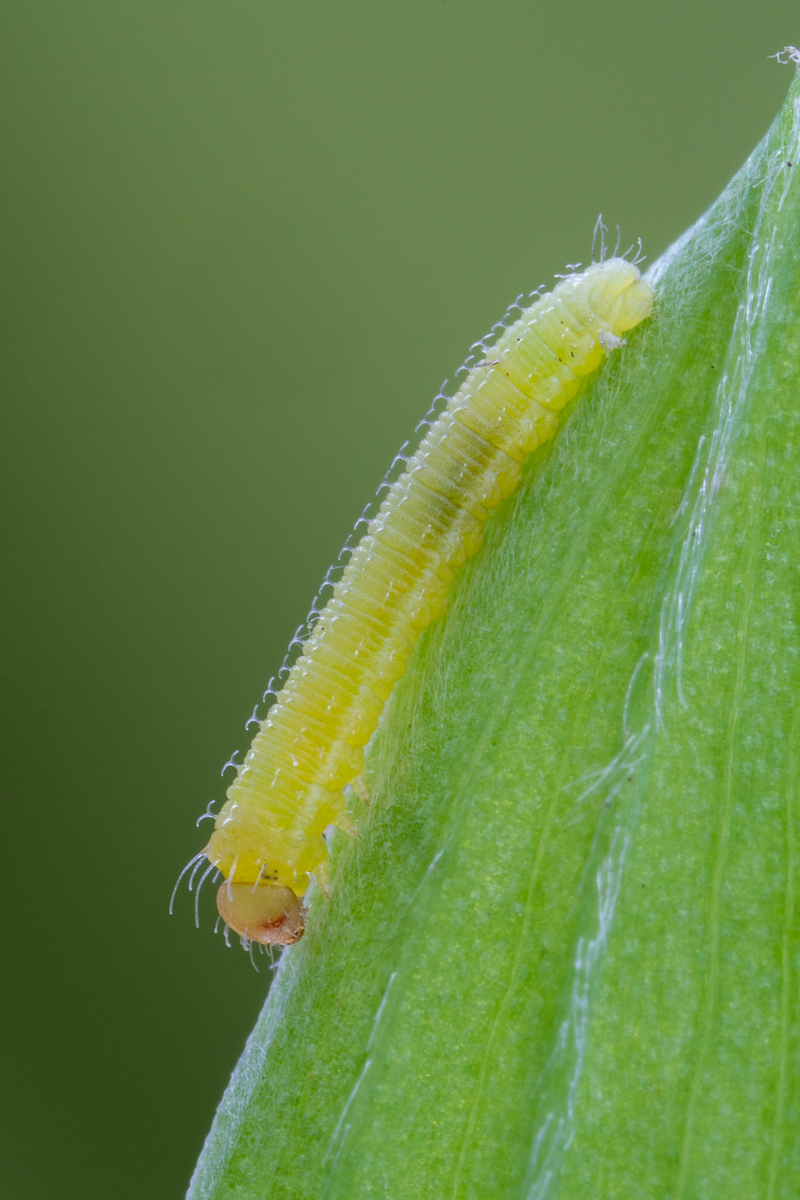
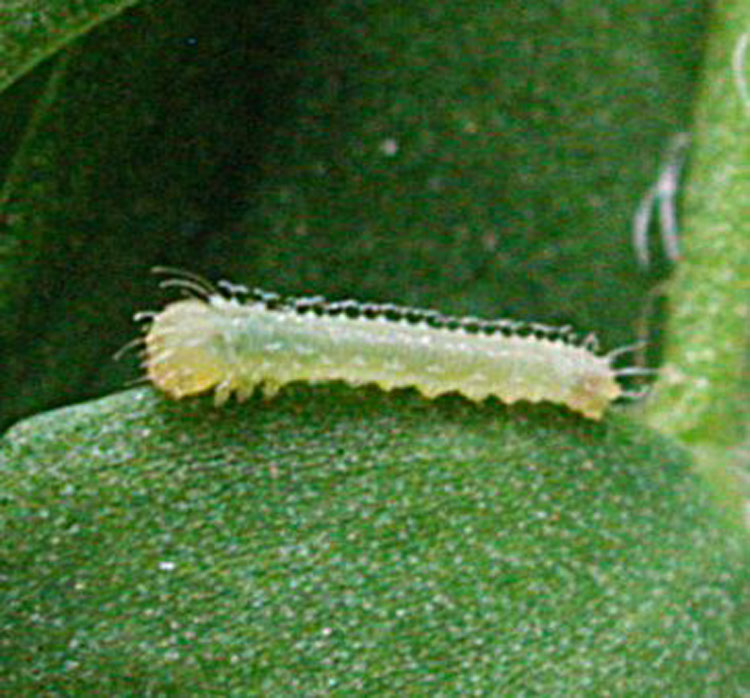
"After the first moult the larva is 3.5 mm. long, and of a light greenish-yellow colour; it has a pale lateral line and a darker green sub-dorsal line. The T processes are reduced in size and resemble the letter Y; there are sub-dorsal and super-spiracular rows of simple spines with dark bases, each bearing a tiny bead of white fluid. The head is coloured like the body. It rests and feeds on the edge of the leaf." - Frohawk (1924)
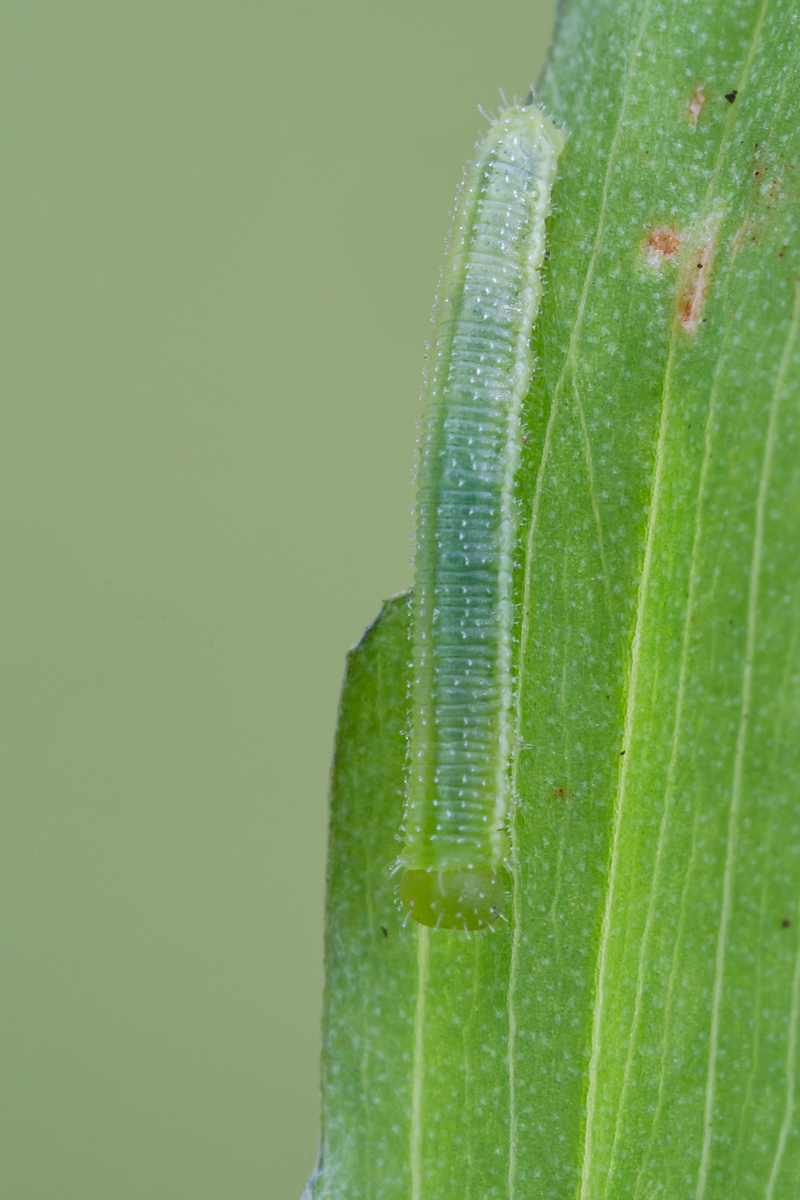
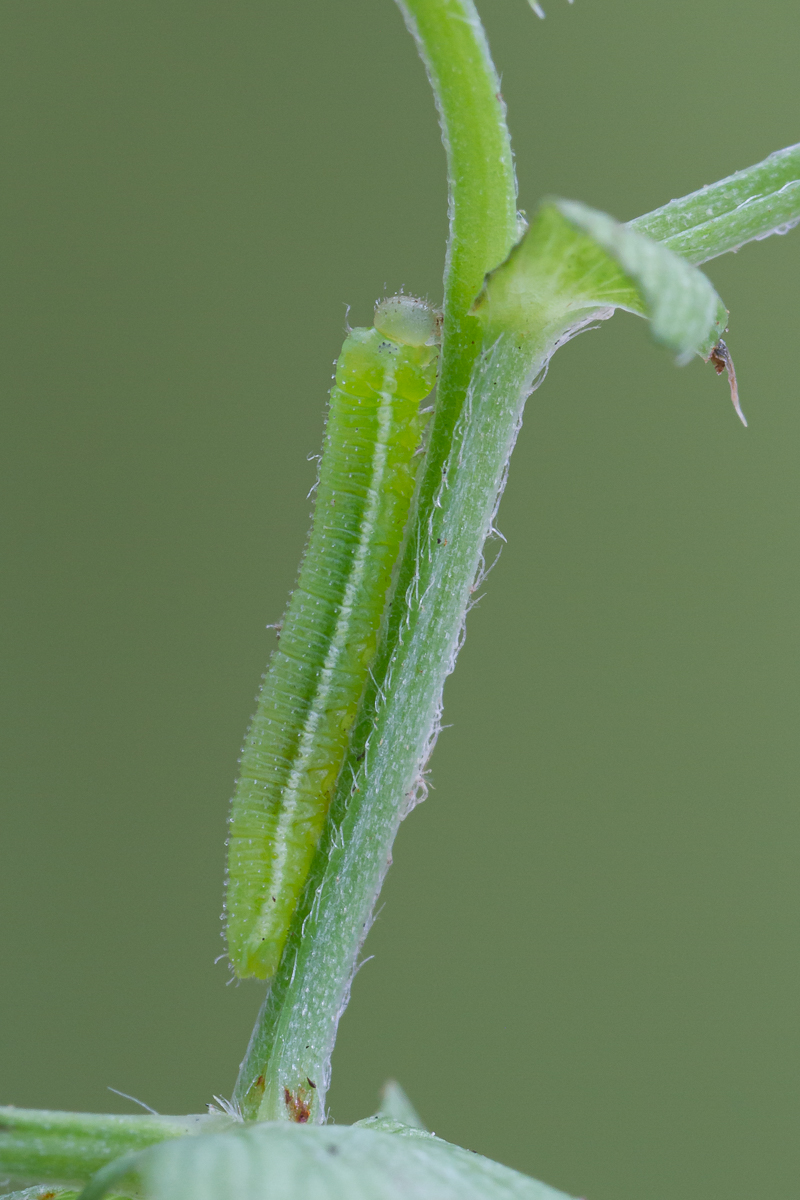
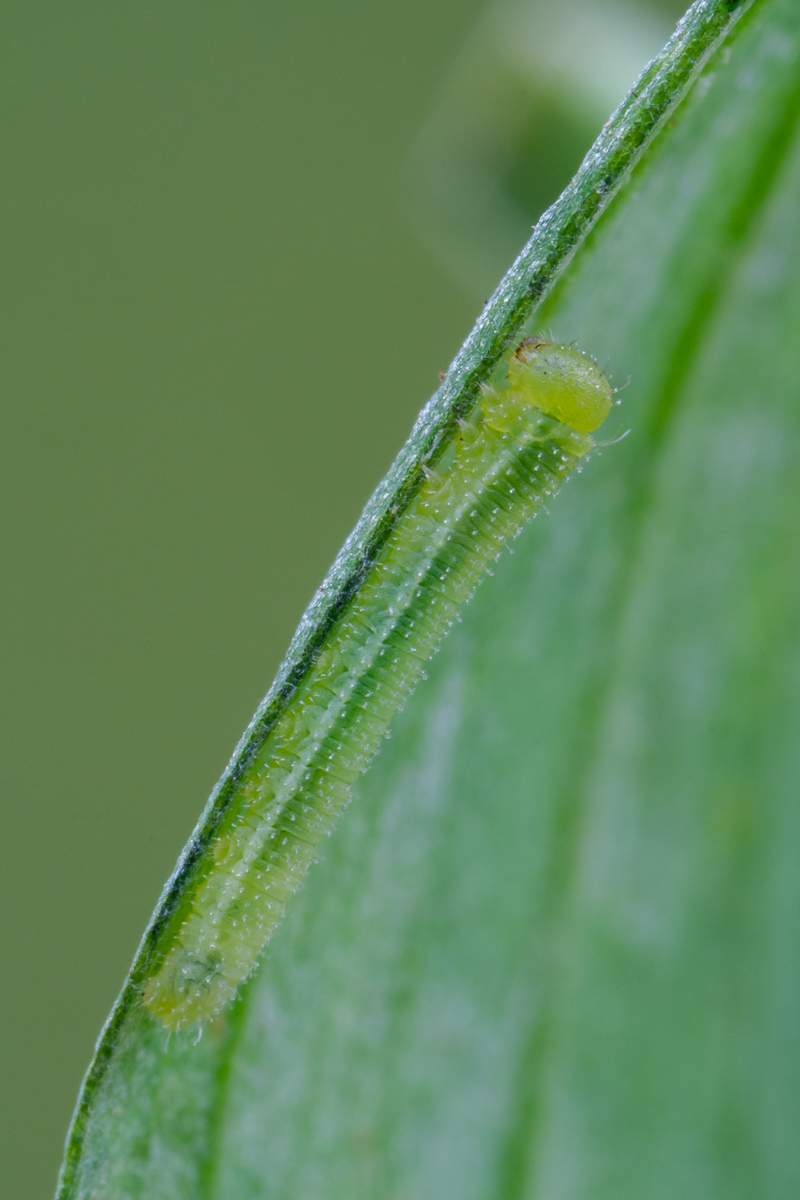
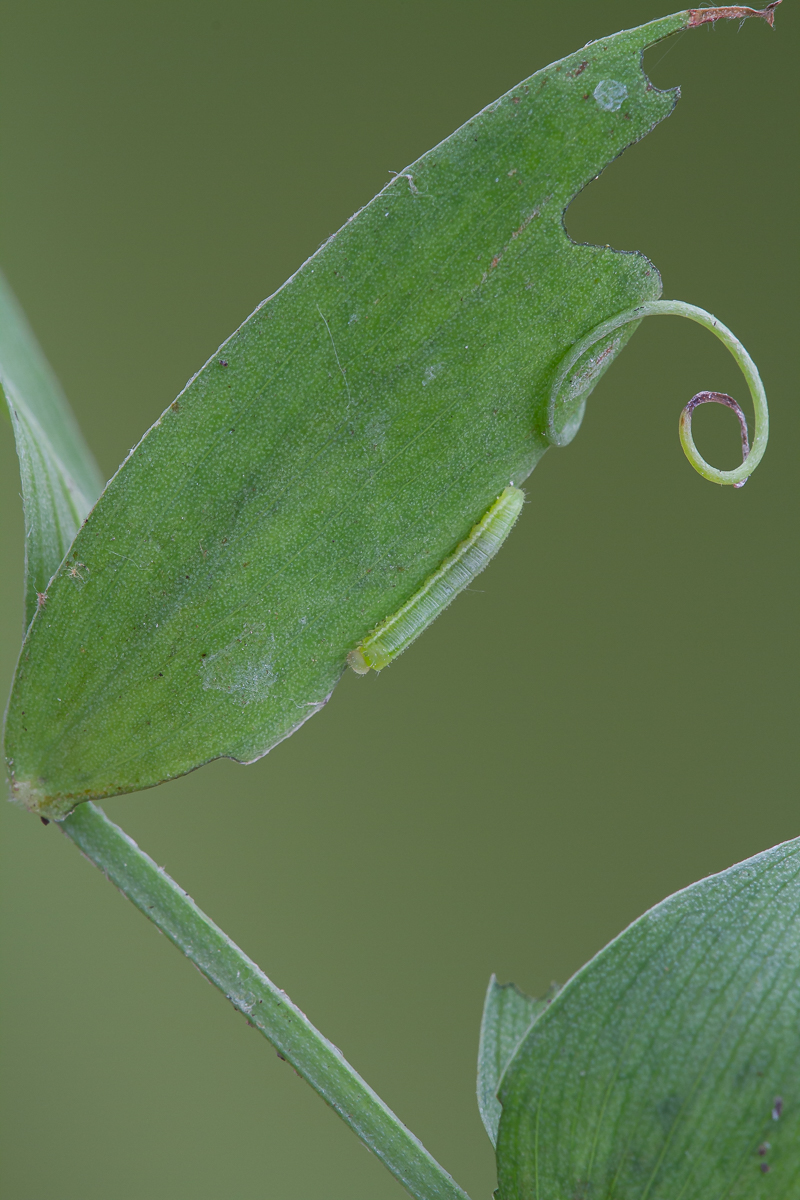
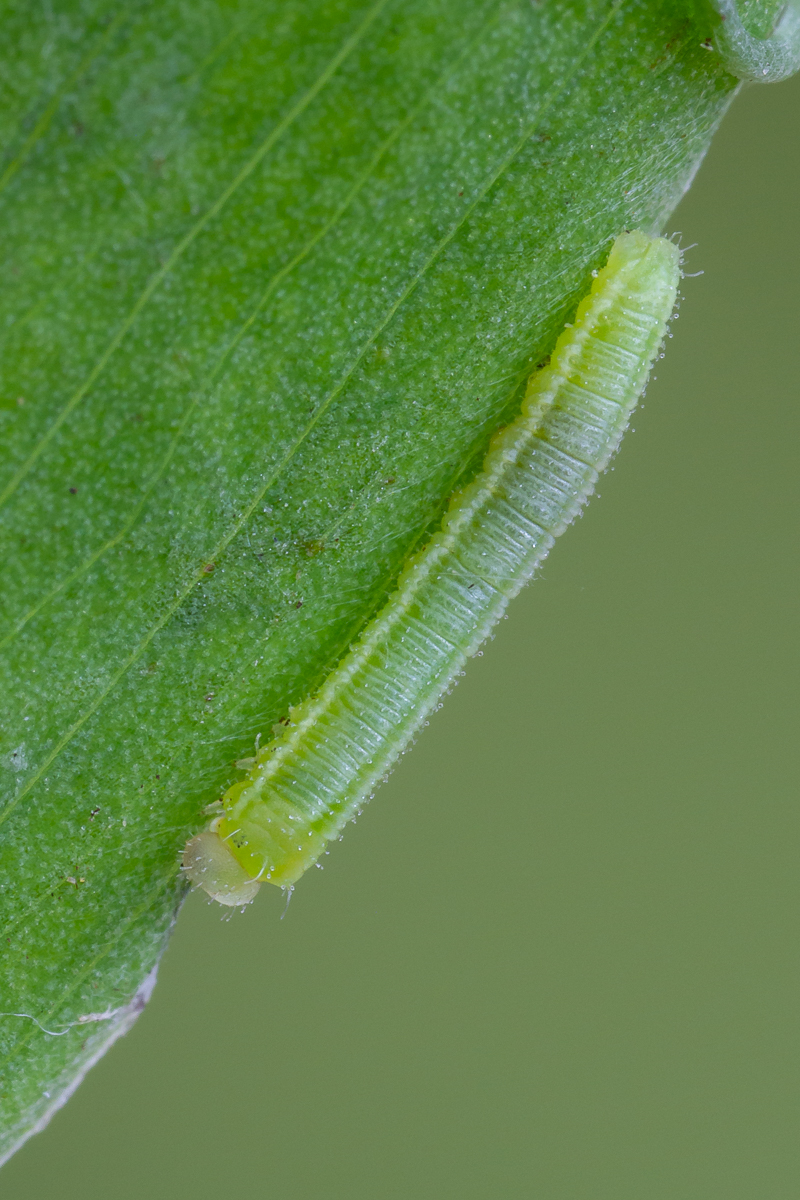
"After the second moult the larva measures 6.3 mm. long; otherwise it is similar to the previous stage." - Frohawk (1924)
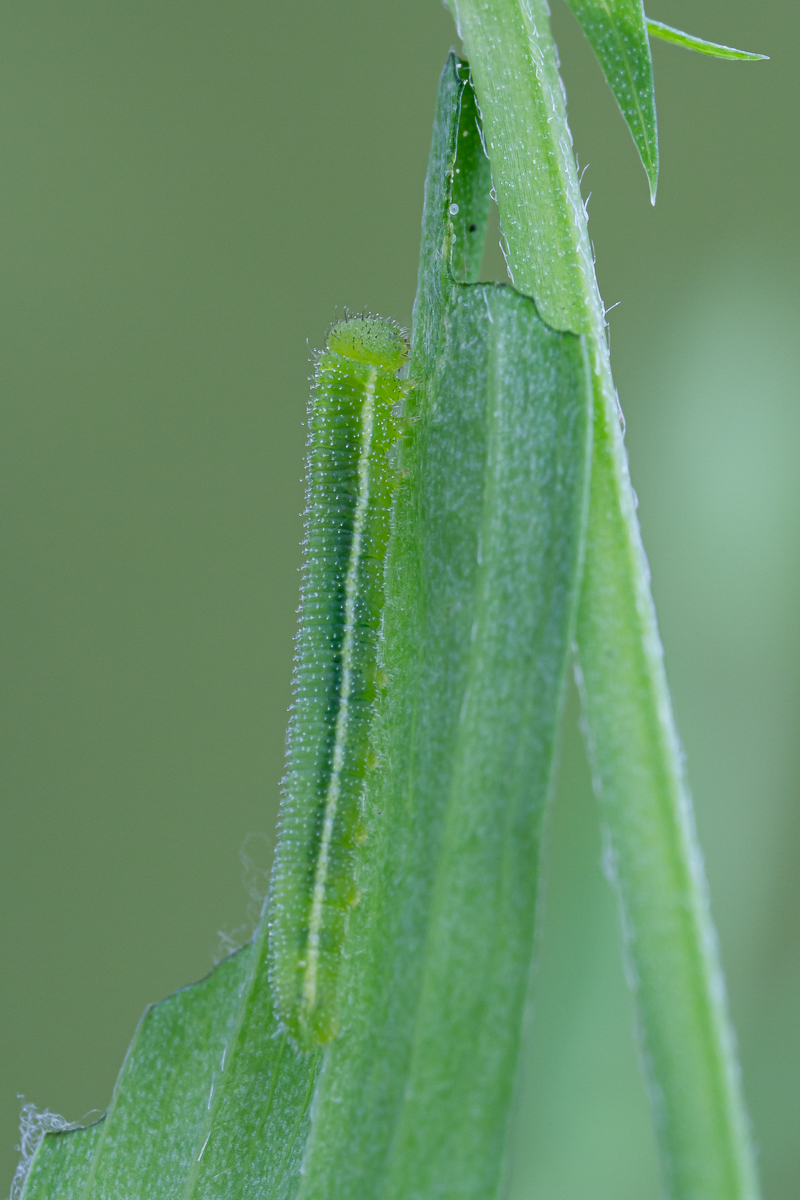
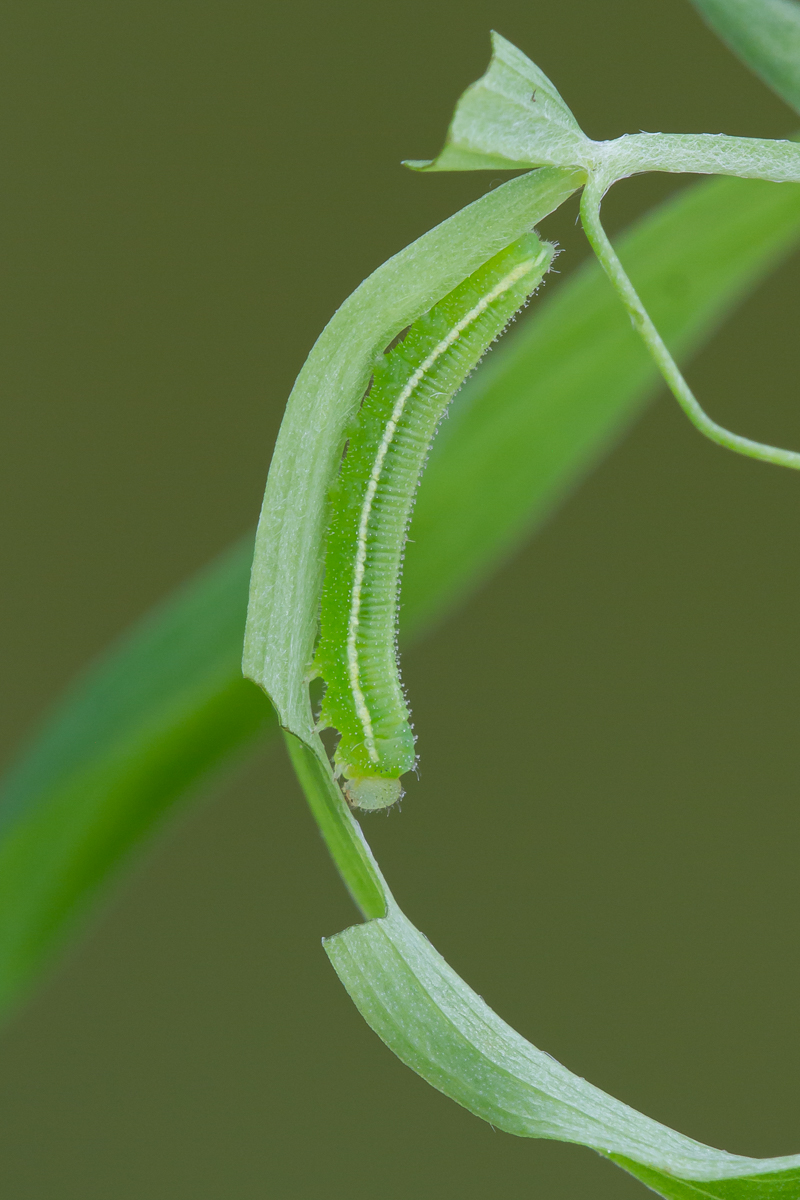
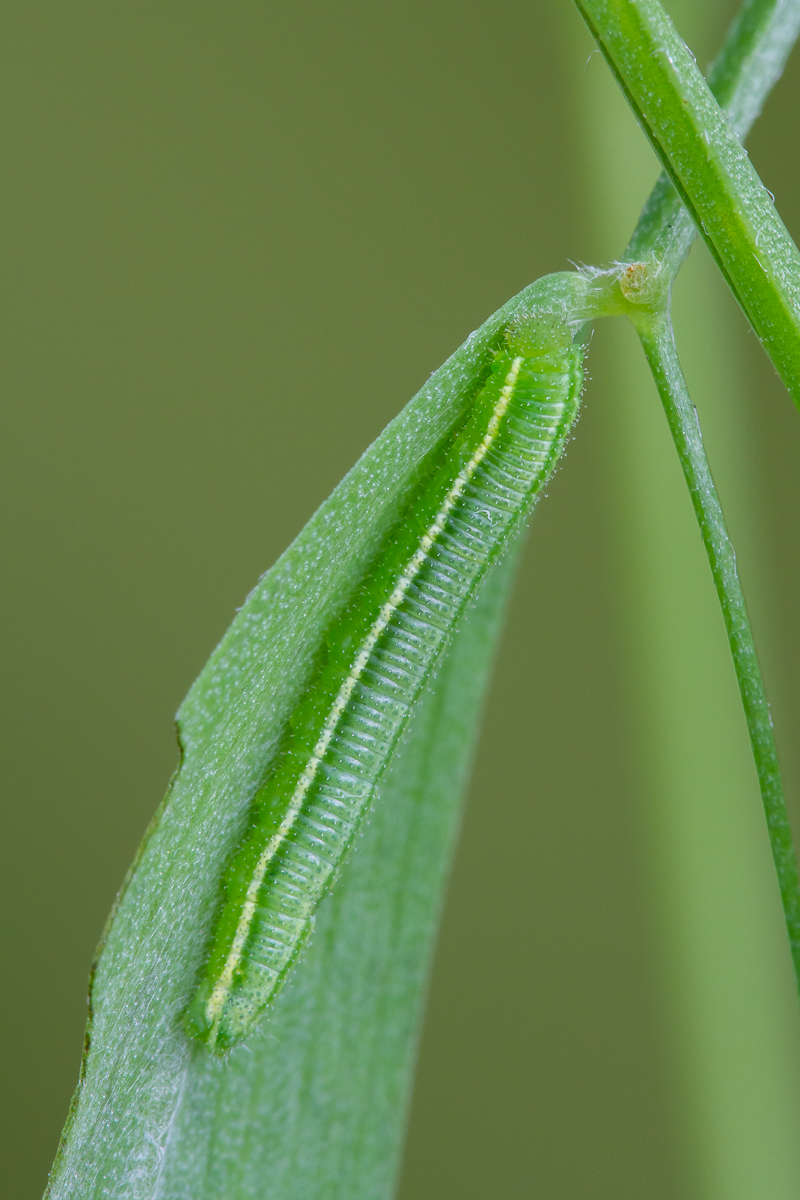
"After third moult and shortly before the fourth it is 12.8 mm. long, and is similar in colour and all structural detail to the previous stage." - Frohawk (1924)
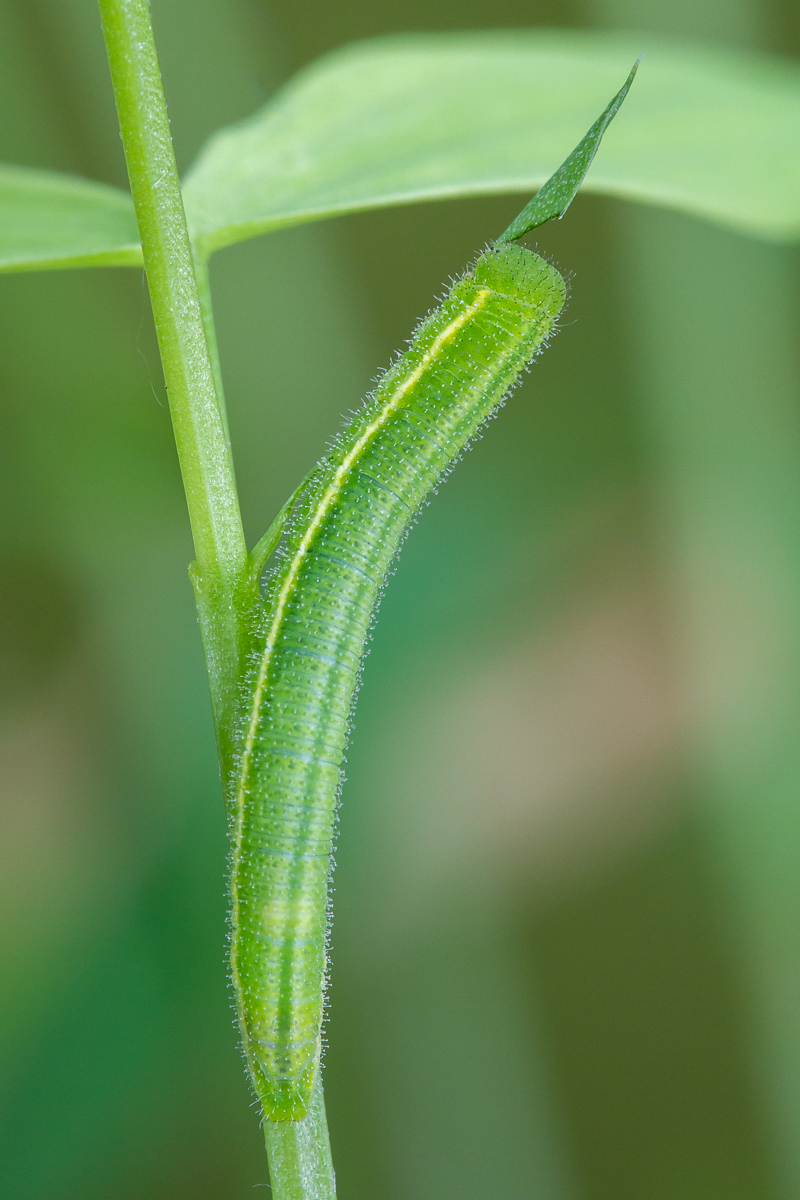
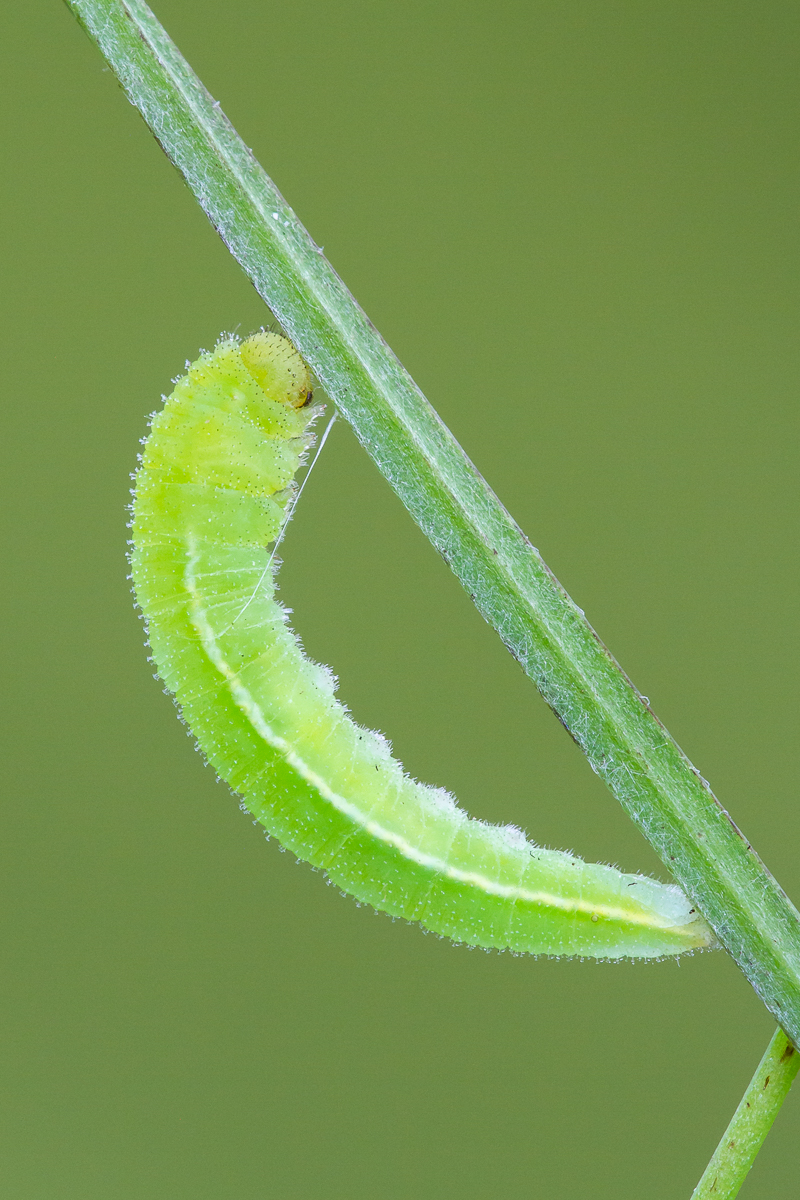
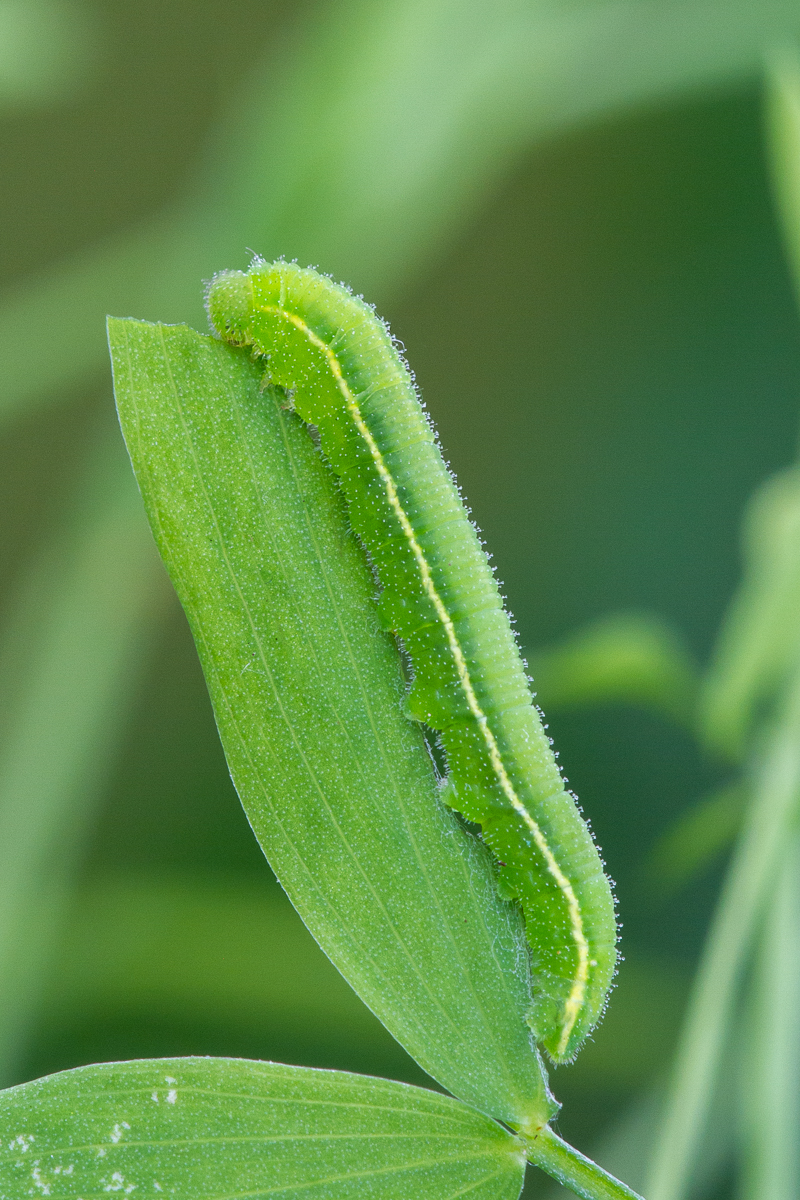
"After fourth and last moult, fully grown, it measures 19 mm. long. It is almost cylindrical and somewhat slender in form, gradually tapering at the posterior end, the last segment terminates in a flap overlapping the anal claspers and is almost squarely ended. Each segment has six sub-divisions. The colour is a bright clear green, with a darker green medio-dorsal line running the entire length, and a spiracular yellow stripe bordered above by a darker green stripe which blends into the ground colour above, but is sharply defined below, which throws up the yellow in strong contrast; the small white spiracles are placed exactly between the two stripes. The surface is finely granular and sprinkled with curious pillar-like processes, which are modifications of those in the first stage; these little pillars have bifurcating, club-shaped tops and conical bases; they gradually become elongated and club-like along the ventral surface, while the claspers have simple short spines; there are also along the dorsal surface two simple spines, longer than the pillars, placed sub-dorsally on each segment; these have a tiny bead of fluid adhering to the finely pointed tips, resembling minute glassy white pins; all the processes are white and glass-like. Those on the anterior segments have more or less dark bases and are more simple in structure. The head is green and bilobed, with dark eye and mouth spots. Besides the tuberous pea, the larvae feed readily on both the sweet and everlasting pea. They always rest in a straight position. The first larva spun up for pupation on July 17th, and pupated the following day, the larval stage lasting thirty days." - Frohawk (1924)
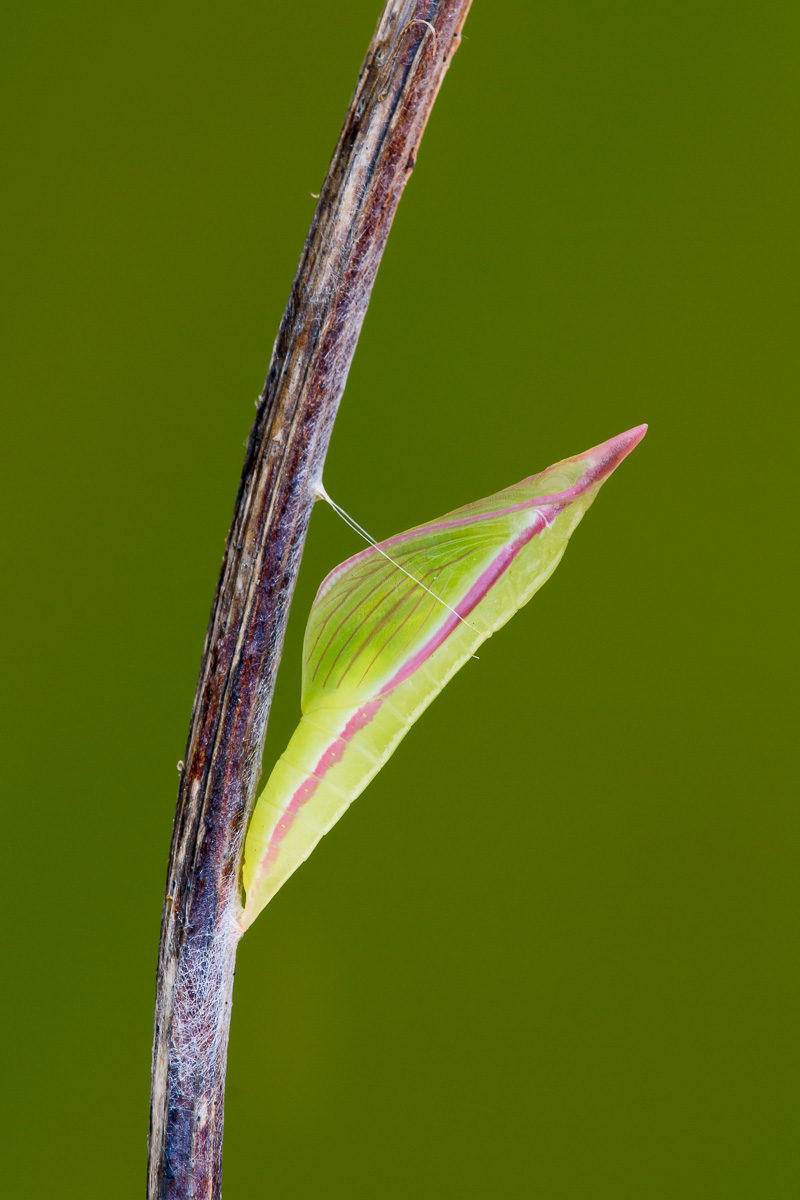
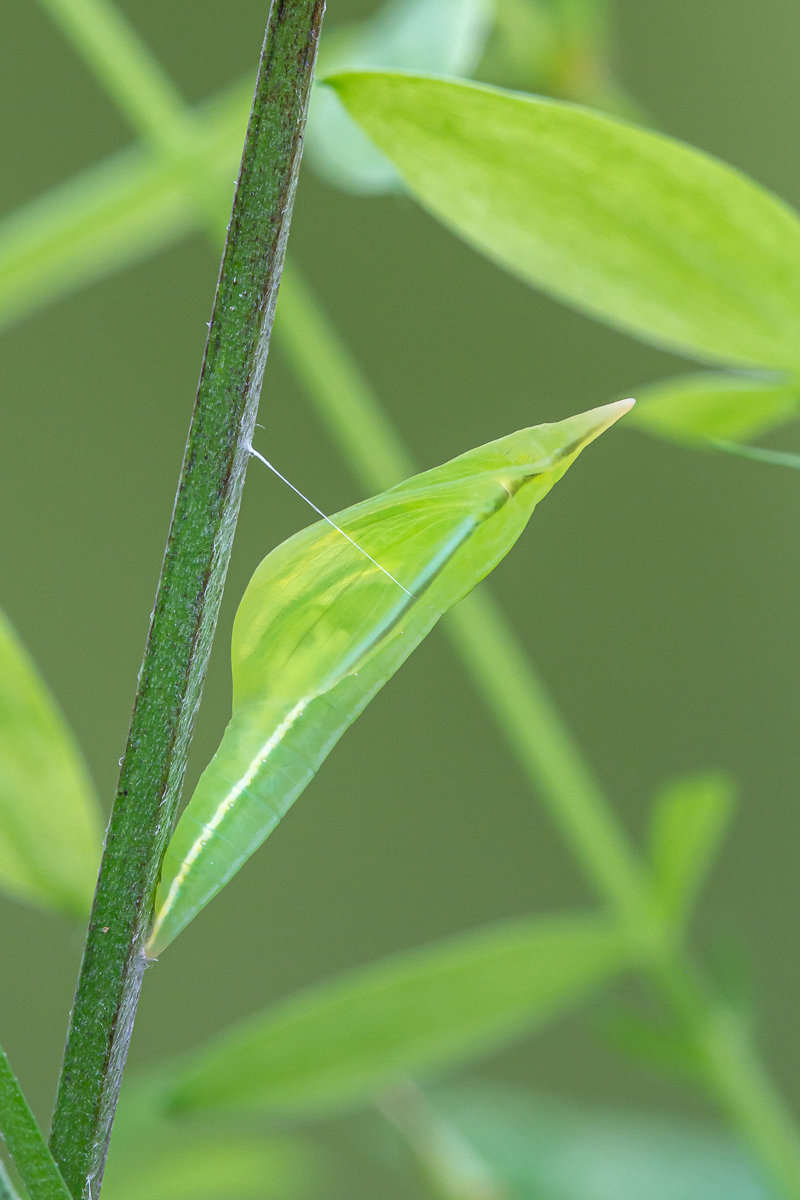
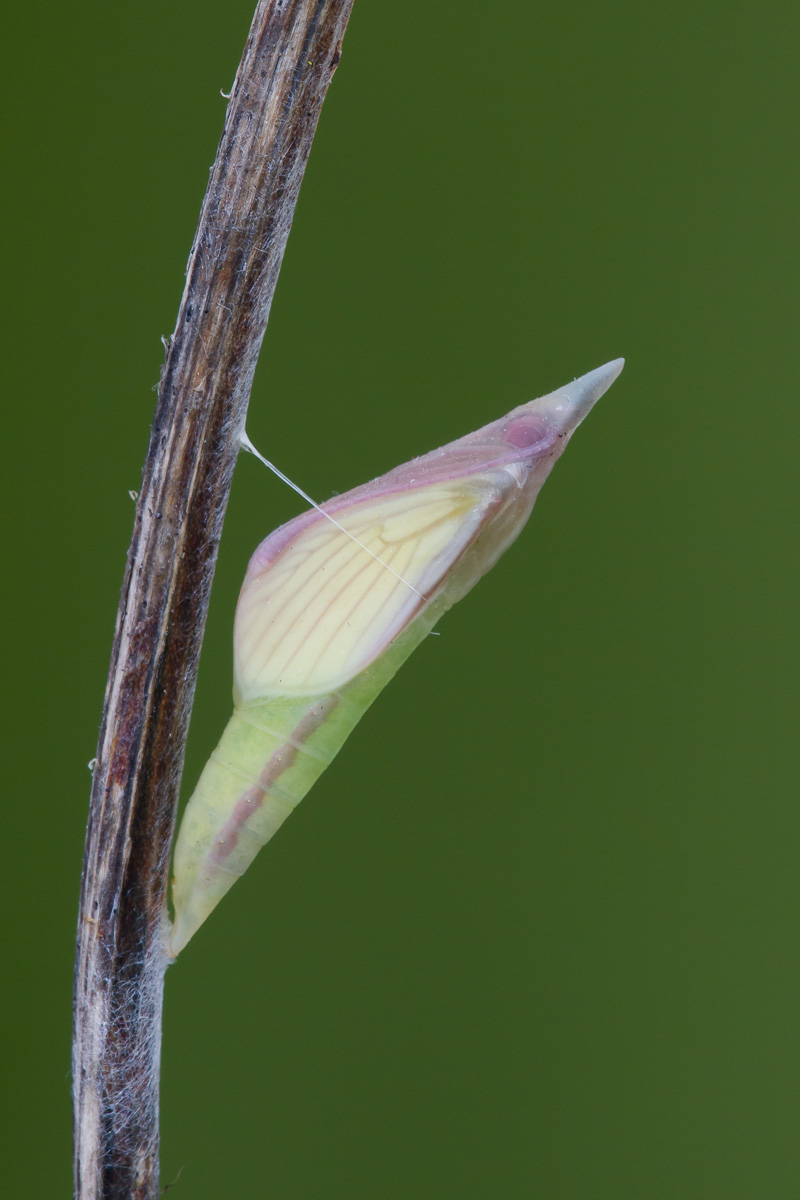
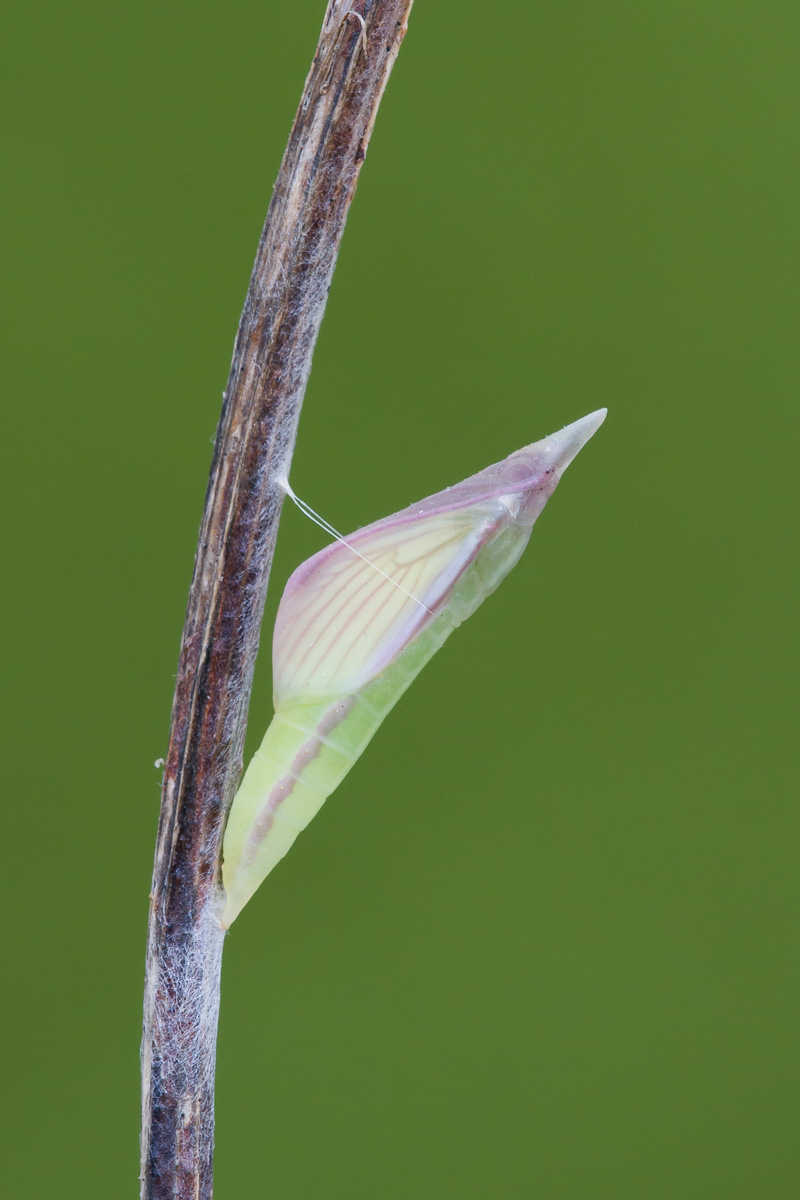
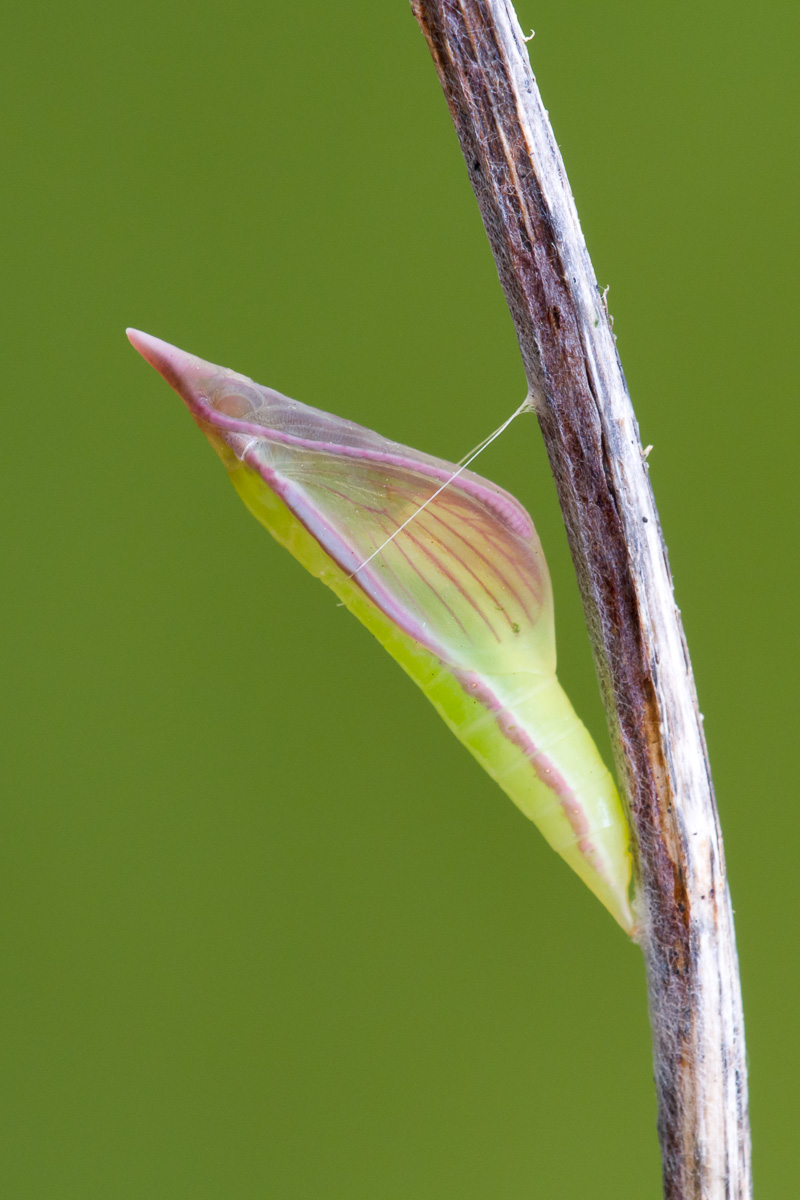
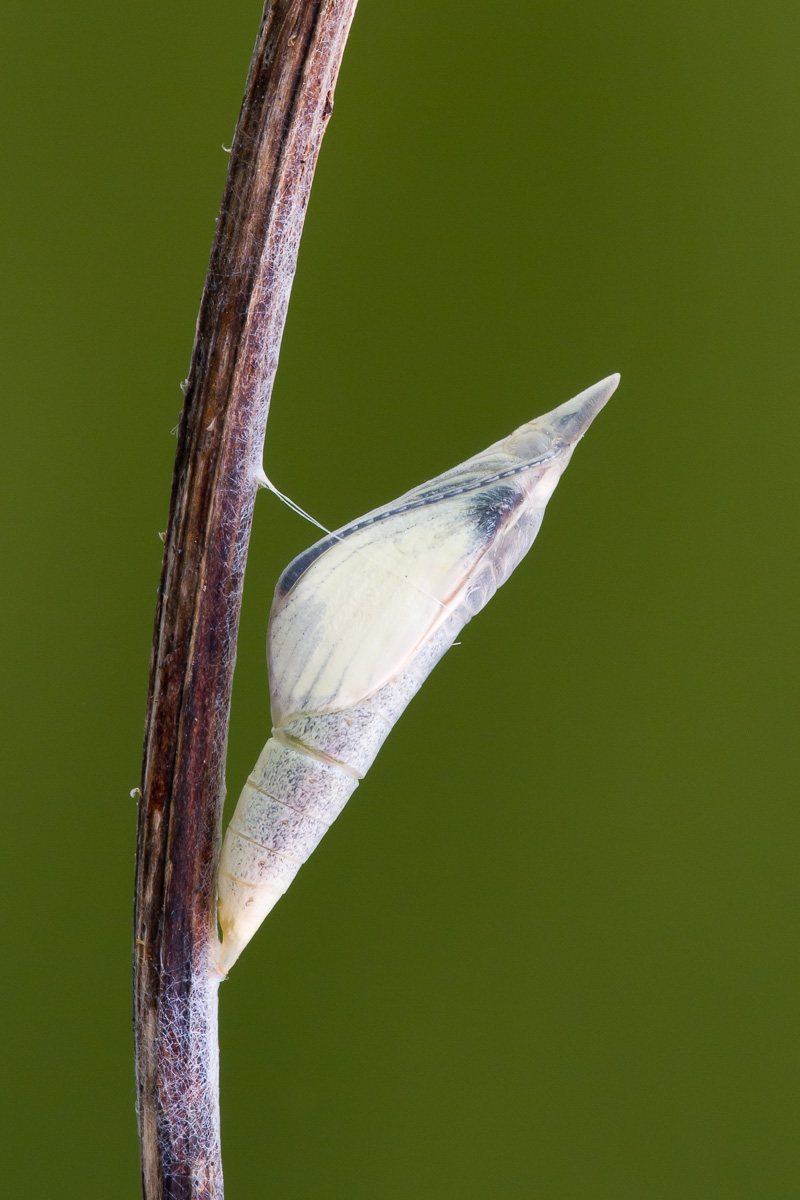
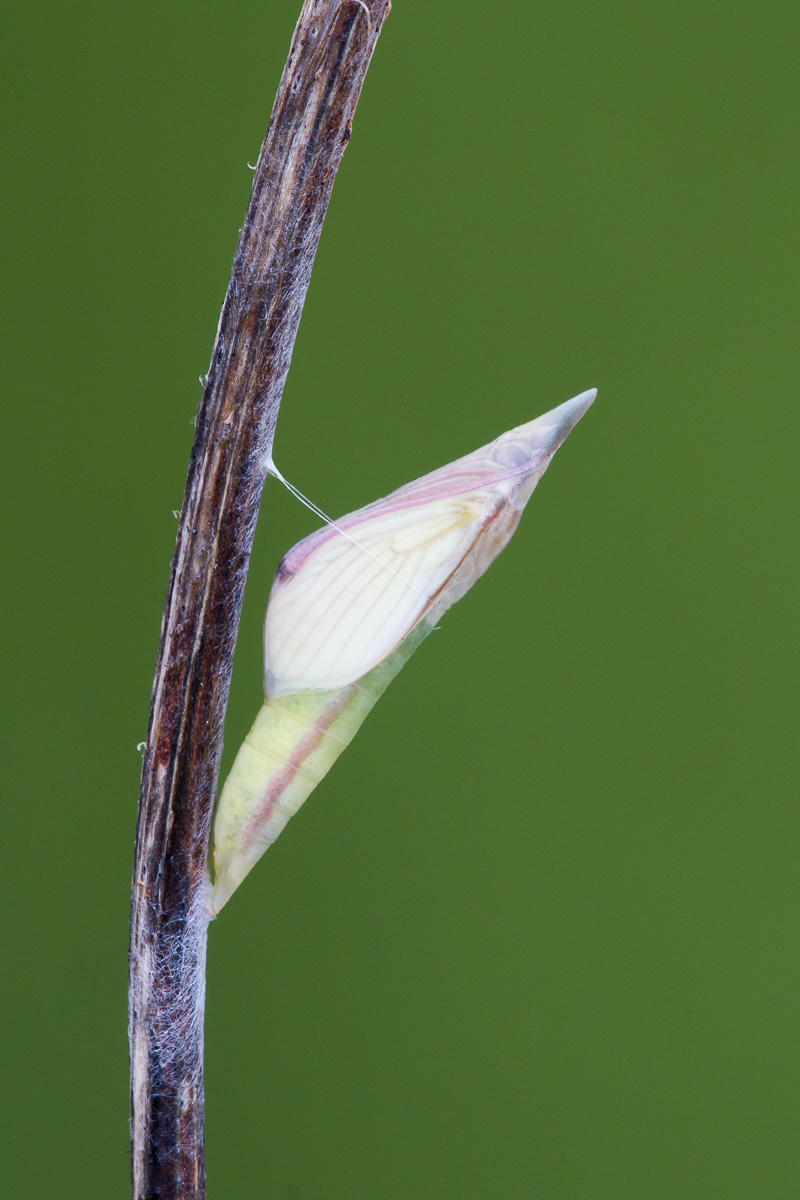
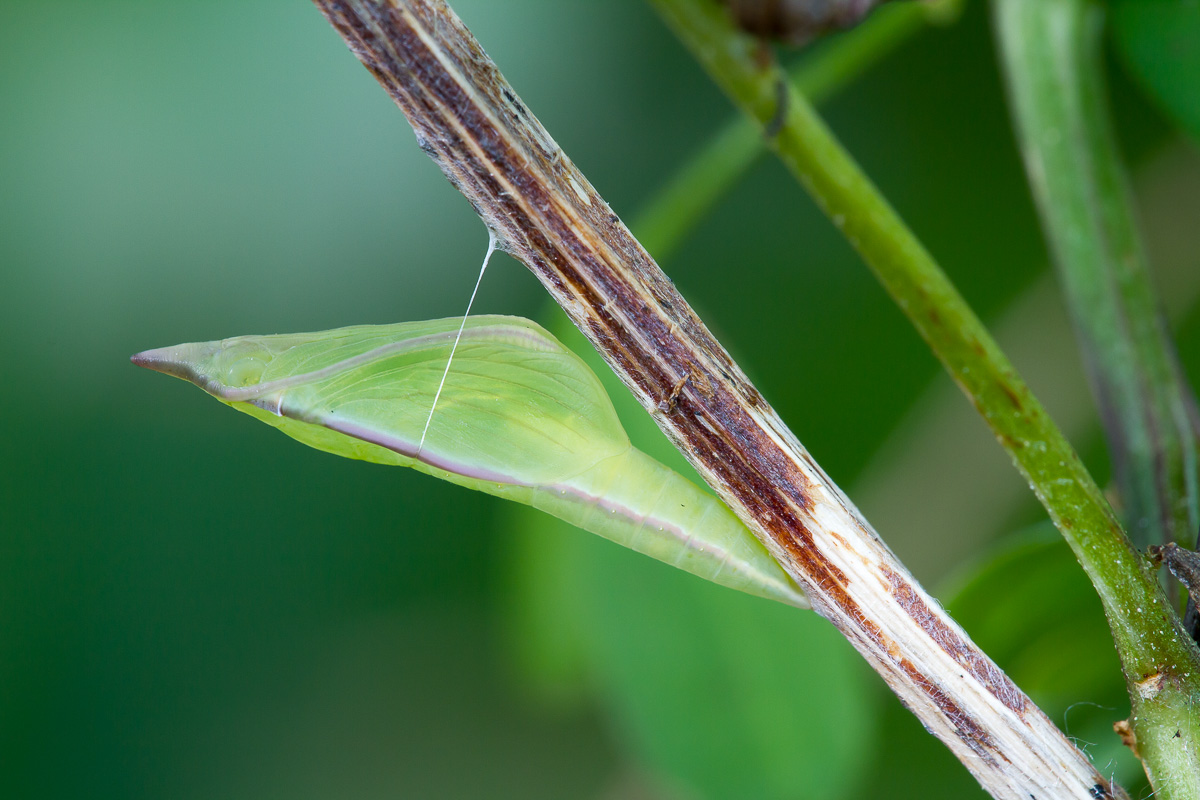
The pupa is primarily green, although the wing edges and veins are a beautiful pink. It is attached to the stem by a silken girdle and the cremaster. Those pupae that do not give rise to a new generation in the same year overwinter.
"The pupa measures 16 mm. long; in form it is intermediate between Euchloe cardamines [Anthocharis cardamines, Orange-tip] and Colias edusa [Colias croceus, Clouded Yellow], but also bears a close resemblance to a miniature Gonopteryx rhamni [Brimstone], but is much more slender. The head terminates in a rather long, pointed and slightly upturned beak; the thorax is swollen, sunken at the meta-thorax and swollen at the basal abdominal segments, and slightly sunken again at the middle segments; it then takes a gentle curve to the anal segment, which is flattened at the extremity and bears the cremastral hooks, which are firmly attached to a pad of silk spun on the stem of the plant supporting the pupa. The costal margin of the wing is much arched in the middle; the wing surface is flat and the inner margin forms a ridge; the antennae run along the costal margin, forming a keel. At first the colour is a clear light green, the abdomen yellow-green, the beak and antennae gradually turn to a delicate lilac-pink; a lilac stripe runs along the inner wing margin, which blends into the whitish spiracular line, bordered above by a slightly darker green than the ground colour; the medio-dorsal line is also dark green which is bordered on either side by a whitish line, and a very fine line, almost black, runs down the centre of the head and thorax; the neuration is very faintly outlined with darkish streaks. Such is the description when three days old. When the pupa is seven days old the pink on the beak and antennae becomes faded and the wings assume a lemon-yellow, the eyes grey, the thorax and abdomen paler green. The general colouring and shape much resemble a withered and partly eaten leaf of the food plant. The spiracles are white, the lilac-pink markings vary considerably in different individuals; in some, they extend in a continuous line from the beak, along the inner margin of the wing and the spiracular line to the anal segment. The antennae and neuration are also outlined with the same colour. Those boldly marked with pink have generally a paler green ground colour. Shortly before emergence the whole colouring of the imago is distinctly visible through the delicate pupal skin. The first specimen, a male, emerged on July 26th, the pupal stage occupying eight days. The above description applies to the pupae producing the second brood. The pupa is attached by the cremastral hooks to a pad of silk and by a silken cincture round the body. As there is usually but one brood in the season in the British Isles, the normal period of the pupal existence is about ten months, as the Wood White hibernates in the pupal state." - Frohawk (1924)
The following links provide additional information on this butterfly.