UK Butterflies
Building a Community of Responsible Butterfly Enthusiasts in Britain & Ireland
Building a Community of Responsible Butterfly Enthusiasts in Britain & Ireland
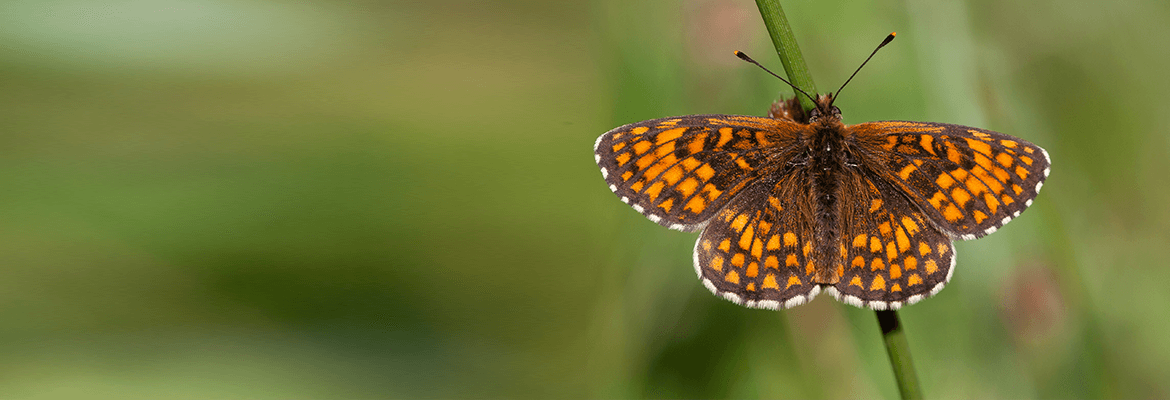
Wingspan
♂ 39 - 44 mm, ♀ 42 - 47 mm
Checklist Number
59.036
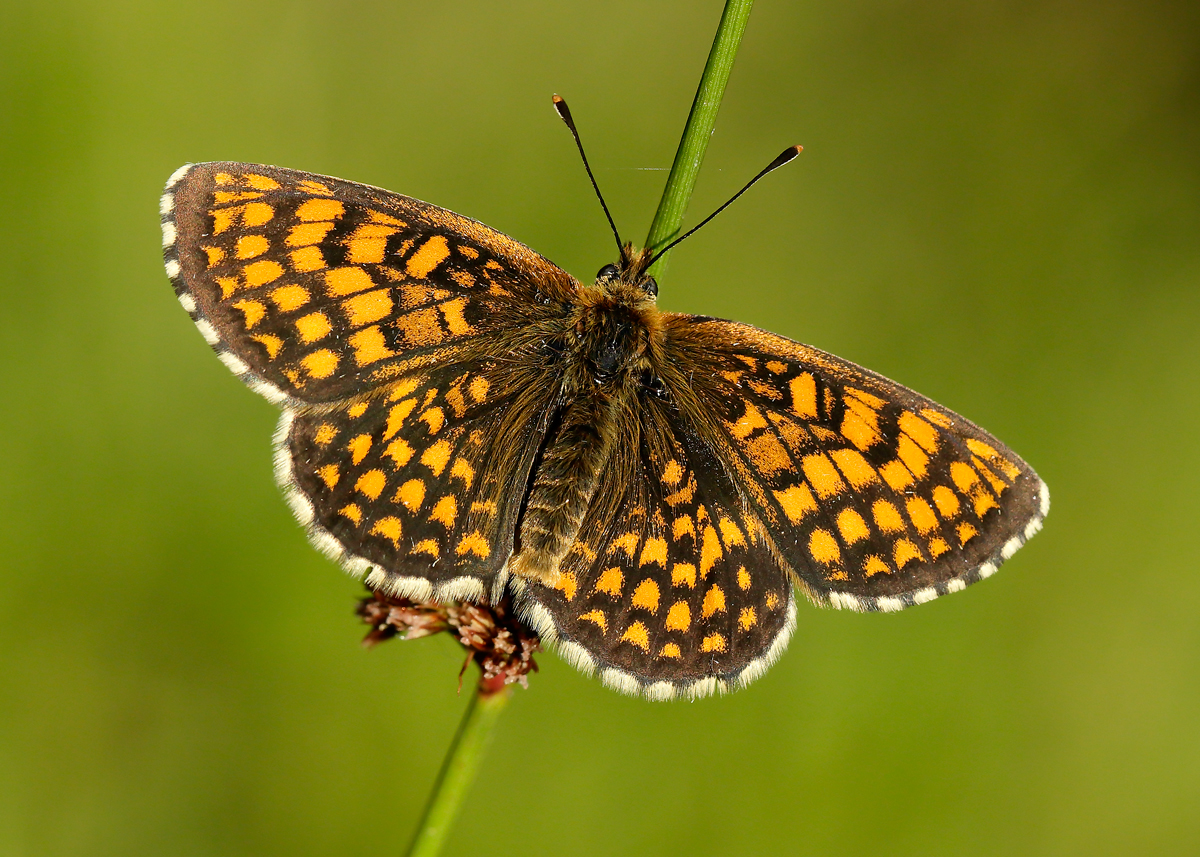
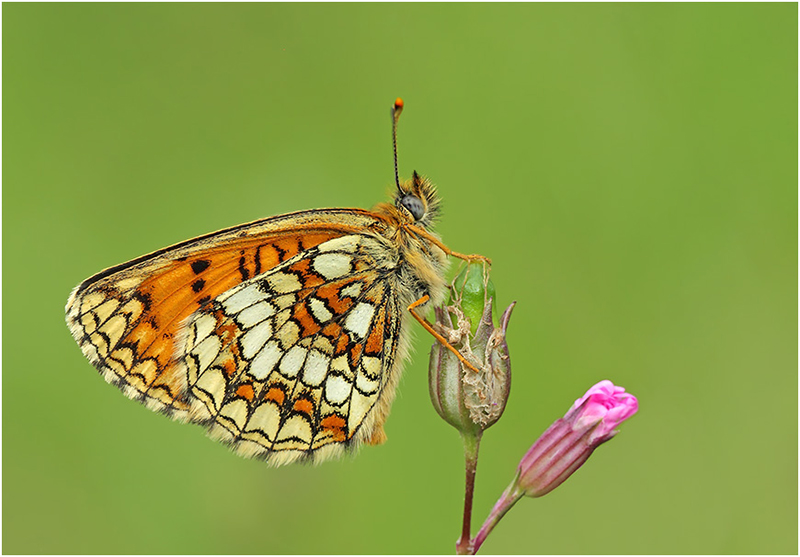
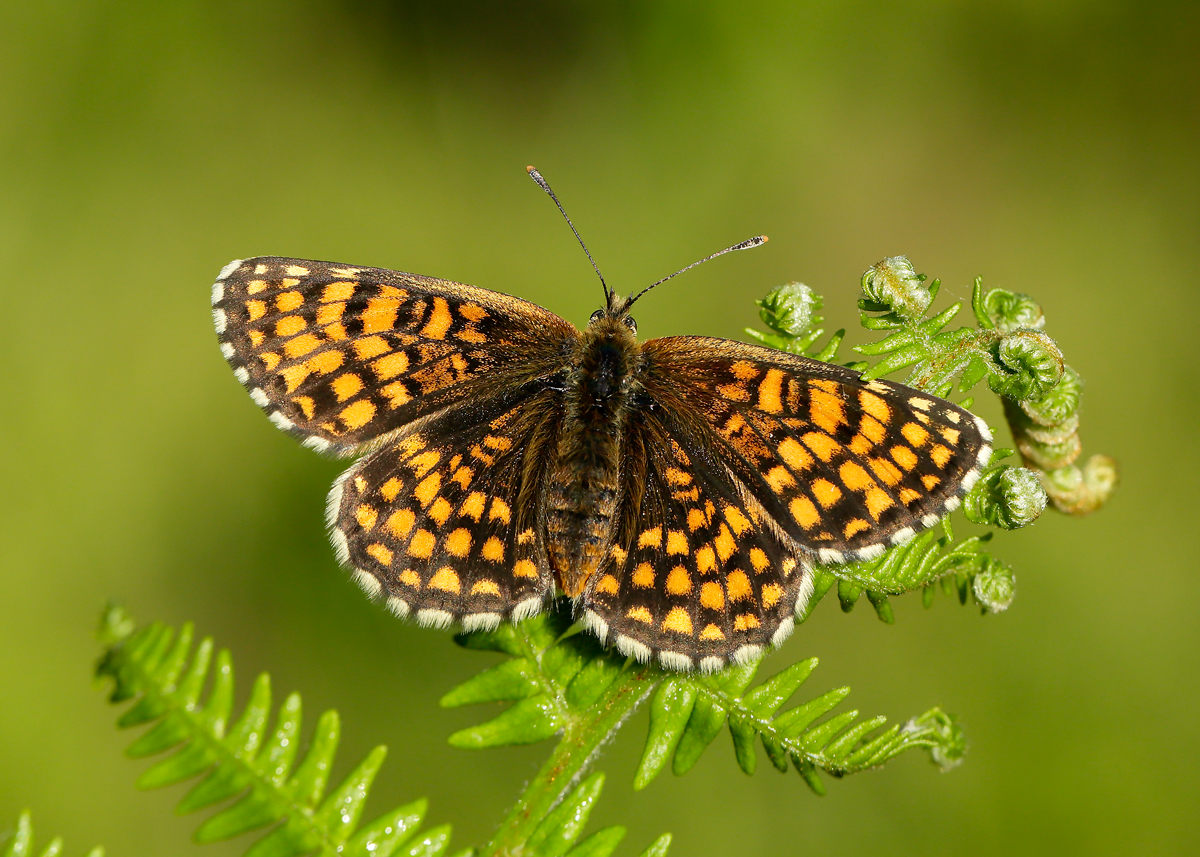
The Heath Fritillary is one of our rarest butterflies and was considered to be on the brink of extinction in the late 1970s. Strange as it may sound, the extinction of the Large Blue in 1979 was to work in favour of this species, since the shock felt by many entomologists resulted in a renewed effort to conserve the Heath Fritillary. This required detailed knowledge of this butterfly's requirements and, as a result of research conducted by Martin Warren, appropriate habitat management plans were put into effect that saved this butterfly from extinction.
This butterfly is confined to a small number of sites in Somerset, Devon and Cornwall in south-west England, and in Kent in south-east England, where it has also been reintroduced into sites in Essex. It is absent from Wales, Scotland, Ireland, the Isle of Man and the Channel Islands. Although very local in its distribution, this butterfly can be seen in large numbers at some sites in good years. This butterfly is widespread on the continent and can be one of the commonest butterflies seen in some regions. This butterfly forms discrete colonies and rarely strays from the main breeding grounds.
| Family: | Nymphalidae | Rafinesque, 1815 |
| Subfamily: | Nymphalinae | Rafinesque, 1815 |
| Tribe: | Melitaeini | Newman, 1871 |
| Genus: | Melitaea | Fabricius, 1807 |
| Subgenus: | ||
| Species: | athalia | (Rottemburg, 1775) |
Description to be completed.
The distribution data (2000-2009) has been made available through the generosity of Butterfly Conservation and any subspecies distribution is taken from Riley (2007). Click here to see the distribution of this species together with site information overlaid.
Colonies in south west England are found on heathland, as well as on rich grassland. Those in south east England are found in woodland. Whatever the habitat, this species requires areas that are relatively-warm. This could be a patch of heathland that has recently been burned or a newly-coppiced clearing in a wood. The butterfly will readily colonise such areas, which resulted in it being given the name of "woodman's follower" as it colonises new clearings that have been created in a wood.
Woodland colonies tend to use Common Cow-wheat and Foxglove as the larval foodplant, whereas those on other sites tend to use Ribwort Plantain and Germander Speedwell.
This butterfly has suffered a long-term decline and requires targeted habitat management. This species continues to be a priority species for conservation efforts.
The table below shows the occurrence (distribution) and abundance (population) trends, using information from The State of the UK's Butterflies 2015 (Fox, 2015). Any UK BAP status is taken from the UK Biodiversity Action Plan (UK BAP) (2007 review).
1976-2014 (%) | 1976-2014 (%) | 2005-2014 (%) | 2005-2014 (%) | Click here to access the Biodiversity Action Plan (BAP). |  -68 -68 | -87 |  -12 -12 | -79 |
|---|
At sites in the west country, this butterfly emerges from the second week of May, peaking in early June. The butterfly emerges at the end of May elsewhere, peaking in mid-June. There is one generation each year.

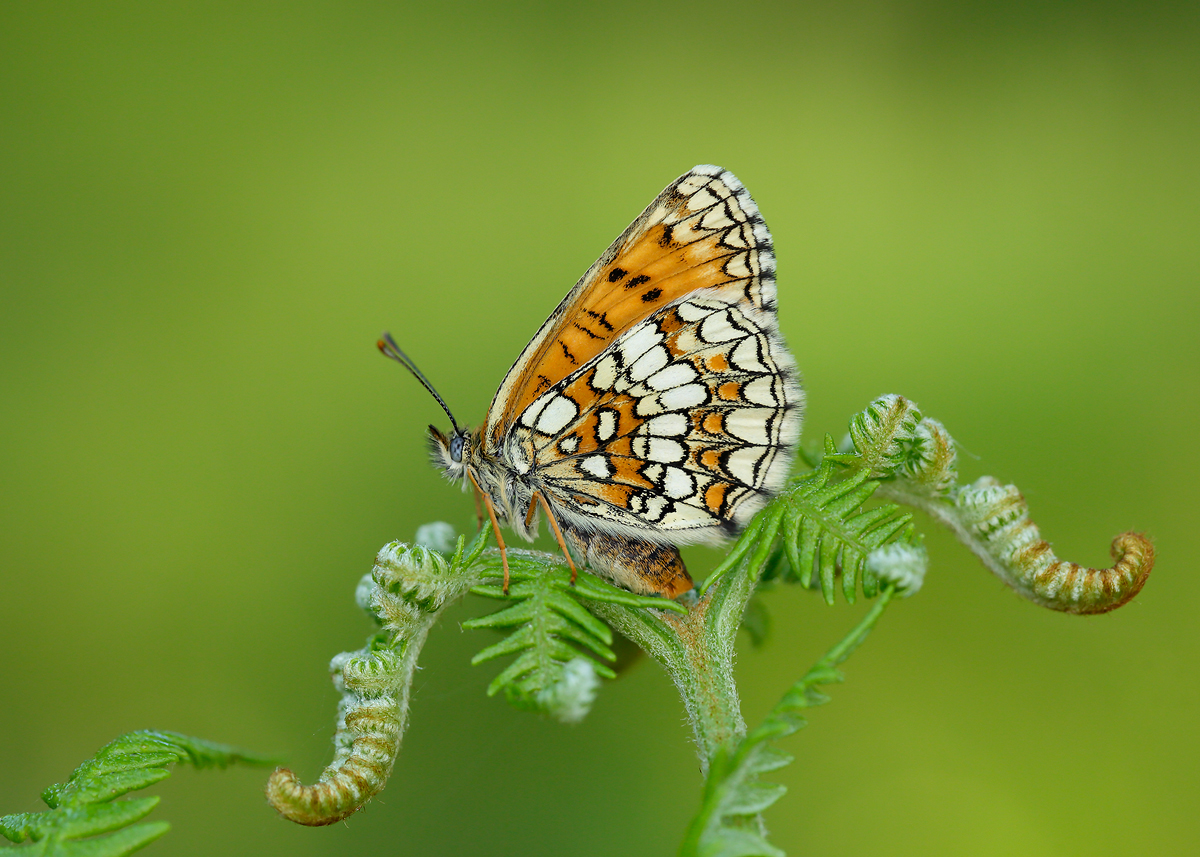
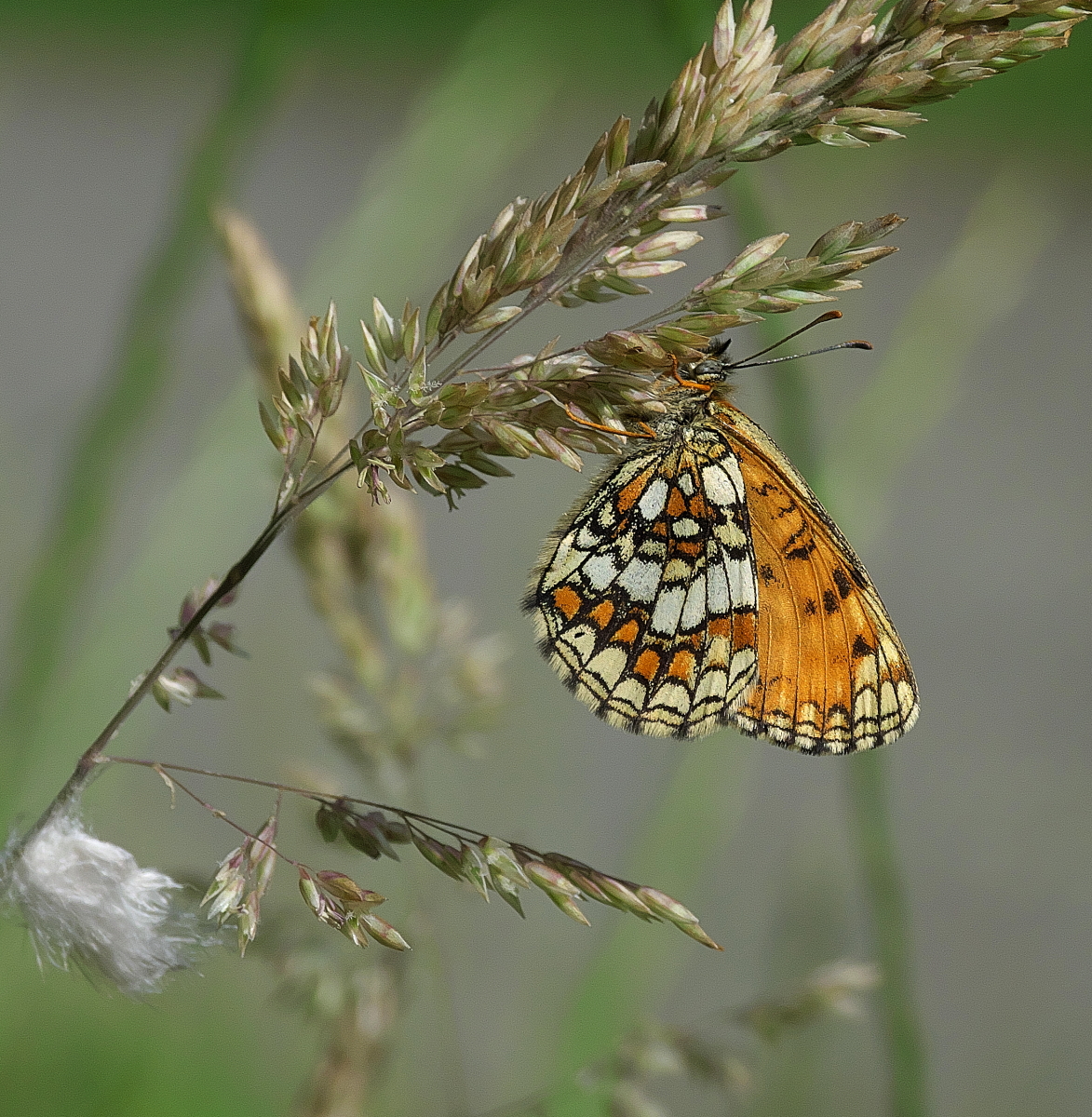
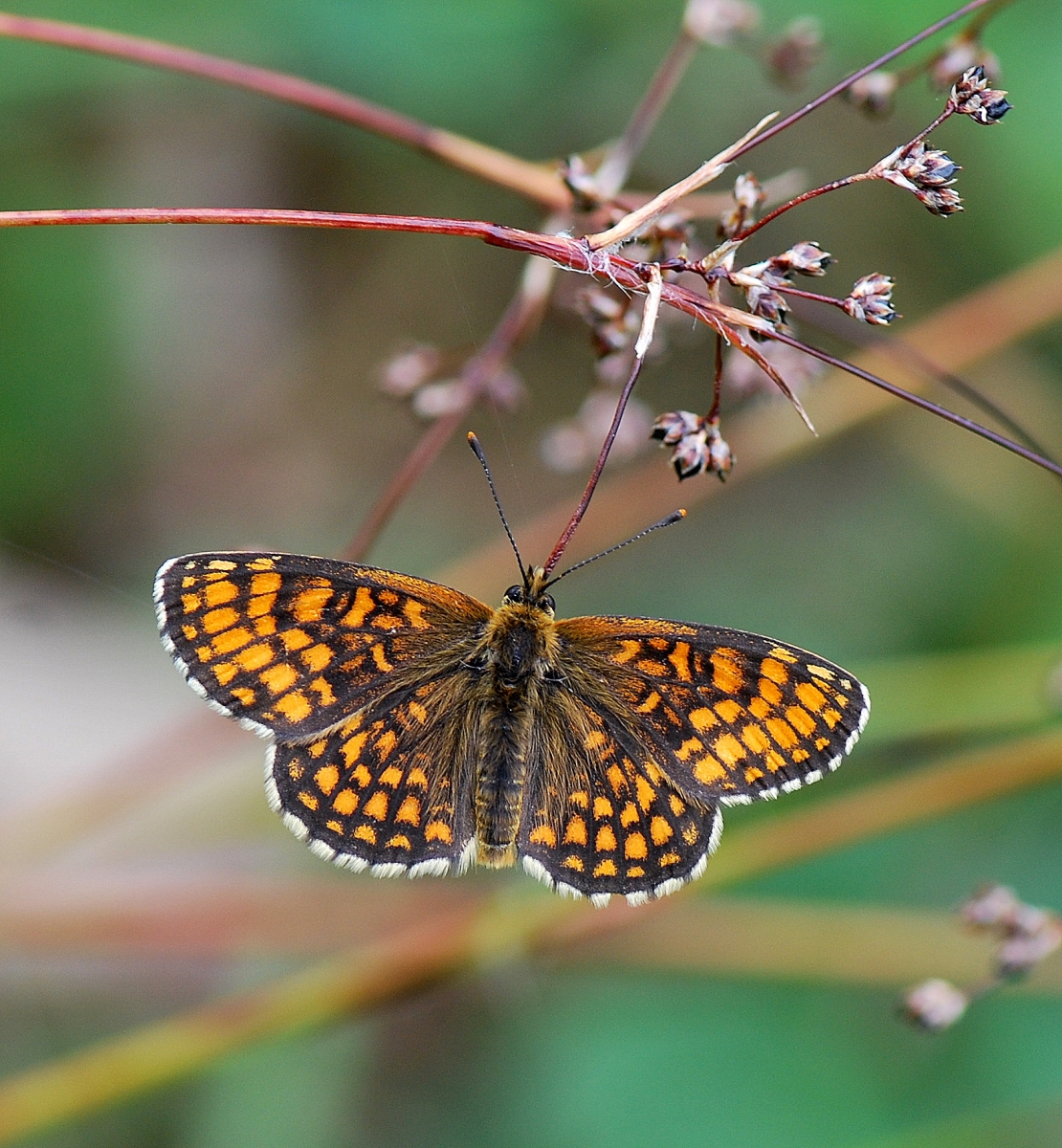
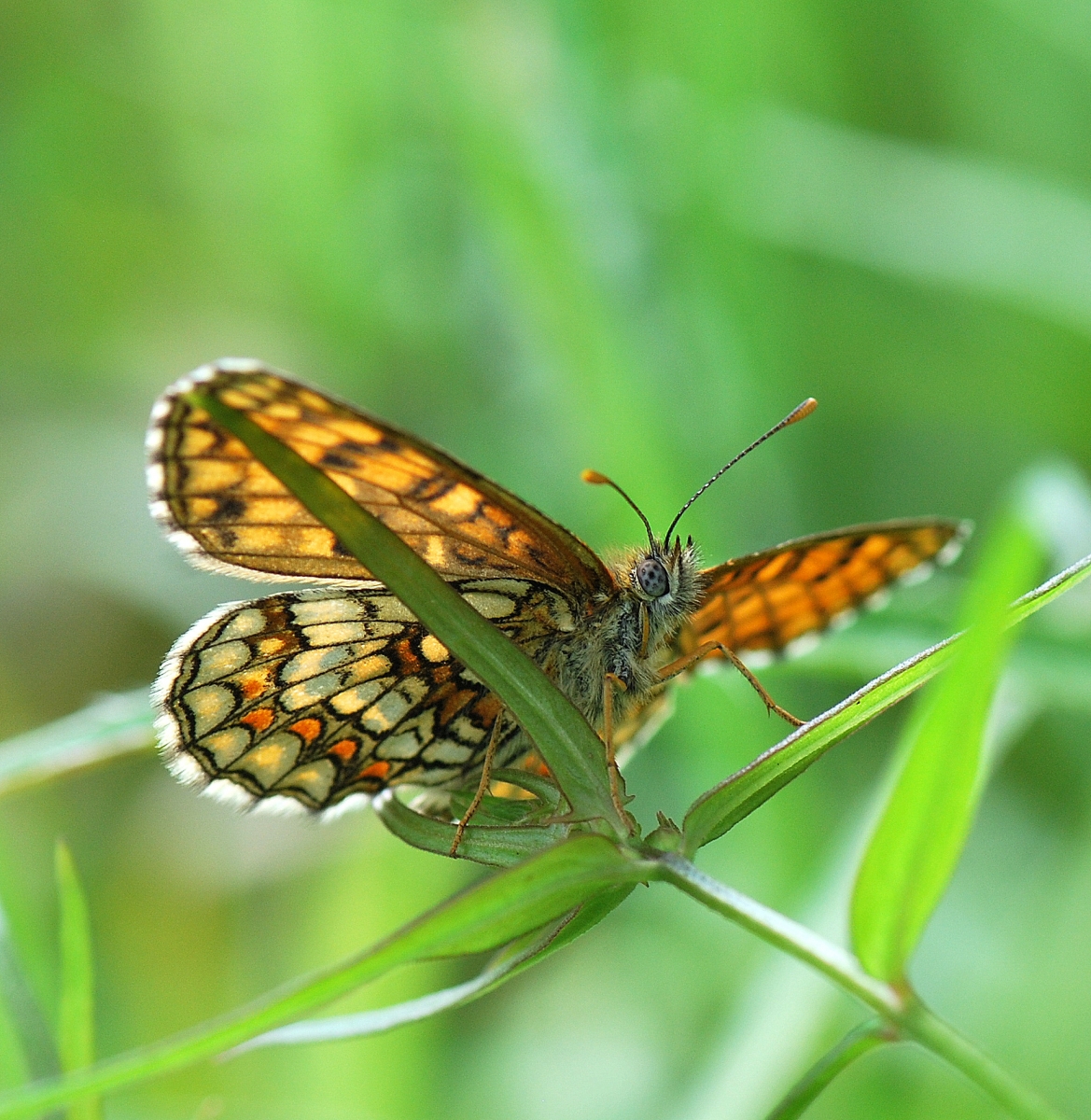
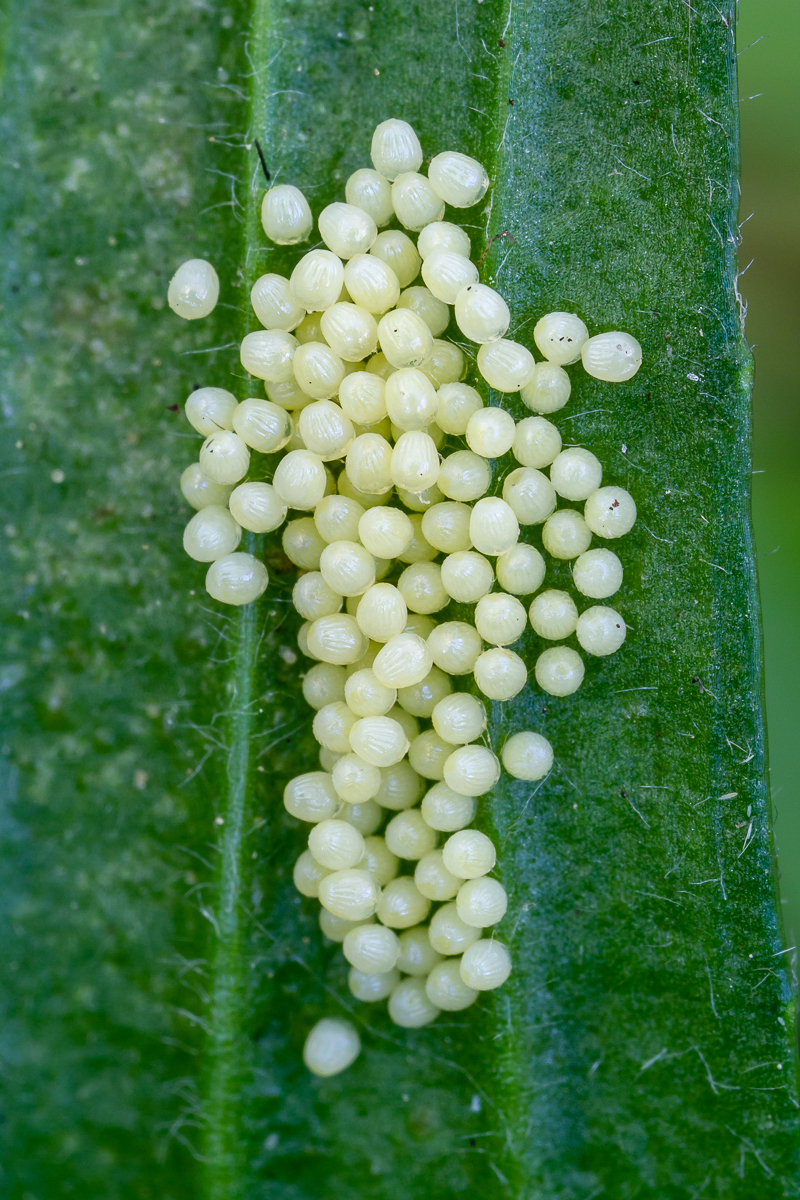
This butterfly is very variable in terms of both the colour and the pattern of the wings. The male is the more conspicuous of the two sexes as it patrols clearings in search of a mate. They can be seen flying close to the ground alternating a few flicks of their wings with a short glide. The female has a much more laboured flight, weighed down by her load of eggs. Having found a suitable area, she will crawl around the vegetation before laying an untidy batch of up to 150 eggs. These are typically laid close to the foodplant on the underside of a Bramble leaf, or on a dead leaf. Both sexes can often be found in the company of others as they bask on shrubs.
Adults feed primarily on brambles (Rubus spp.). Bugle (Ajuga reptans), buttercups (Ranunculus spp.), heathers (Calluna and Erica spp.), knapweeds (Centaurea spp.) and Tormentil (Potentilla erecta) are also used.
Eggs are pale green when first laid, but soon turn pale yellow in colour. Eggs hatch in around 2 weeks.
"On June 23rd, 1907, the author captured three females in Sussex. All three were placed on growing plants of narrow-leaved plantain (Plantago lanceolata) the next day. During the following few days the weather remained dull and cloudy, but on the 27th, with a little sunshine, one laid a small batch of 27 eggs on the under surface of a leaf. On the 28th another laid a larger batch of 97 eggs between 2.30 and 5 p.m. She remained the whole time hanging on the leaf with abdomen extended and curved to the under side, and laid the eggs on an average of about one every thirty seconds. Upon examining the plants after they had done depositing it was found that one female had laid three batches of eggs - 138, 86, 76, amounting to 300 in all — another laid 216, and another 160; total laid, 676. The eggs are always laid in batches on the under side of the leaves. When first laid the egg is a very pale greenish-pearl-white, very gradually becoming slightly deeper in colour until the third day, when it assumes a tinge of pale lemon-yellow, chiefly in shadow. The egg is ovate in form, with a slightly flattened base; it is 0.51 mm. high and of rather less width; the crown is slightly pitted and the base smooth; there are about twenty-six shallow longitudinal ribs and it is finely striated transversely. Before hatching they turn to an opaque creamy-yellow, and finally the young larva shows plainly through the shell, the dark head filling up the crown. The eggs commenced hatching July 16th, 1907, remaining in the egg state sixteen days." - Frohawk (1924)
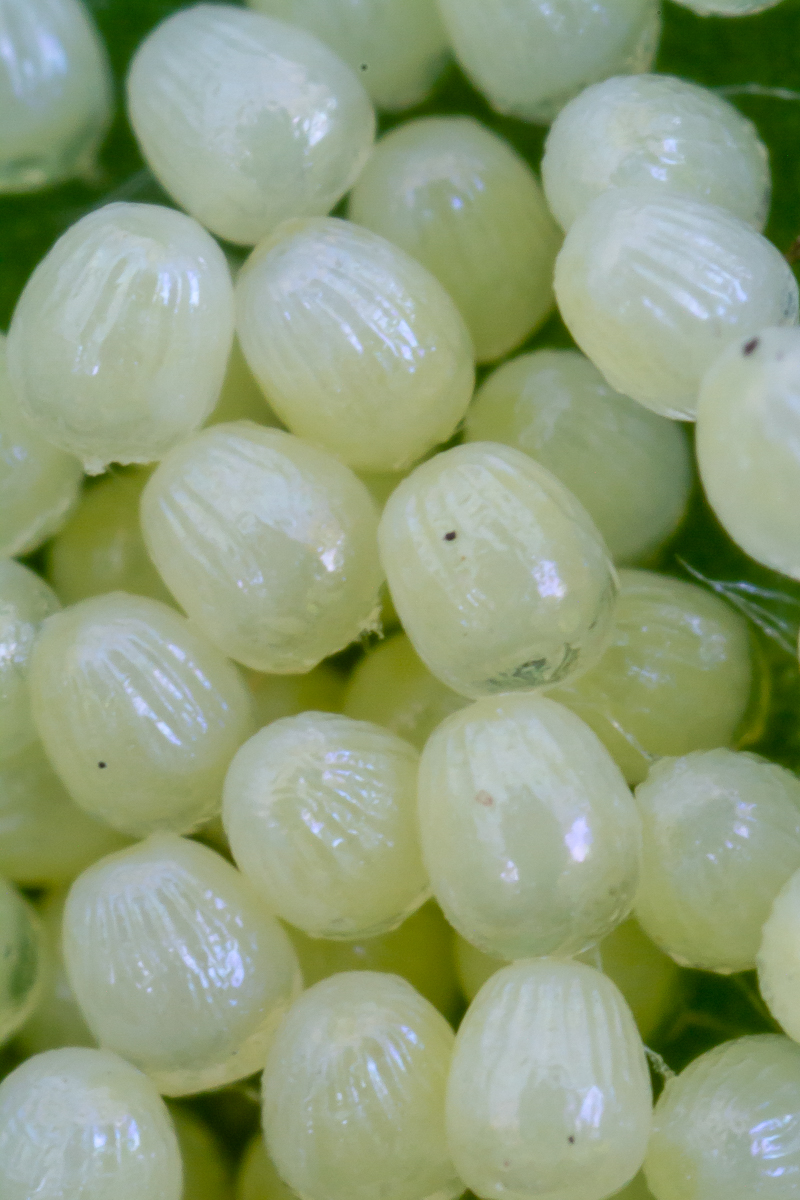
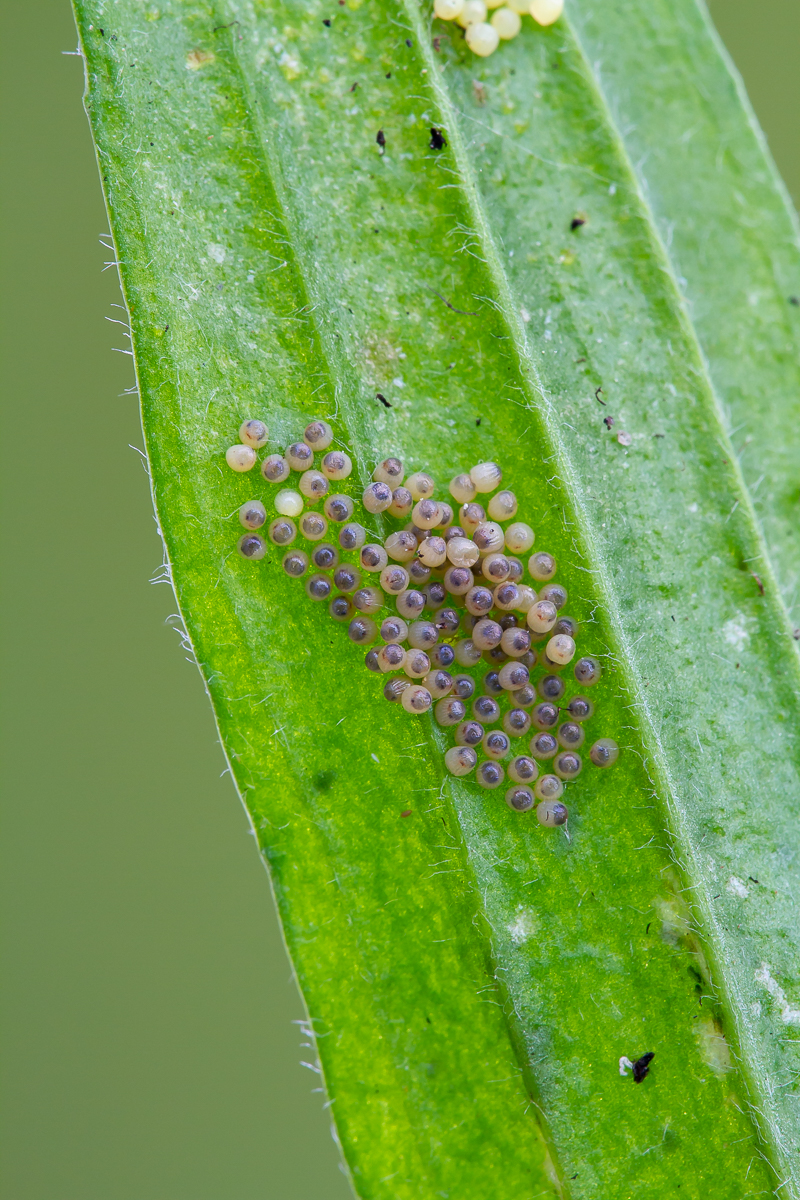
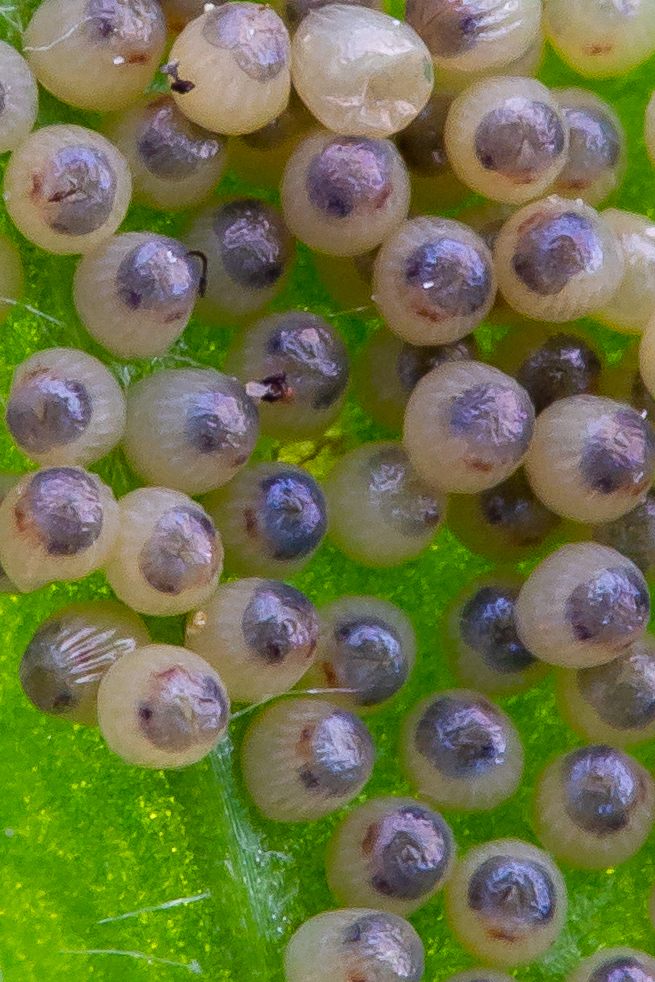
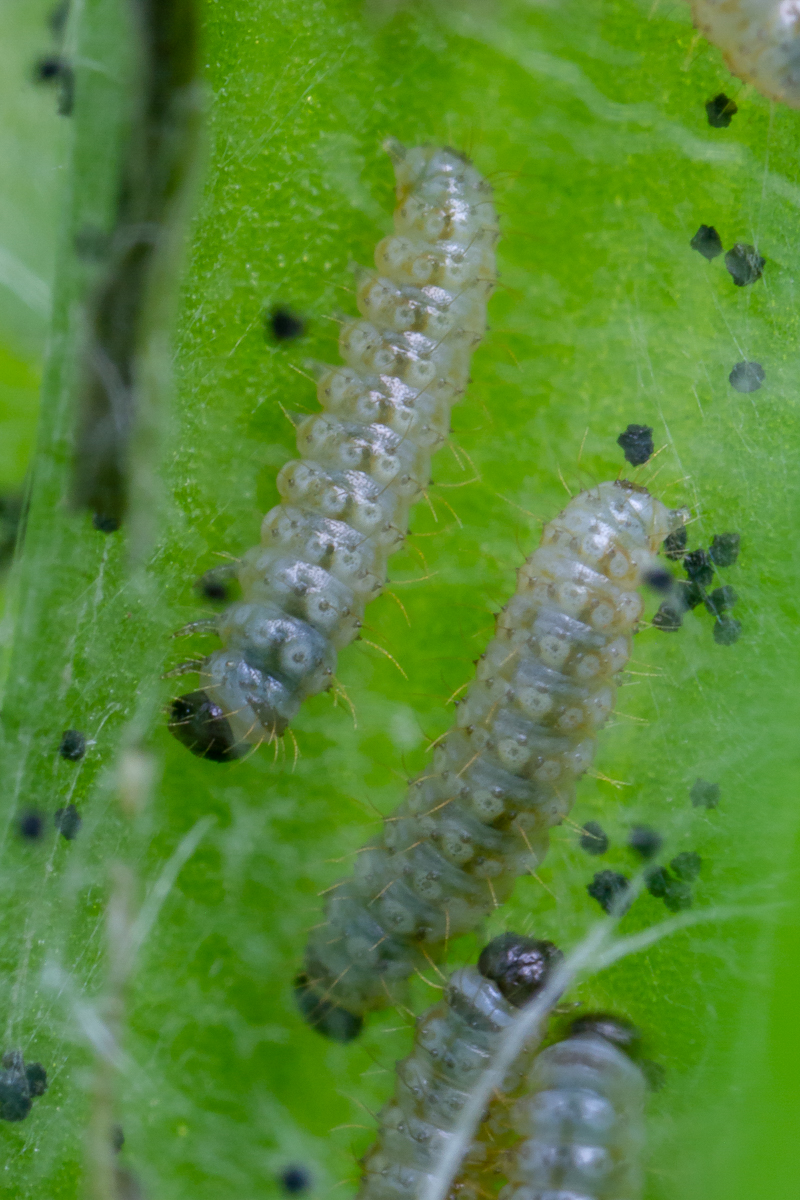
On hatching, newly-emerged larvae eat their eggshells before moving together to the foodplant, where they spin a loose silk web on which they bask and from which they feed. The larvae eventually divide into smaller groups, creating new webs as required, before ultimately separating to find a curled up dead leaf within which to hibernate, although they may be found together in twos and threes.
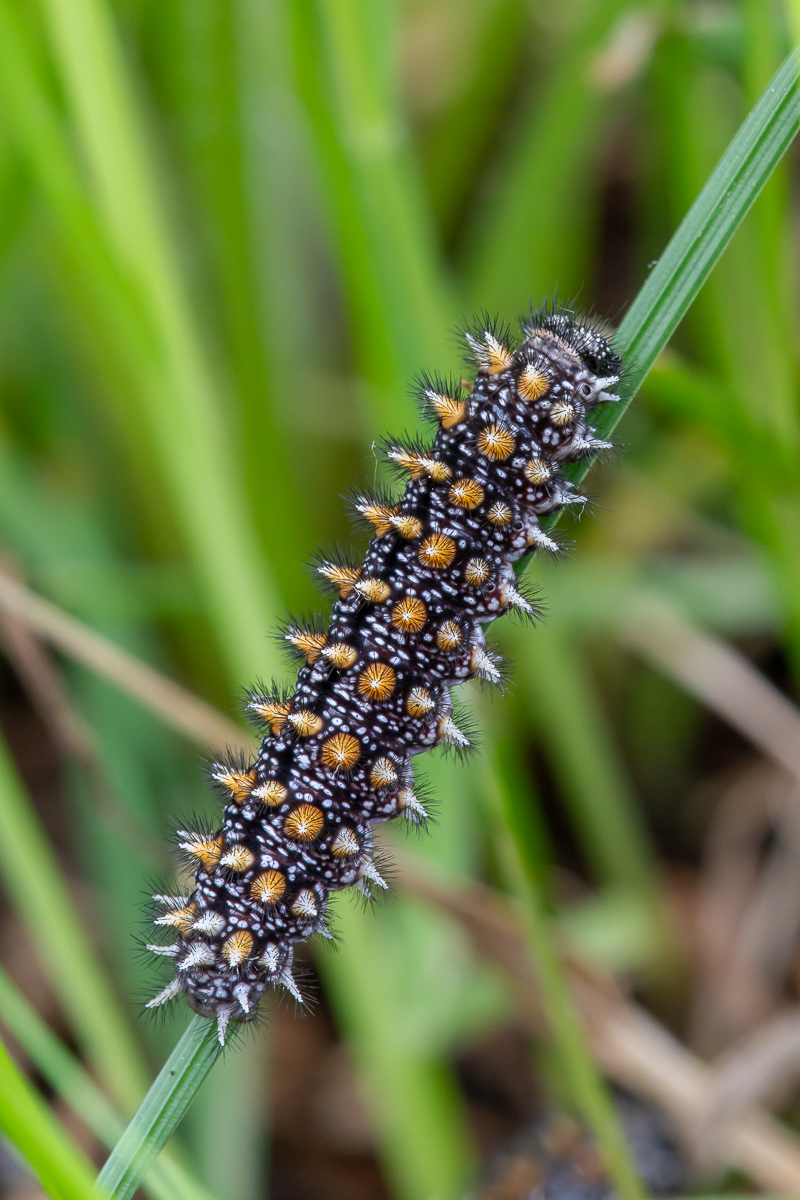
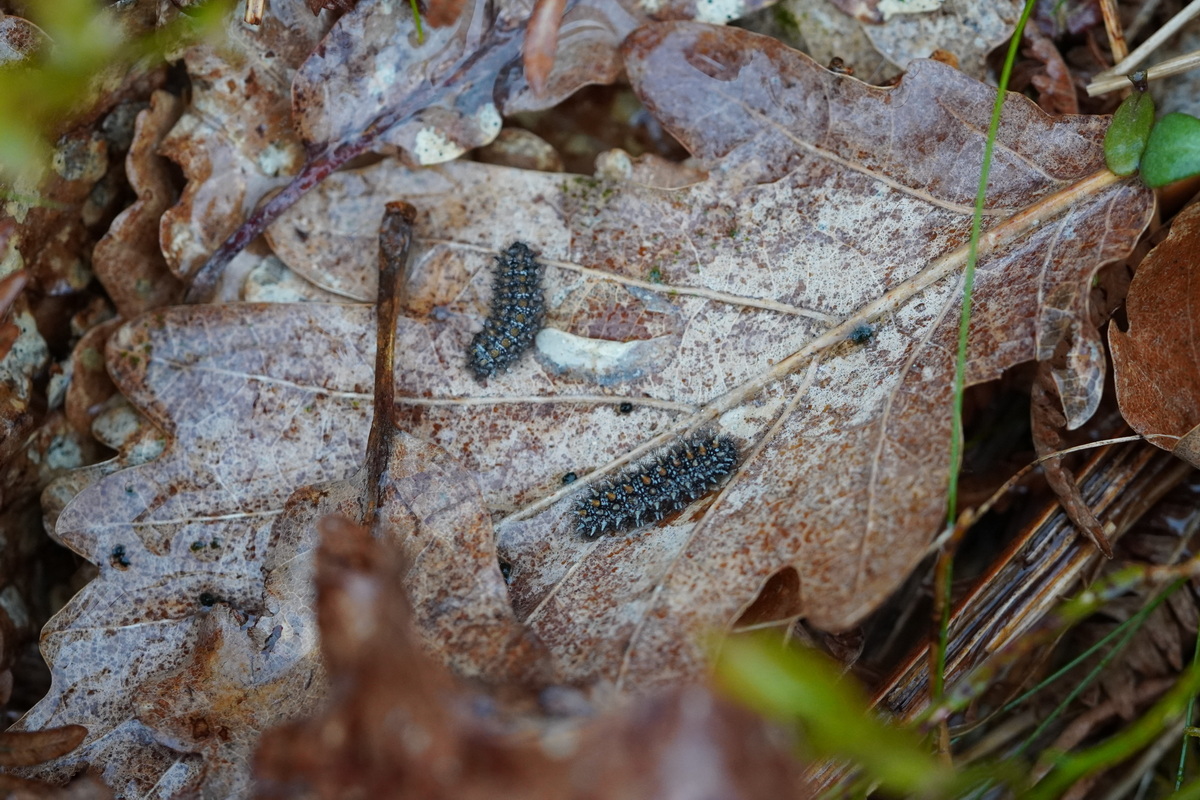
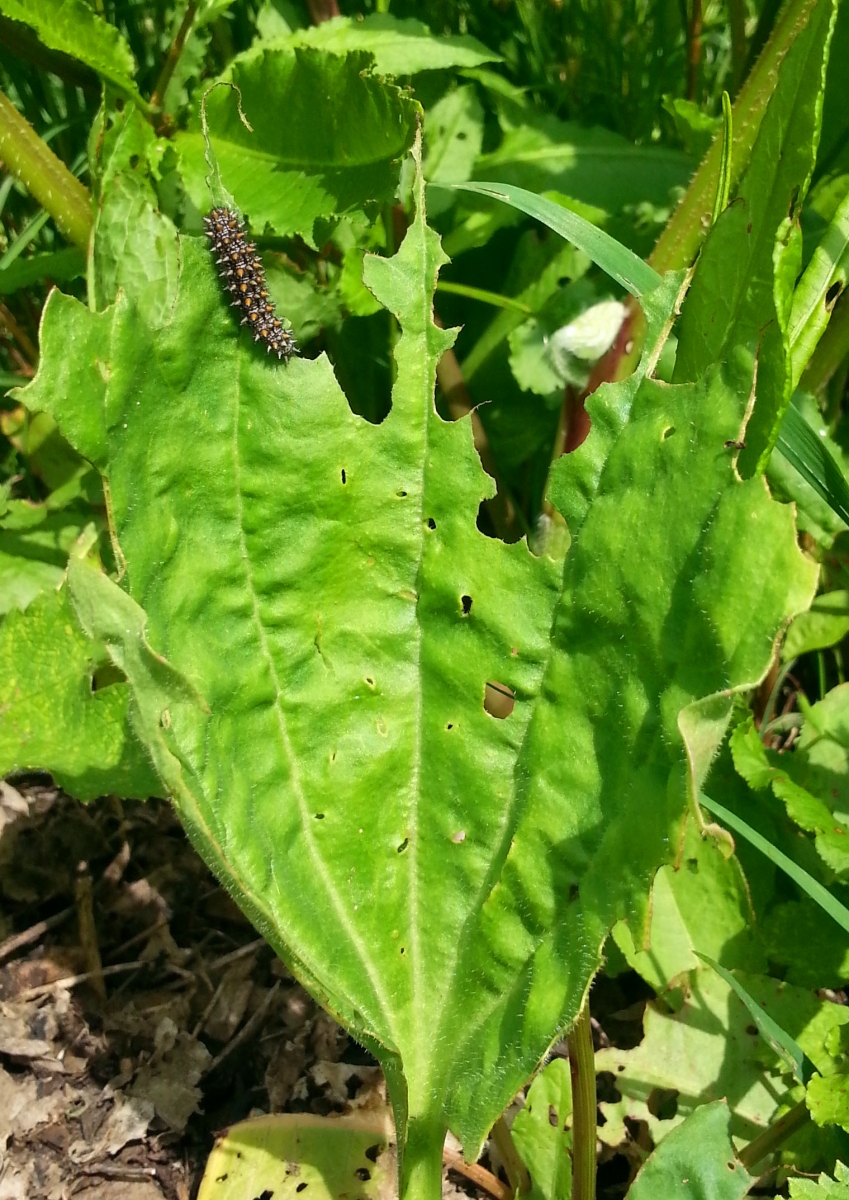
The larvae emerge in the spring and recommence feeding and can be seen basking in full sun as they absorb the sun's rays, when their higher body temperature aids digestion. There are 6 moults in total.
The primary larval foodplants are Common Cow-wheat (Melampyrum pratense) and Ribwort Plantain (Plantago lanceolata). Foxglove (Digitalis purpurea) and Germander Speedwell (Veronica chamaedrys) are also used.
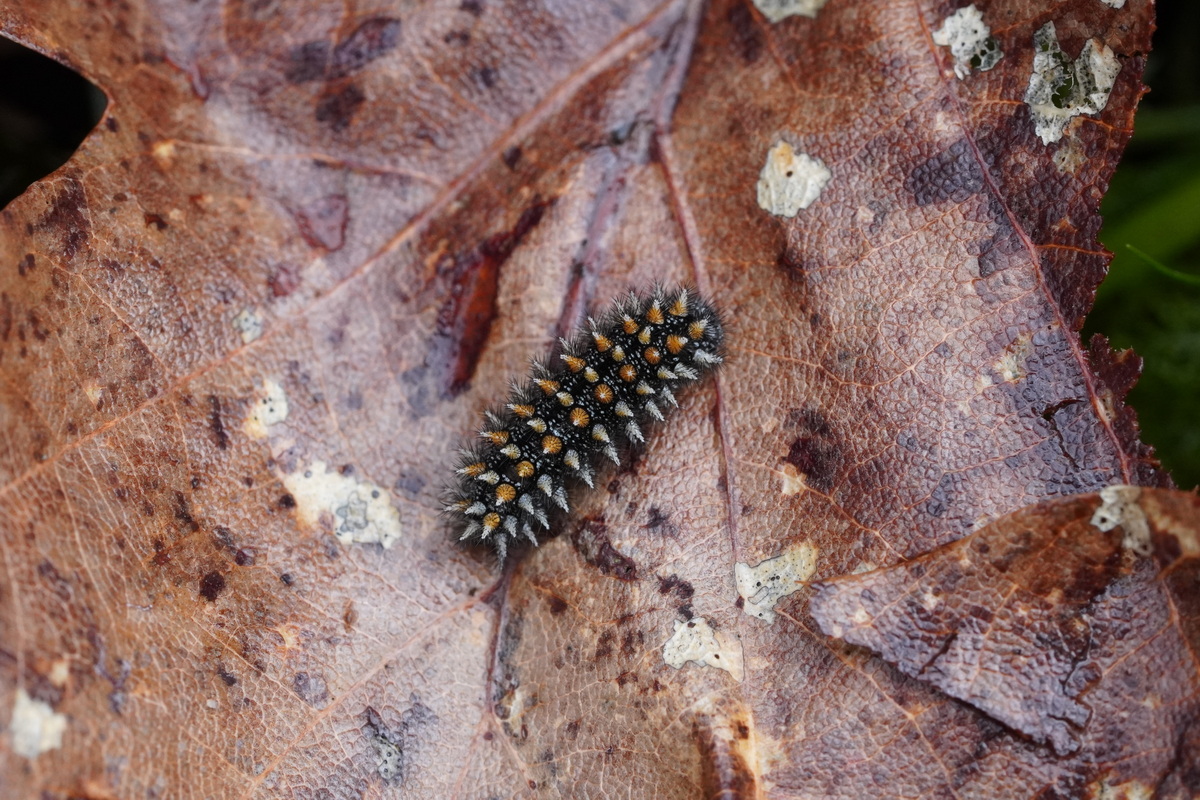
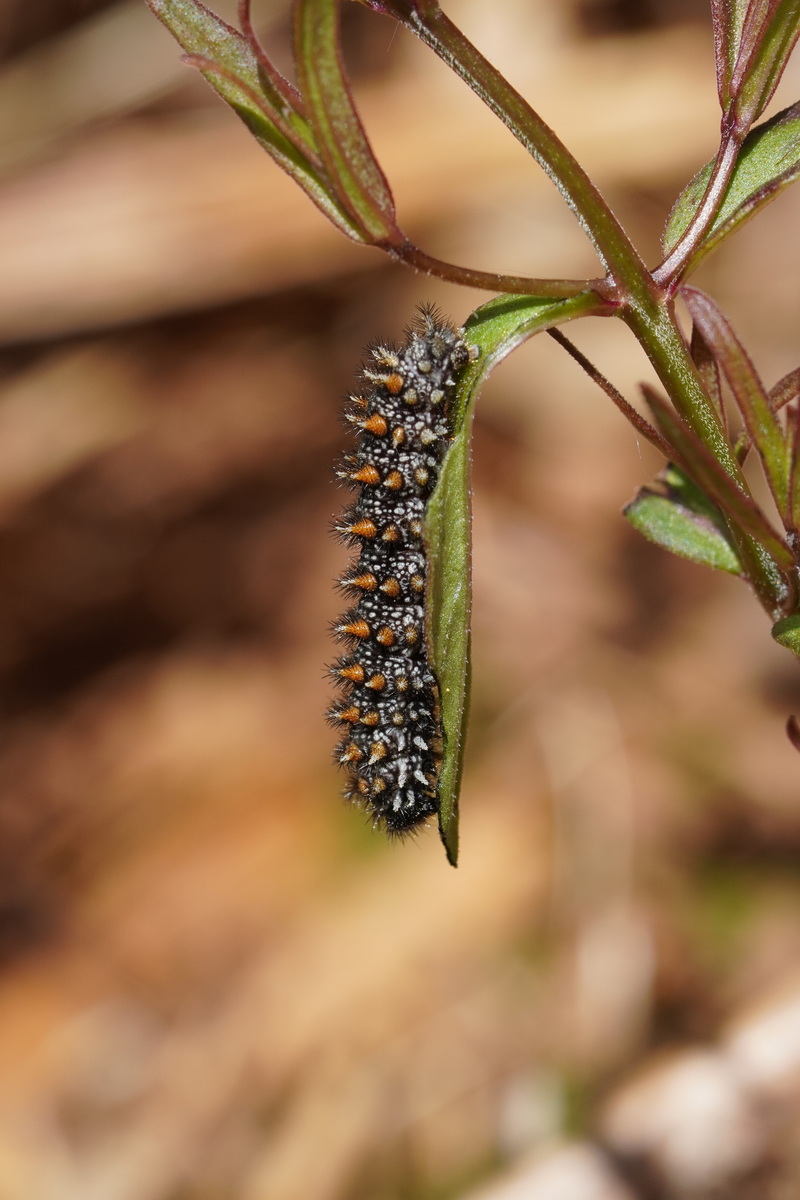
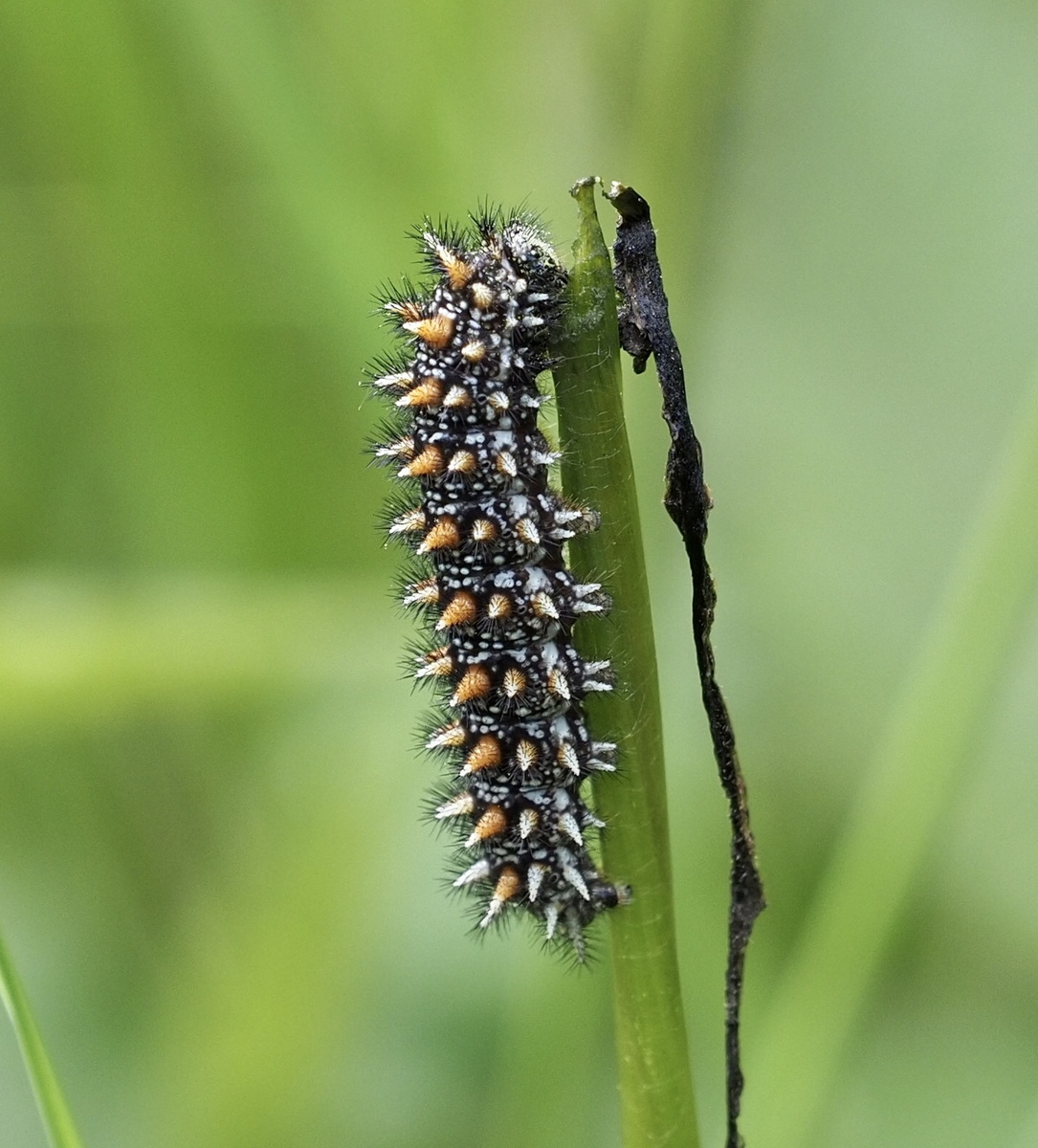
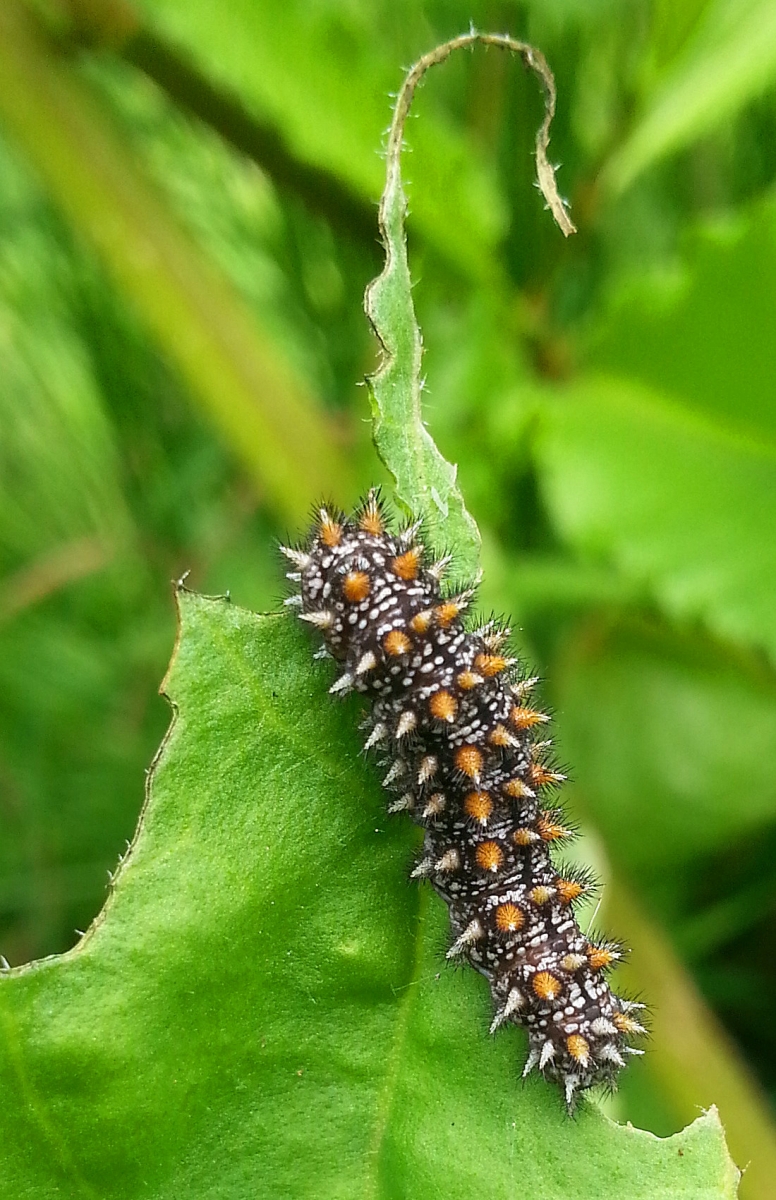
"The larva eats a circular hole out of the crown, through which it creeps, and remains on the batch of eggs for some time afterwards. Directly after emergence it measures 1.3 mm. long. The head is large and shining olive-black, and beset with numerous minute hairs; the body is entirely covered with extremely small darkish points. Along the dorsal surface are six longitudinal rows of long, curved, amber-brown, finely serrated hairs, with large bulbous bases, three on each dorsal half of each segment, and two other similarly formed hairs, one just behind the spiracle and one below; the first dorsal hair curves forwards, the second backwards, the others laterally and downwards; on the legs, claspers and ventral surface are numerous simple white hairs. The whole colouring of the body, legs and claspers is a very pale greenish-ochreous-white. The larva are gregarious, living in companies under a web on the under surface of the leaves, feeding on the cuticle and leaving only a thin membrane. They feed in little parties, and after a meal return to rest with the company." - Frohawk (1924)
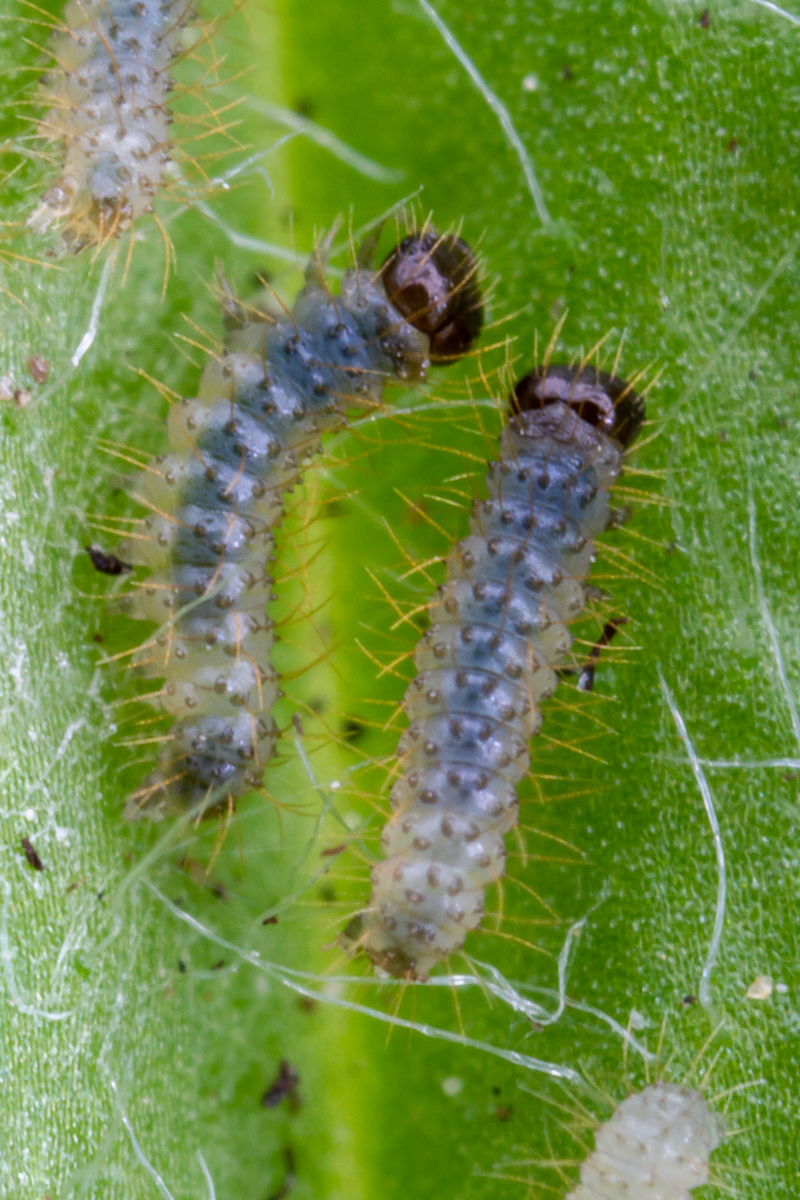
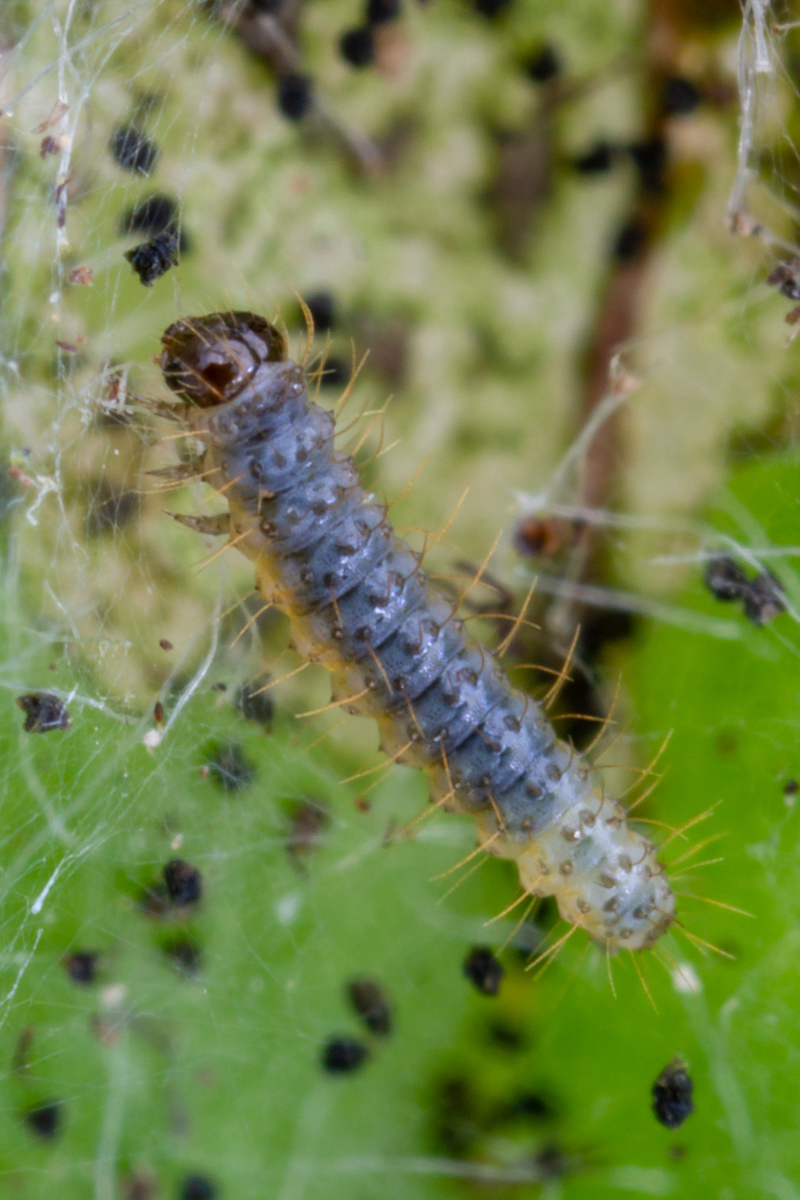
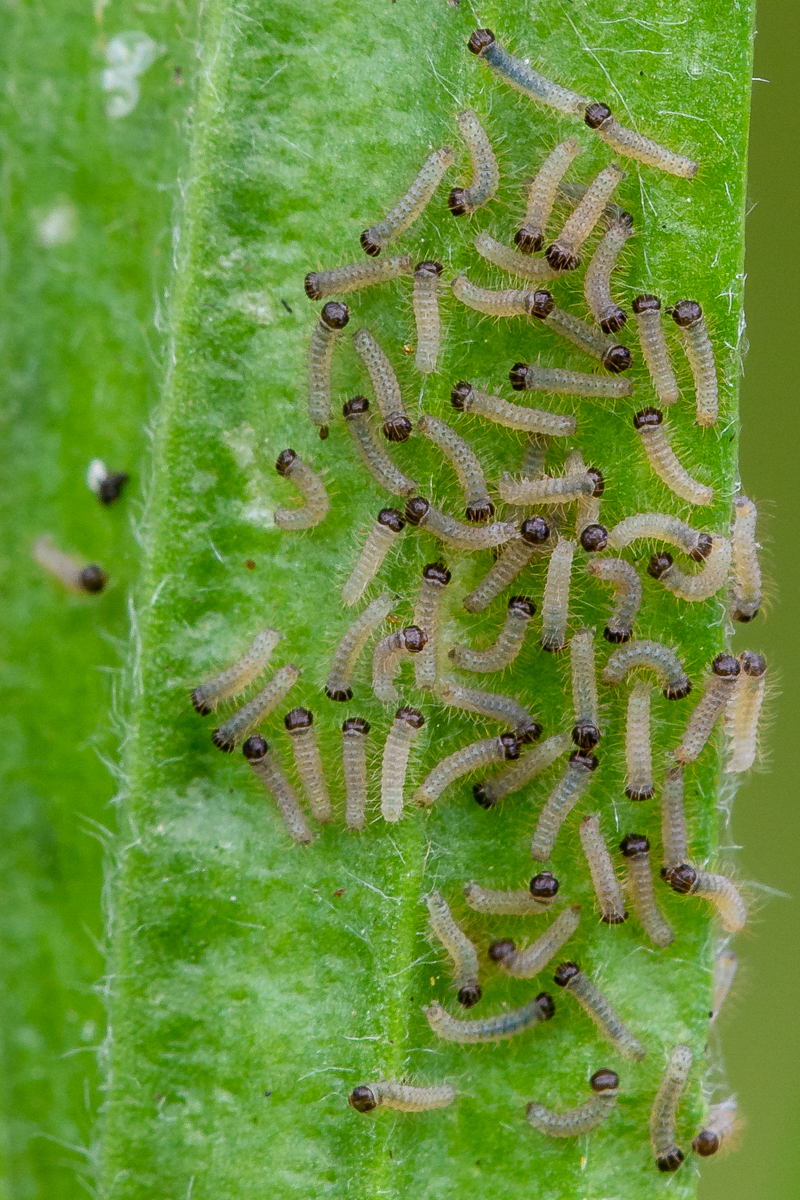
"The first moult took place on July 28th, the first stage occupying about twelve days. After the first moult, seventeen days old, it measures 3.5 mm. long. It is rather stout in proportion to the length. The head is shining black, beset with numerous hairs, both dark and light, and of various lengths. The body is considerably wrinkled transversely and densely scattered with tiny black points, and seven longitudinal series of pale olive-white tubercles, each bearing several long, finely pointed, black, serrated spines; they are situated medio-dorsal, sub-dorsal, super and sub-spiracular, and along the lateral and ventral surface are short bulbous tubercles bearing similar spines, but of a paler ochreous colour; the legs and claspers are dusky-olive, and beset with ochreous-coloured, simple, finely pointed hairs. They live and feed in the same manner as in the previous stage." - Frohawk (1924)
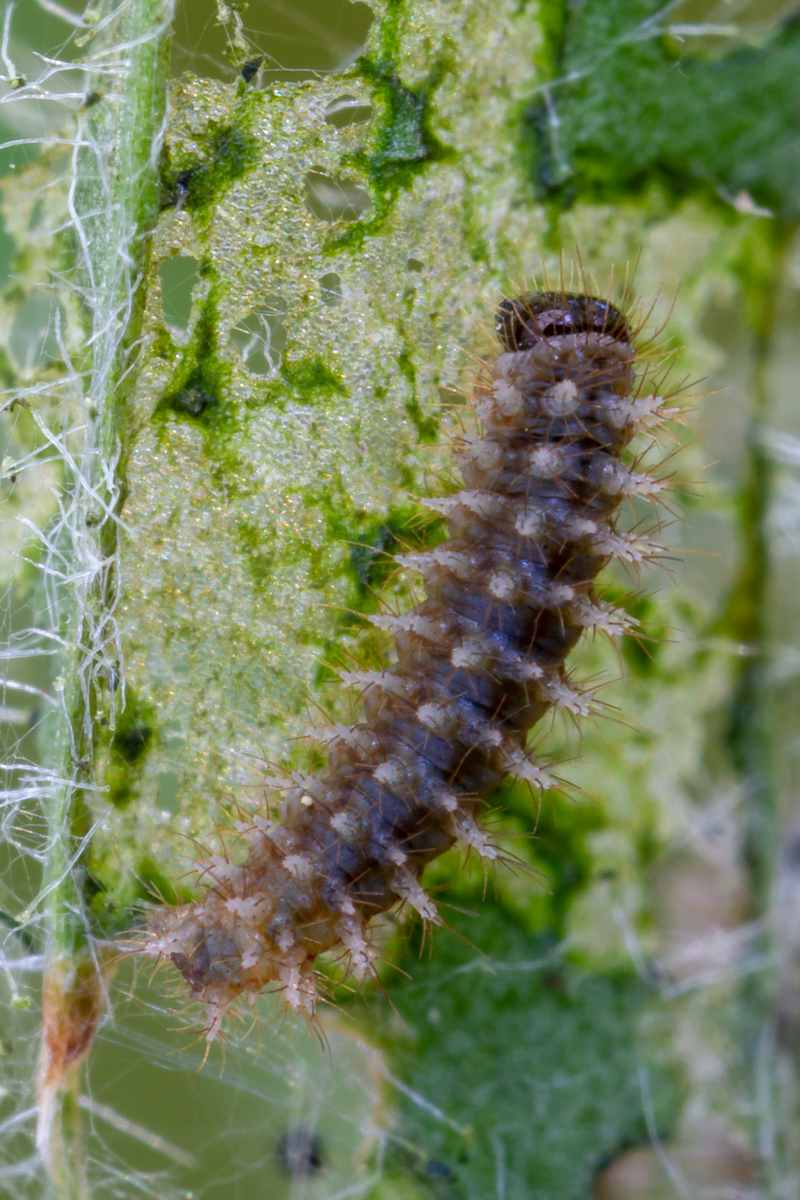
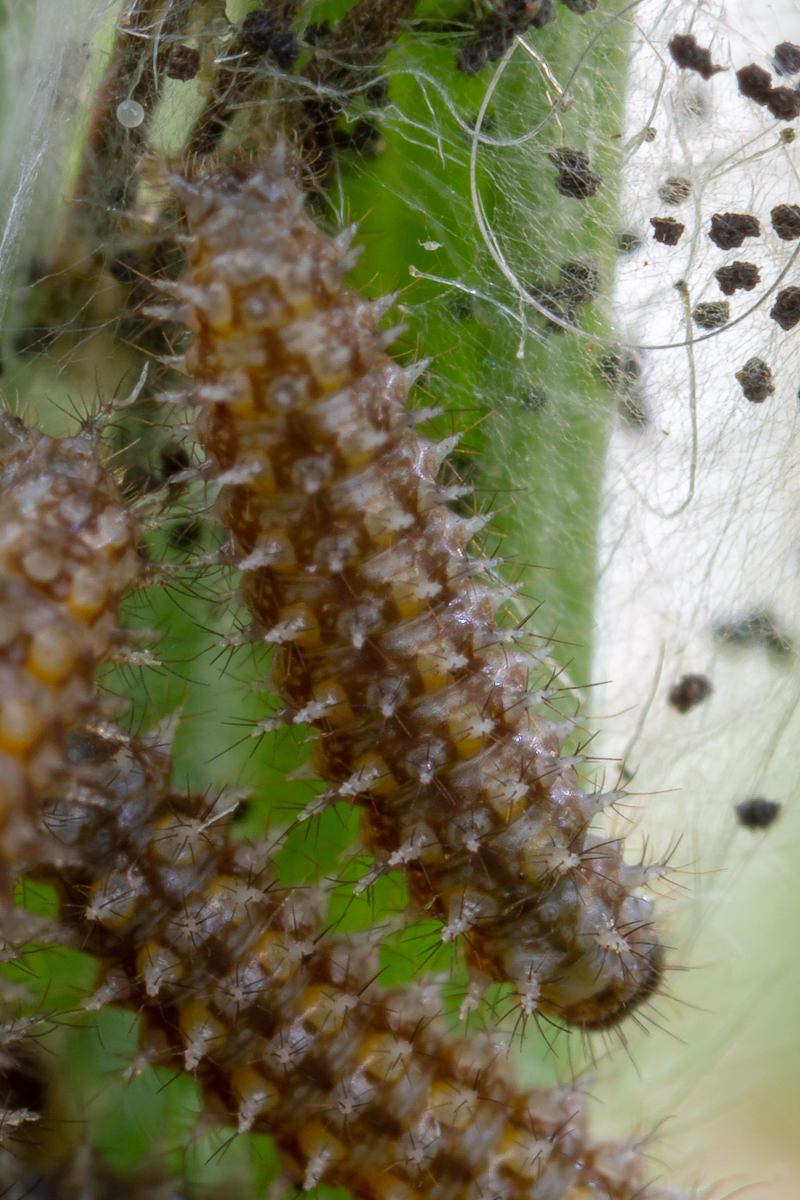
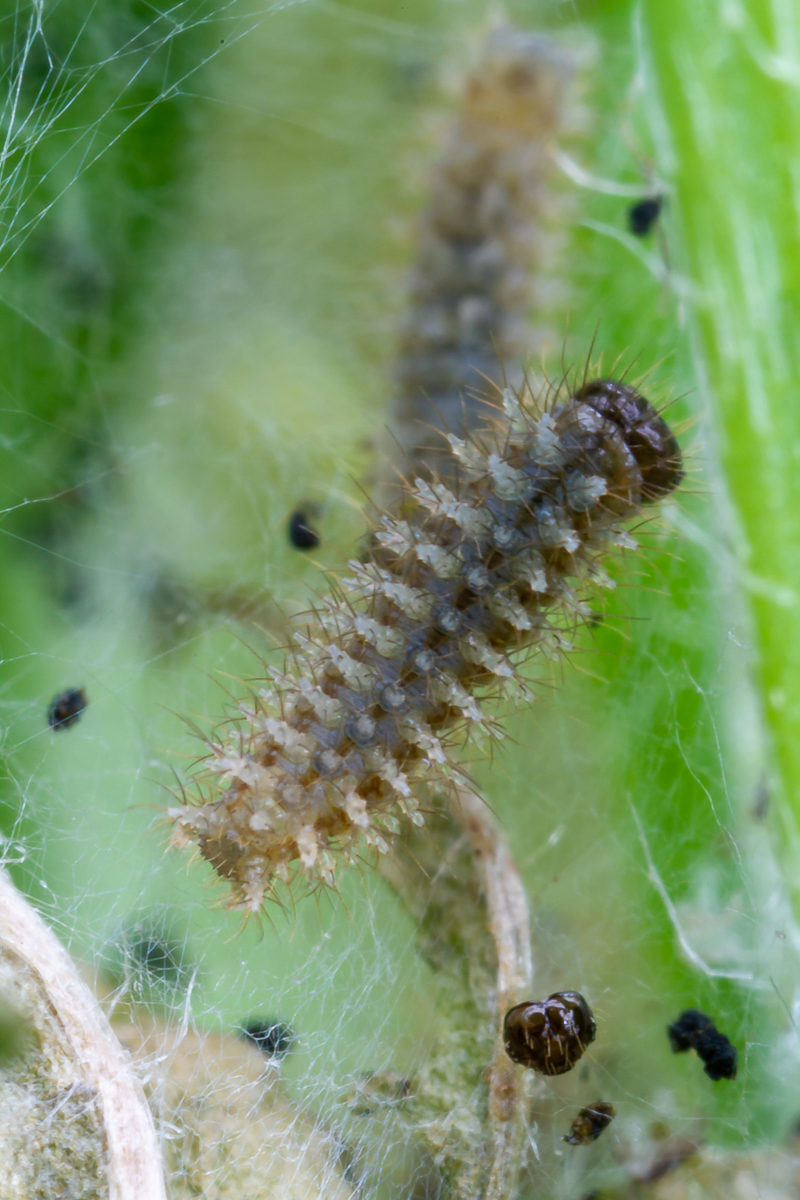
"The second moult occurred about August 7th. After second moult, twenty-five days old, it measures 4.8 mm. in length. It is very similar to the previous stage, but the dorsal tubercles are much larger and have the basal half citrine-yellow, the apical half pearl-white like the rest of the smaller tubercles; the body is purplish-brown, mottled with dull pearly-white dots, arranged in transverse rows, each dot centred with a fine bristle. The larva have still the same habits, living together under a web." - Frohawk (1924)
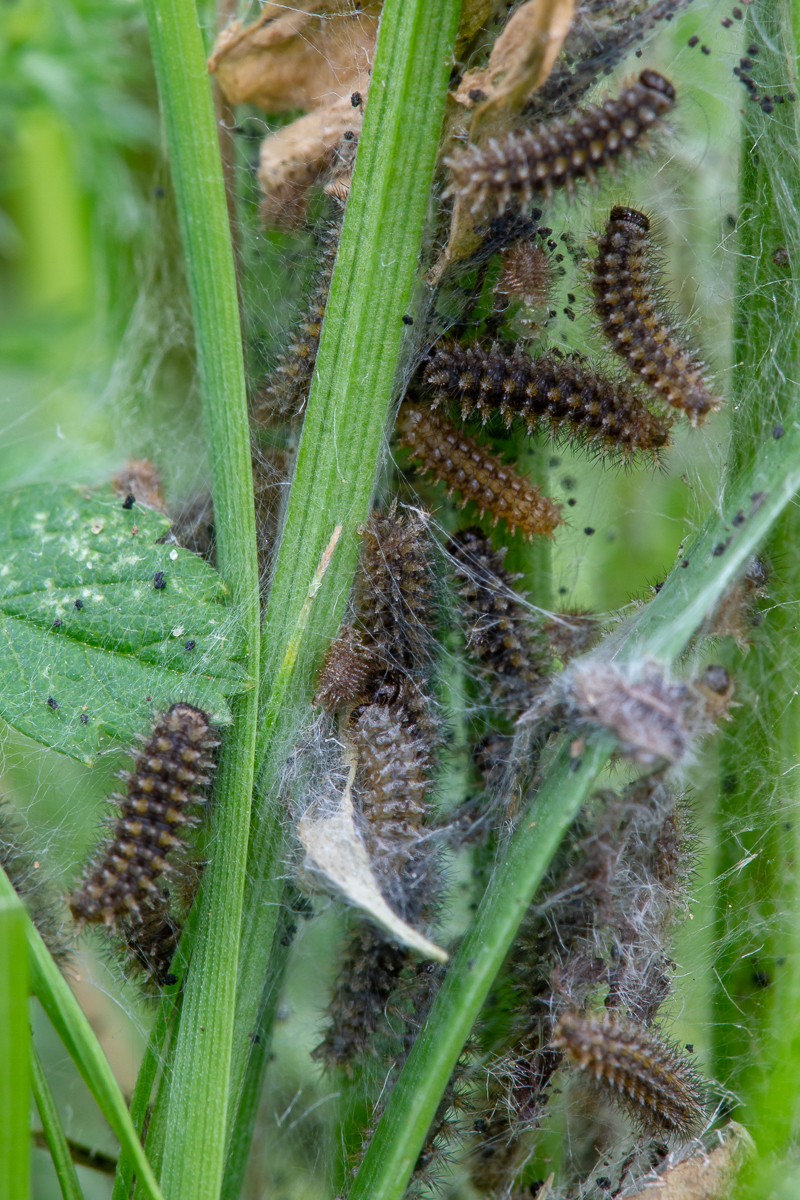
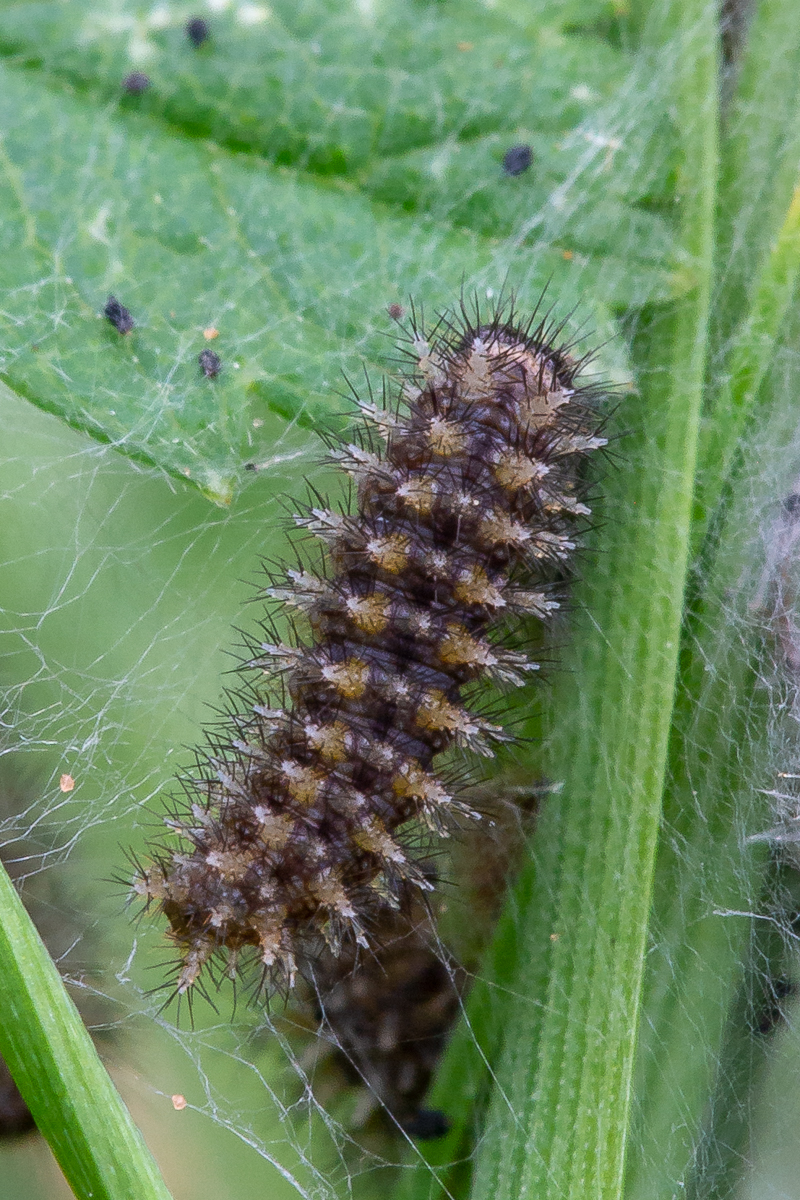
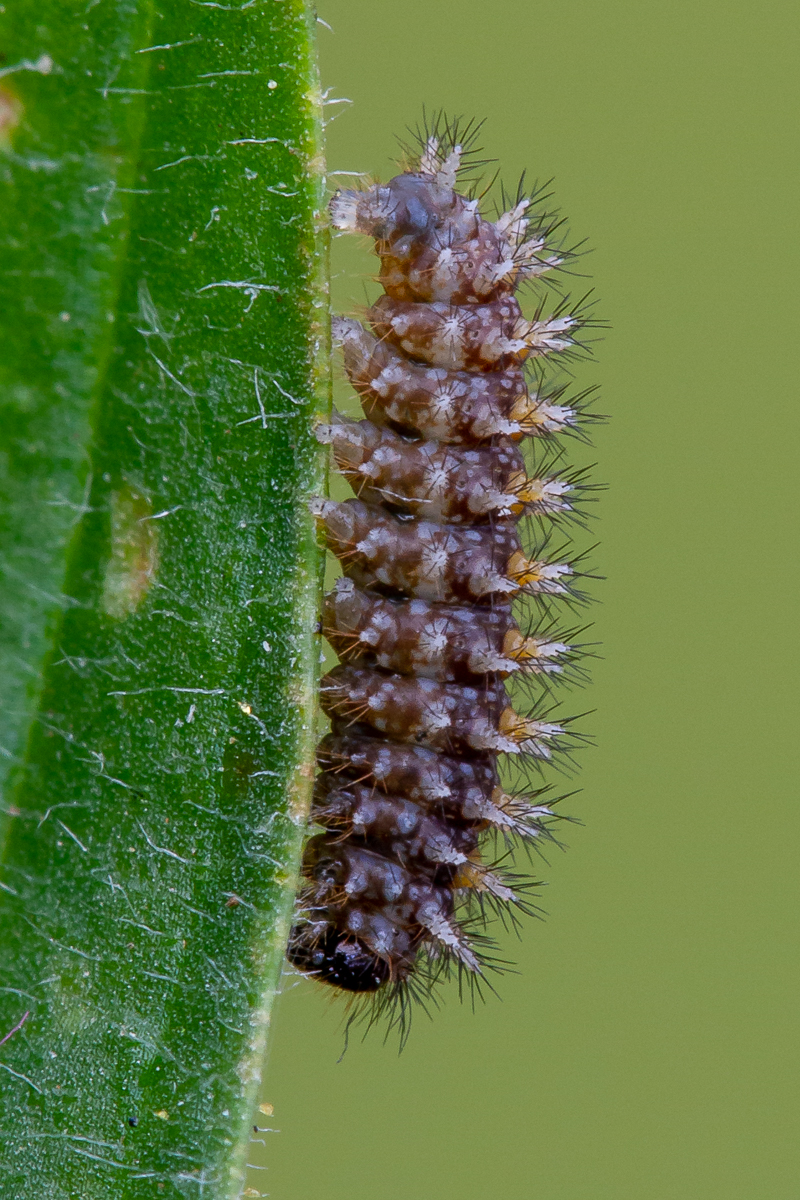
"The third moult took place during the third week of August. They hibernate after the third moult, at the end of August or beginning of September. During hibernation it measures only 3.2 mm. long, being much contracted and very densely covered with black bristles; there are two rows of rather large sub-dorsal, dull amber-coloured tubercles; between these is the medio-dorsal series, which are very much smaller; the super and sub-spiracular series are pale ochreous, small and inconspicuous; each tubercle is covered with sharply pointed, black, serrated spinelets; the head is black, shining and covered with similar spinelets; legs black; claspers pale ochreous. They hibernate in companies, from a few to several dozens, together under a web covering. Some were found hibernating in the twisted-up dead leaves, but nearly all had spun up on the gauze covering the plants. On January 20th, 1908, the plants kept out of doors were examined, when it was found that most, if not all, of the larva were apparently healthy; they were spun up under a web on the top of the coverings over the plants and subject to all conditions of weather. Those kept in a cold green-house were spun up in the same way." - Frohawk (1924)

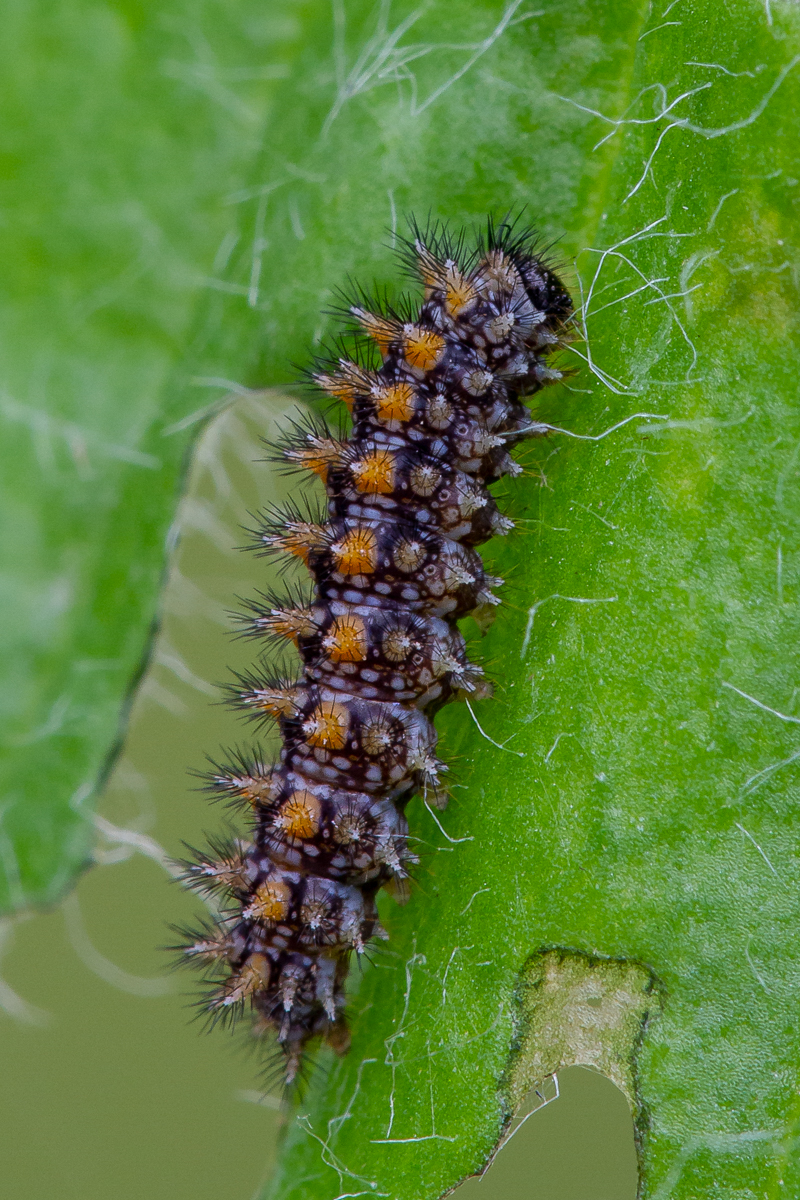
"On February 26th I again examined the larvae, and found several had recently moulted and were comparatively lively, having emerged from the hibernaculum and resting just outside; when touched they moved slowly about. One or two were hanging by a web, lowering themselves down, after being disturbed. The fourth moult takes place at the end of the hibernating period, before leaving the hibernaculum. After the fourth moult it resembles the previous stage, excepting the tubercles are larger and densely covered with spinous bristles. During March and April they feed at times, but only in the warmest weather. Almost the whole of April remained dull and cold, which retarded their growth." - Frohawk (1924)
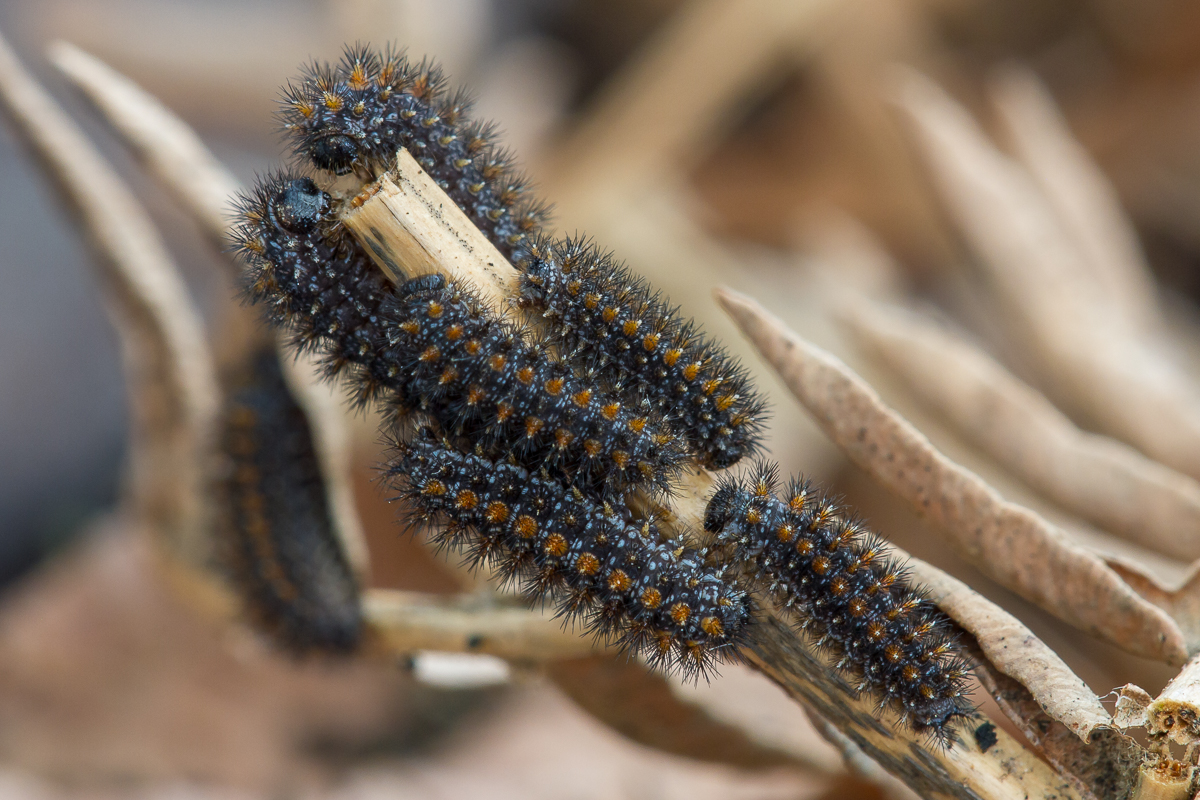
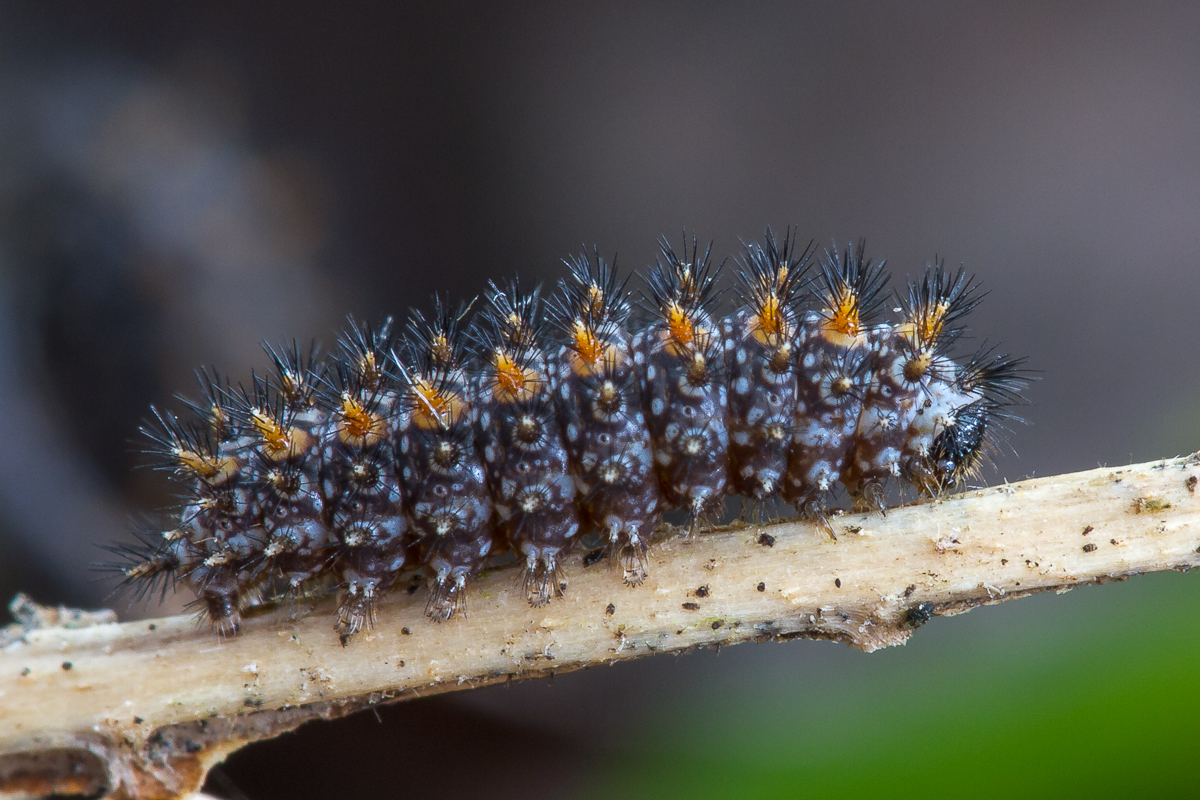
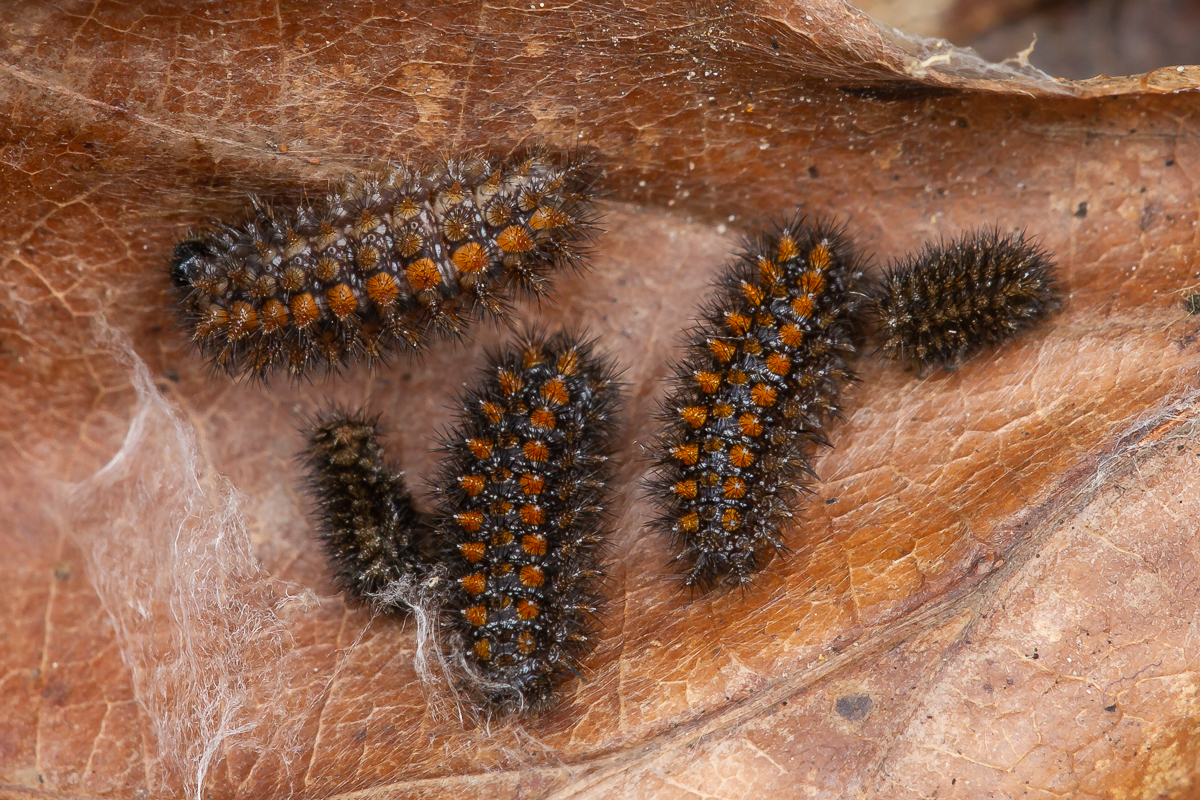
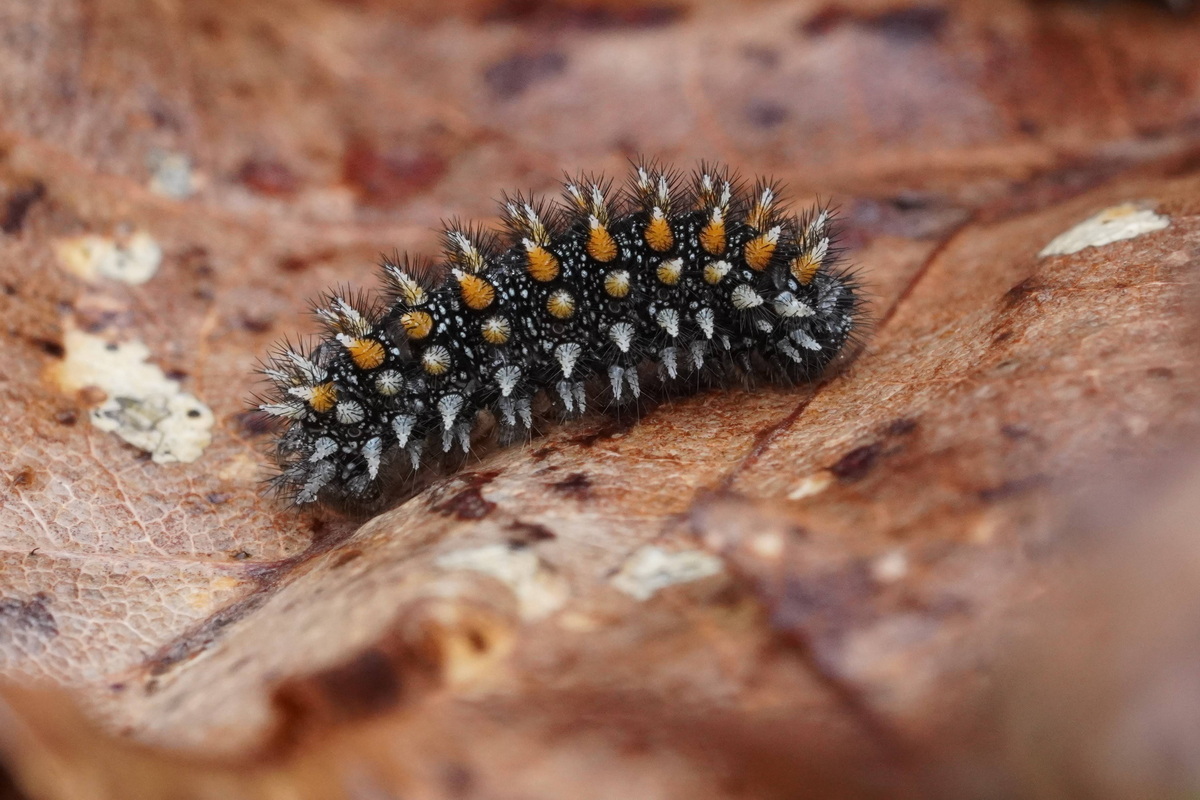
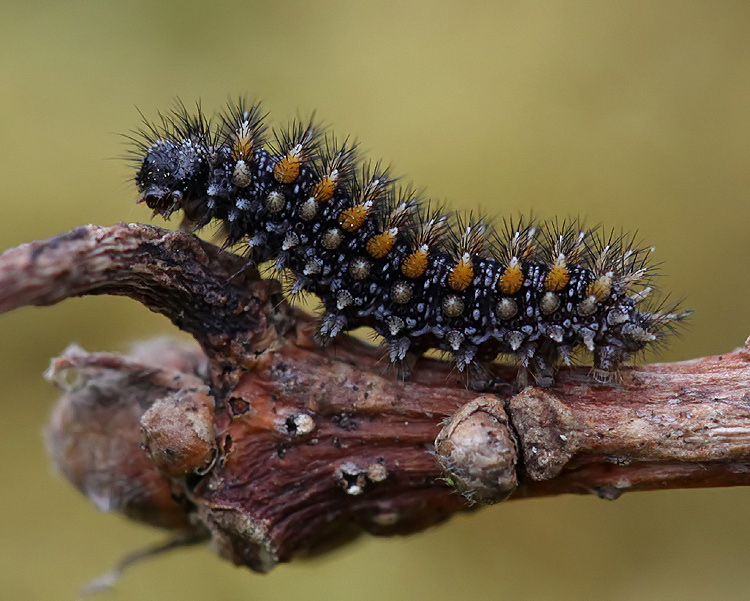
"By the beginning of May some had moulted the fifth time. Before the fifth moult it measures only 6.35 mm. long; the body now shows grey speckles. After the fifth moult it measures 11 mm. in length. The ground colour is purplish-black, very finely granulated and sprinkled with minute black hairs, each situated on a whitish spot, giving the larva a speckled appearance; the sub-dorsal tubercles are amber colour, with pale tips, and covered with numerous finely serrated black spines, each with a pale swollen base; the other tubercles are mostly whitish. The head is black, shining and covered with spines." - Frohawk (1924)
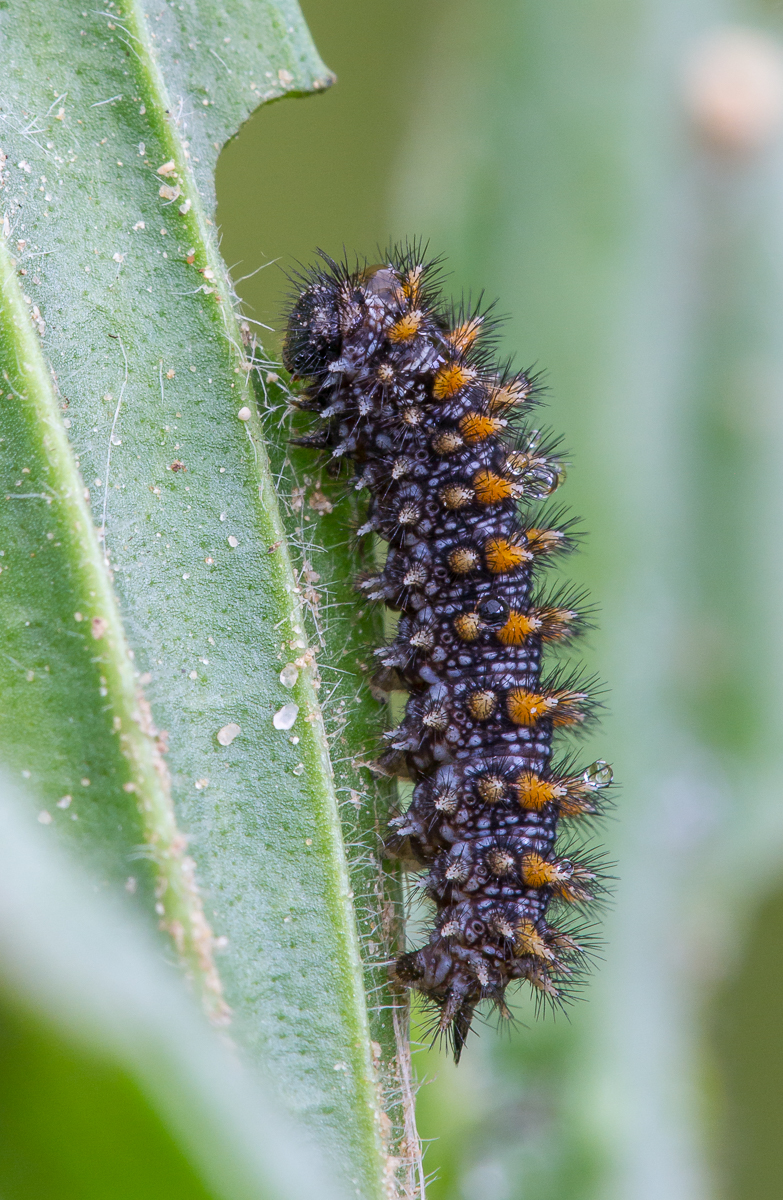
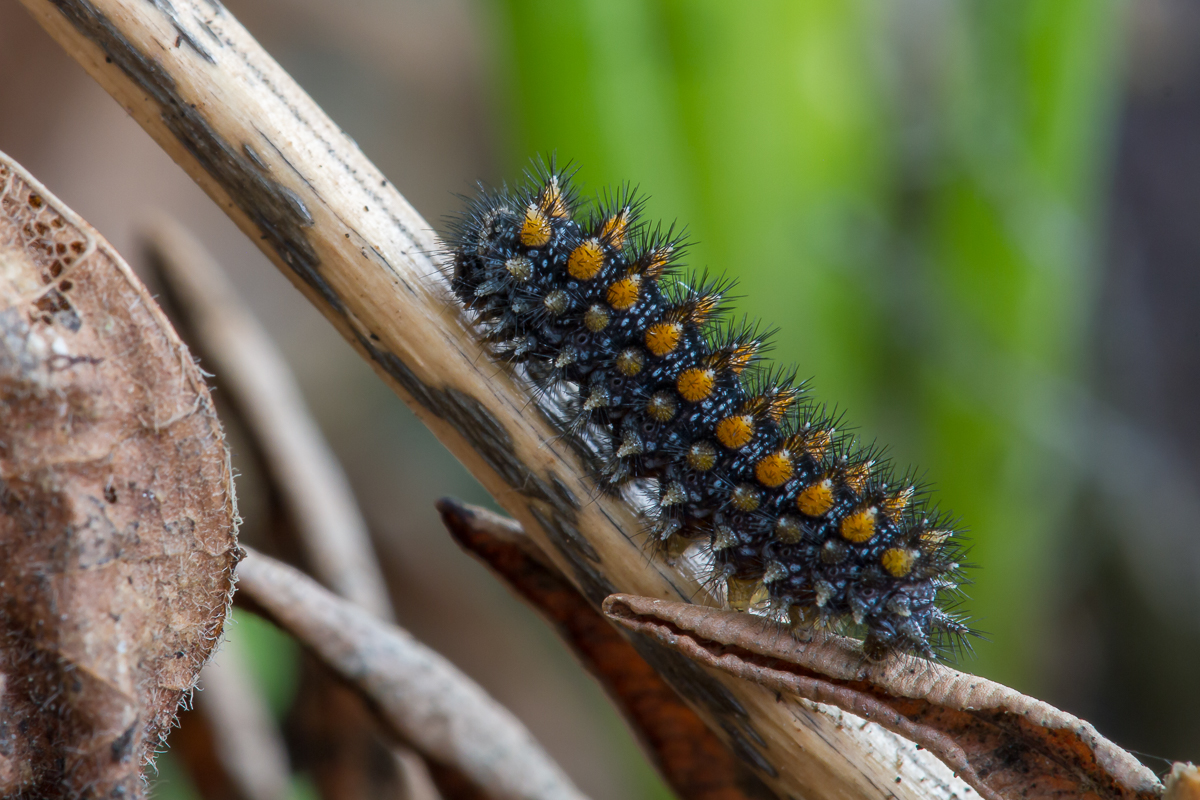
"Sixth moult: Several moulted on May 15th. After the sixth and last moult, fully grown, 300 days old, it measures from 22.2 mm. to 25.4 mm. long. The body carries in all 113 tubercles, numerically arranged as follows: first segment, 4; second segment, 10; third segment, 10; fourth to tenth segments, 11 each; eleventh segment, 8; twelfth segment, 4. These are arranged thus: on the fourth to eleventh segments a medio-dorsal series; the others form longitudinal series, which are sub-dorsal, super-spiracular and sub-spiracular; these are all conical and fleshy, whitish tinged with amber, the sub-dorsal being the deepest in colour, all having pale tips; those along the lateral region are smaller and more slender and whitish. All are covered with numerous fine black spinelets which are very slightly serrated and have bulbous bases. The whole surface of the body is extremely finely granulated with tiny points, and amply studded with small black hairs, each springing from a white spot; the ground colour is velvety-black. The ventral surface is inclining to olive and the claspers are pale green; legs olive-green and black; the head is shining bronze-black with white spots on the crown, and has numerous black, slightly curved bristles. The first few larvae pupated on June 1st, 1908, the last stage occupying fifteen days." - Frohawk (1924)
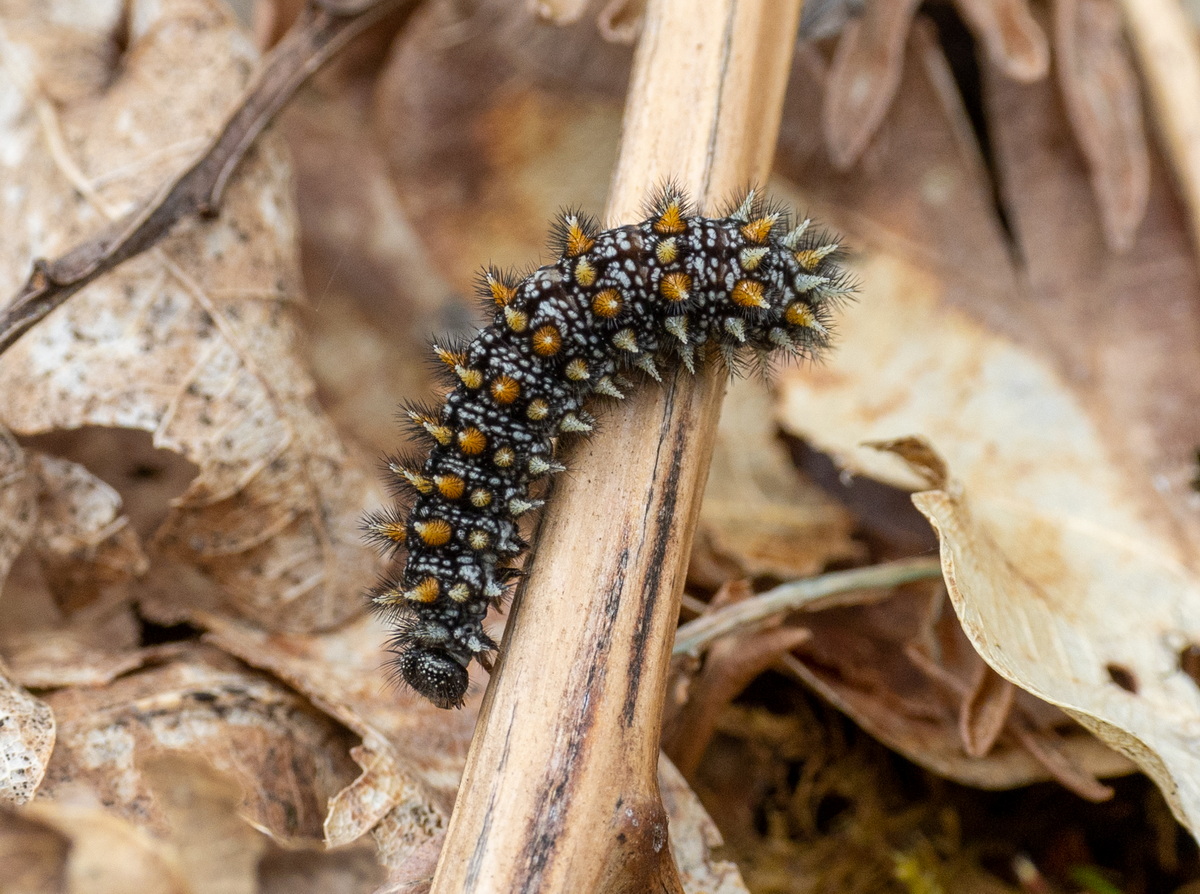
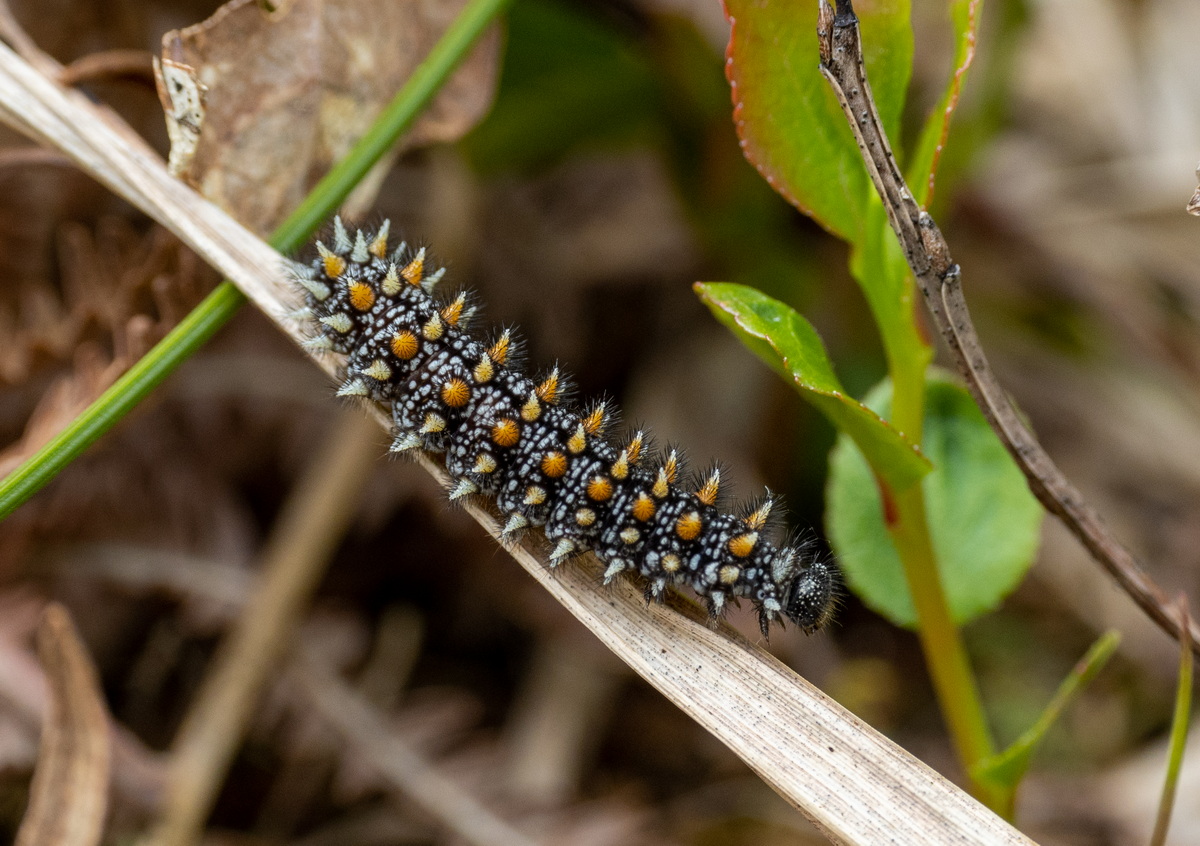
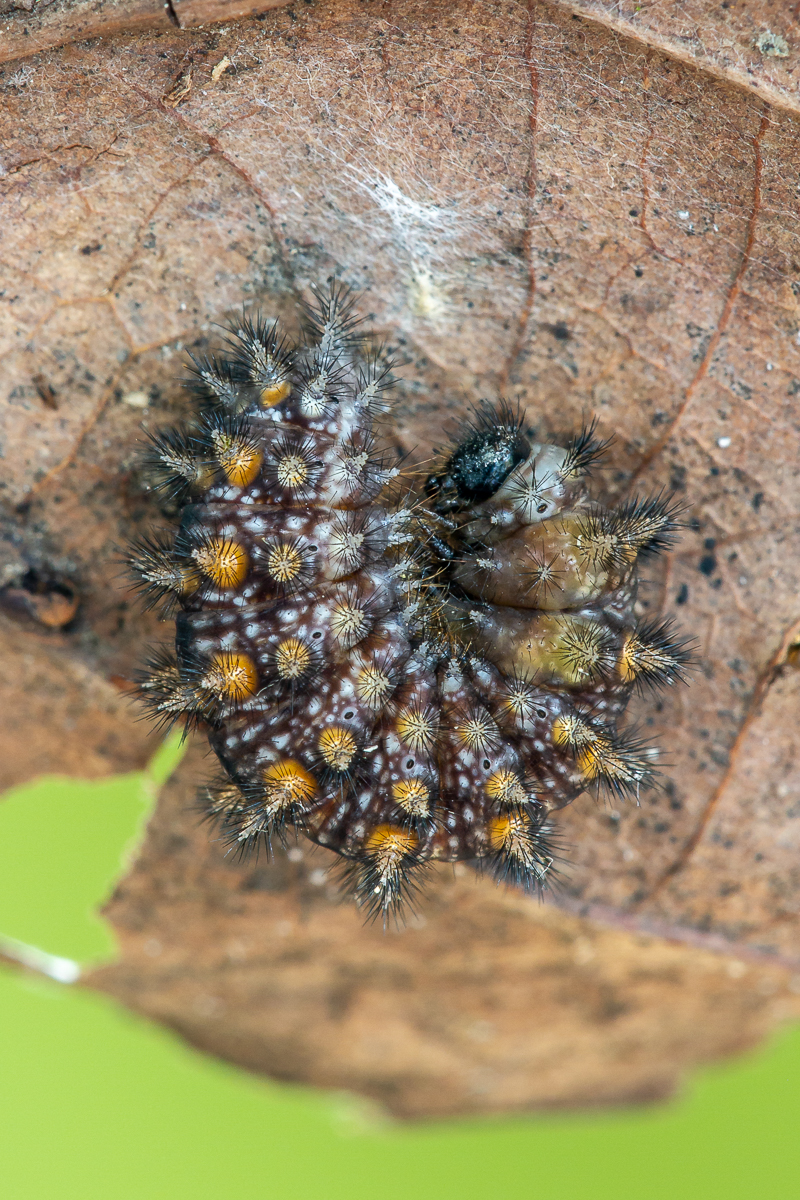
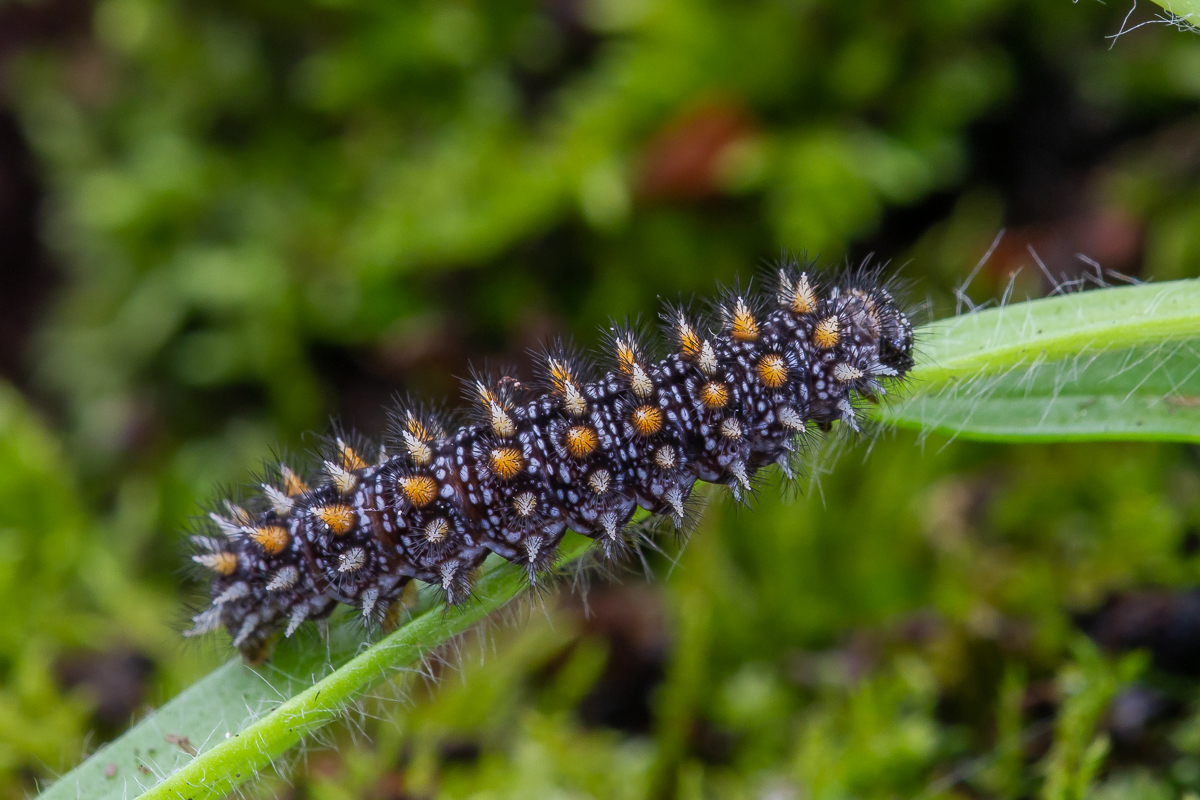
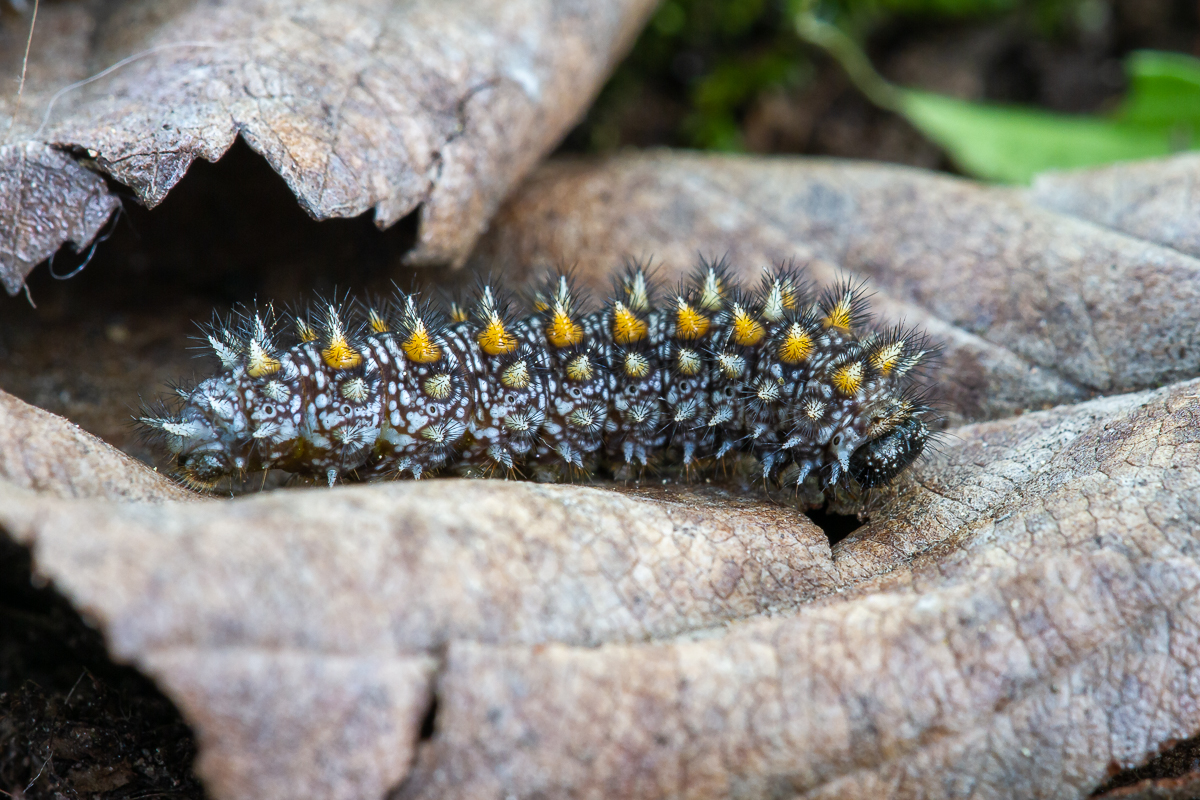
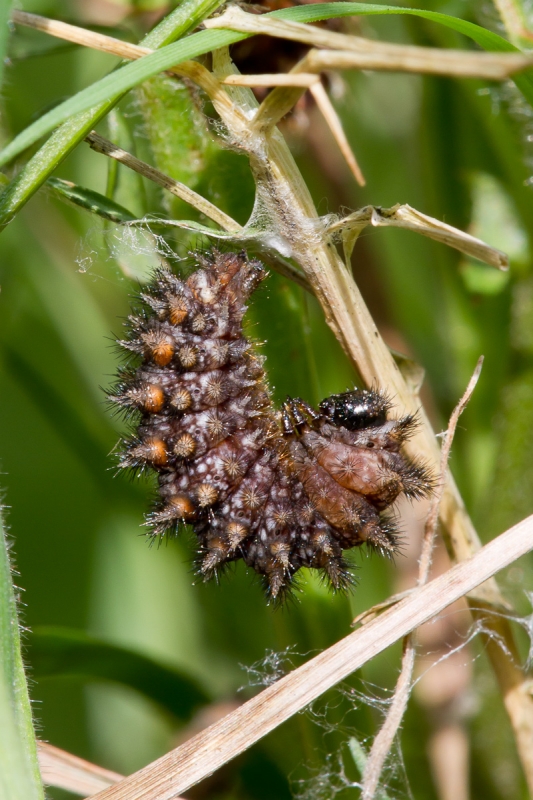
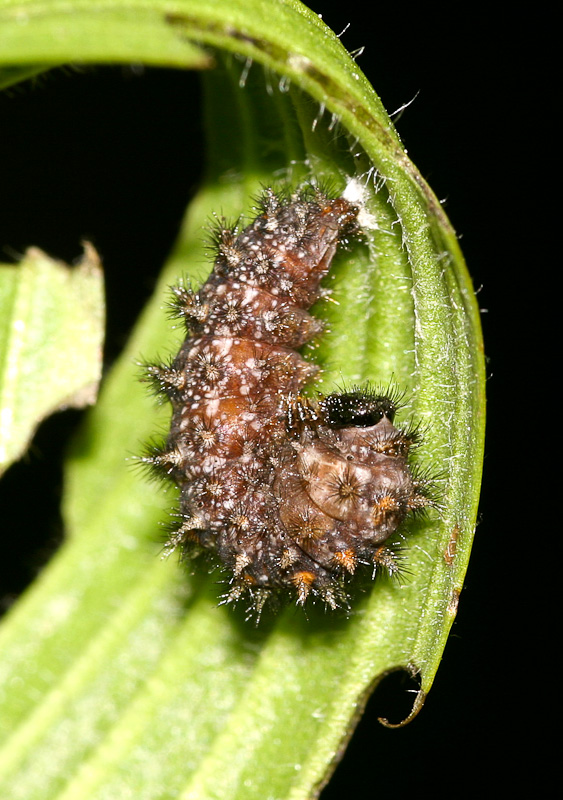
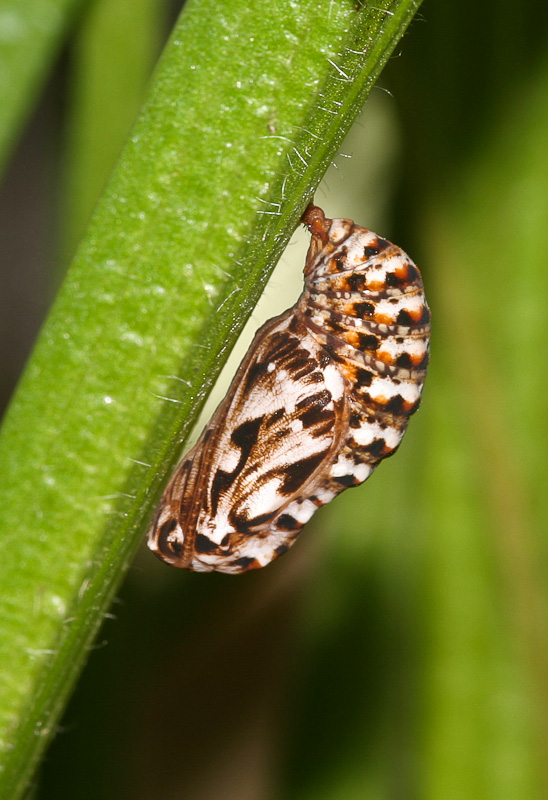
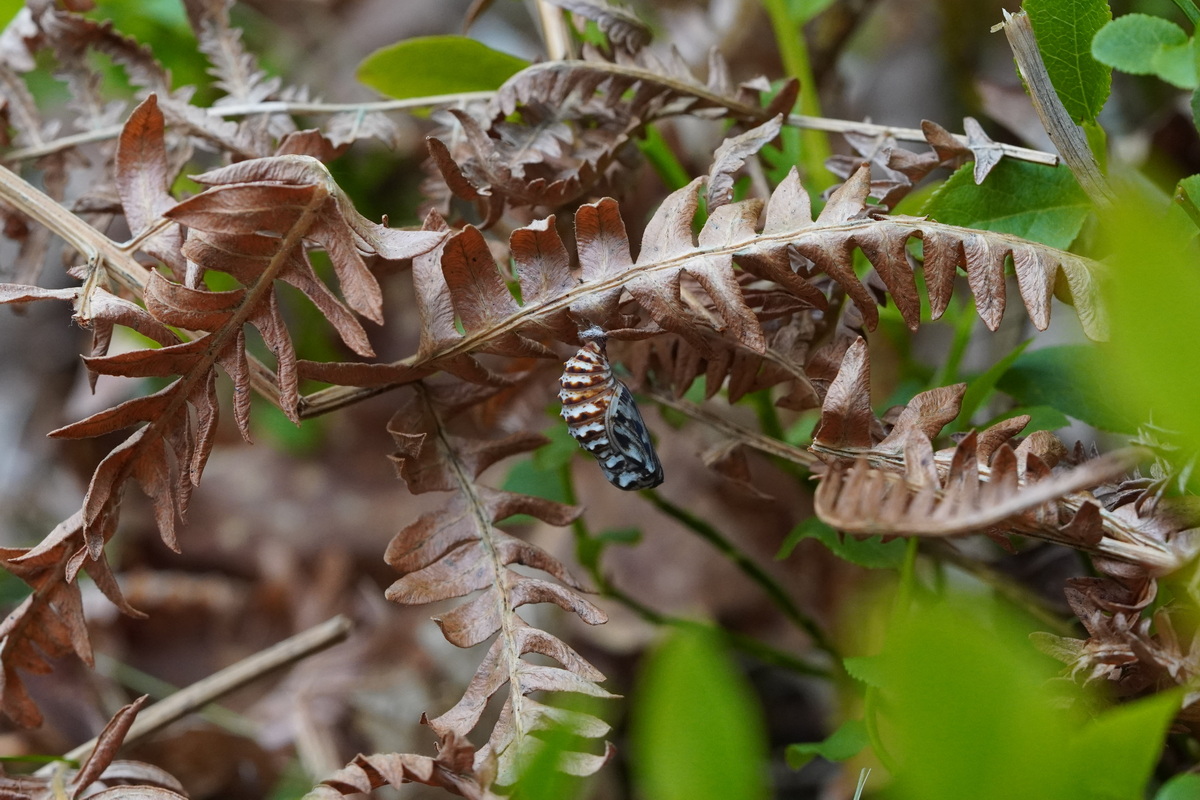
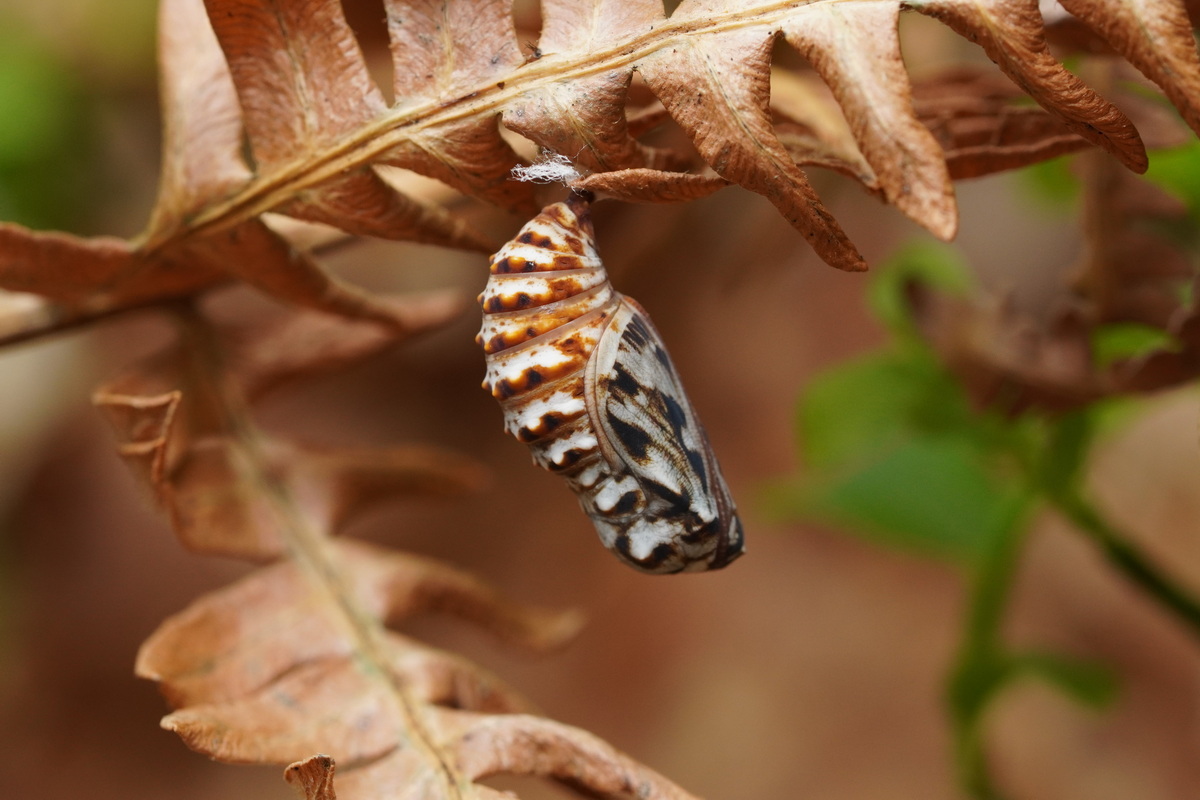
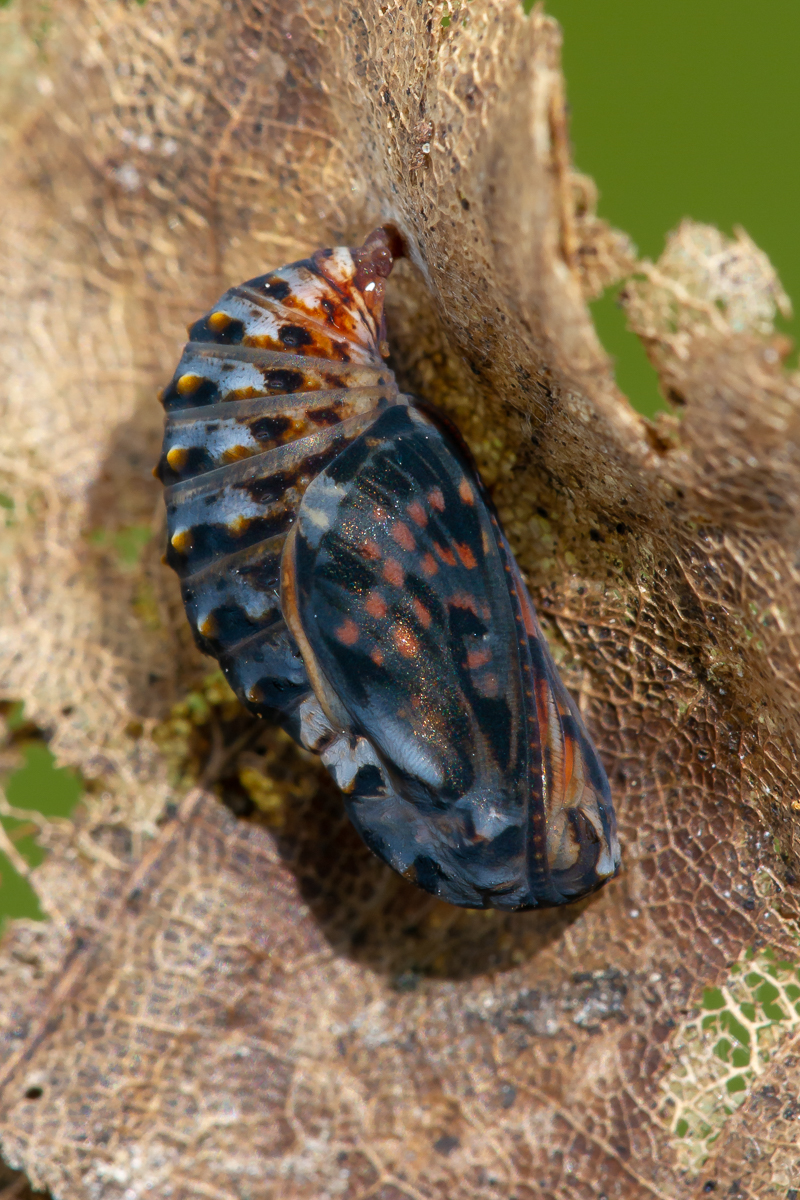
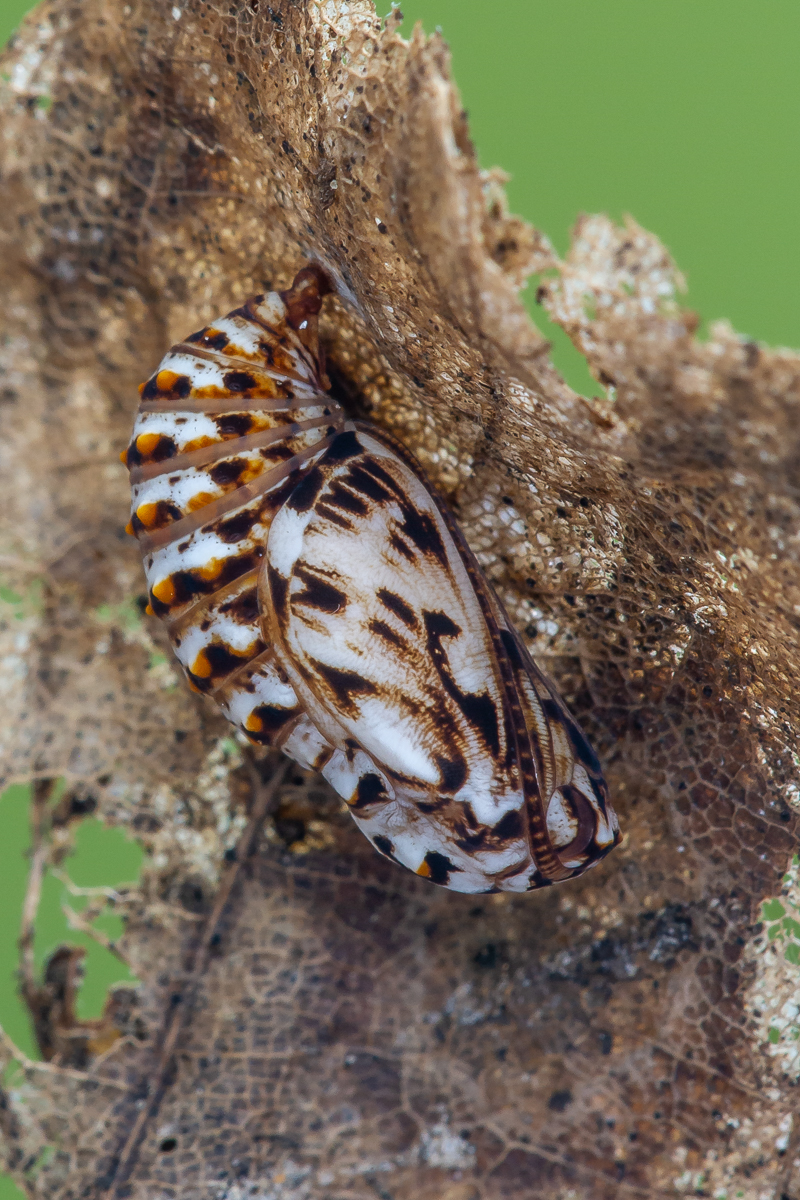
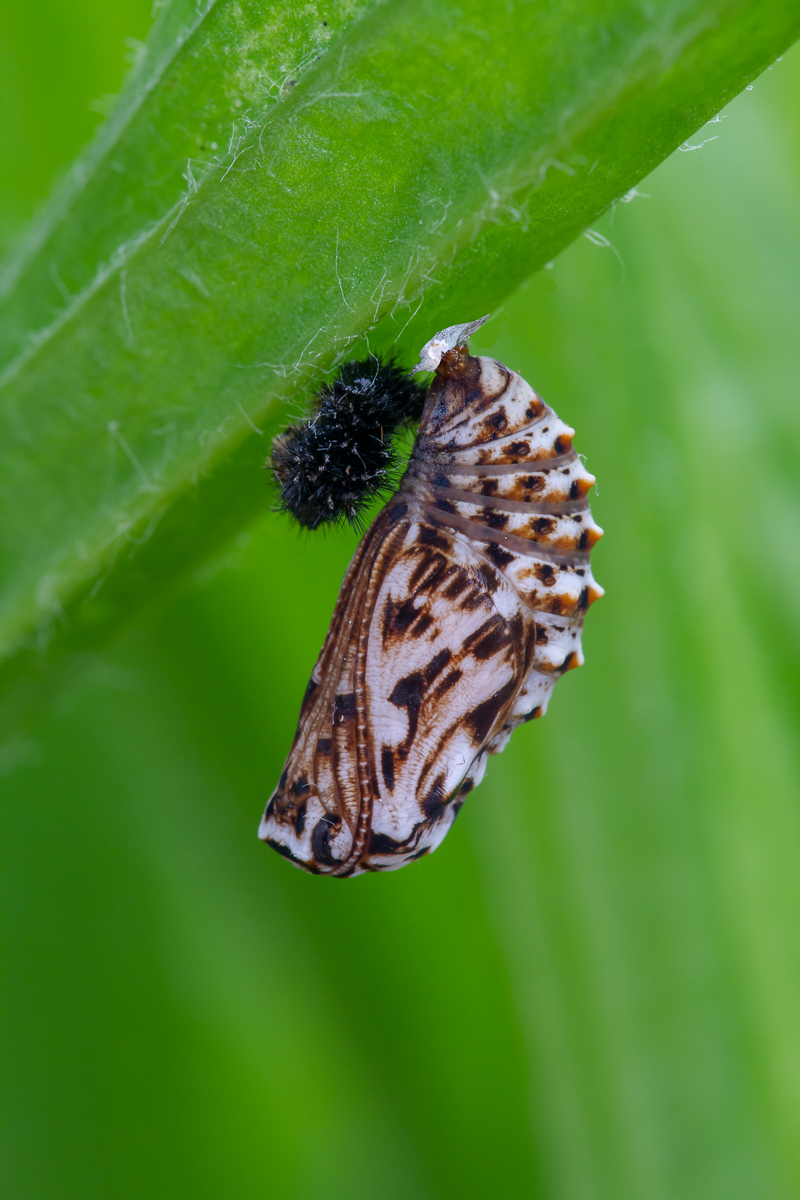
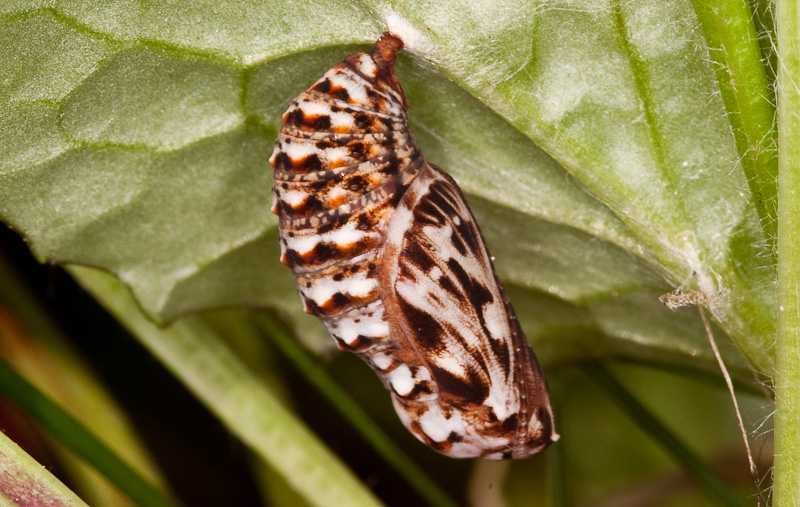
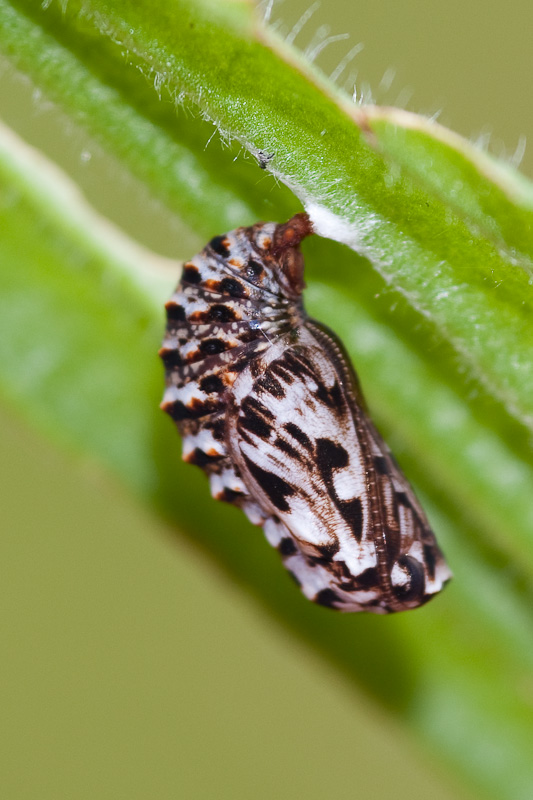
The pupa is formed among ground debris, attached upside-down to a dead leaf or twig. This stage lasts around 2 weeks.
"The pupa measures 12.7 mm. long. Dorsal view: The head is bilobed, the base of wings angular; it is slightly concave at the waist, and bulging at the middle of the abdomen and tapering to the anal segment, which terminates in a truncated cremaster which is furnished with a great number of hooks. On each side of the cremaster is an orange knob. Side view: The head is angular; the meso-thorax convex, and sunken at the meta-thorax and first abdominal segment; the abdomen is convex and curves round to the anal extremity; the ventral surface of the segments is contracted and slightly concave; the antennae are swollen at the tips, then the outline is fairly straight to the head. The ground colour is a pearl-white, the whole surface excepting the abdomen is minutely striated, the latter being more or less granular. The head, thorax, wings and legs are boldly checkered with black, the wing nervures ochreous; the antennae and legs are outlined with pale brown; the abdomen is transversely banded over the anterior half of each segment with black, on which are conical orange knobs replacing the tubercles of the larva. The brown spiracles are situated in the centre of a black blotch forming a longitudinal abdominal series, duplicated laterally by irregular black markings; on the white bands are a few black dots. The cremastral process is amber-brown. Excepting the wings there are extremely minute club-shaped bristles, each rising from a dark, slightly sunken base, which are scattered over the body. Before emergence the white ground of the thorax and abdomen turns a leaden-grey and the wings assume a red-brown and black. The first larva that pupated, June 1st, emerged on June 16th (a male), being fifteen days in the pupal state. Many others emerged during the remainder of the month and first week of July, 1908." - Frohawk (1924)
The following links provide additional information on this butterfly.