Wingspan
Male: 37 - 43mm Female: 42 - 48mm |
|
Gatekeeper
|
|
Pyronia tithonus
|
|
|
|
Linnaeus, 1771 |
|
Ref: 1625 |
|
| Superfamily: | Papilionoidea |
| Family: | Nymphalidae |
| Subfamily: | Satyrinae |
| Genus: | Pyronia |
| Subgenus: | |
| Species: | tithonus |
| Subspecies: | britanniae (Verity, 1915) |
|
|
|
|
Male |
|
|
|
Male Underside |
|
|
|
Female |
|
|
|
Female Underside |
|
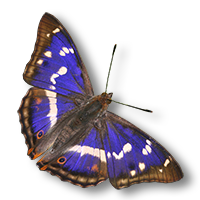
The Gatekeeper, also known as the Hedge Brown, is a golden butterfly that provides a welcome sight in the middle of summer, when the fresh adults start to emerge. This butterfly spends much of its time basking with wings open, when the sexes are easy to tell apart - only the male has the distinctive sex brands on the forewings. Subspecies: britanniae The population in the British Isles is represented by this subspecies.
This butterfly is found throughout most of England, Wales and the south of Ireland, being common in the south of its range, becoming scarcer further north. The habitat it requires is found over most of the British Isles, and so we can only assume that the restriction to its range is governed primarily by climate. Colonies vary greatly in size, depending on the available habitat, ranging from a few dozen individuals to several thousand.
There is one generation each year, with adults emerging in July, peaking in early August, with only a few adults remaining until the end of the month. In contrast with its close relative, the Meadow Brown, this butterfly has a relatively-short flight period. Subspecies: britanniae 
This species can be found wherever shrubs grow close to rough grassland. In fact, some of the largest colonies can be found at field edges and along hedgerows and we can expect to find this butterfly in scrubby grassland, woodland rides, country lanes, hedgerows and the like anywhere within its range.
The primary larval foodplants are Bents (various) (Agrostis spp.), Fescues (various) (Festuca spp.) and Meadow-grasses (various) (Poa spp.). Common Couch (Elytrigia repens) is also used.
Adults feed primarily on Bramble (Rubus fruticosus agg.), Carline Thistle (Carlina vulgaris), Devil's-bit Scabious (Succisa pratensis), Fleabane (Pulicaria dysenterica), Hemp Agrimony (Eupatorium cannabinum), Privet (Ligustrum vulgare), Ragwort (Senecio jacobaea), Red Clover (Trifolium patense), Thistles (Cirsium spp. and Carduus spp.), Thyme (Thymus polytrichus) and Water Mint (Mentha aquatica).
Males set up small territories, often centred on a particular shrub or bush, and will fly up from their perch to investigate passing butterflies in the hope of finding a mate. Pairing occurs without any obvious courtship and, once mated, a female will typically lay between 100 and 200 eggs. Although both sexes feed from honeydew, they will also feed from whatever nectar sources are available - Bramble and Ragwort being particular favourites. Subspecies: britanniae
Description to be completed
|
|
|
|
|
|
|
|
|
Photo © Rory Ravenswater 20-Jul-2009 |
|
Eggs are laid singly, usually in shade underneath a shrub, either on the foodplant, on nearby vegetation or at random - ejected into the air over a suitable patch of foodplant. Eggs are pale yellow when first laid but soon develop brown patches, giving a mottled effect. They darken further as the larva develops within the egg. This stage lasts between 2 and 3 weeks.
The larva eats its eggshell on hatching and proceeds to feed on the tenderest parts of the foodplant by day, before hibernating after its first moult at the base of a grass clump, usually within a withered grass blade. Larvae resume feeding in the spring and typically only feed at night. There are 2 colour forms of the larva - light brown and green and there are 4 moults in total.
The pupa is formed low down in vegetation, hung upside down and attached by the cremaster. This stage lasts around 3 weeks.
Description to be completed
Click here to see the distribution of this species overlaid with specific site information. Alternatively, select one of the sites listed below. |
 | Aylesbeare Common, Bedfont Lakes Country Park LNR, Hockley Woods, Howardian Local Nature Reserve, Moors Valley Country Park, Roudsea Wood NNR |  | Whitbarrow NNR |  | Fleam Dyke |  | Bentley Wood |  | | | Not rated | Arnside Knott, Ashampstead Common, Hounslow Heath LNR, Hyde, Mayford Pond, Winsdon Hill |
This butterfly is relatively stable in terms of both distribution and population and it is not currently a species of conservation concern. |
| Not Listed |  |  |
From The State of Butterflies in Britain and Ireland and the UK Biodiversity Action Plan (UK BAP) (2007 review).
The following links provide additional information on this butterfly.
The species description provided here has been derived from the author's own observations and the information contained in the following works:
- A Natural History of British Butterflies, by F.W.Frohawk.
- British and Irish Butterflies, by Adrian M. Riley
- South's British Butterflies, by T.G.Howarth (which is based extensively on the classic work, "The Butterflies of the British Isles", by Richard South).
- The Butterflies of Britain and Ireland, by Jeremy Thomas and Richard Lewington.
- The Millennium Atlas of Butterflies in Britain and Ireland, by Jim Asher, Martin Warren, Richard Fox, Paul Harding, Gail Jeffcoate, Stephen Jeffcoate.
- The Moths and Butterflies of Great Britain and Ireland Volume 7 (1) Hesperiidae to Nymphalidae (the Butterflies), by A. Maitland Emmet and John Heath (editors).
- The State of Butterflies in Britain and Ireland, Richard Fox, Jim Asher, Tom Brereton, David Roy and Martin Warren.
Site brought to you by Webified
Copyright © Peter Eeles 2002-2010 All rights are reserved Administrator Login
|