UK Butterflies
Building a Community of Responsible Butterfly Enthusiasts in Britain & Ireland
Building a Community of Responsible Butterfly Enthusiasts in Britain & Ireland
Wingspan
40 - 52 mm
Checklist Number
58.008
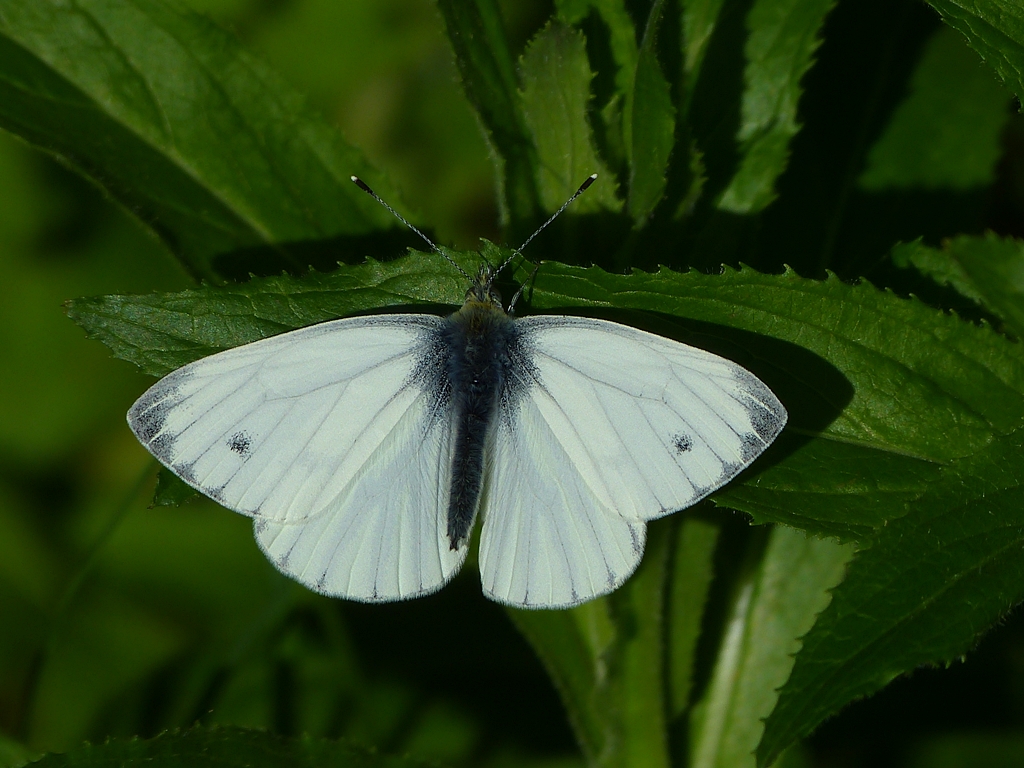
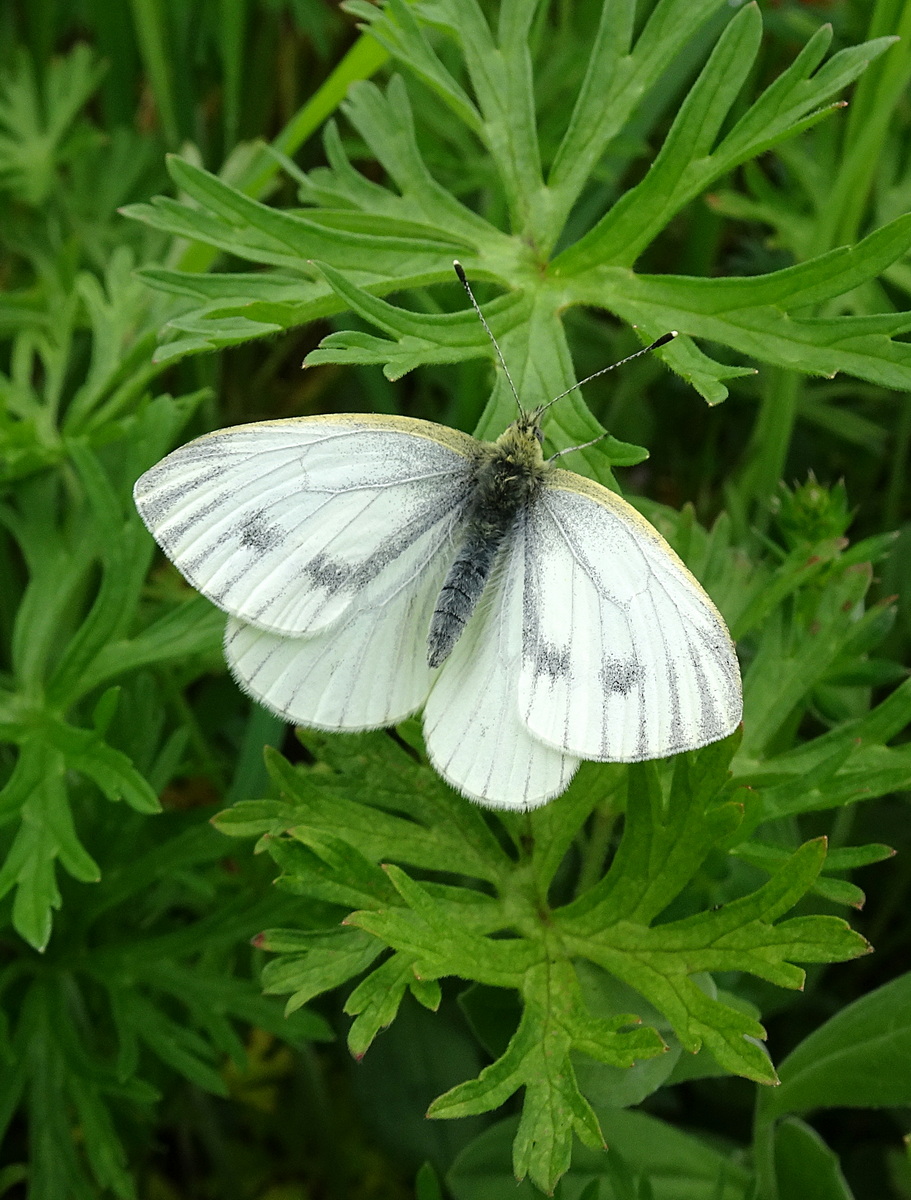
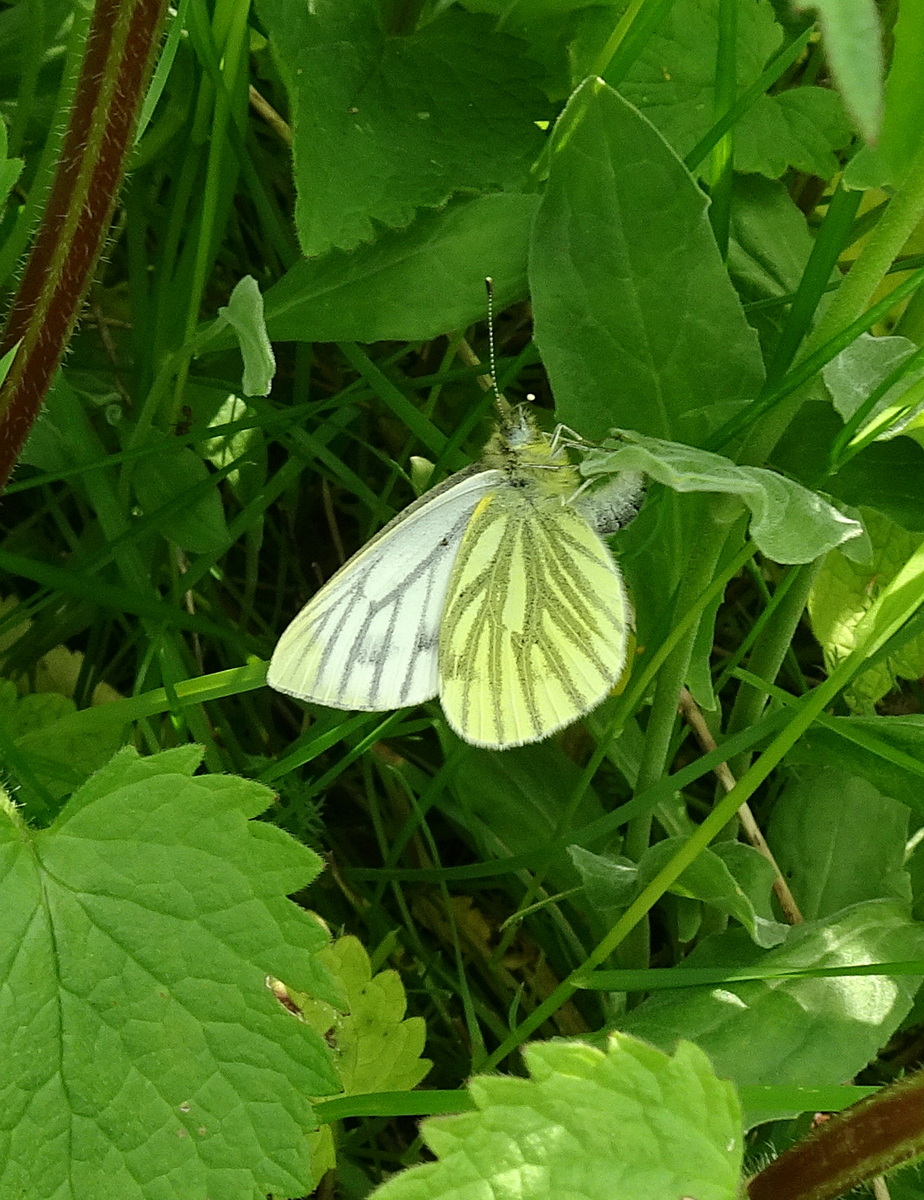
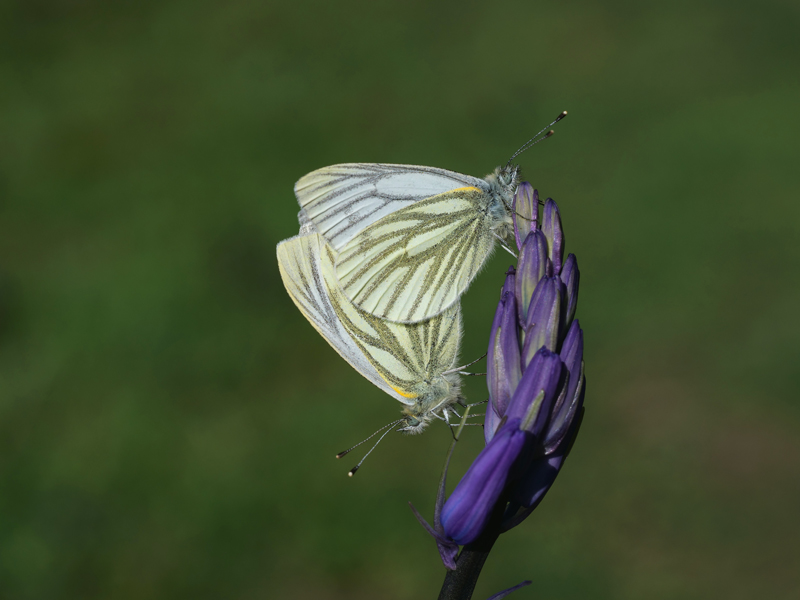
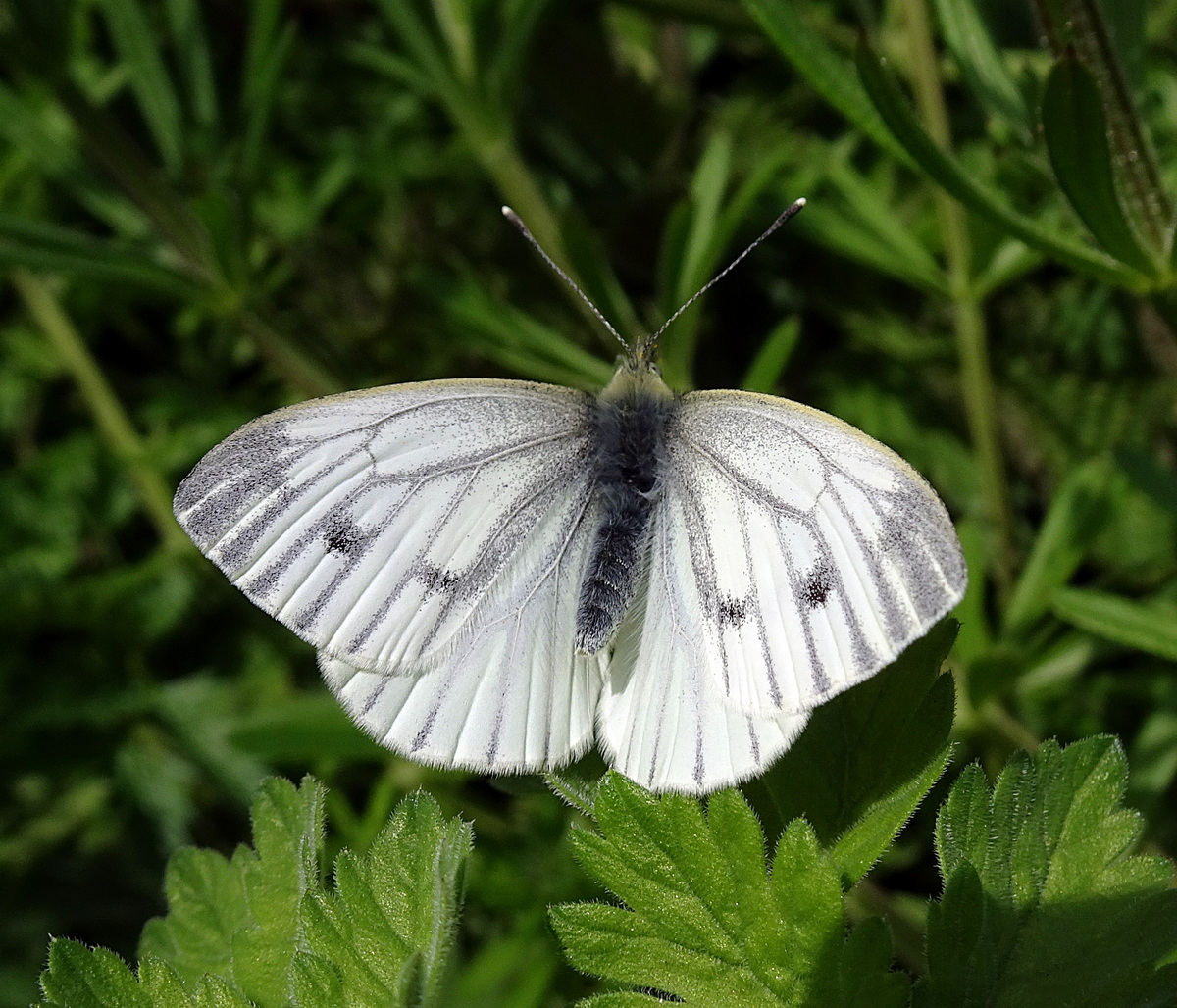
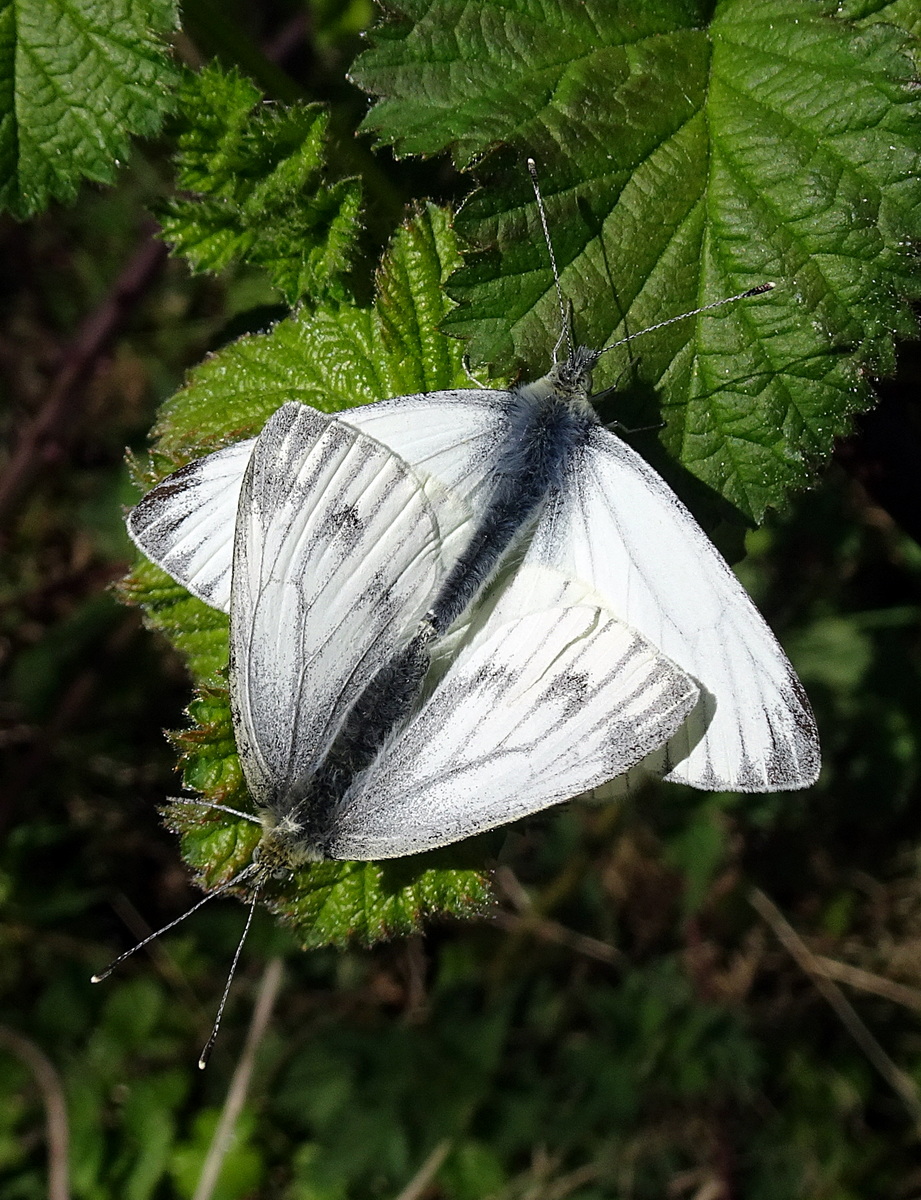
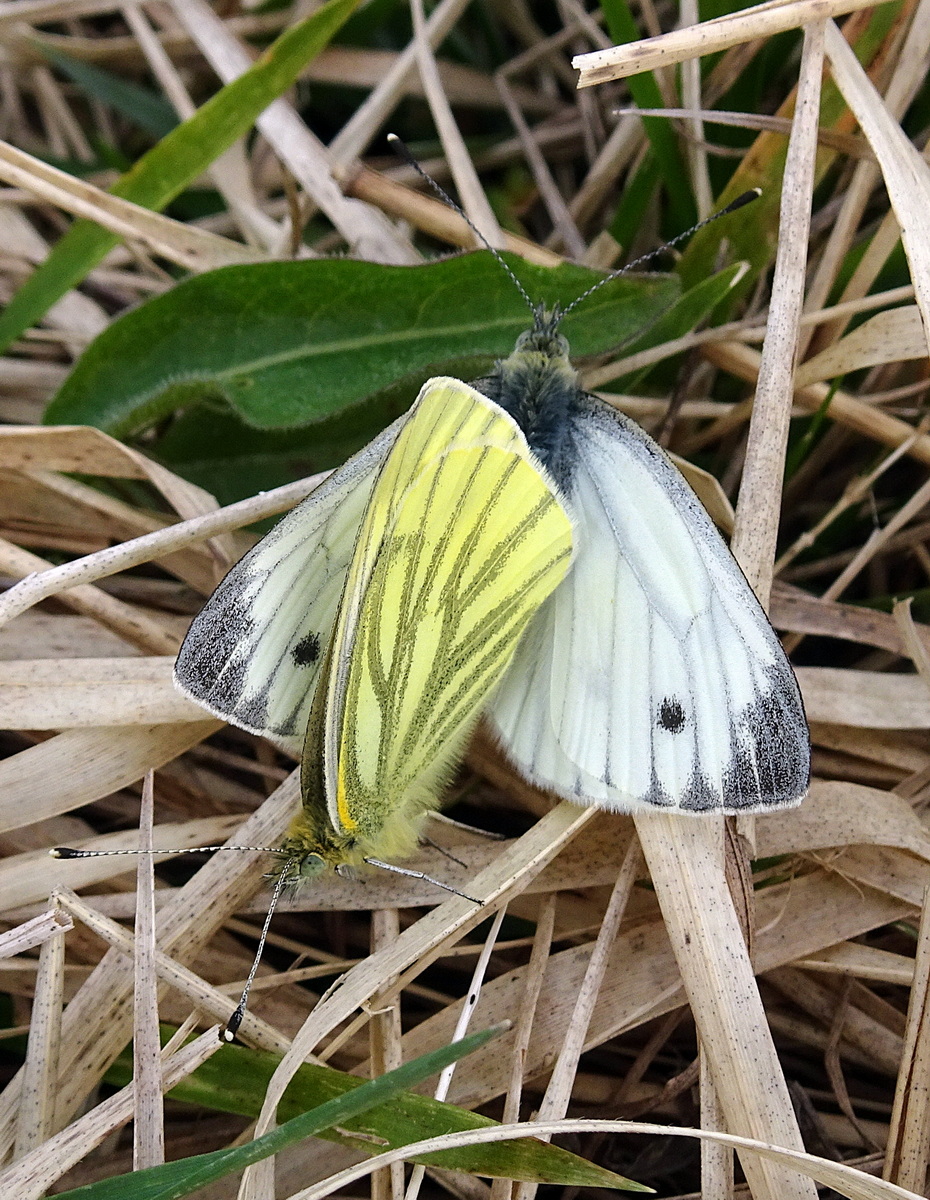
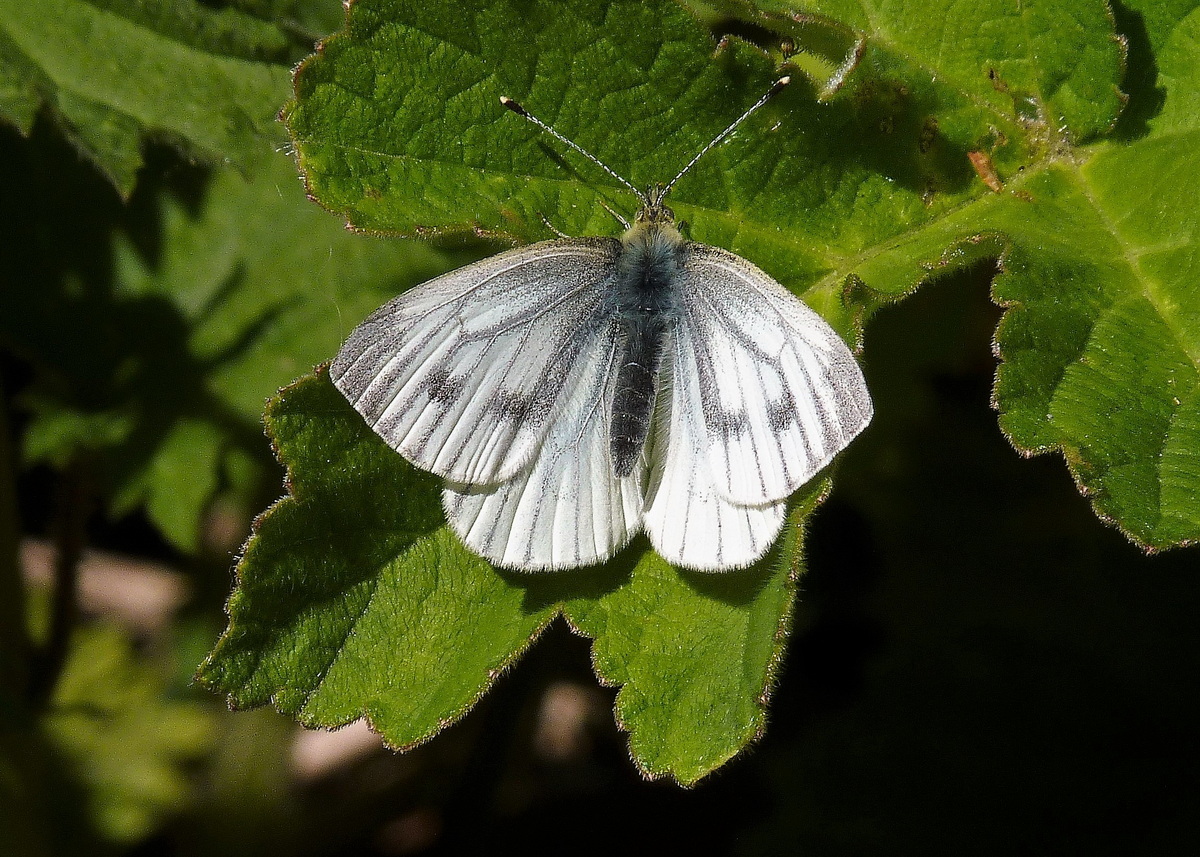
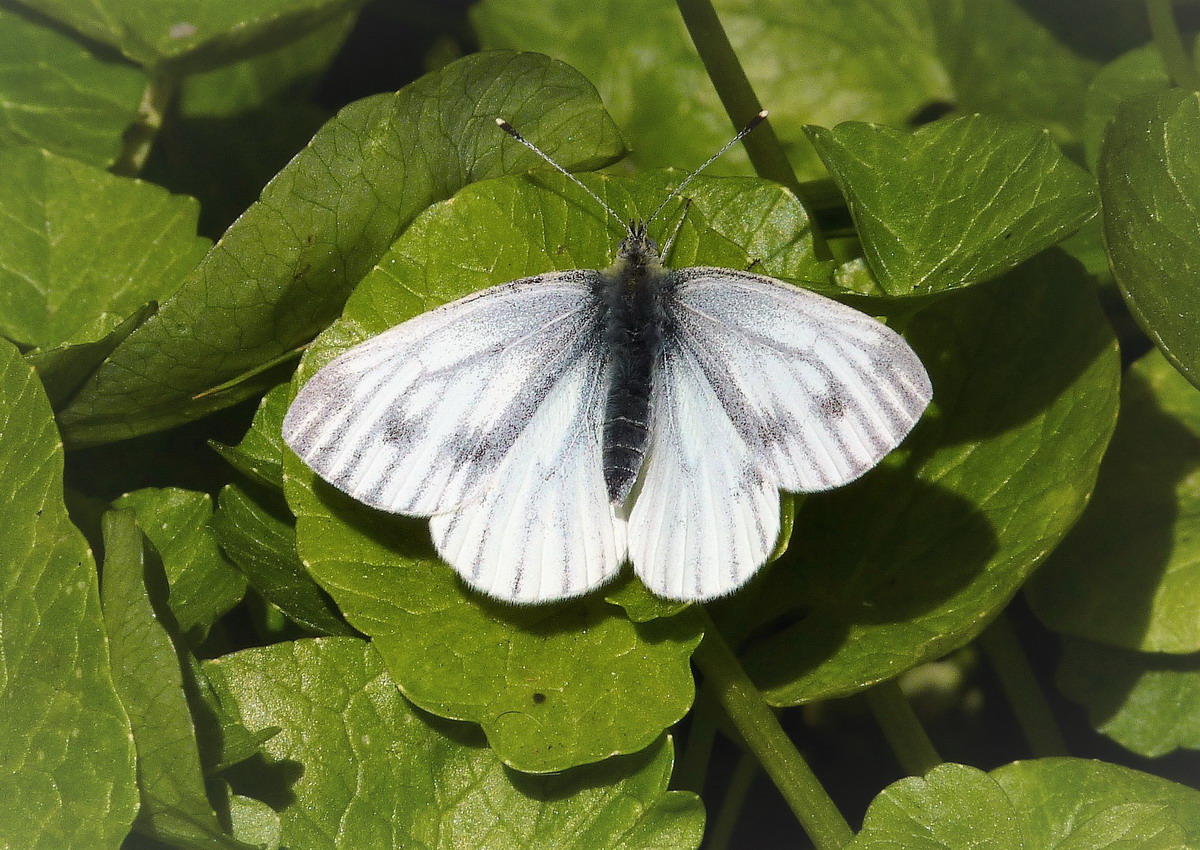
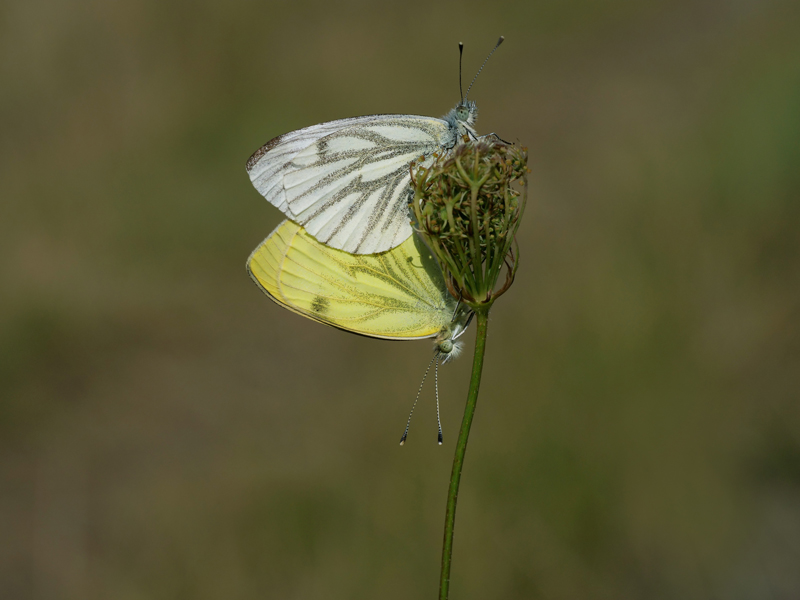
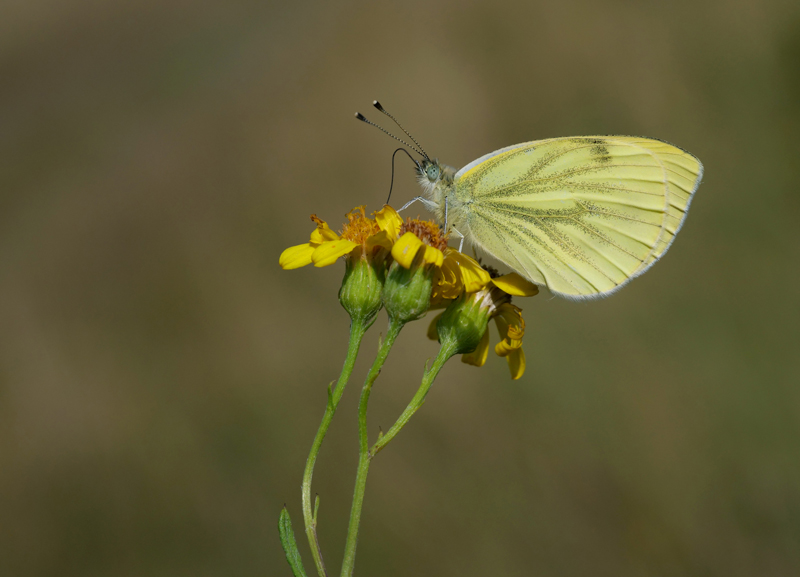
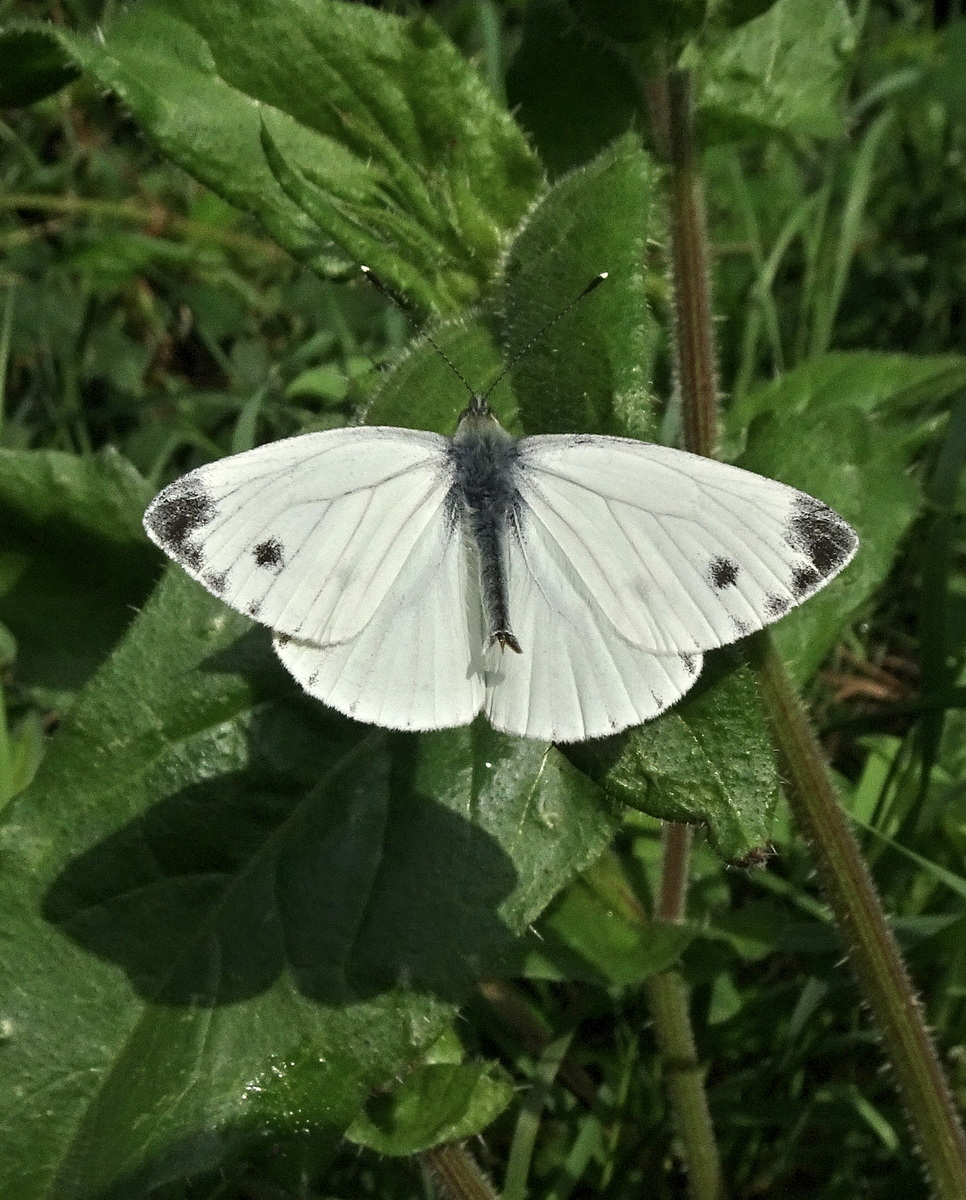
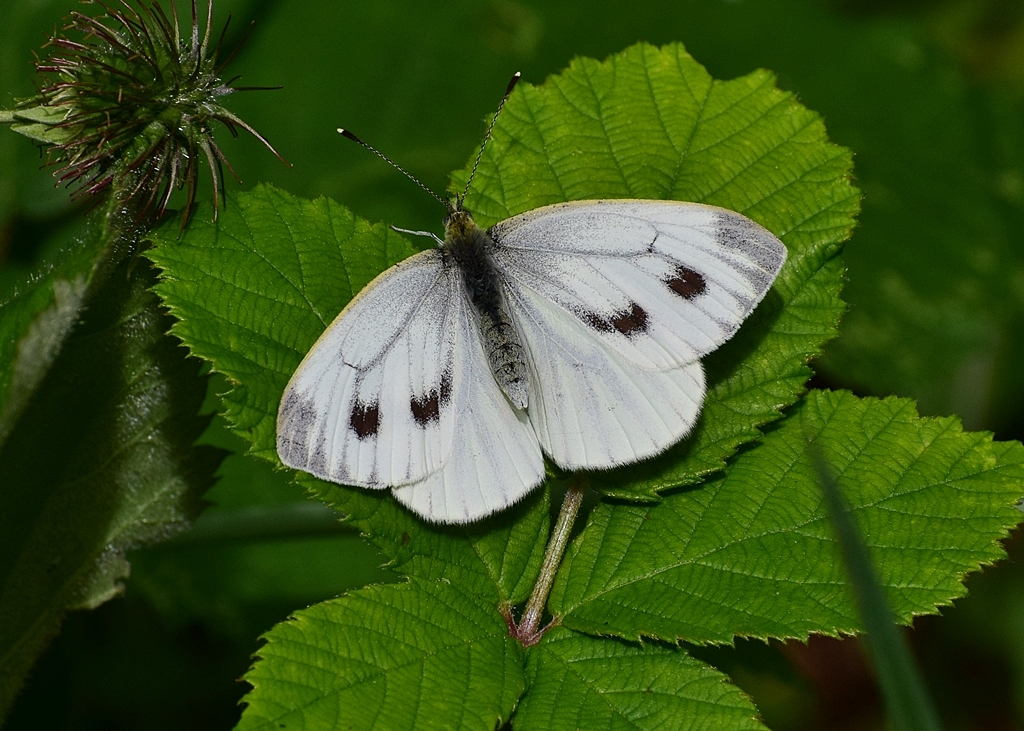
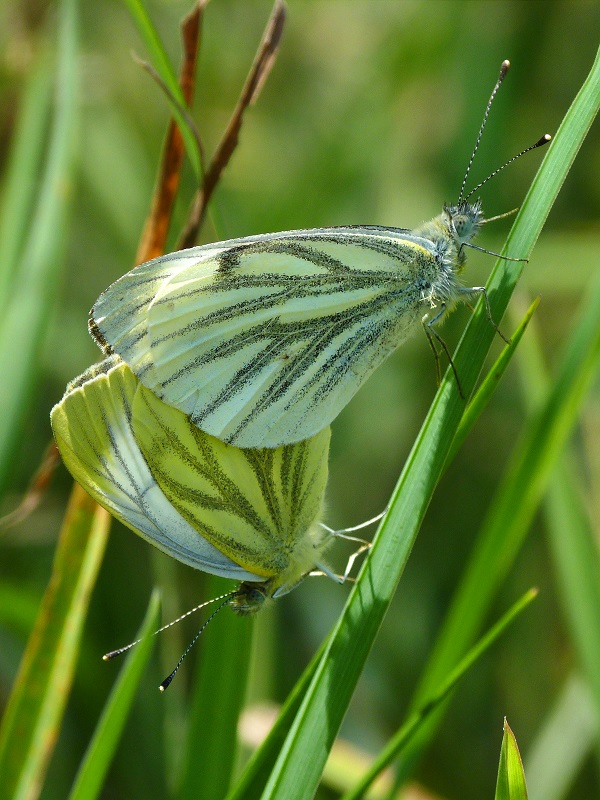
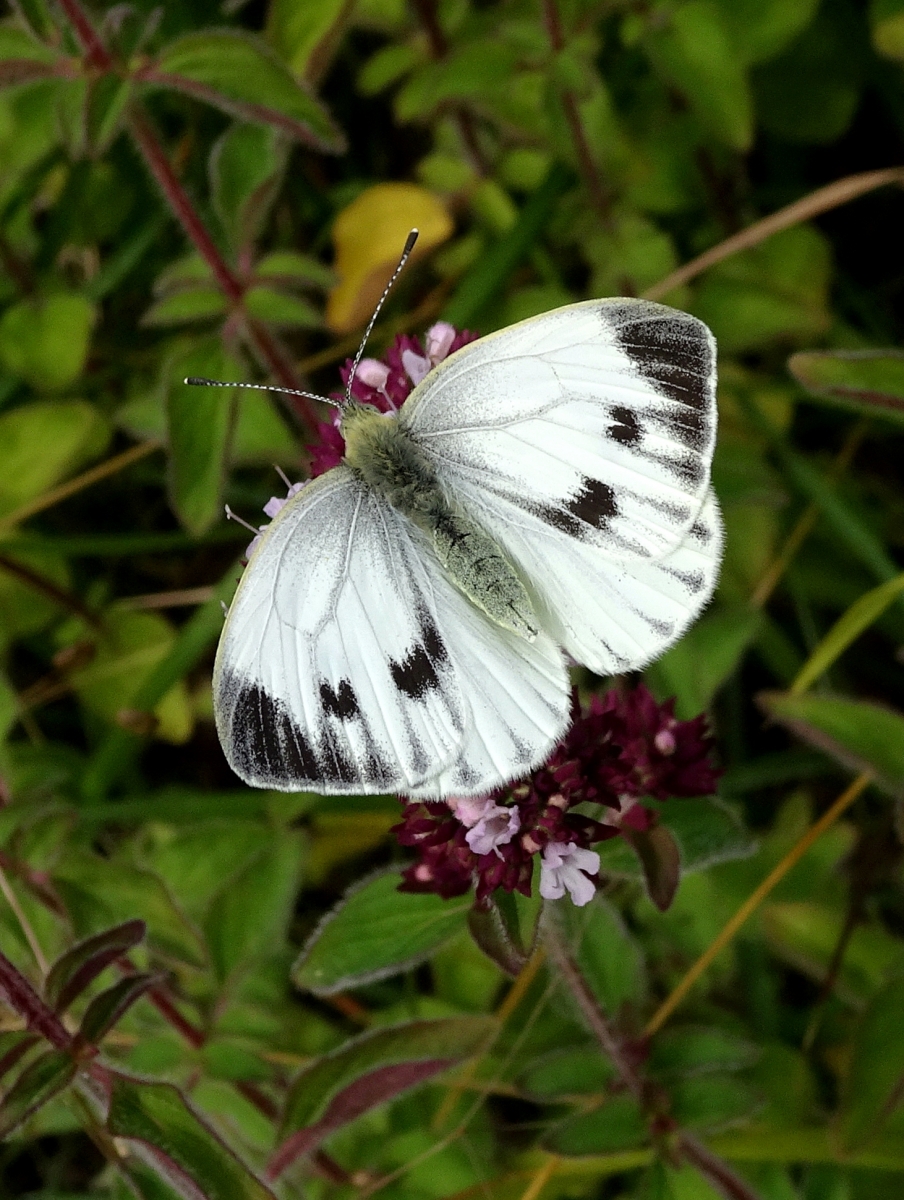
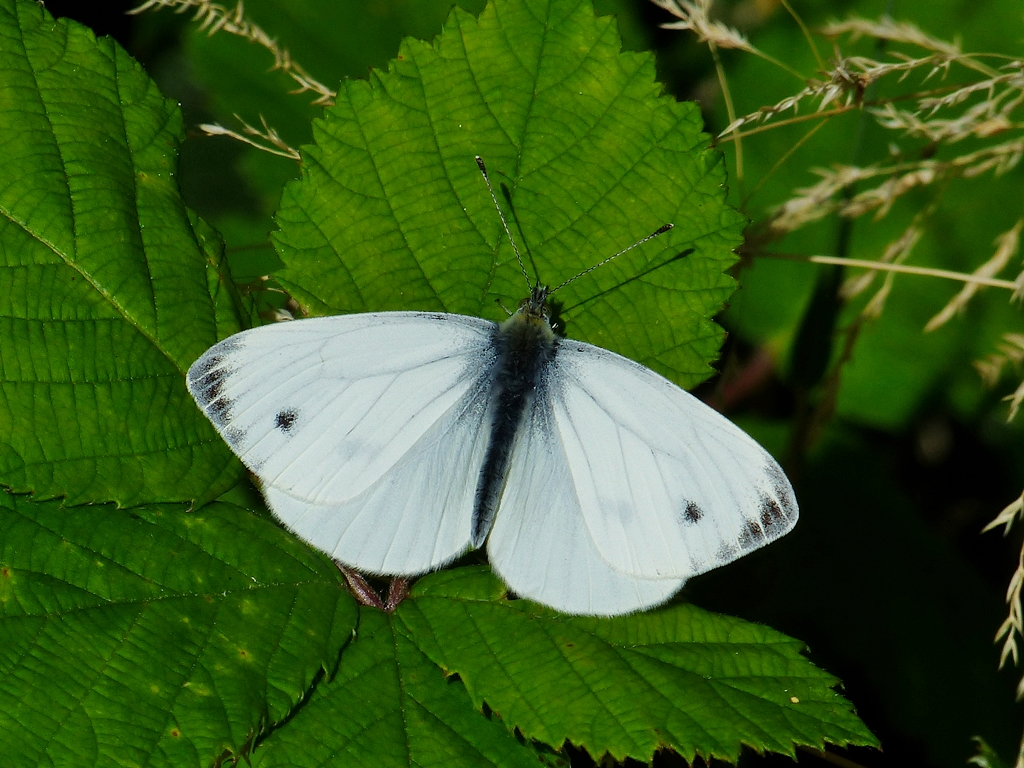
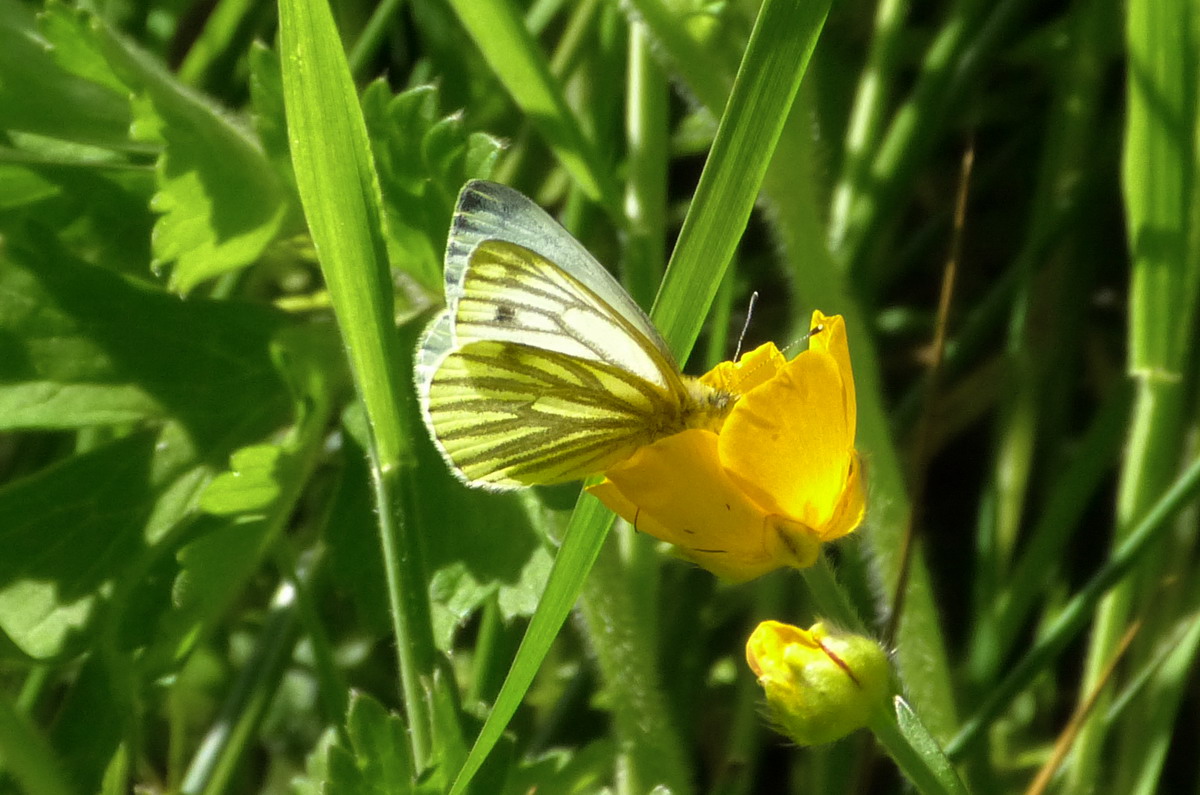
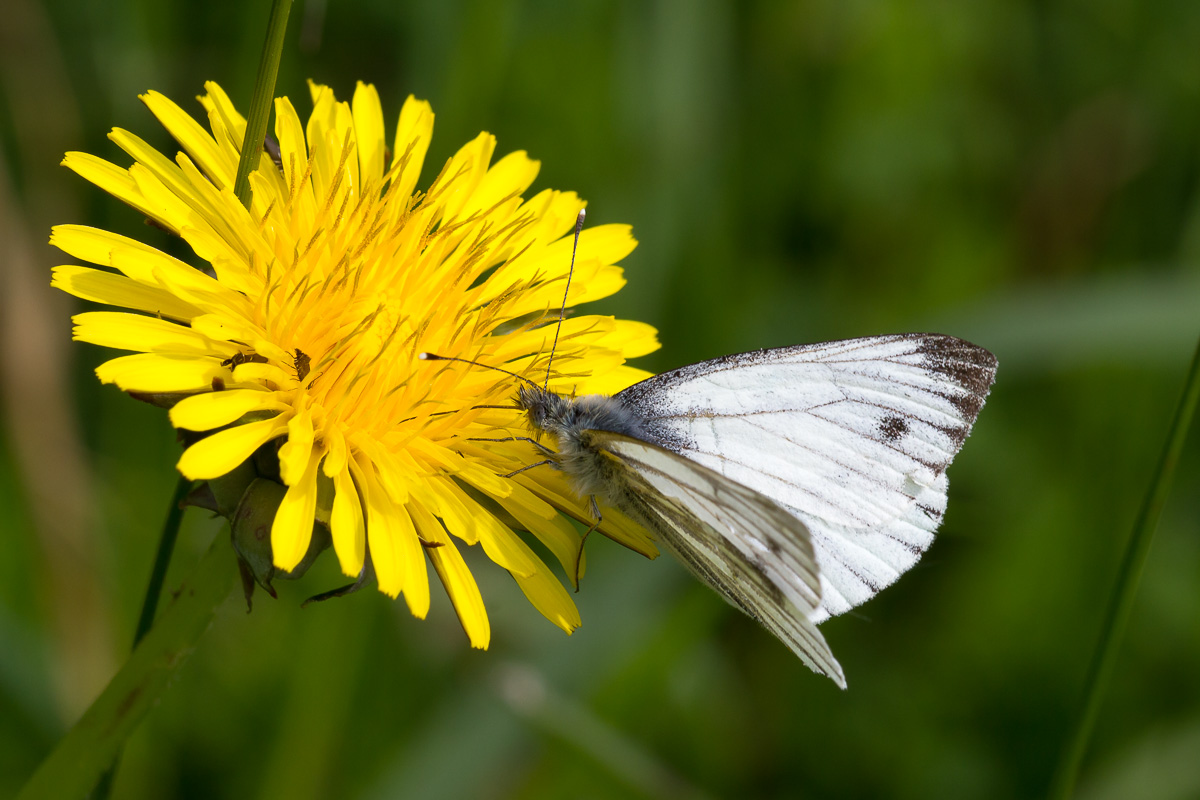
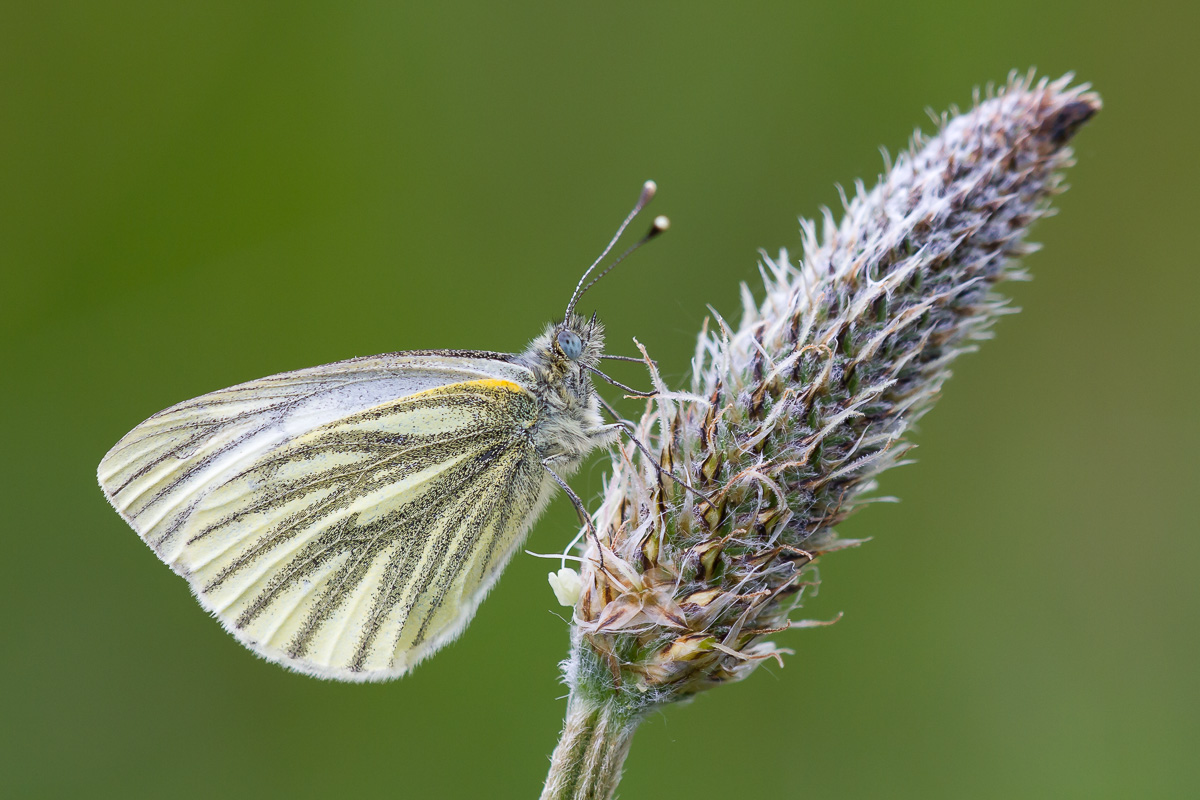
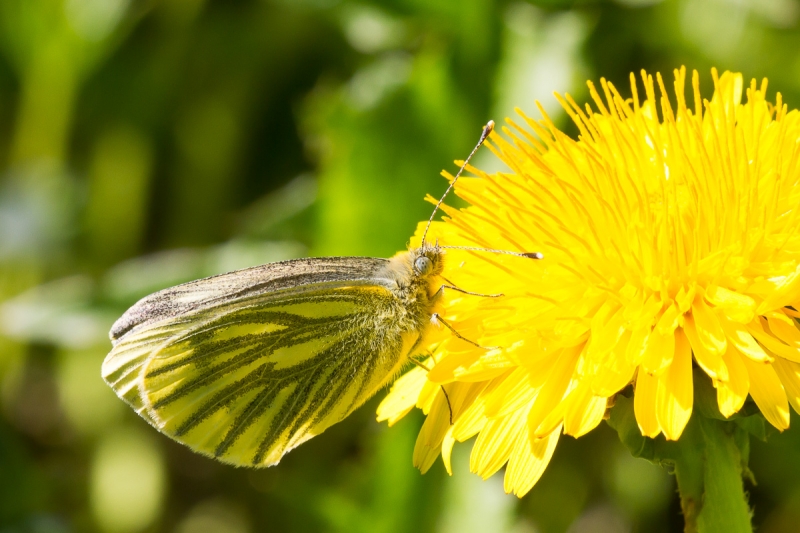
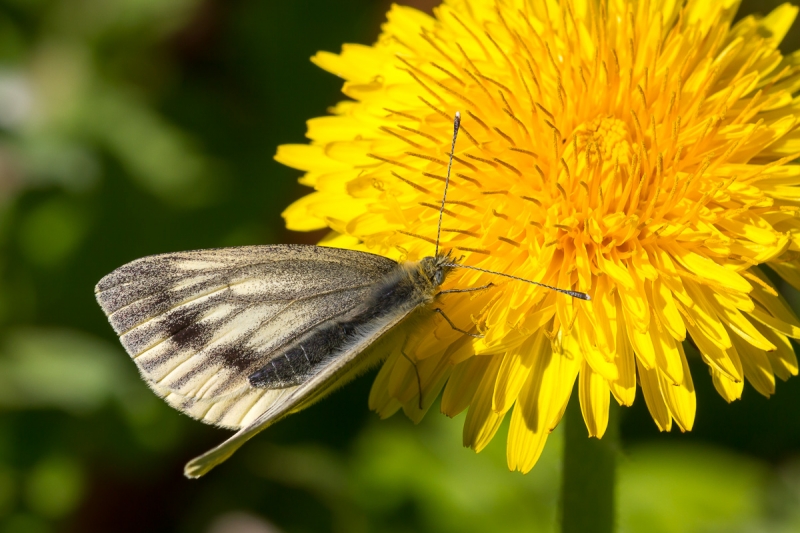
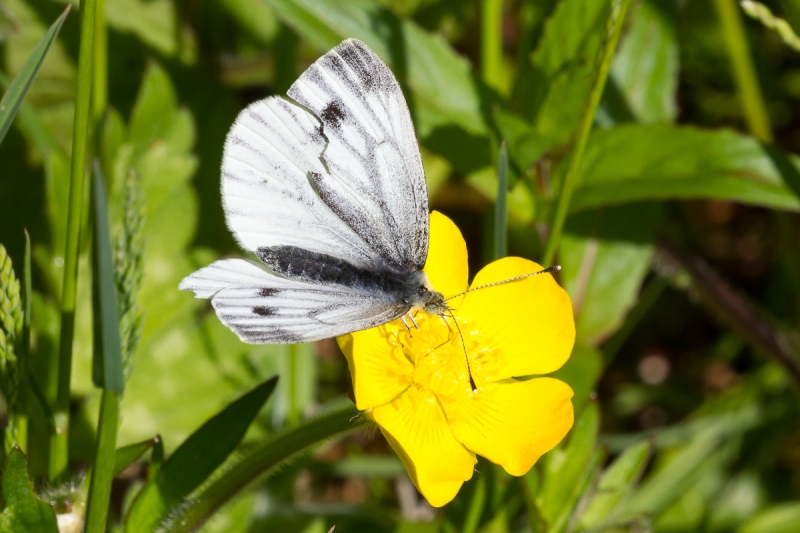
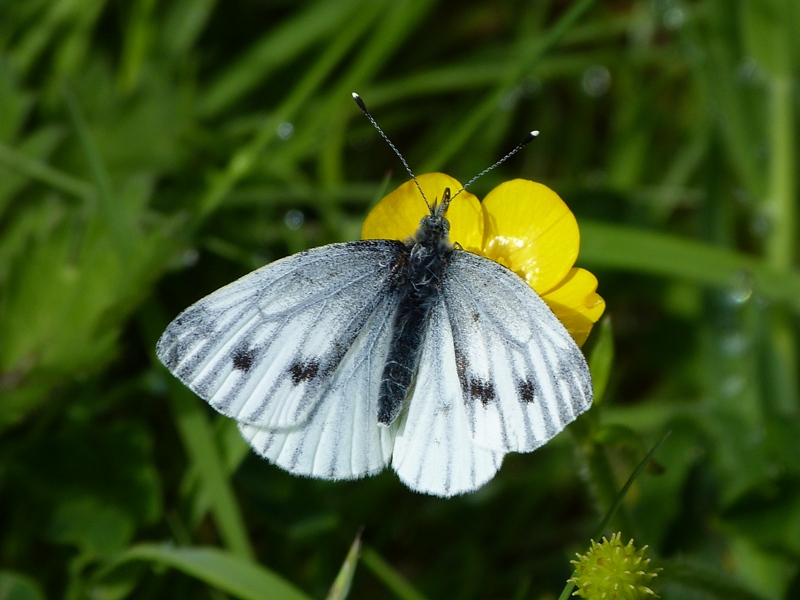
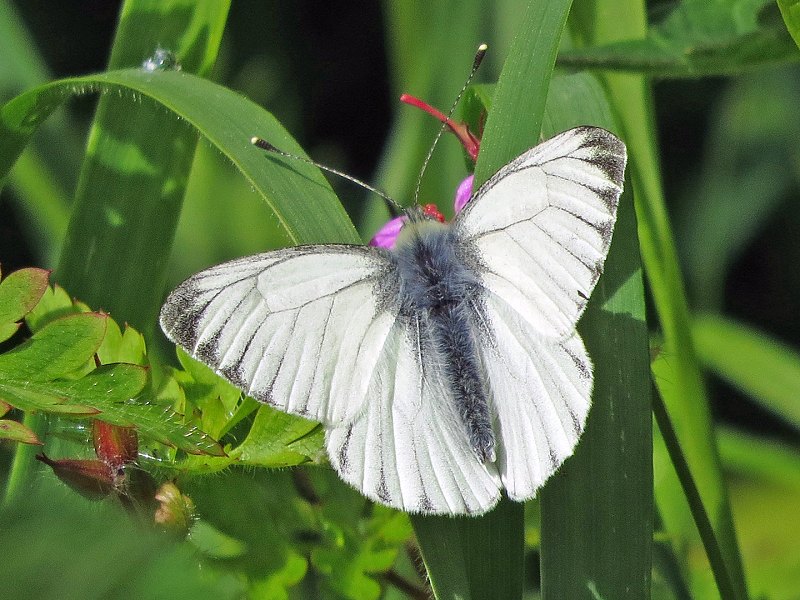
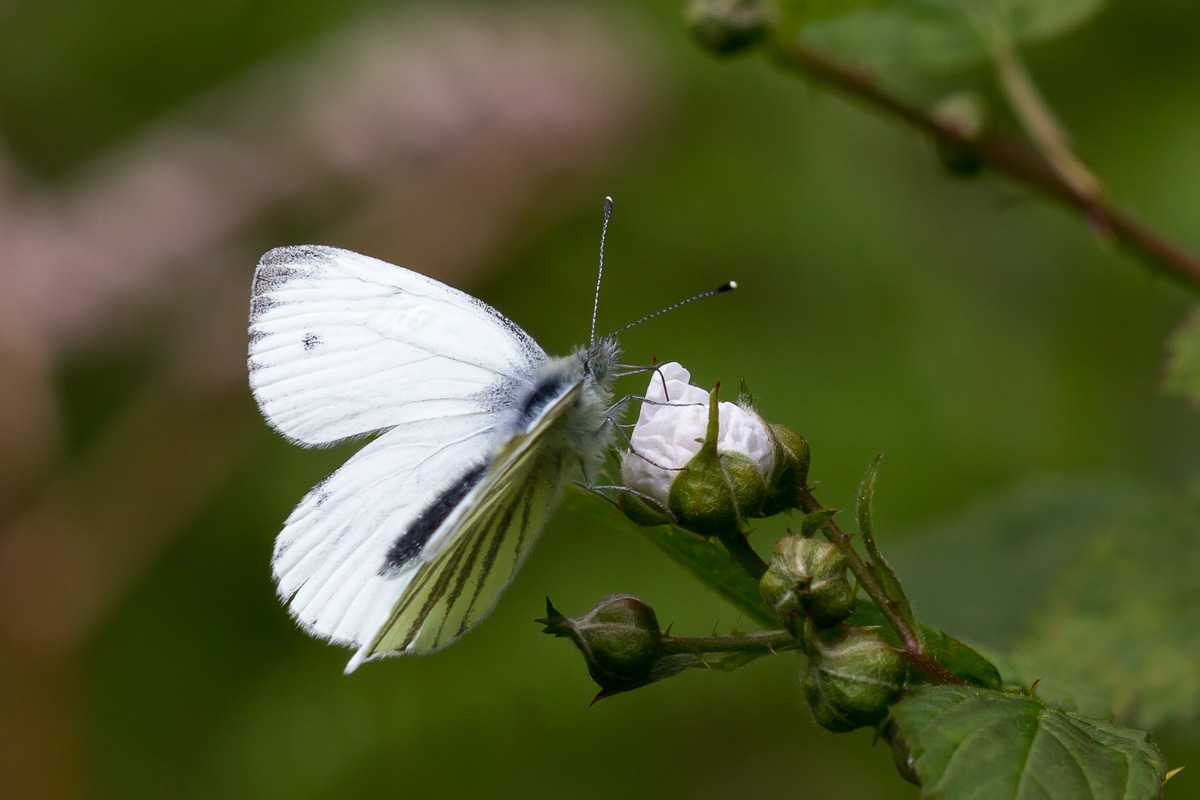
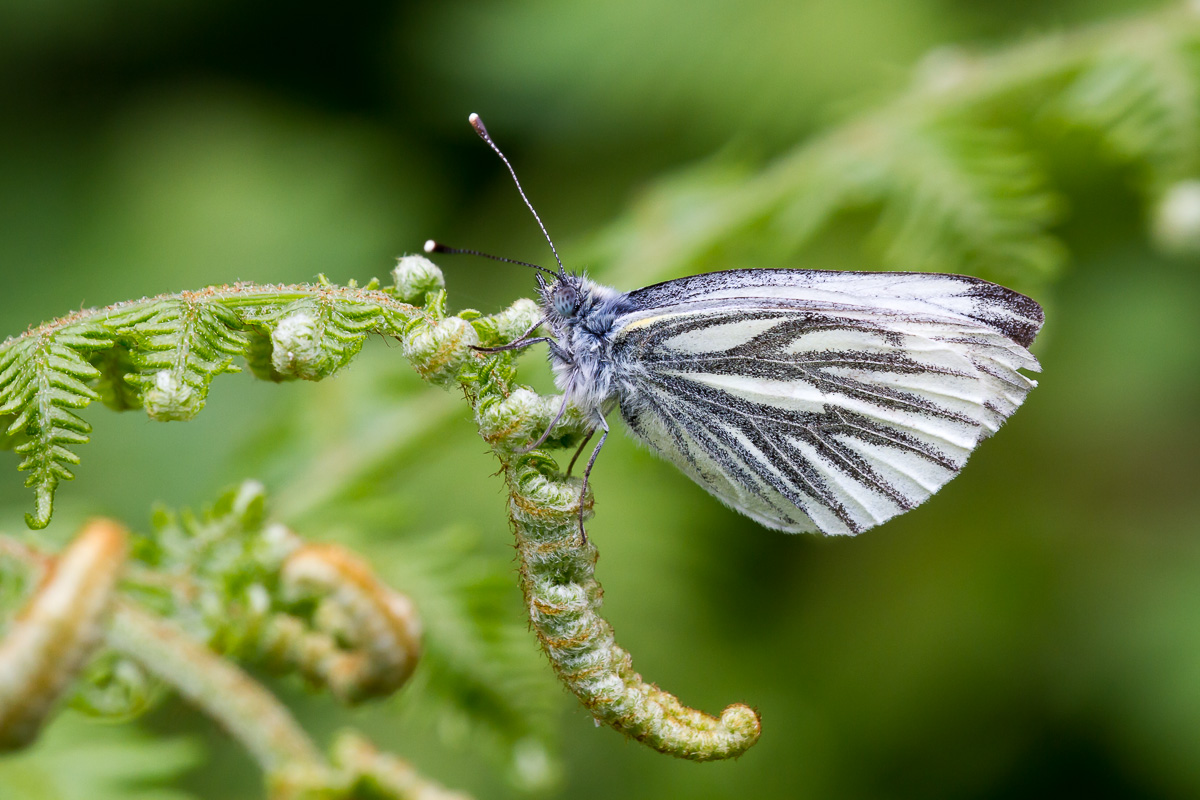
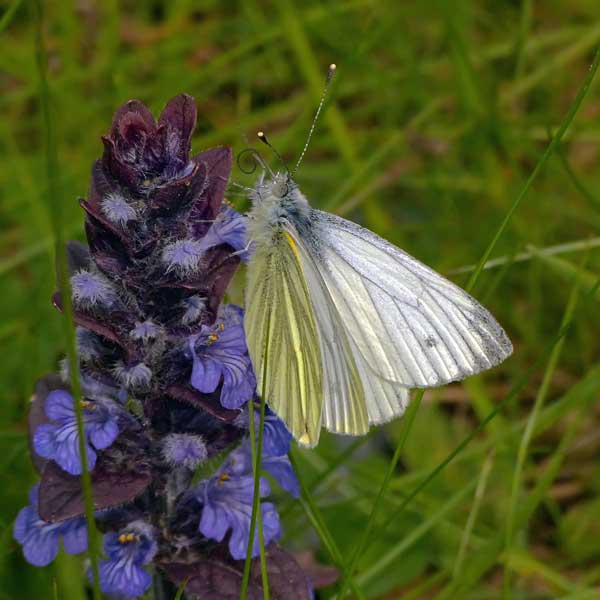
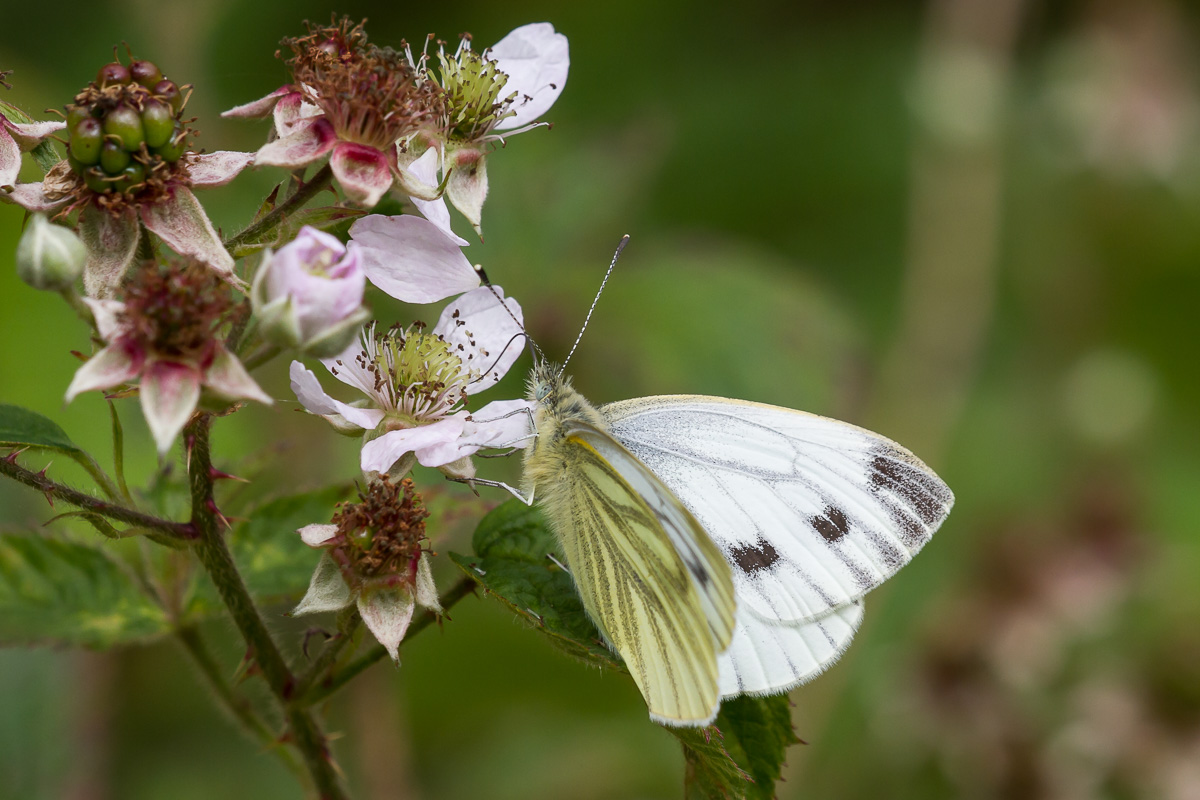
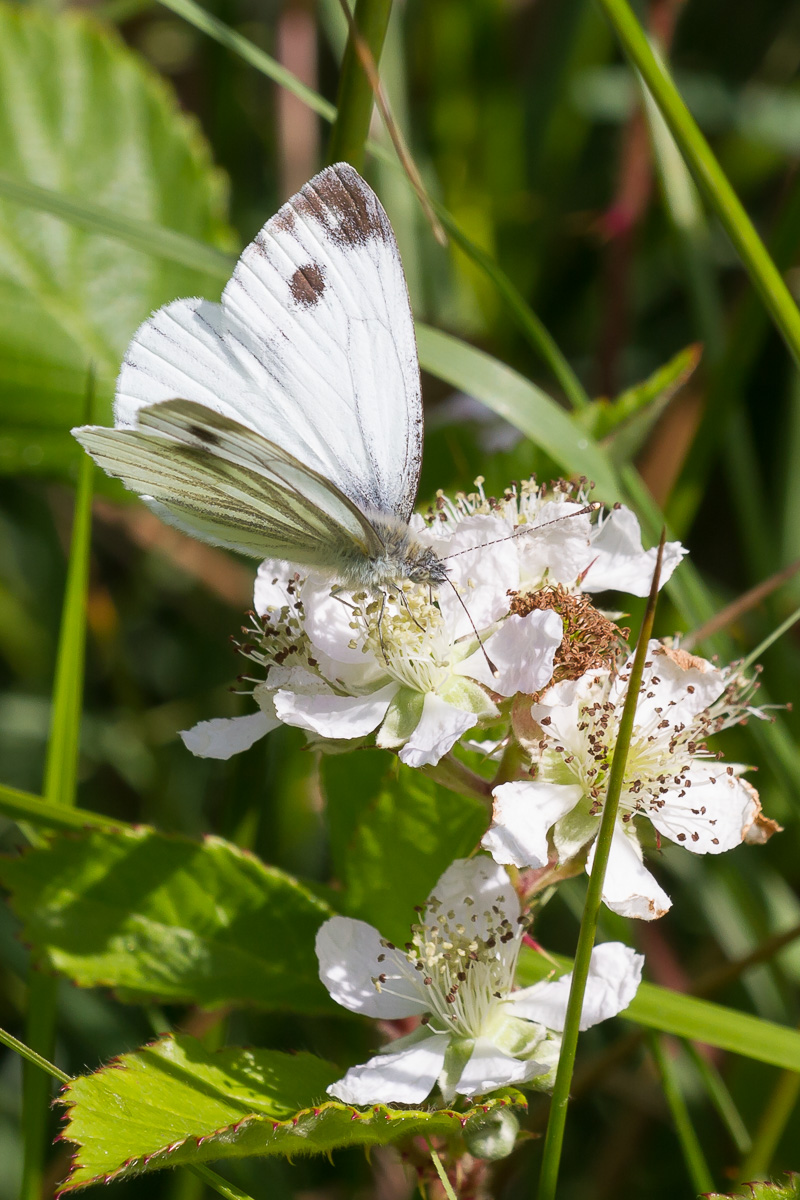
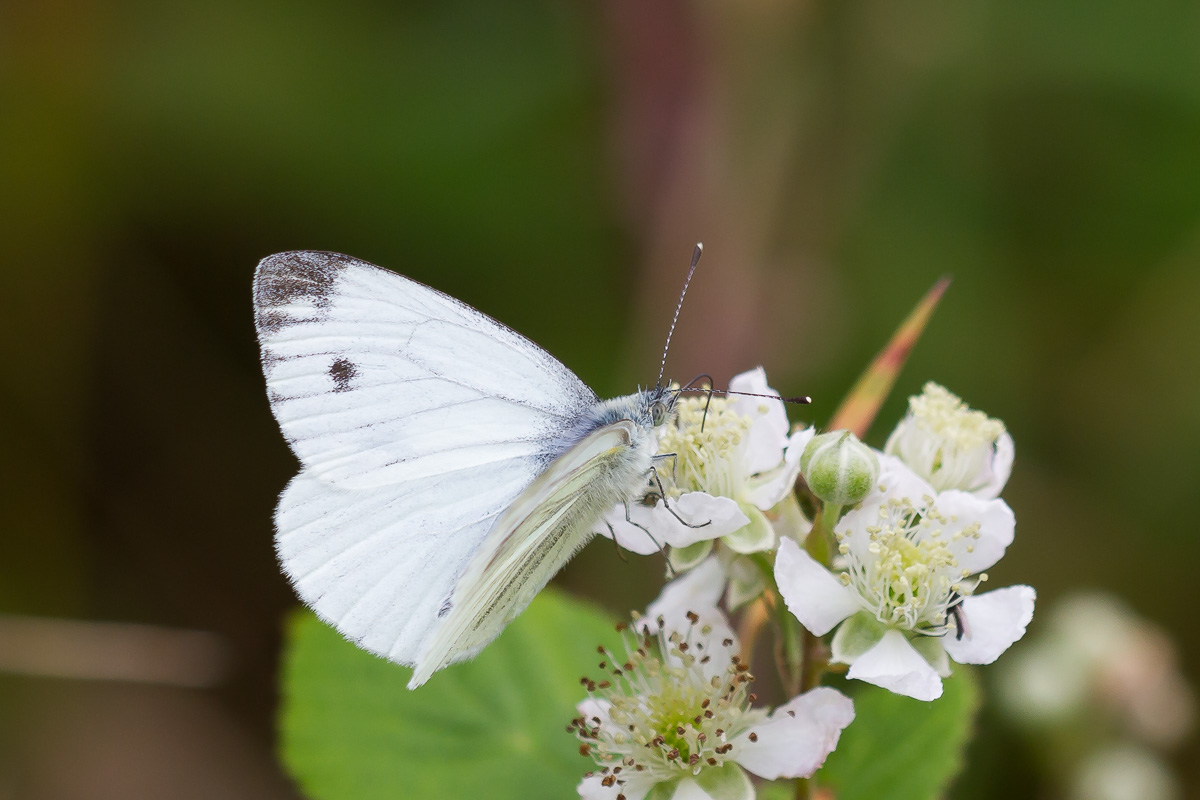
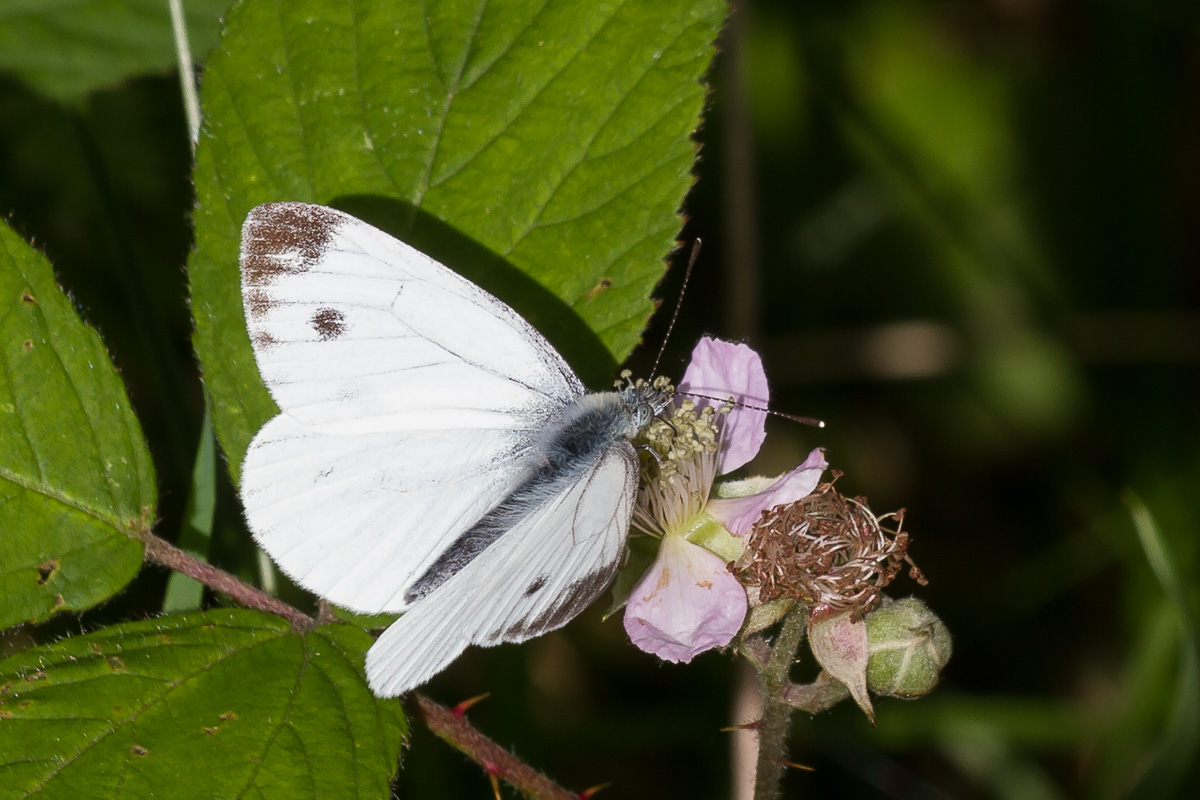
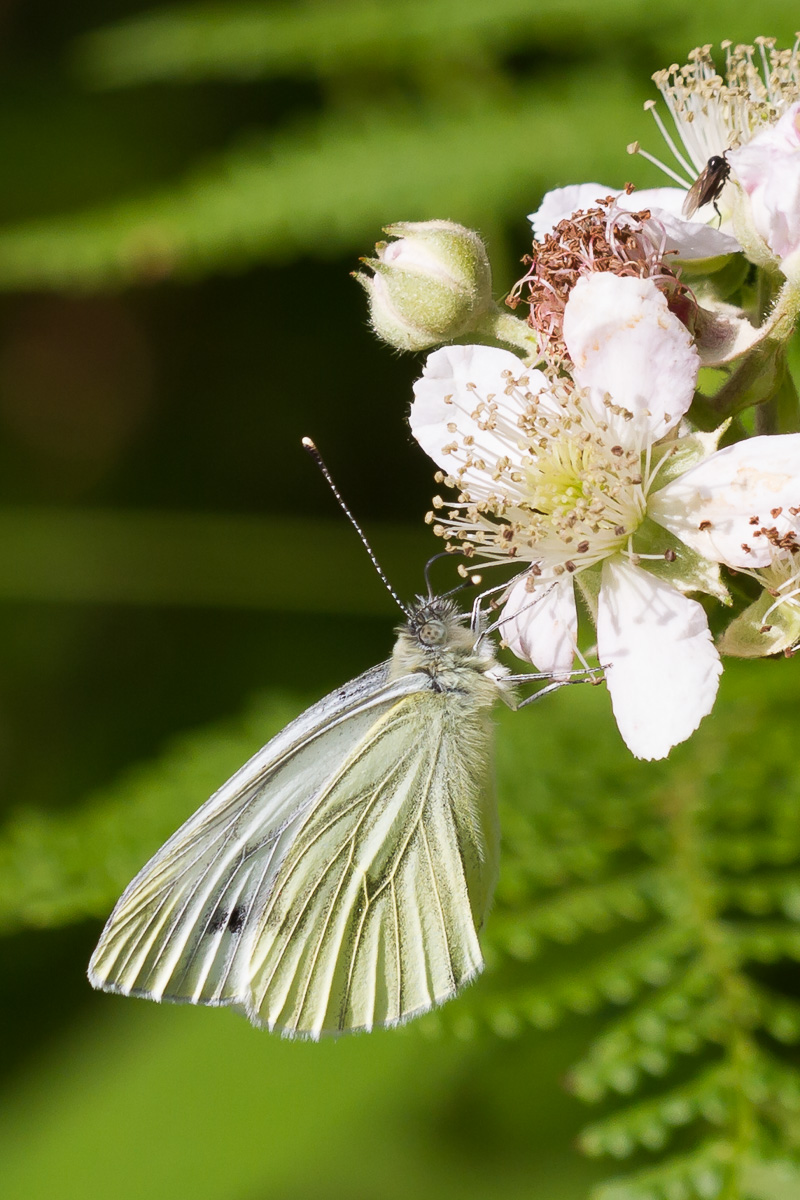
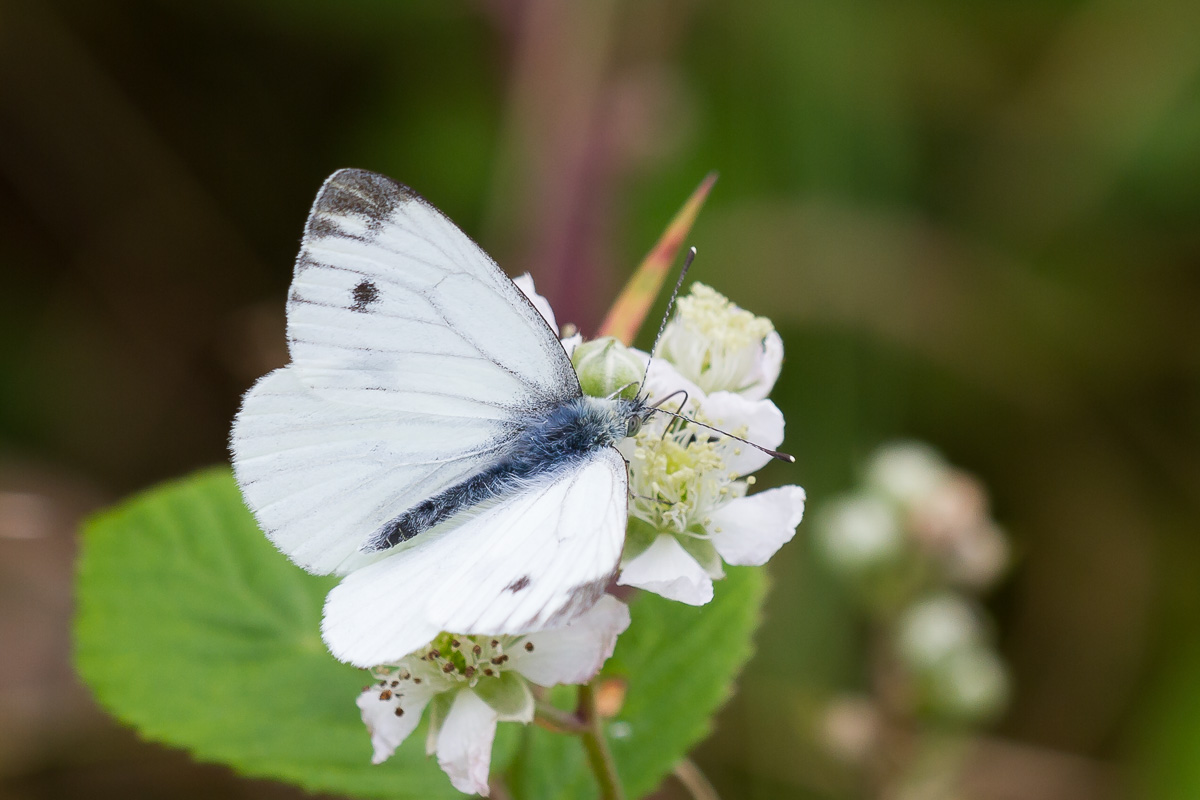
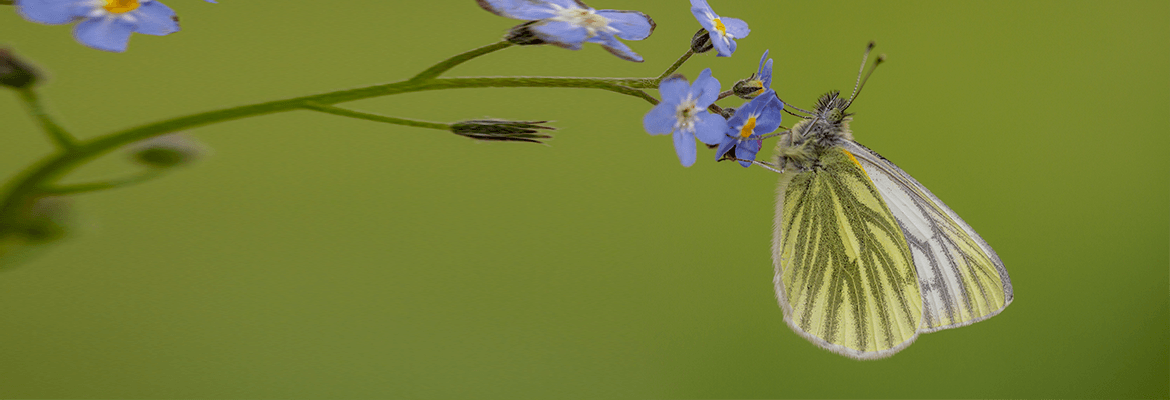
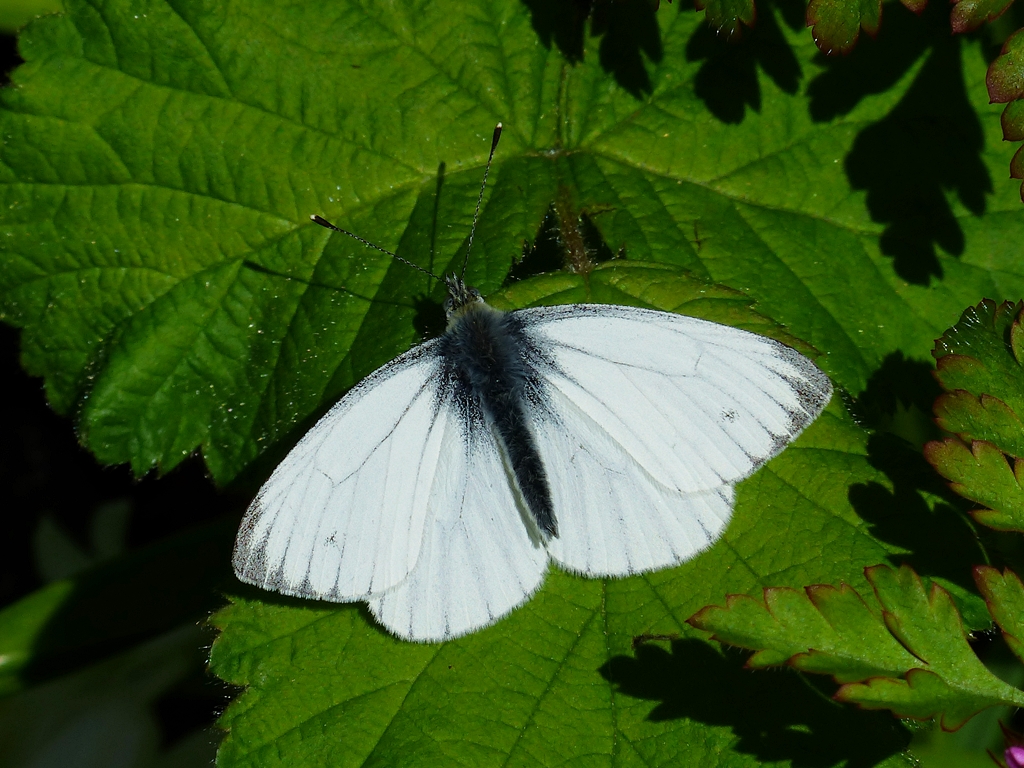
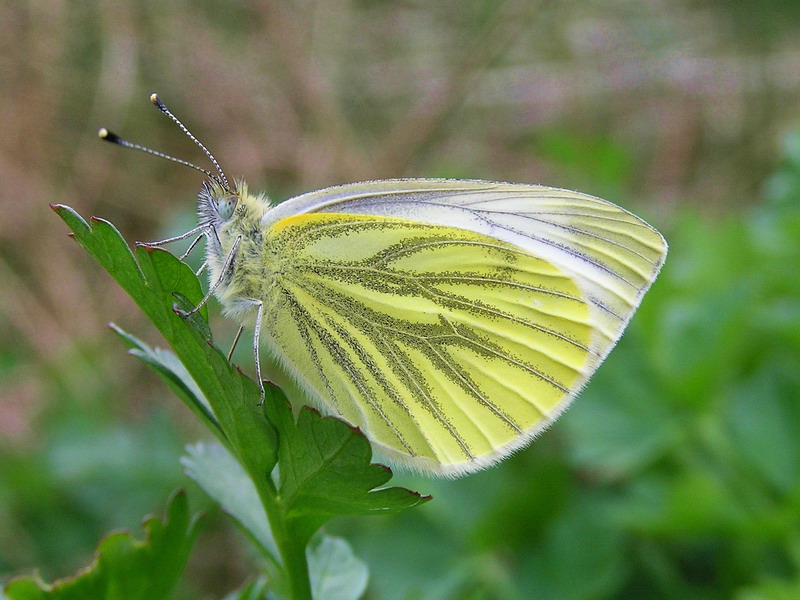
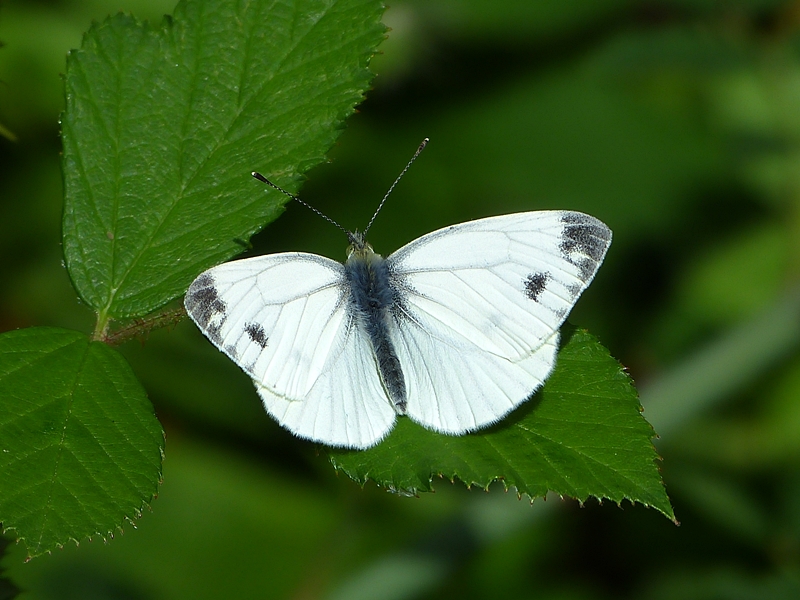
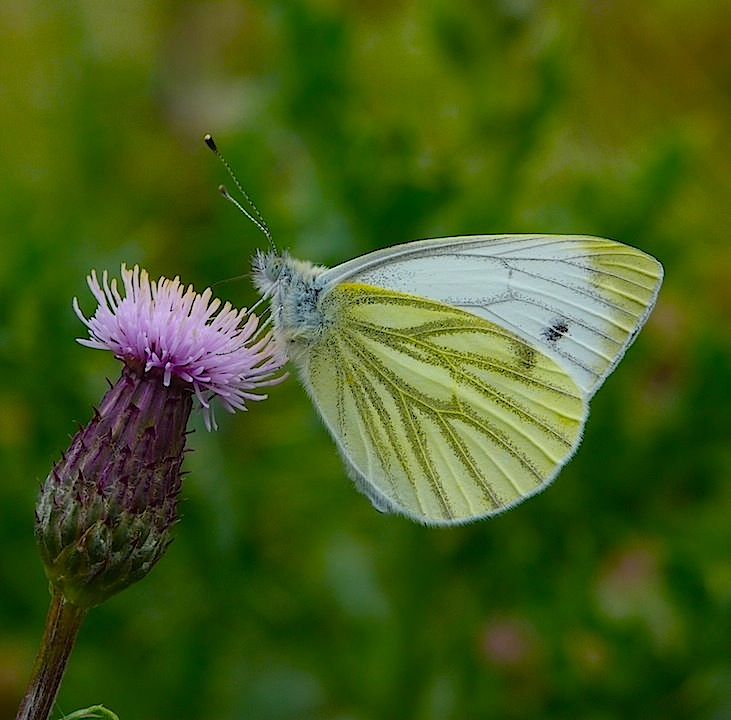
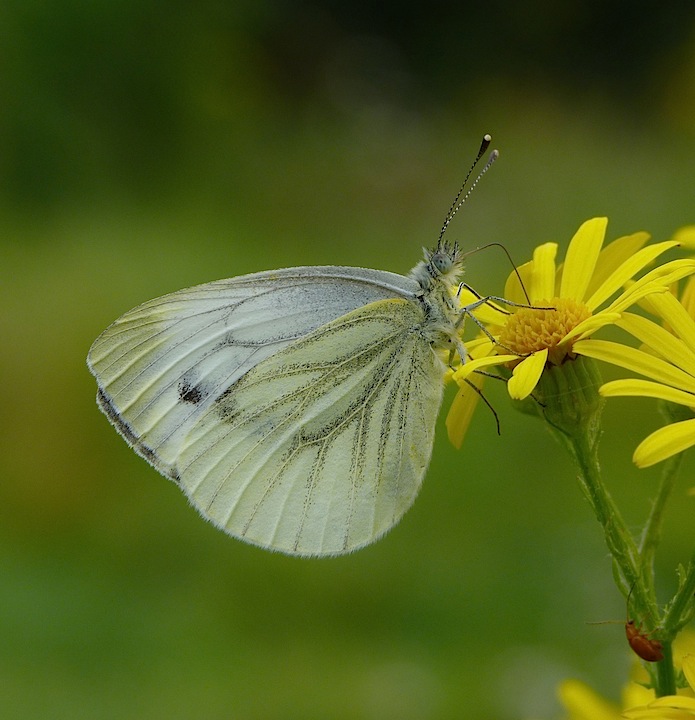
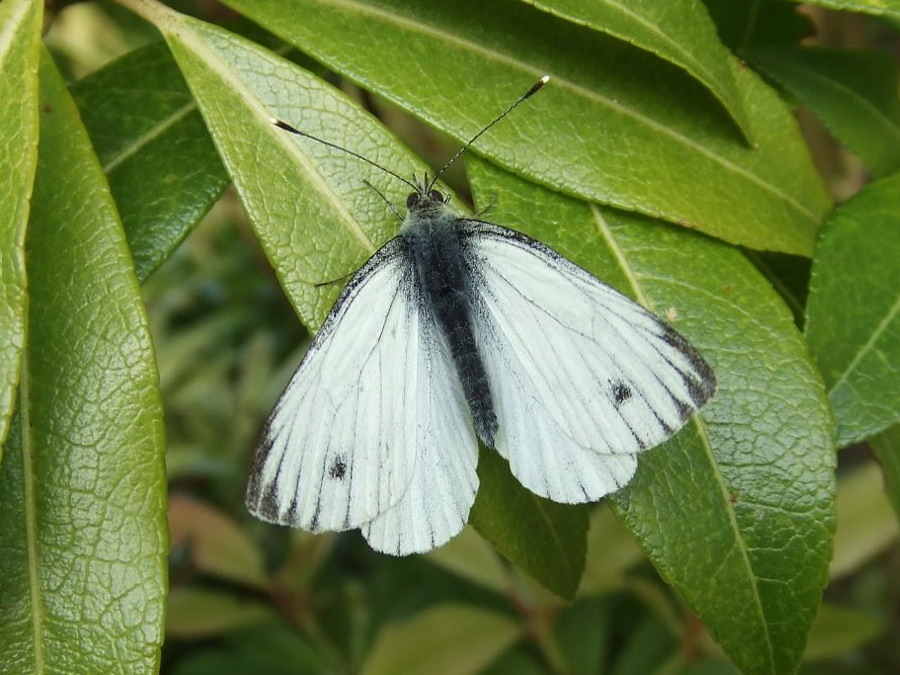
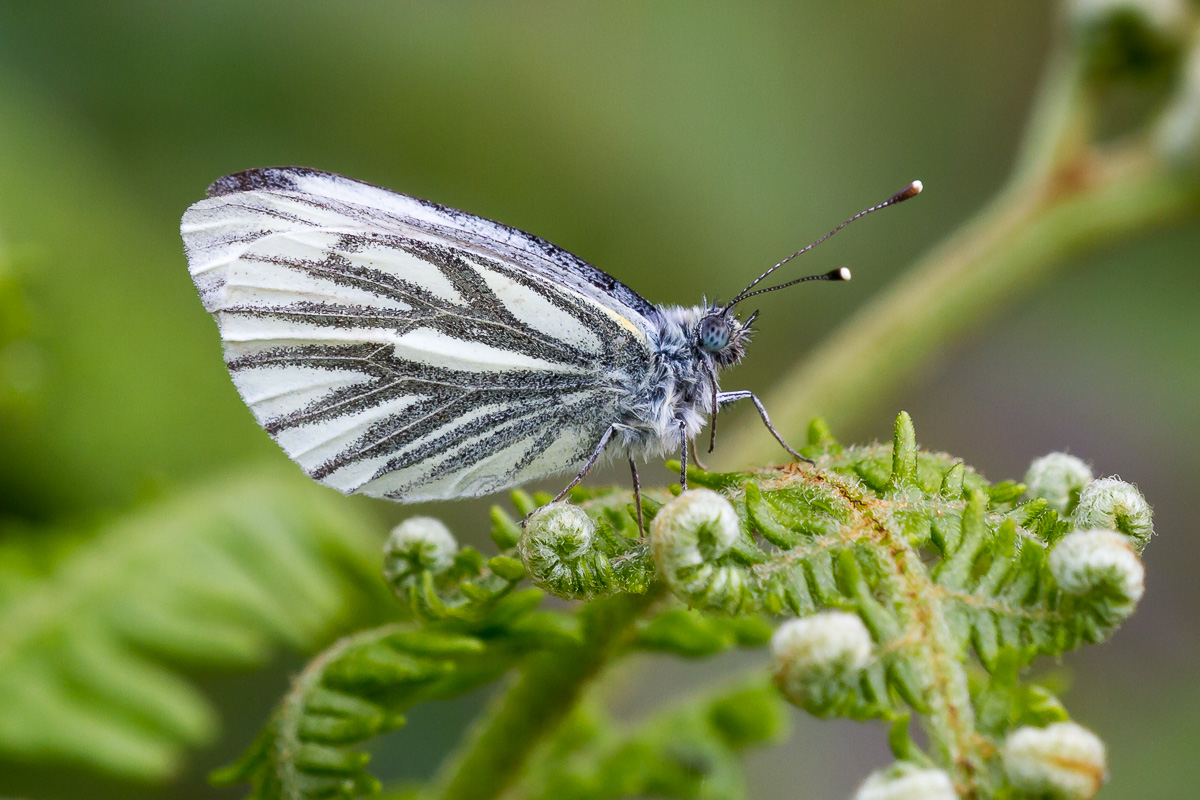
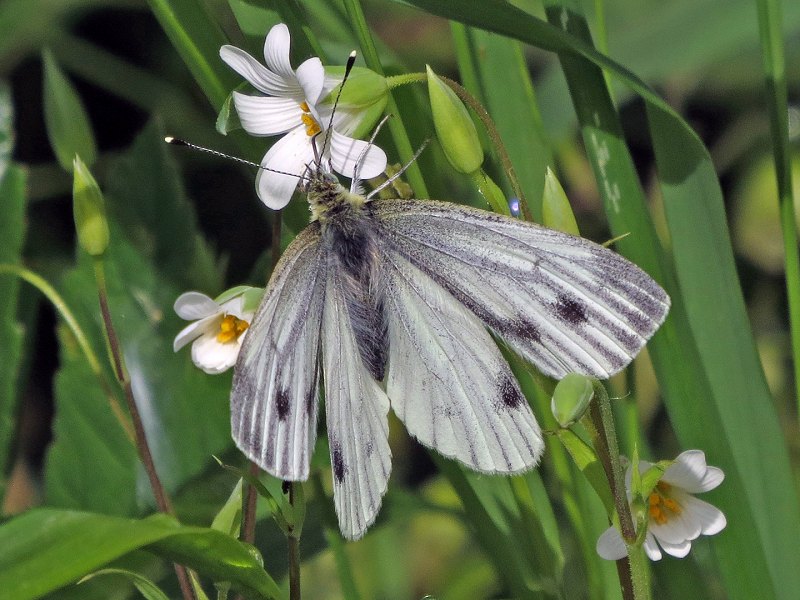
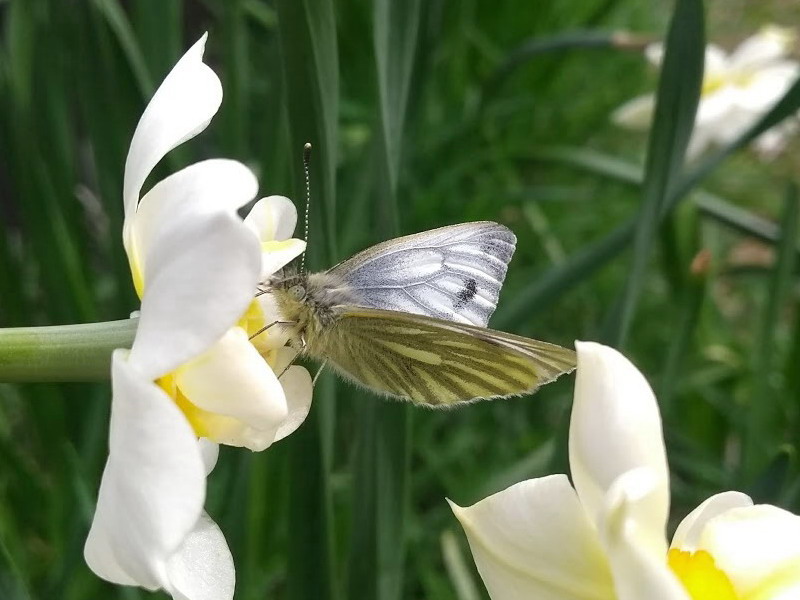
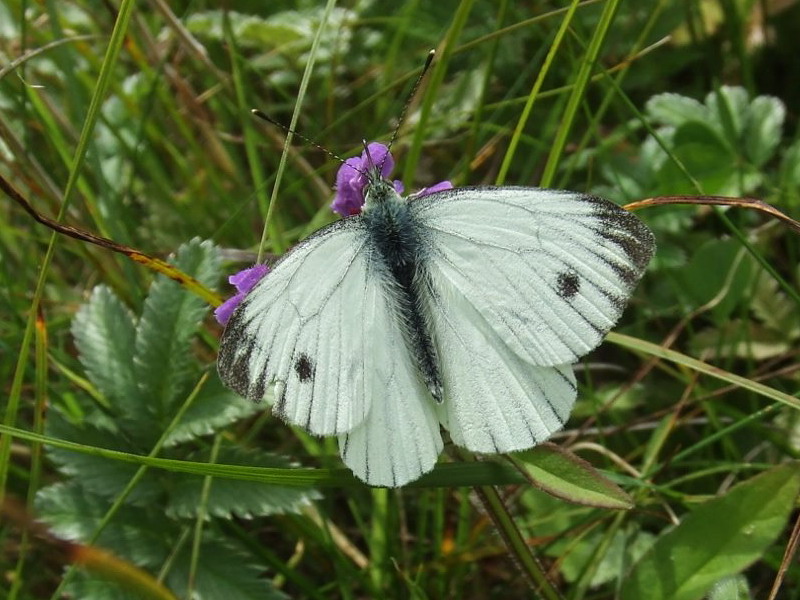
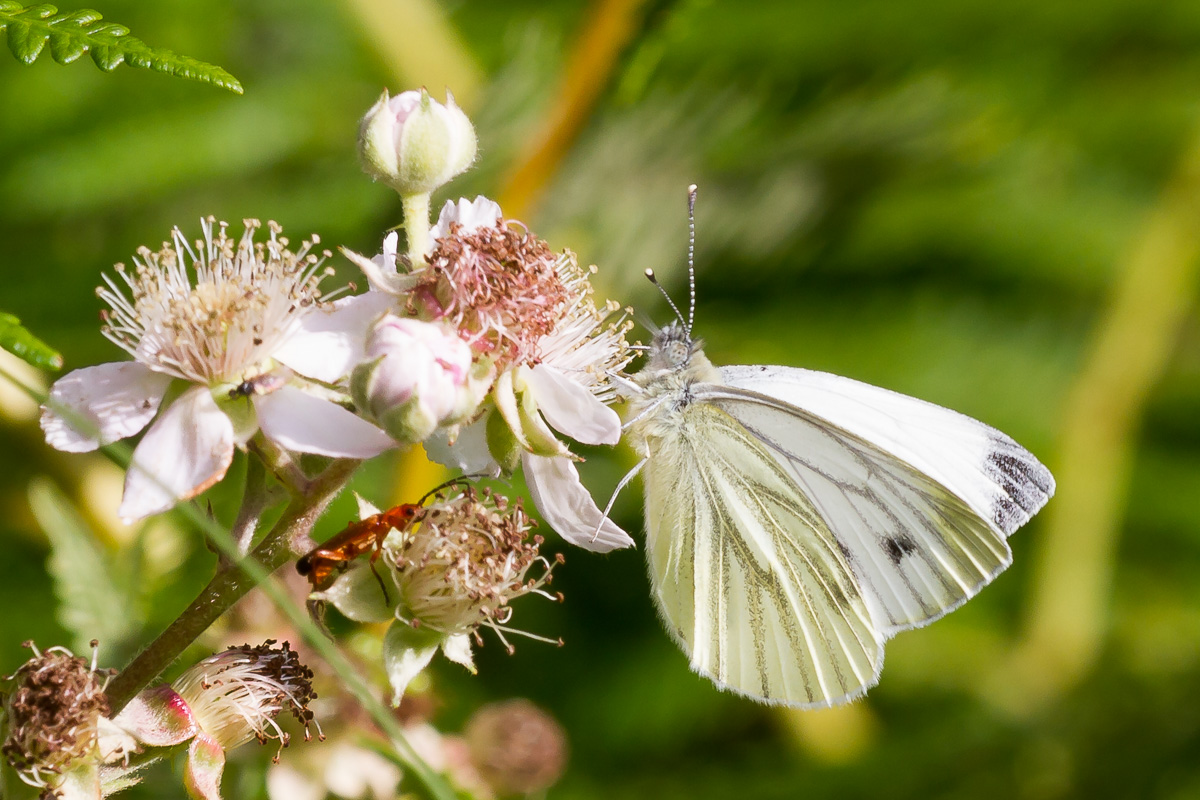
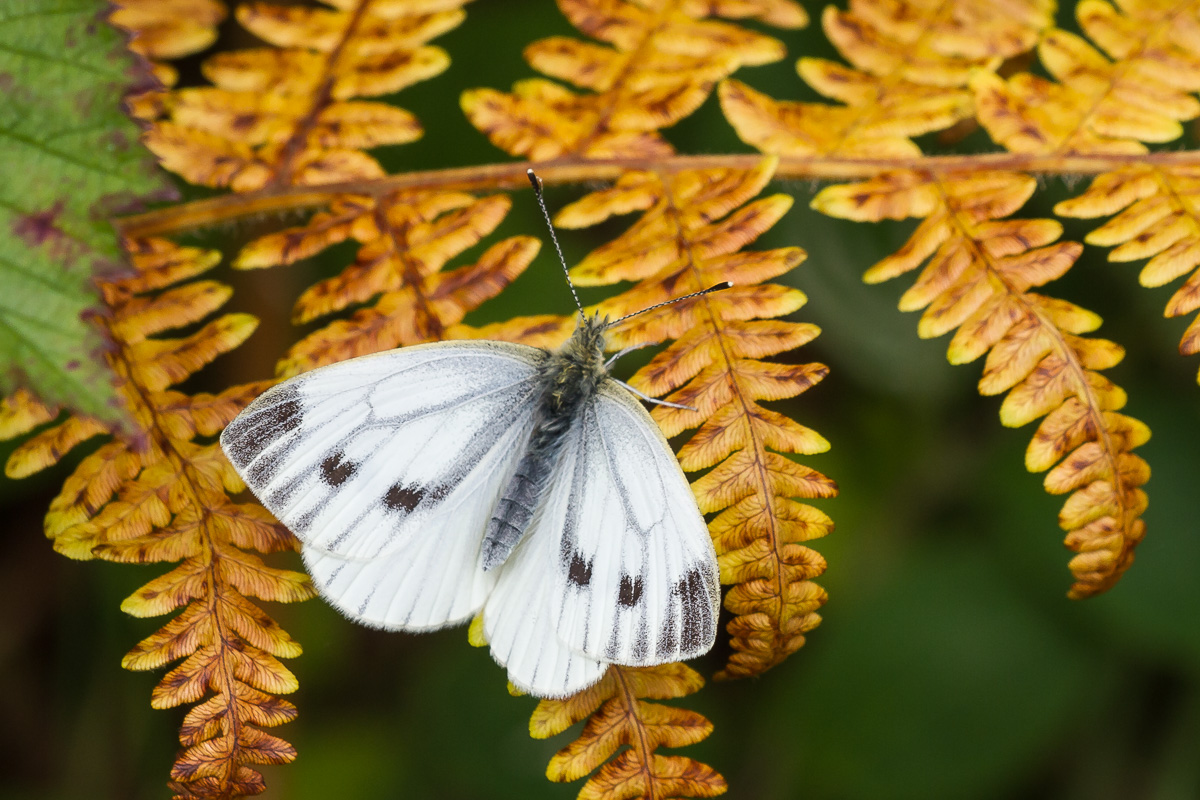
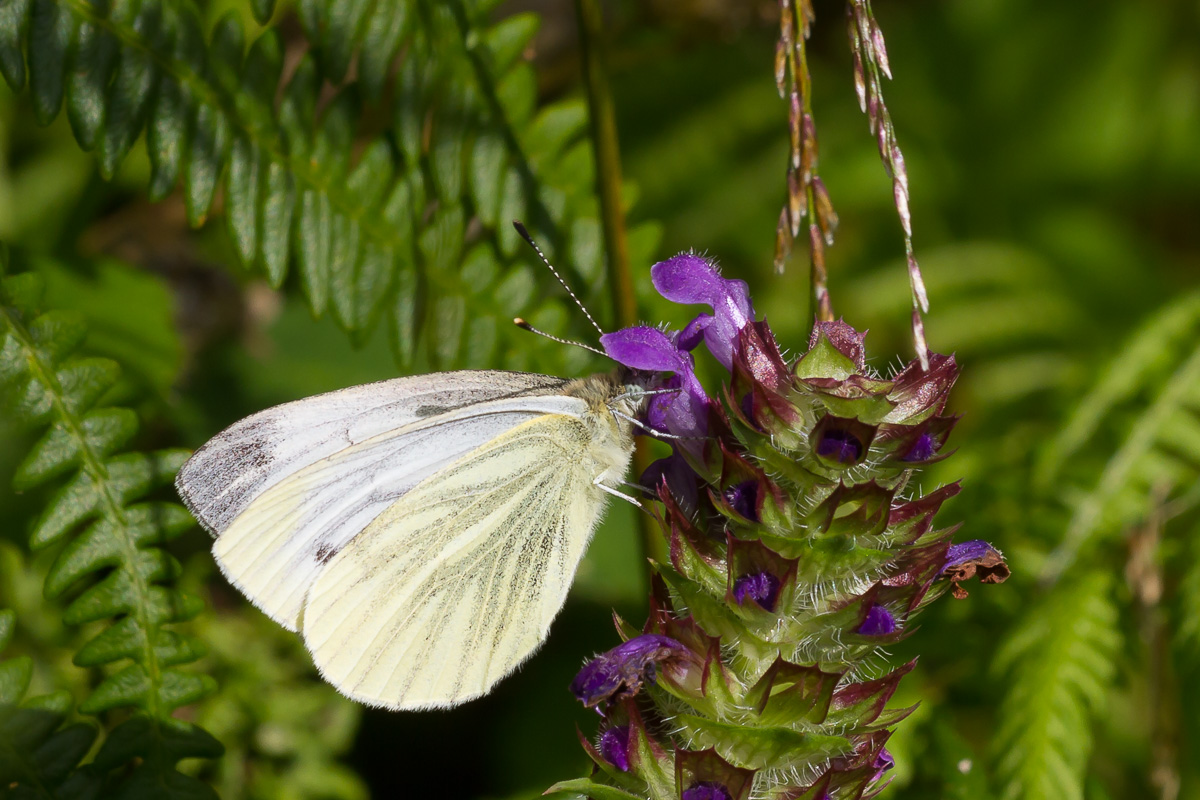
This is a common butterfly of damp grassland and woodland rides and is often mistaken for its cousin, the Small White. It can be found from spring through to autumn in parks and gardens, as well as less-urban areas such as meadows and woodland rides. The so-called green veins on the underside of the adults are, in fact, an illusion created by a subtle combination of yellow and black scales. This is one of the most widespread species found in the British Isles and can be found almost everywhere although it is absent from Shetland and areas of the Scottish Highlands. It is also a highly-variable species and populations have been distinguished based on an analysis of androconial scales as documented in Warren (1967), Warren (1968), Thomson (1970b) and other articles.
The species was first defined in Linnaeus (1758) as shown here (type locality: Sweden). The nominate subspecies has not been recorded in Britain or Ireland.
This subspecies was first defined in Stephens (1827) as shown here and as shown in this plate (type locality: England).
This subspecies is found in England and Wales. However, in the north of England and southern Scotland, there is no clear dividing line between the distribution of this subspecies and that of the subspecies thomsoni. Bowden (1975) considers the name sabellicae to be redundant, suggesting septentrionalis Verity (1916) (type-locality Westcliff-on-sea) instead. Dennis (1977) also questions the name: "The southern English race is superficially very similar to samples from the Continent, and the slight differences evidenced in its smaller size, brighter yellow underside and reduced seasonal dimorphism could well be part of environmental variation, as was indeed indicated by rearing Tuscany napi in Durham (Verity 1916). This, together with the marked seasonal dimorphism and microgeographical variation between adjacent localities makes these names [sabellicae, vulgaris] inapplicable".
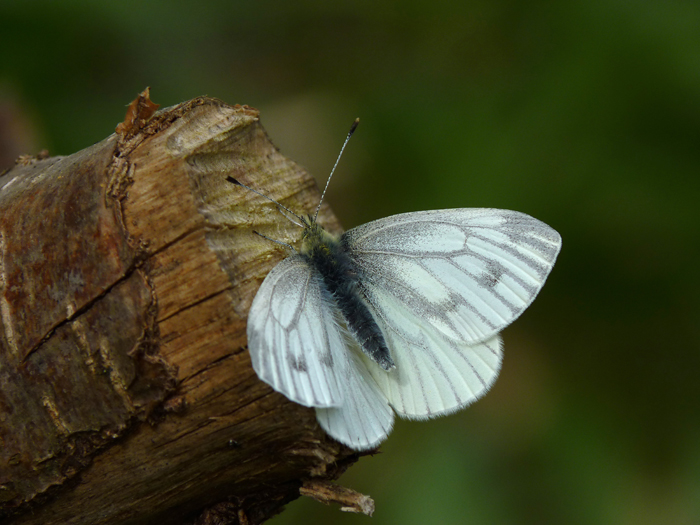
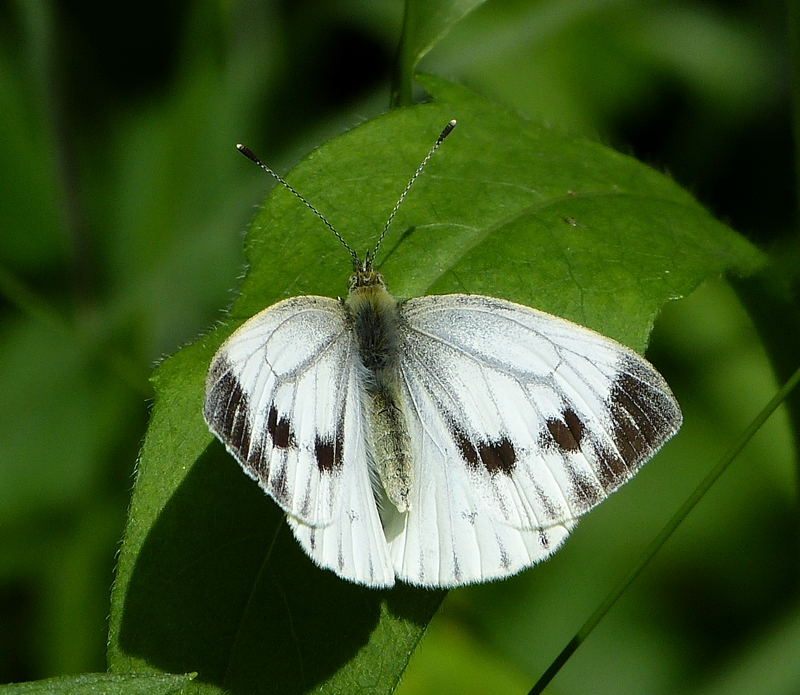
Spring brood males have very feint markings and often lack the single spot on each forewing, whereas summer brood males have more pronounced markings. Spring brood females, on the other hand, are generally more heavily marked than their offspring, especially on the forewings. In both sexes, summer brood adults are generally larger than those of the spring brood.
Sabellicae. Plate III. f.3,♂. - f.4.♀. - Alis suprà albidis basi nigricante, utrinquè fuscescente-venosis; subtus anticis apice, posticis paginâ omni flavescentibus. (Exp. alar. 1 unc. 7-10 lin.)
Pa. Sabellicae. Petiver, pl.1. f.17,18, ♂. - f.15,16, ♀. - Po.Sabellicae. Steph. Catal.
Allied to Po. Napi, but dissimilar in form, the wings being shorter and more rounded; the anterior being nearly of the form of those of Po. Cardamines,- it has the upper surface of all the wings of a yellowish-white, with broad dusky irrorated nervures; broadest towards the hinder margin : the male has the base of the anterior wings and a single irregular spot in the fourth marginal cell dusky, and the female the base and tips of the same wings, a spot in the fourth and sixth marginal cells, and the inner edge of the wings of the same colour : both sexes have a similarly coloured spot on the upper margin of the posterior wings above. Beneath, all the wings are adorned with very broad dusky nervures, resembling those in var. [zeta: Dilated nervures of the posterior wings beneath dusky in both sexes] of Po. Napi, but varying in different specimens; and the dilated nervure on the upper edge of the discoidal cell is destitute of the insulated yellow spot, which every specimen of Po. Napi that has passed under my examination possesses.

This subspecies was first defined in Müller & Kautz (1939) (type locality: Ireland).
This subspecies is found throughout Ireland, where it is common, as well as parts of Scotland, as confirmed by Verity (1905-1911), Verity (1916) and Bowden (1970). Chalmers-Hunt (1970) extends the distribution to the Isle of Man. This subspecies exhibits differences between spring and summer broods, as described for the subspecies sabellicae. This subspecies differs from the subspecies sabellicae as follows:
The description of this subspecies is included within an extensive German text that runs to several pages. The intent of the definition is as follows:
A pre-ice age, "tertiary napi", moved into the British Isles and survived the ice age. After the ice age, continental napi moved back into the British Isles while the land bridge was still open and bred with the tertiary napi in the south. "Pure" tertiary napi remained in Scotland and Northern Ireland. So, there is a dark form in Scotland and Northern Ireland, a lighter, "mixed" form in the rest of the British Isles, and napi proper, on the continent. Verity apparently identified the southern mixed form as napi and the northern forms as britannica.
In their description, Müller & Kautz refer to the definition given by Verity (1905-1911) which is reproduced below.
Original (French)
Ayant vu de grandes séries de cette espèce provenant d'Irlande et d'Ecosse, j'ai pu me persuader qu'il existe dans ces pays une race bien distincte (Pl. XXXII, fig.4 et 6), charactérisée par sa petite taille, l'intensité des dessins noir, les nervures bordées légèrement de gris aussi sur les antérieures en dessous, la superbe teinte jaune des postérieures en dessous, la différence moins marquée des générations etc.; je la nommerai donc britannica; la première génération en Angleterre diffère peu de cette forme.
Translation
Having seen large series of this species from Ireland and Scotland, I am persuaded that a clearly distinct race exists in these countries (Pl. XXXII, figs. 4 and 6), characterised by its small size, the intensity of the black markings, the veins lightly bordered in grey on the undersides of the forewings as well, the superb yellow colour of the hindwing undersides, the less marked difference between the generations &c.; I will therefore call it britannica; the first generation in England differs little from this form.
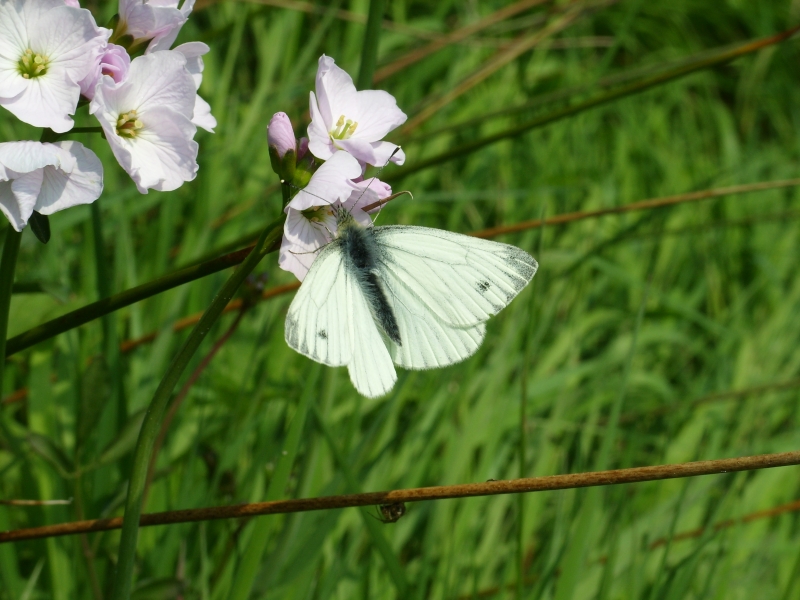

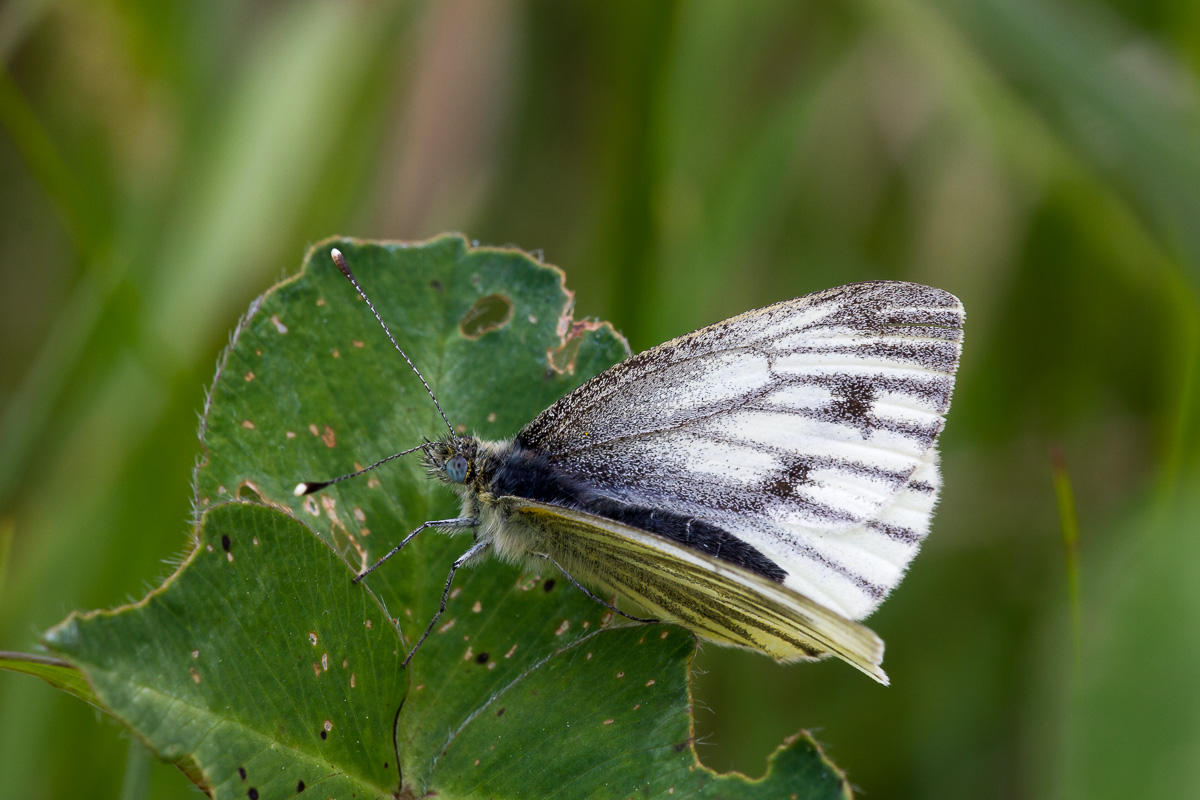
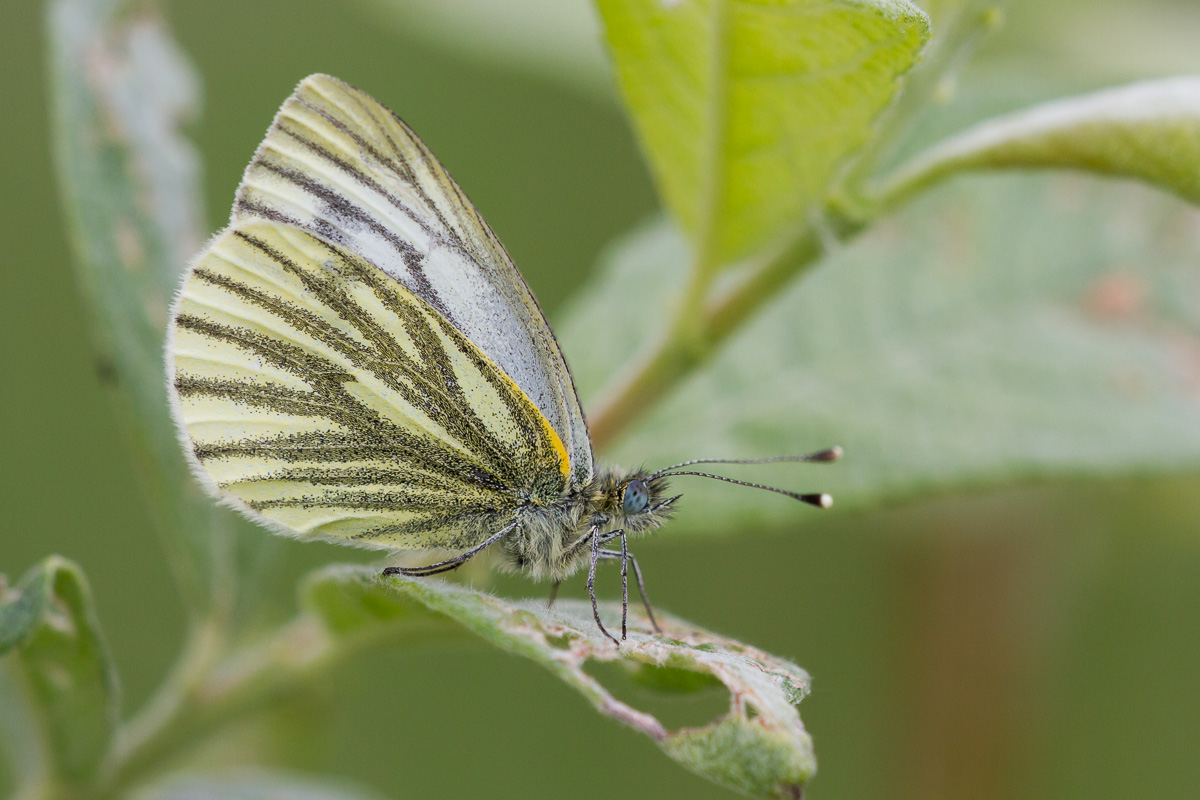
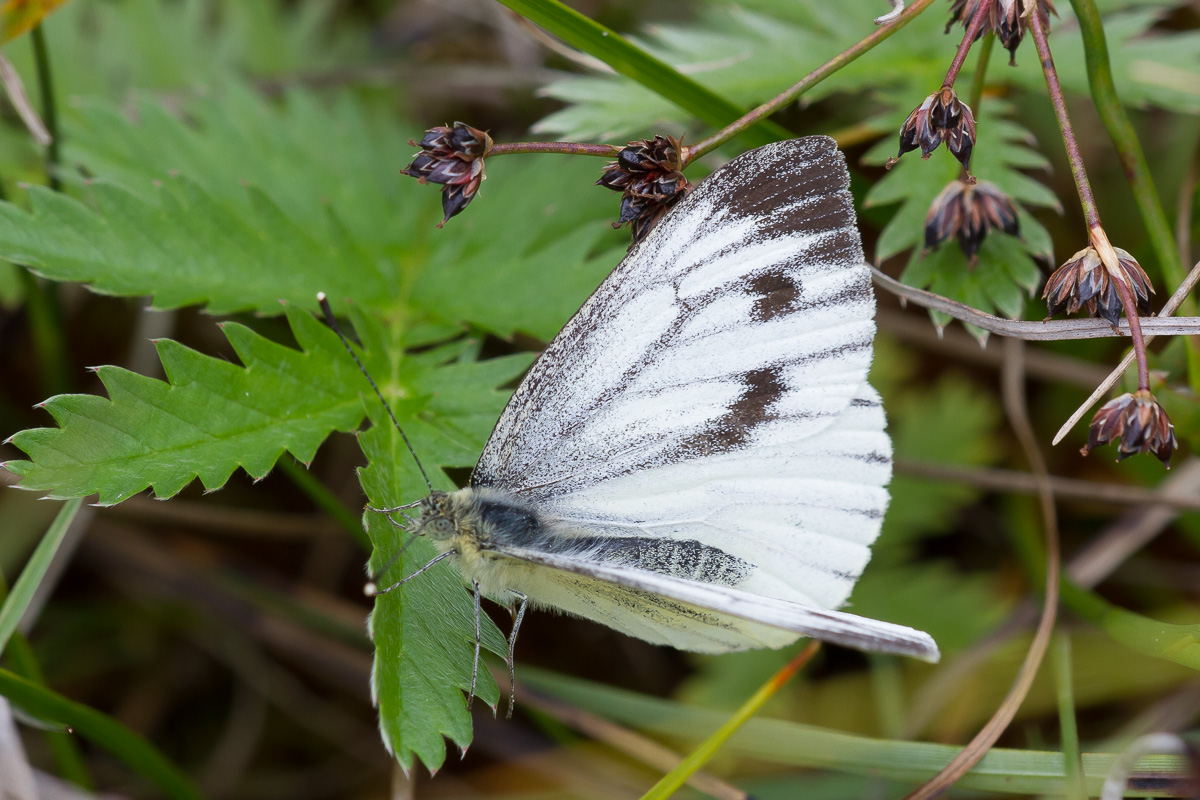
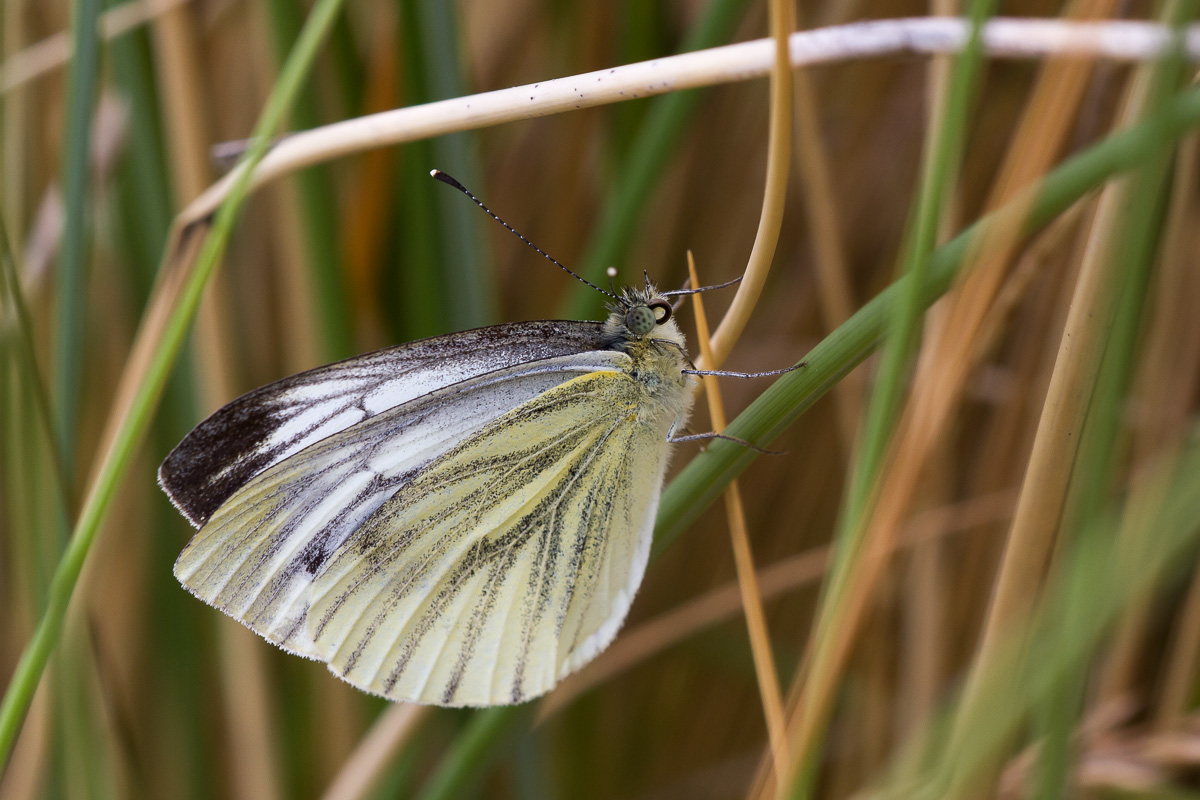
This subspecies was first defined in Warren (1968) as shown here (type locality: Sheriffmuir, West Perthshire).
This subspecies is found in Scotland, with most records coming from a belt between Argyllshire in the west and Fifeshire and East Lothian in the south-east. Another stronghold is the Thurso district of Caithness. In southern Scotland and in the north of England, there is no clear dividing line between the distribution of this subspecies and that of the subspecies sabellicae. This subspecies also exhibits differences between spring and summer broods, as described for the subspecies sabellicae. Aldwell & Smyth (2015) note that "In Donegal the range colour is extensive and some specimens seem closer to the Scottish form".
This subspecies exhibits minor colour differences with the subspecies sabellicae as follows:
Dennis & Shreeve (1996) make an interesting assertion when listing thomsoni: "probably = britannica".
Turning to the superficial features of the Scottish race, the most conspicuous are of course the markings of the females. The majority of these are of the form described as radiata in P. bryoniae by Röber. In this the nervures of the forewings, and sometimes hindwings also, on the upperside are outlined in black, lightly or heavily. In the Scottish race many have the areas between the nervures also suffused with black. They most often have a white ground-colour and a few specimens can resemble P. napi exactly. Some however (estimated at about 25% by Mr. Thomson), have a yellow ground-colour. In these the dark suffusion can occur as in the white specimens. The yellow colour is not that of the well-known Irish yellow specimens (as illustrated by Müller and Kautz 1939 [Müller & Kautz (1939)], plate 1, figs. 5,6), but close that that of the flavescens form of P. bryoniae (as Müller and Kautz [Müller & Kautz (1939)], plate 5, figs. 7, or between that and fig. 6). All these female forms are of course characteristic of P. adalwinda, though they do not habitually occur in one locality. They concur with the characters of the scales connecting the Scottish race with P. adalwinda.
A further character connecting with P. adalwinda is the colouring of the under side. This mostly is darker than in normal P. napi, the dark scaling on the nervures is more black than grey. There is also a not infrequent tendency for the marking on the hindwing to spread on each side of the nervures, especially on the basal half of the wing. The ground-colour is often a deeper yellow, especially in the females, with a tinge of orange, somewhat as in the figure given by Müller and Kautz [Müller & Kautz (1939)] (pl. 10, fig. 4). These features are normal to P. adalwinda, but like all other characters, very variable in thomsoni. It is impossible to leave this race under the obliterating name P. napi. It is a fluctuating race of P. adalwinda and must have a distinctive name. Müller and Kautz (1939) [Müller & Kautz (1939)], used the name "britannica" Vty. for it. Fortunately that misleading title is ruled out, for the types of britannica, which are in the Oberthür collection, came from the south of Ireland. The Irish race, though different from that of England, is certainly a race of P. napi. It is Mr. Thomson's work and observations that rescued this unique race from oblivion, so I am naming it P. adalwinda subsp. thomsoni n. subsp. The male holotype and female allotype and one male and female paratype (the latter being a yellow one), are from Sheriffmuir, Dunblane, Perthshire, at 600 feet altitude; and one male and one female paratype from Dunblane at 200 feet altitude, all in the Thomson collection; and 11 paratypes in the author's collection, of which two males and four females come from the Carron Valley, Stirlingshire, two males and two females from the Kilsyth Hills, Stirlingshire, and one female from St. Andrews, Fifeshire.
| Family: | Pieridae | Swainson, 1820 |
| Subfamily: | Pierinae | Duponchel, 1835 |
| Tribe: | Pierini | Swainson, 1820 |
| Genus: | Pieris | Schrank, 1801 |
| Subgenus: | ||
| Species: | napi | (Linnaeus, 1758) |
| Subspecies: | sabellicae | (Stephens, 1827) |
| britannica | Müller & Kautz, 1939 | |
| thomsoni | Warren, 1968 |
Description to be completed.
The distribution data (2000-2009) has been made available through the generosity of Butterfly Conservation and any subspecies distribution is taken from Riley (2007). Click here to see the distribution of this species together with site information overlaid.
The butterfly can be found in a variety of locations, including parks, gardens, meadows, woodland rides, hedgerows and, in fact, anywhere foodplants and nectar sources exist. This species favours damp areas but can also be found in small sheltered pockets, such as patches of scrub, in dry and open habitat such as chalk grassland.
This is the most widespread butterfly in the British Isles and its status is considered relative-stable. It is not, therefore, a species of conservation concern.
The table below shows the occurrence (distribution) and abundance (population) trends, using information from The State of the UK's Butterflies 2015 (Fox, 2015). Any UK BAP status is taken from the UK Biodiversity Action Plan (UK BAP) (2007 review).
1976-2014 (%) | 1976-2014 (%) | 2005-2014 (%) | 2005-2014 (%) |  +5 +5 | -7 | -1 |  +72 +72 |
|---|
First-brood adults typically emerge in late April, peaking around the middle of May and gradually tailing off through June. The second brood, which is always stronger than the first brood, starts to emerge in early July. However, in good years, the second brood may emerge in late June and give rise to a third brood.



As in most species, the males emerge a few days earlier than the females, and spend much of their time searching for a mate as they fly along woodland rides and hedgerows. As well as taking nectar, males may also be seen congregating on mud or other surfaces that are rich in nutrients, giving rise to the phenomenon known as "mud puddling".
As in many whites, an already-mated female will indicate an unwillingness to mate by holding her wings flat and her abdomen upright, making it impossible for a male to mate with her. However, this doesn't always work, and females have been known to mate more than once, although this is completely unnecessary for the fertilisation of the eggs.
Adults feed primarily on Betony (Betonica officinalis), Bluebell (Hyacinthoides non-scripta), Bugle (Ajuga reptans), buttercups (Ranunculus spp.), Common Fleabane (Pulicaria dysenterica), Cuckooflower (Cardamine pratensis), Greater Stitchwort (Stellaria holostea), Hemp-agrimony (Eupatorium cannabinum), knapweeds (Centaurea spp.), Ragged-Robin (Silene flos-cuculi), ragworts (Jacobaea spp.), Red Campion (Silene dioica), thistles (Carduus spp. and Cirsium spp.), vetches (Vicia spp.) and Wild Marjoram (Origanum vulgare).
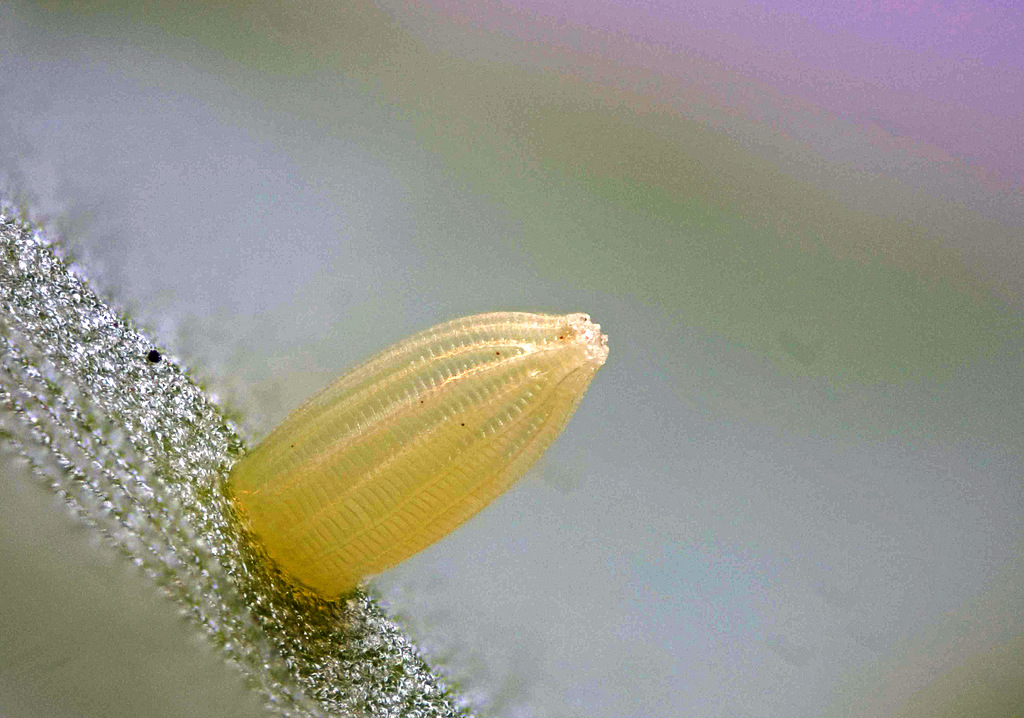
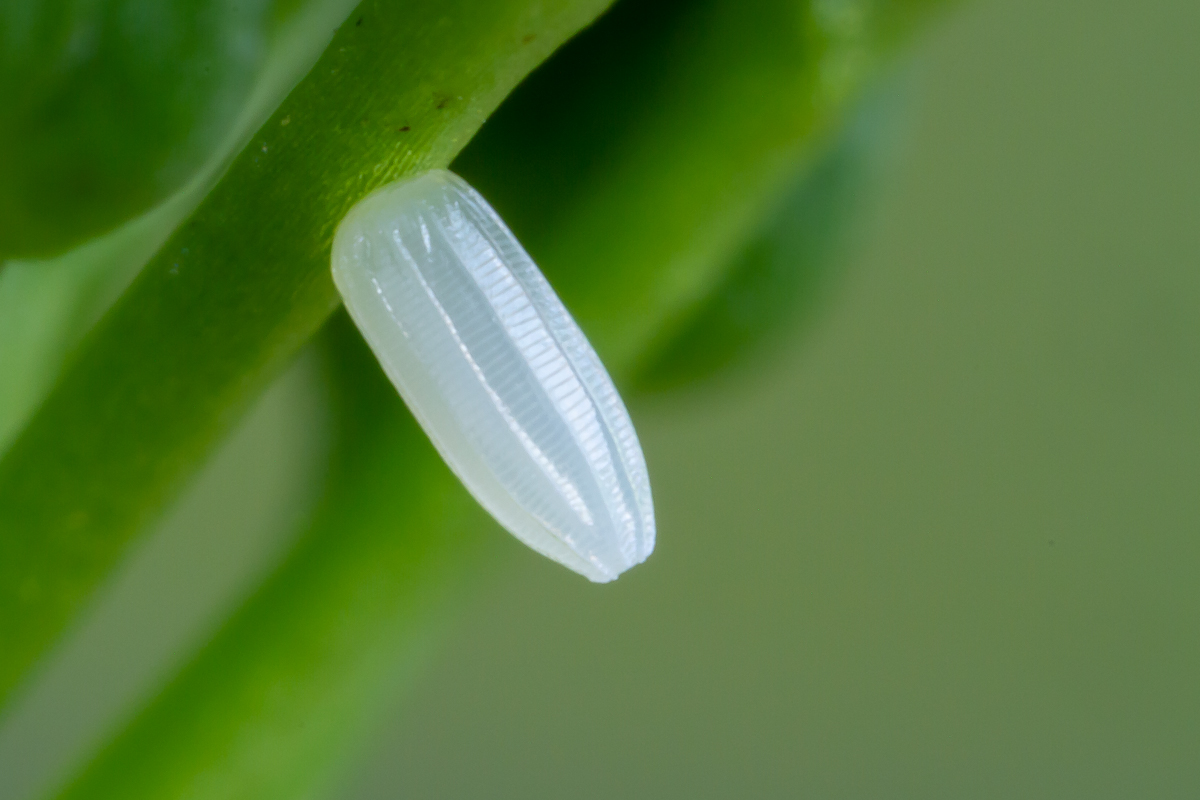
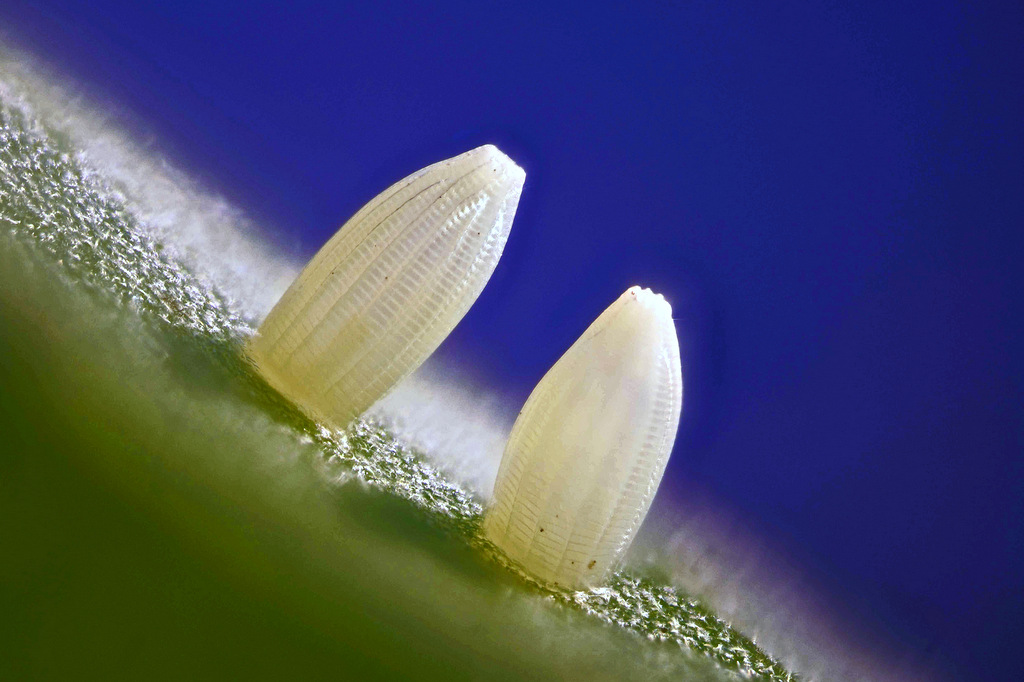
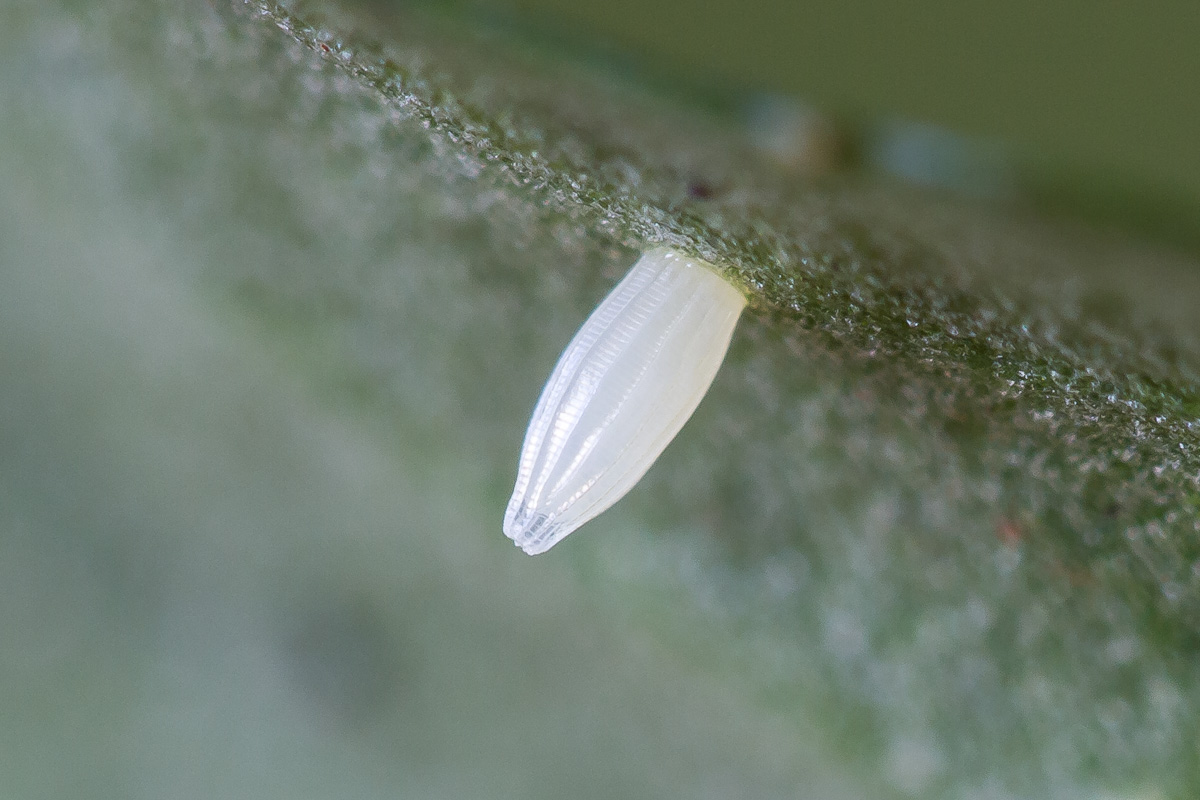
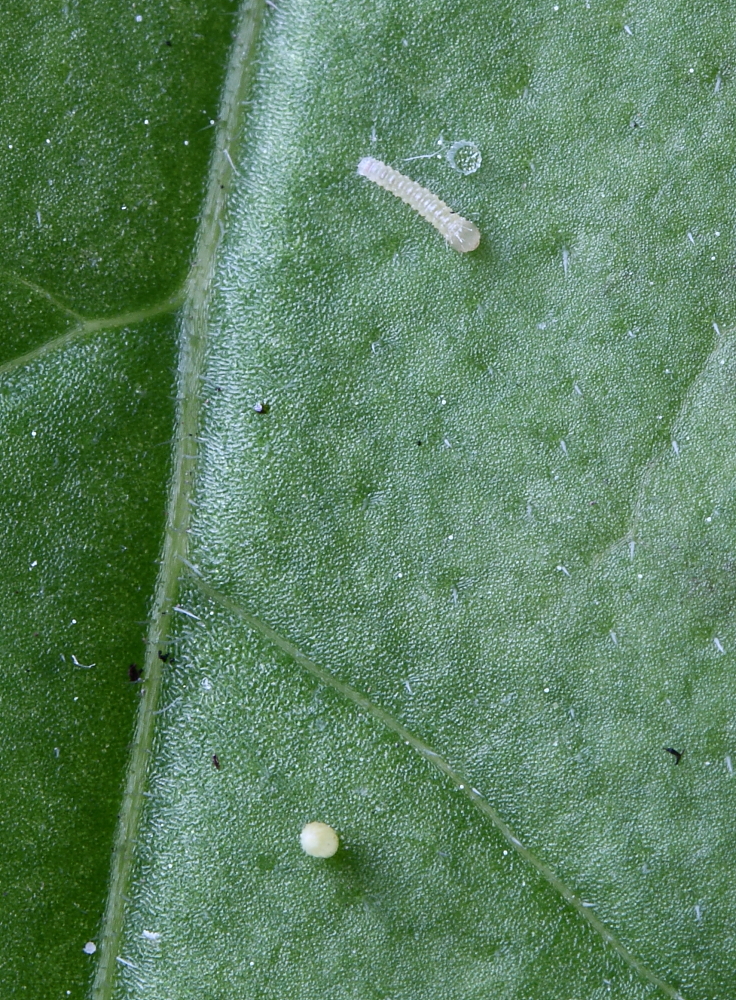
Eggs are laid singly on the underside of a leaf of the foodplant. Small plants are preferred, and the eggs hatch in approximately a week depending on temperature. Eggs are sometimes found on the same plants as those used by the Orange-tip. However, the two species are not in competition since the Green-veined White eats the leaves of the plant, whereas the Orange-tip eats the developing seed pods.
"P. napi lays its eggs singly on the under surface of the leaves of various kinds of cruciferous plants ... Two females captured July 16th, 1901, laid a large number of eggs ... on the 18th and 19th. The eggs started hatching very early on the morning of July 22nd, remaining in the egg state a little over three days. The egg as laid stands erect, it measures 1mm. high, of an elongated conical shape, broader in proportion than the egg of P. rapae [Small White], which species it most closely resembles, but it (napi) is without the slight concavity near the summit. It has fourteen or fifteen longitudinal keels, nine or ten of these run, mostly in pairs, the entire length, while five start a little below the summit and run to the base, the intervening spaces have about forty-five transverse ribs. When first laid it is very pale yellowish in colour, gradually turning to pale yellowish-green, finally becoming whiter and glistening before hatching. The egg state varies in the time it occupies according to the temperature, about four or five days being the normal period." - Frohawk (1924)
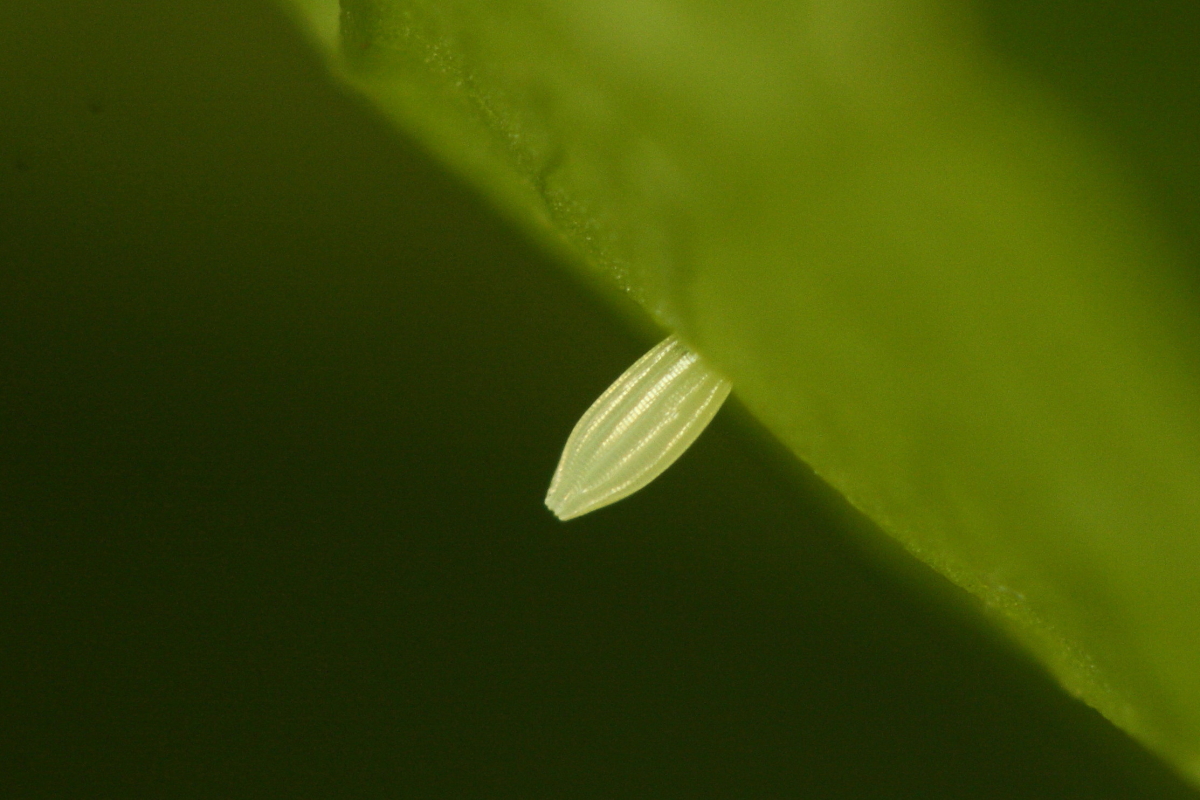
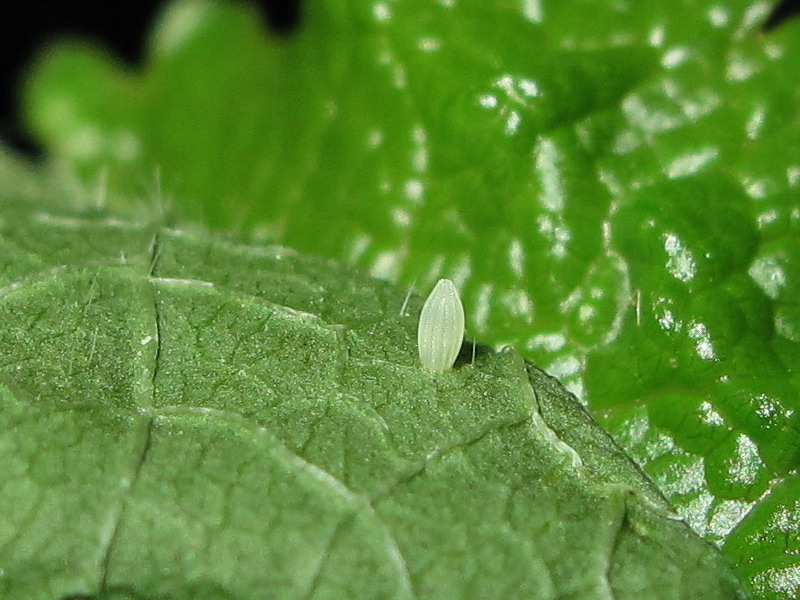
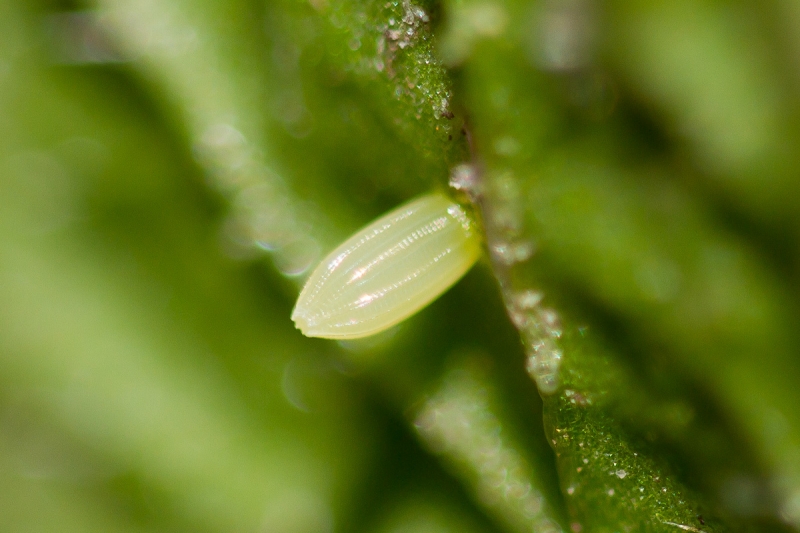
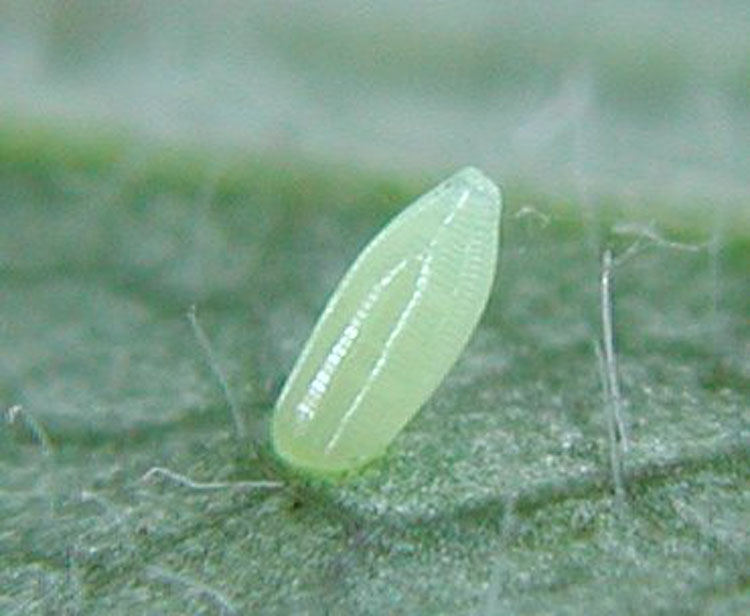
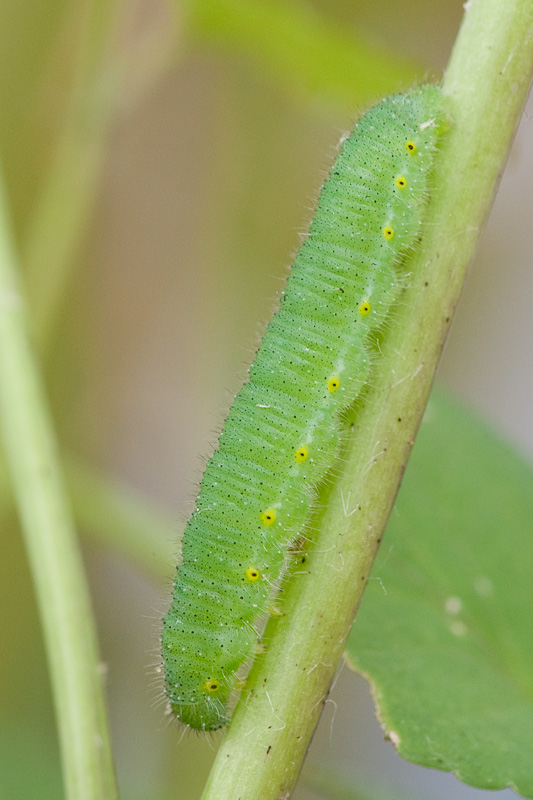
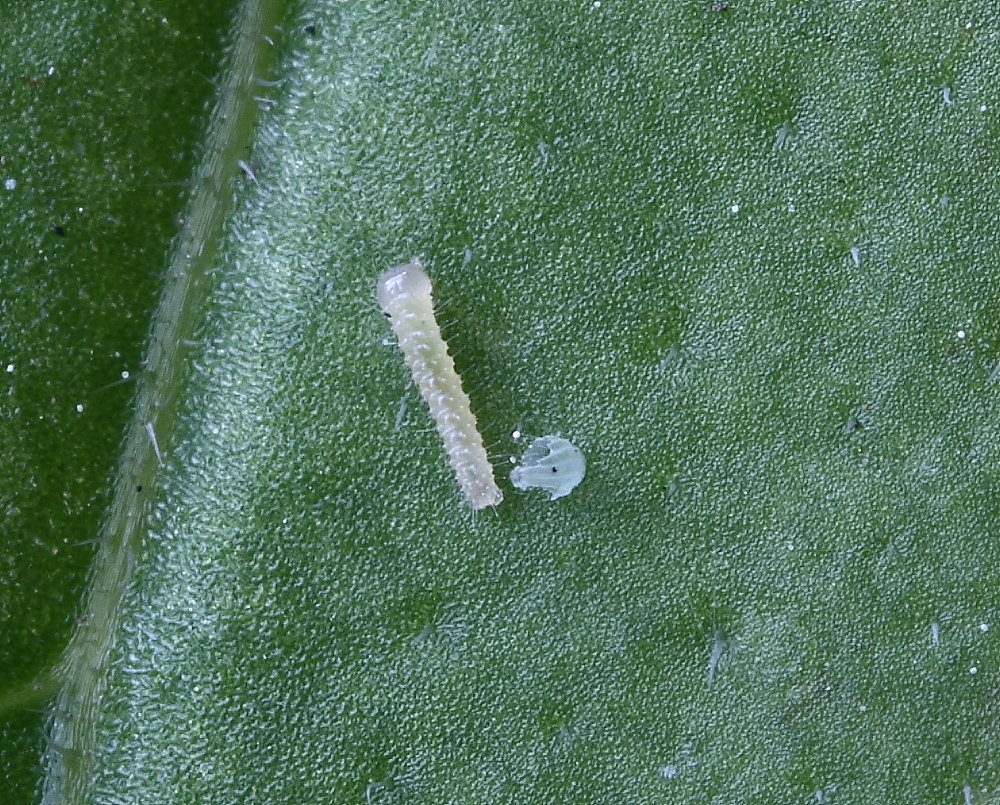
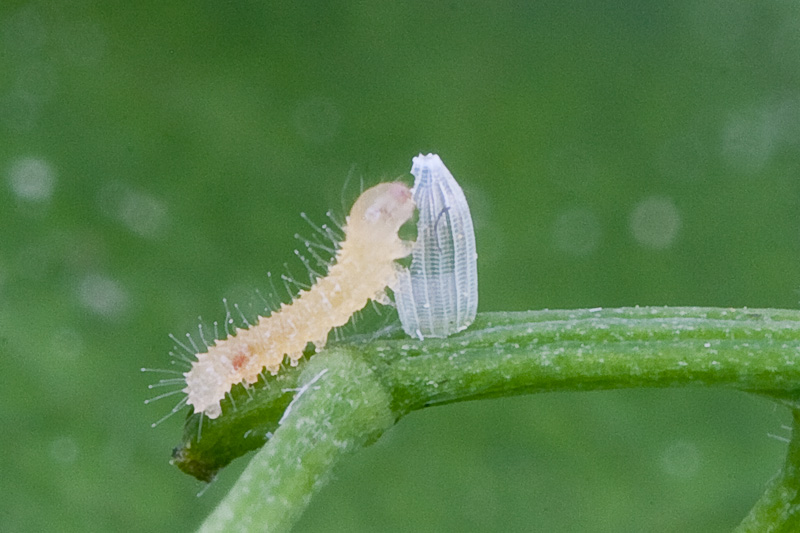
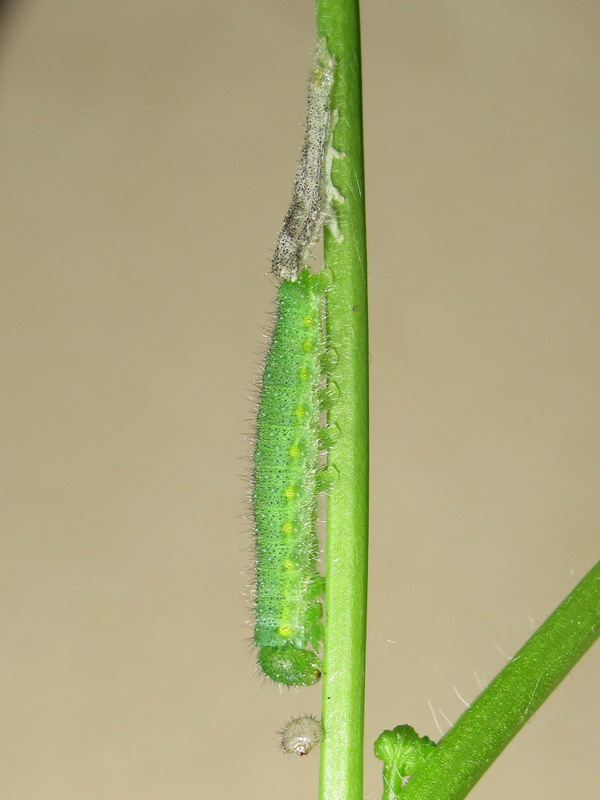
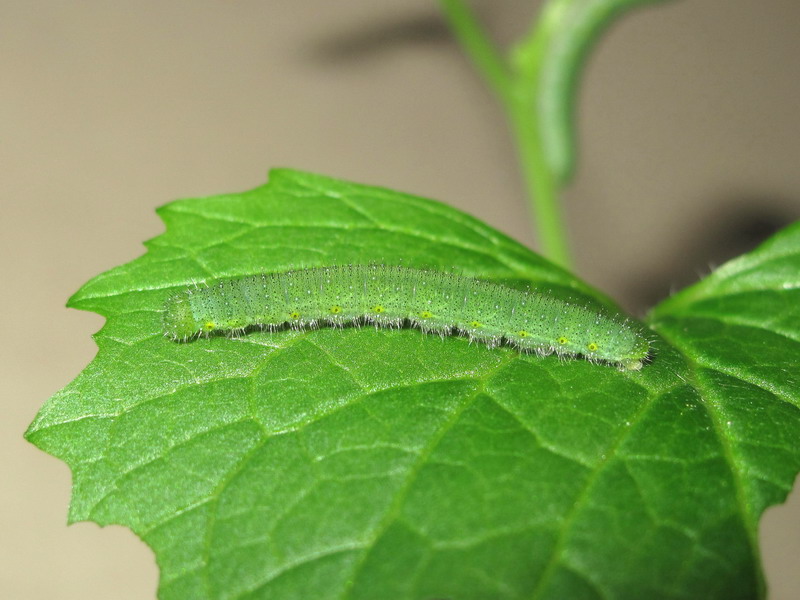
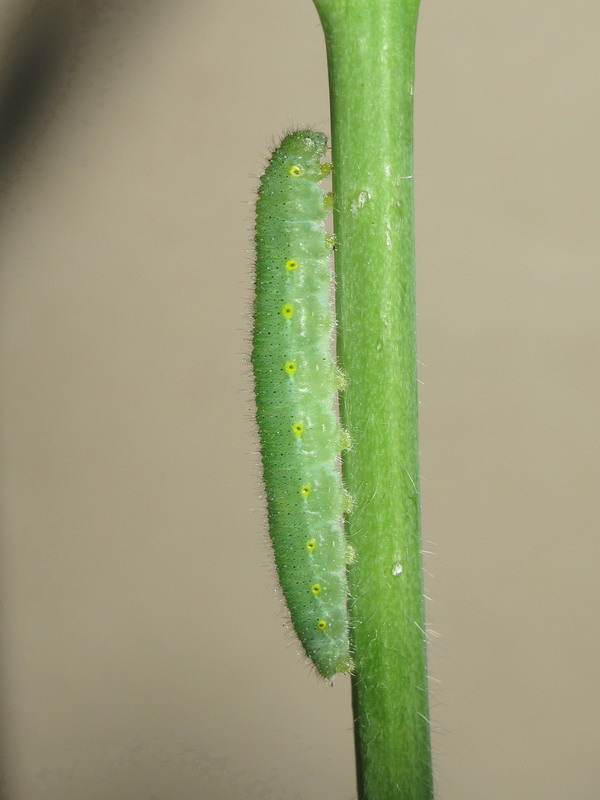
The larva eats its eggshell on hatching, before starting to feed on the leaves of the foodplant. There are 4 moults in total and this stage lasts between 3 and 4 weeks.
The primary larval foodplants are Charlock (Sinapis arvensis), Cuckooflower (Cardamine pratensis), Garlic Mustard (Alliaria petiolata), Hedge Mustard (Sisymbrium officinale), Large Bitter-cress (Cardamine amara), Water-cress (Nasturtium officinale), Wild Cabbage (Brassica oleracea var. oleracea) and Wild Radish (Raphanus raphanistrum ssp. raphanistrum). Nasturtium (Tropaeolum majus) is also used.
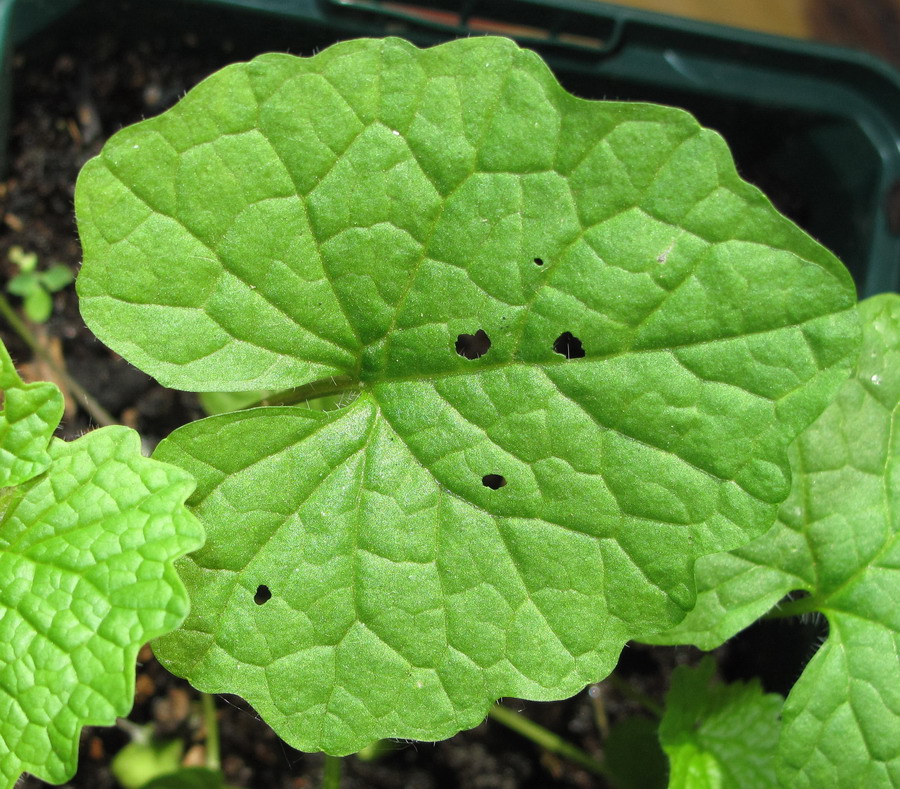
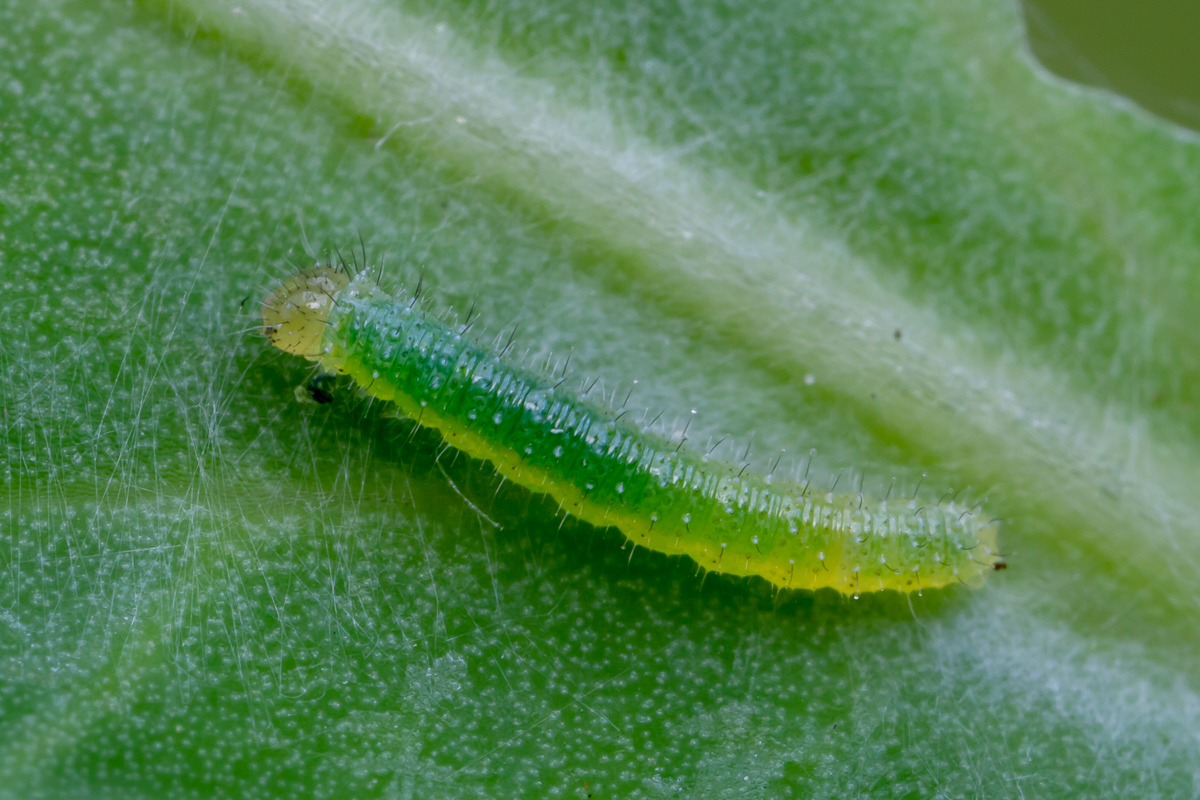
"Directly after emergence the larva measures 1.3 mm. long. The head is large, of a shining pale ochreous colour, sprinkled with very fine hairs, dark eye spots and brown mouth parts. The body is transversely wrinkled and studded with tubercles, each bearing a long slender hair with a slightly cleft knobbed apex (excepting those on the last segment), and curve gently forward; there are six on each segment above the spiracles, i.e., three on each side, and one below the spiracle, the dorsal pair being the largest; on the ventral surface, including the claspers, the hairs are simple. The spiracles are faintly outlined with brown. The entire colouring is a pale cream-yellow." - Frohawk (1924)
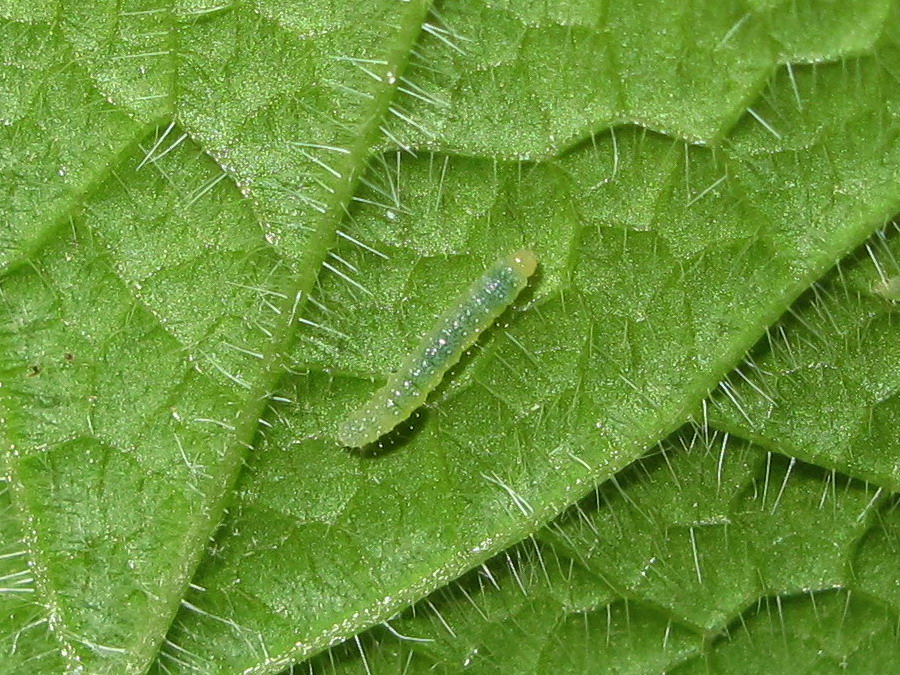
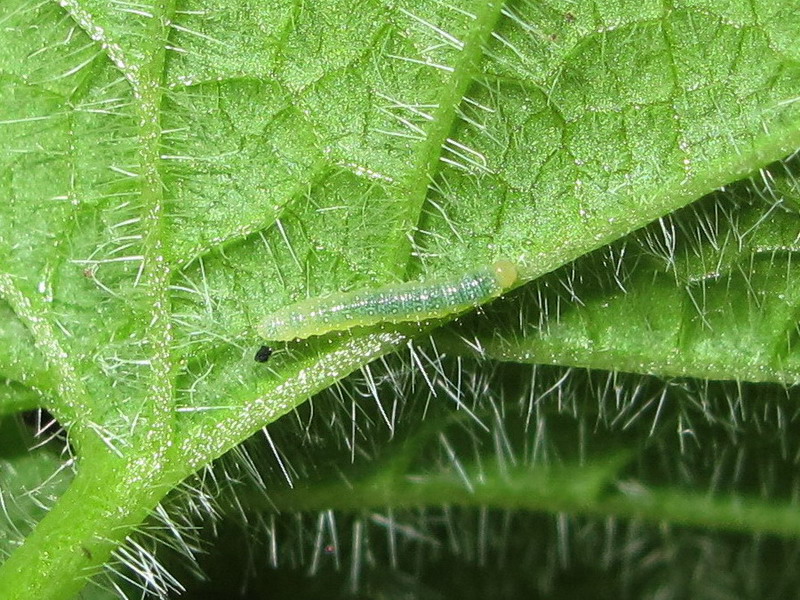
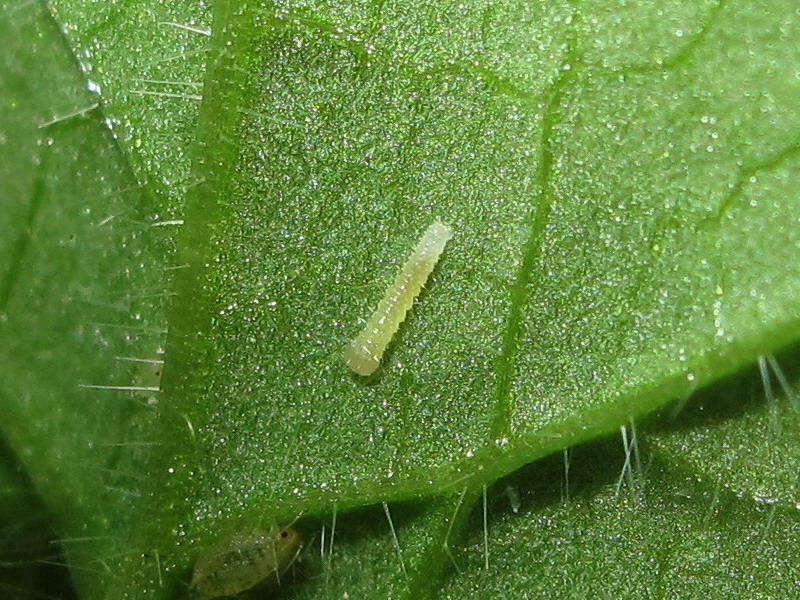
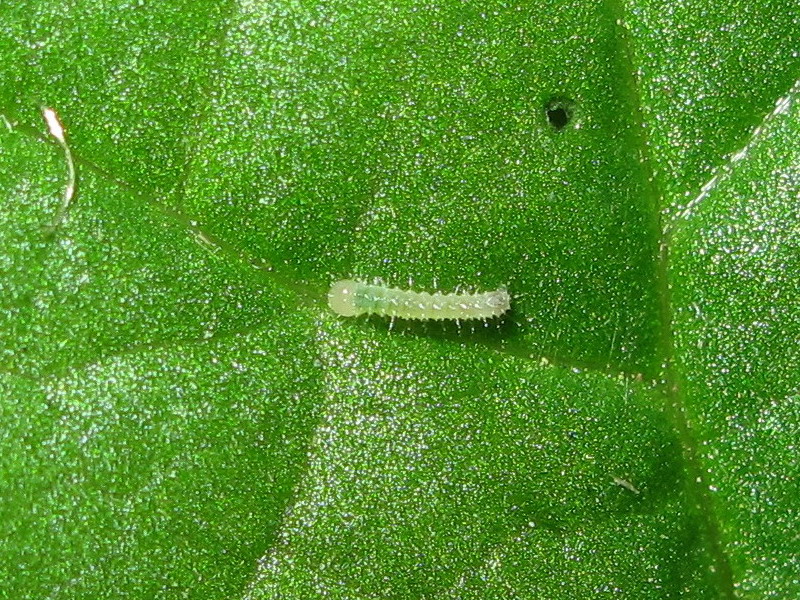
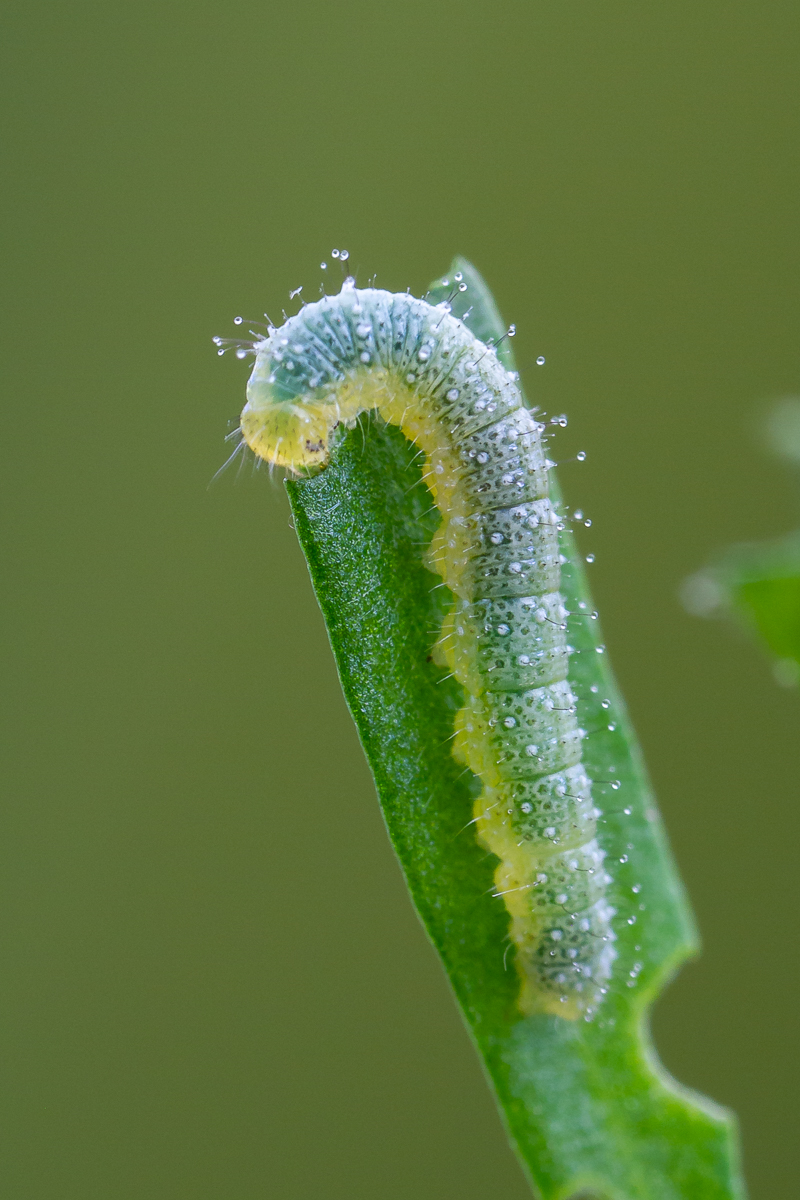
"The first moult occurred on July 25th. Before the second moult, when five days old, the larva is barely 6.35 mm. long, cylindrical and of uniform thickness throughout. The head is pale straw-yellow tinged with greenish, and beset with a number of fine black spines with knobbed tips and a few slender, long, finely pointed hairs. The body is shining pale-green, mottled with whitish along the dorsal surface, and fading into yellow-green on the ventral surface; it is deeply wrinkled transversely. There are four longitudinal rows of large white warts on either side; these are placed singly on each segment, the first close to the medio- dorsal line and on the anterior wrinkle, the second sub-dorsal on the fourth wrinkle, the third above the spiracle on the second wrinkle, and the fourth immediately below the spiracle; the three above the spiracle have each a moderately long black spine with a cleft knob at the apex, which carries a tiny bead of clear white fluid; the one below the spiracle has a white spine. Scattered over the body are several minute white spines, each carrying a similar bead of fluid; these all have black and olive bulbous bases; the surface of the body is extremely finely granulated. The claspers and legs are greenish-white. If dislodged from the plant the larva fall suspended by a thread." - Frohawk (1924)
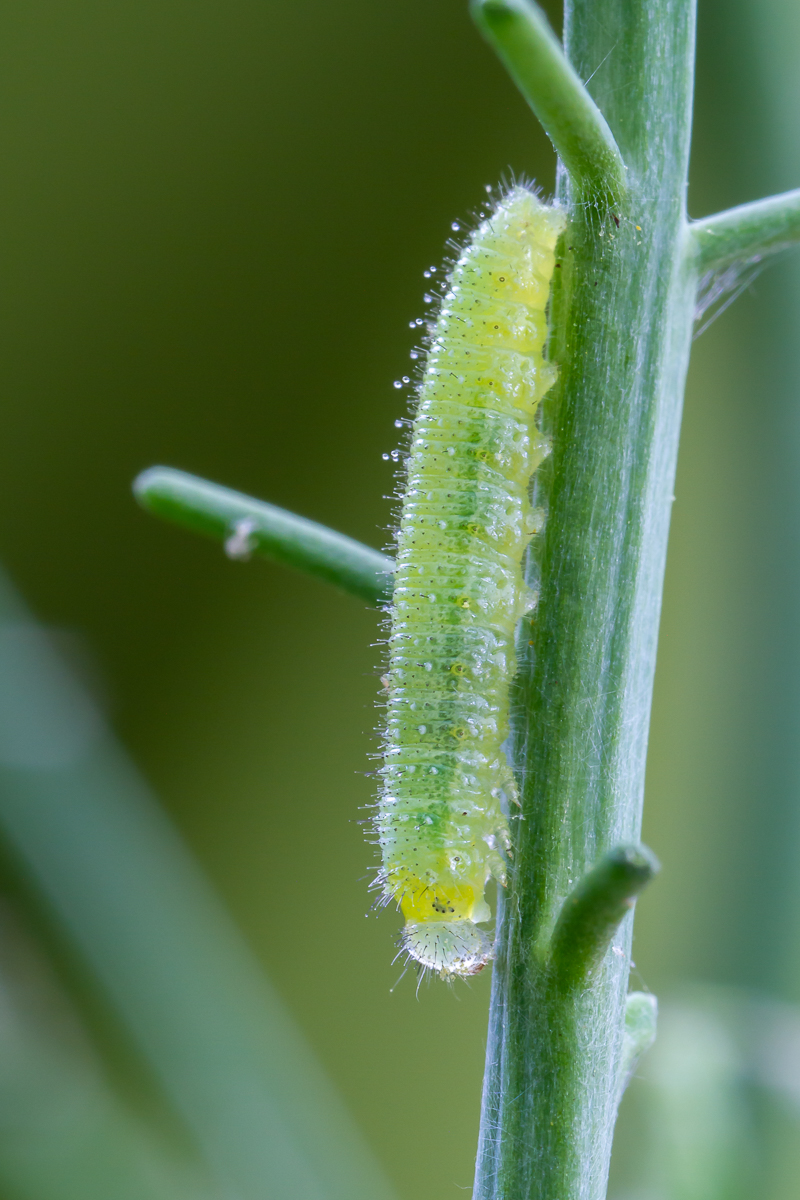
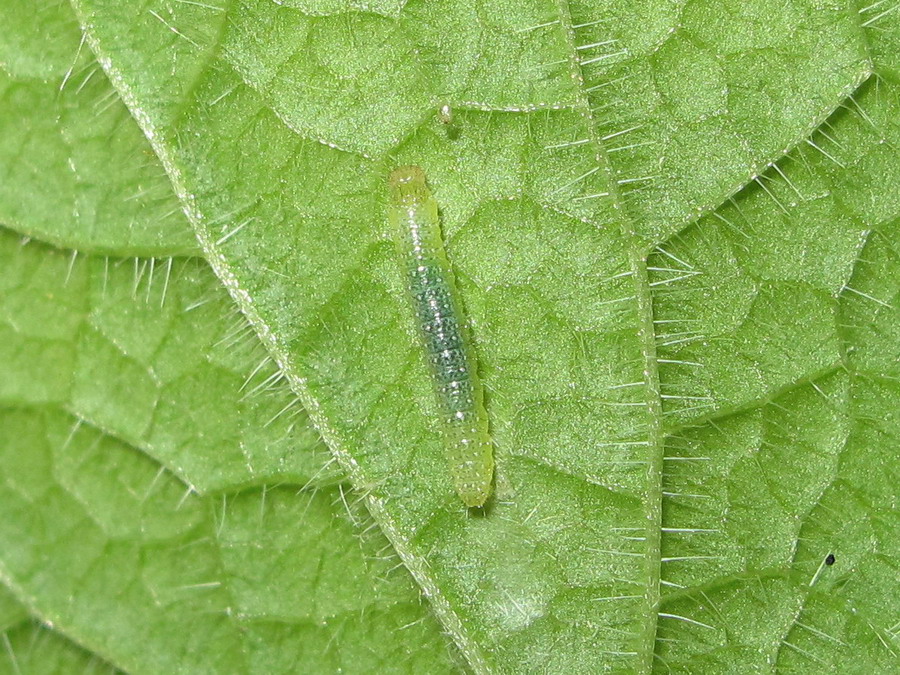
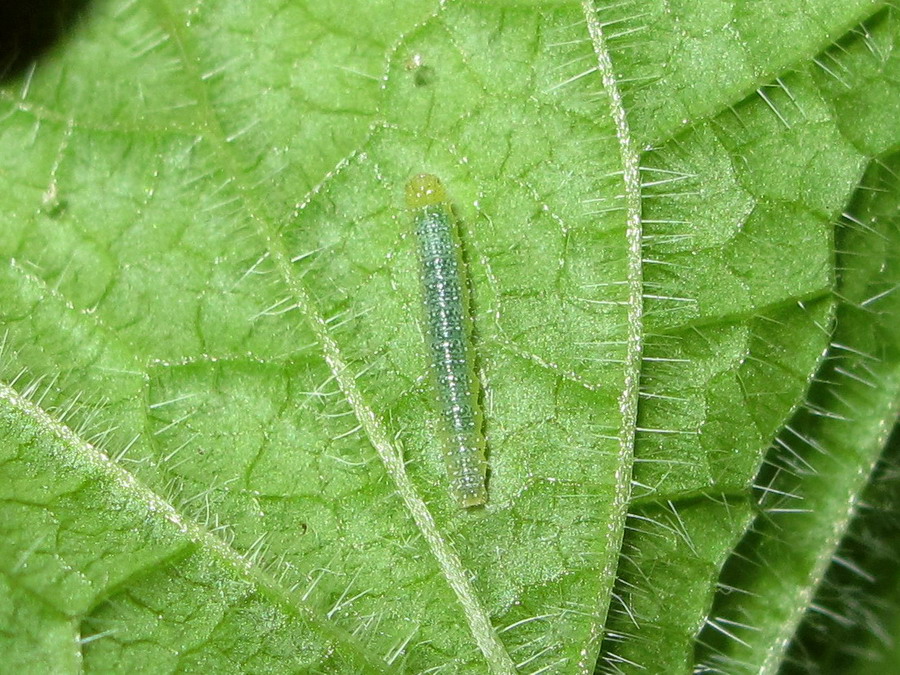
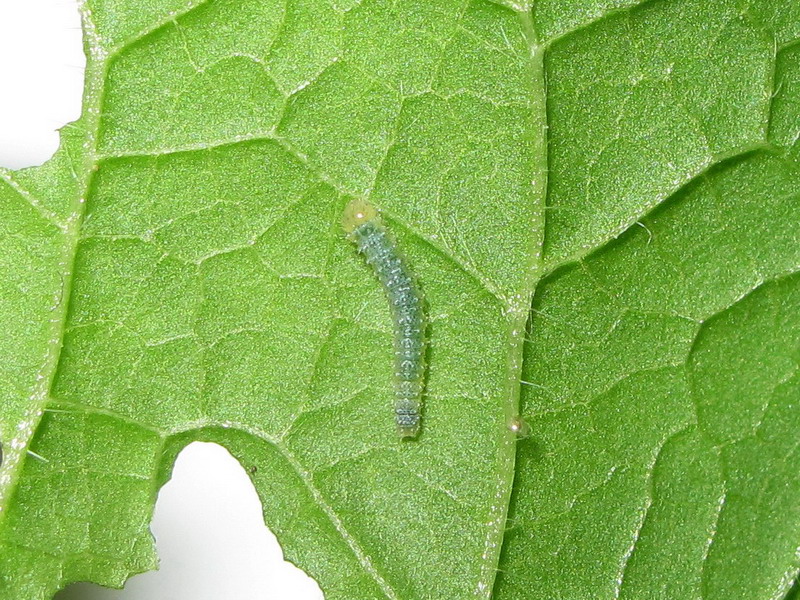
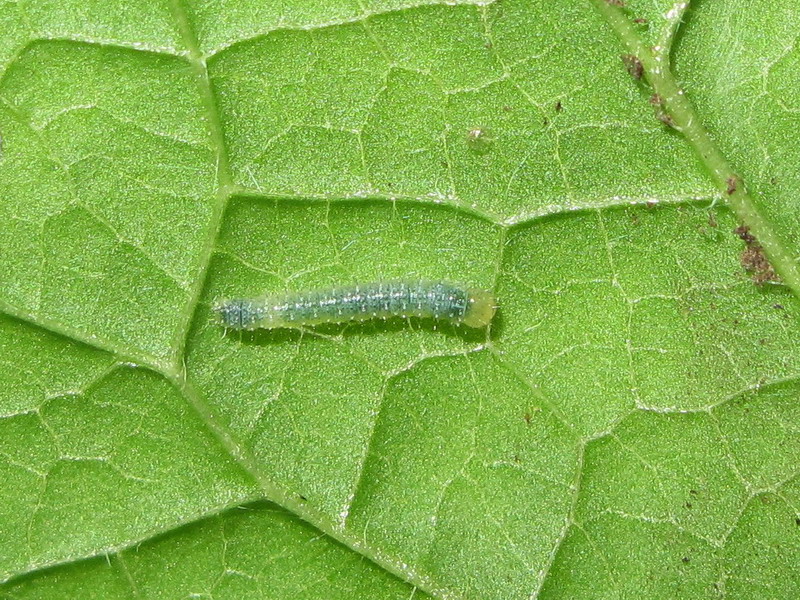
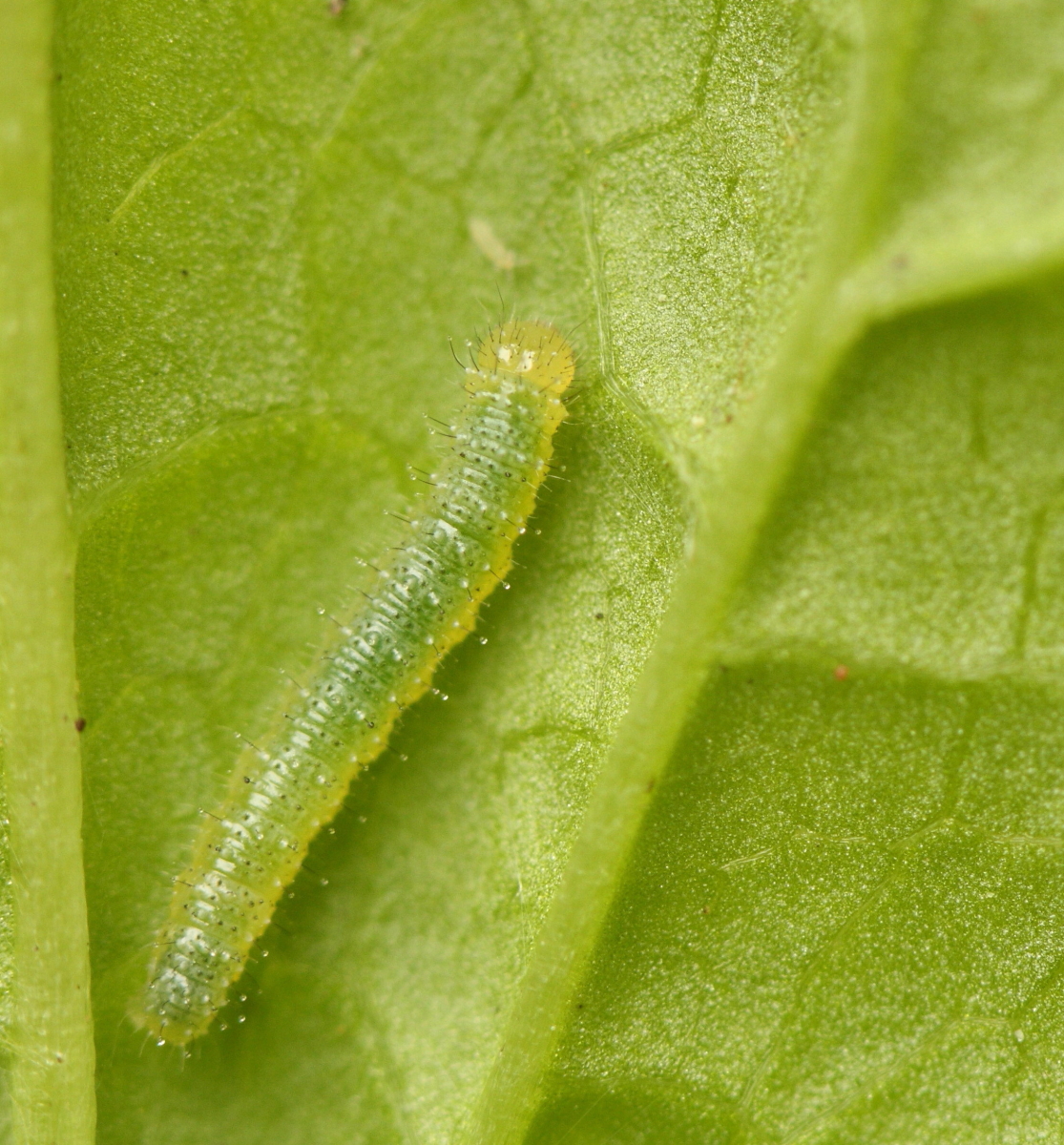
"Before third moult, nine days old, it is 10.5 mm. long, and very similar to the previous stage. The head is slightly greener and there is a very faint yellow spiracular line now visible; the spiracles are outlined with black. Just previous to moulting all the spines are clearly visible under the skin, the large dorsal ones meeting over the back with the points crossed, the second 4 sub-dorsal ones lying in the same position, while the super-spiracular series point towards the spiracles; the position of all is constant in every individual. The colouring is very clear and semi-transparent. The larva rests in a straight attitude." - Frohawk (1924)
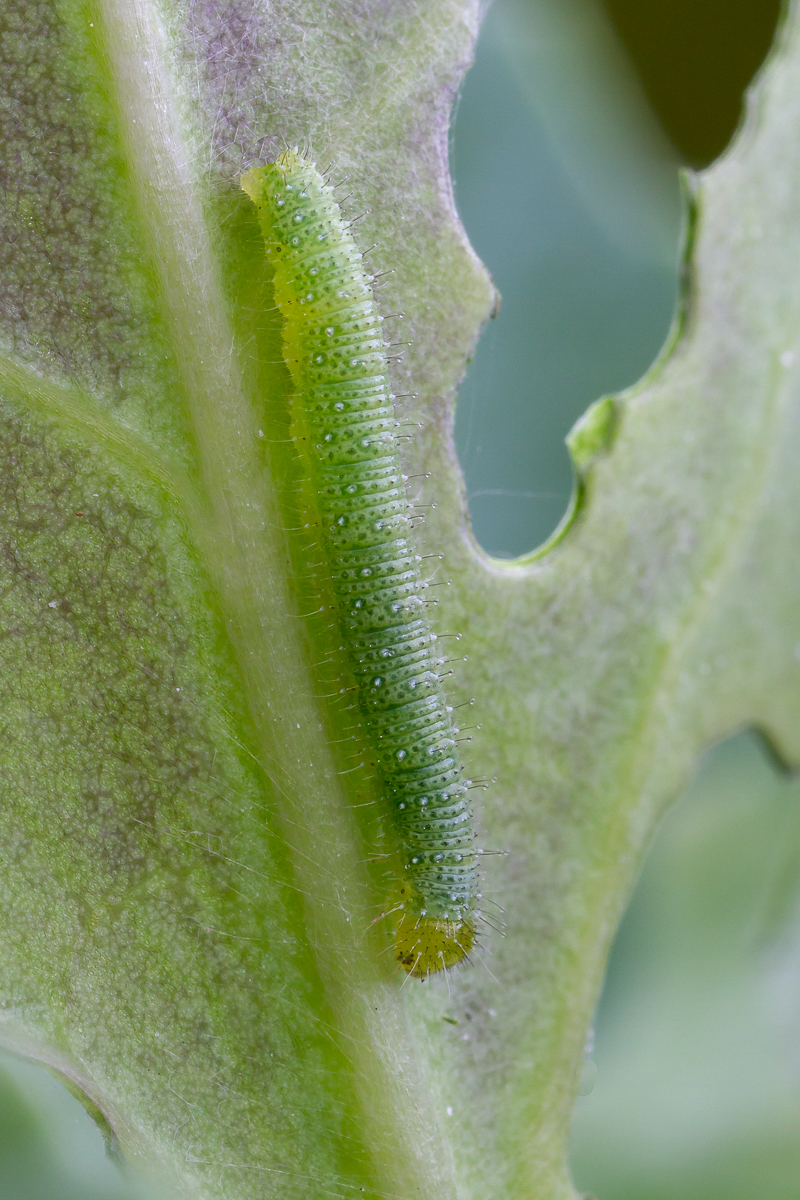
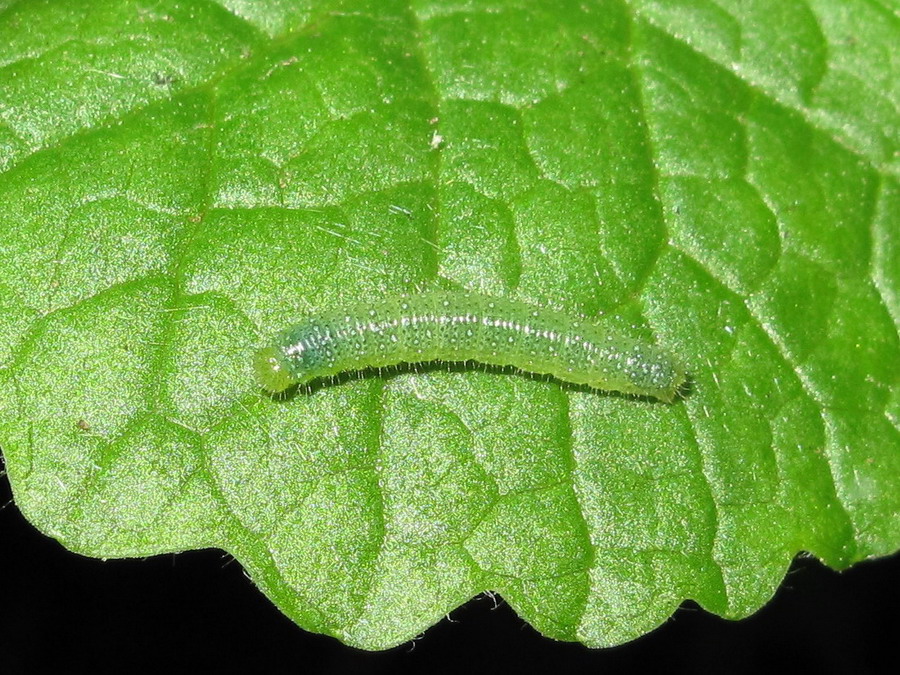
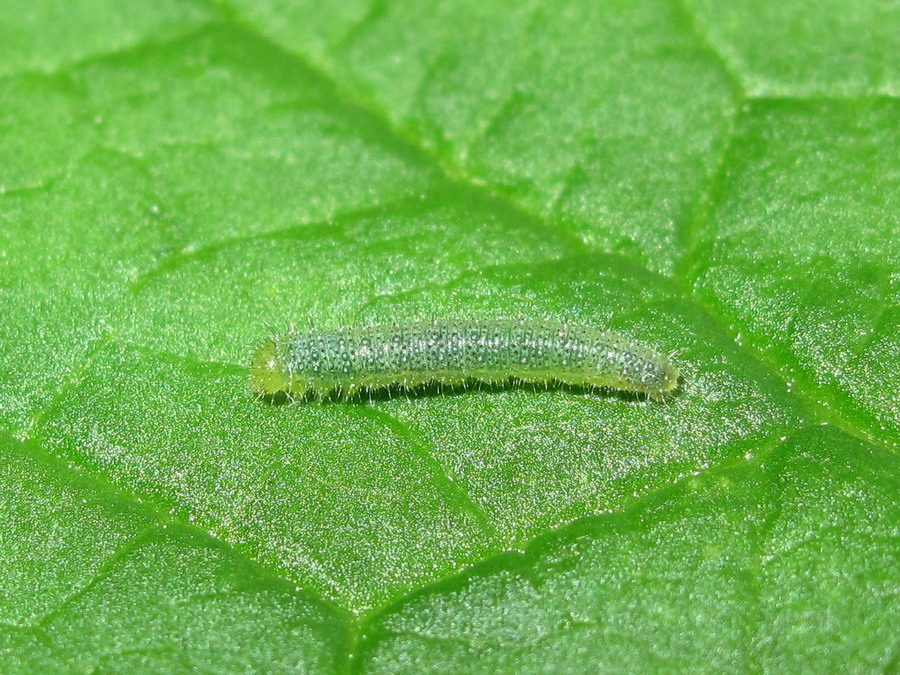
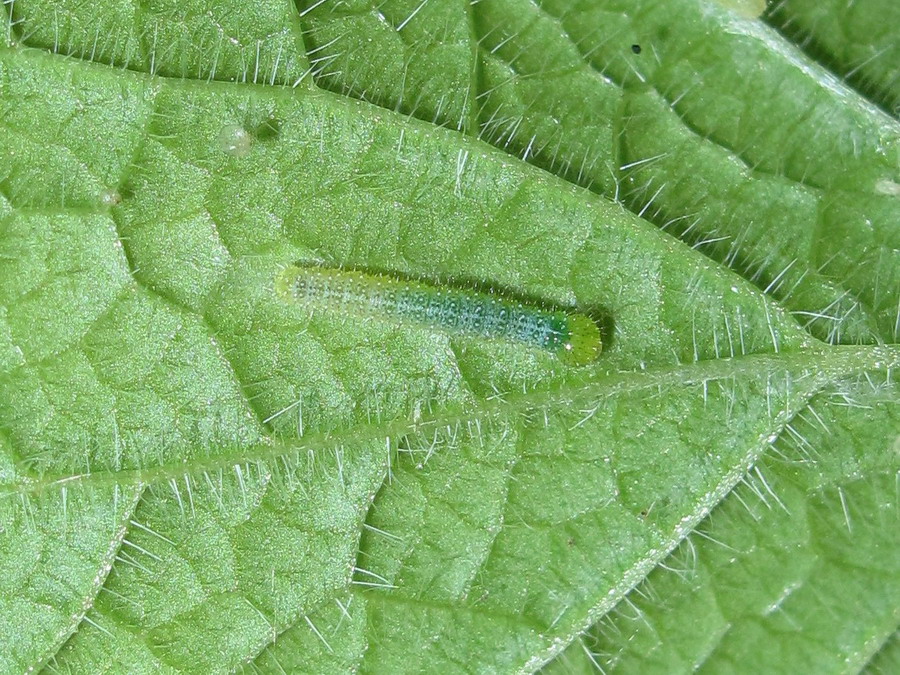
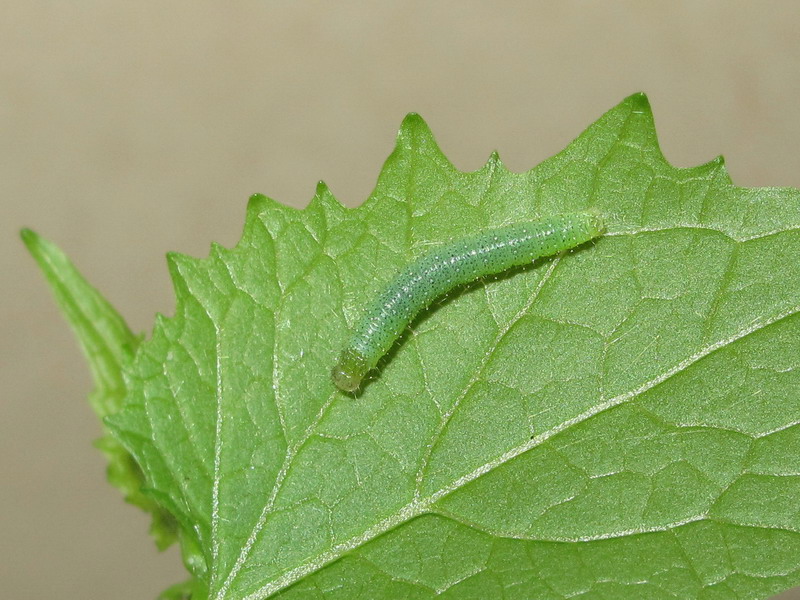
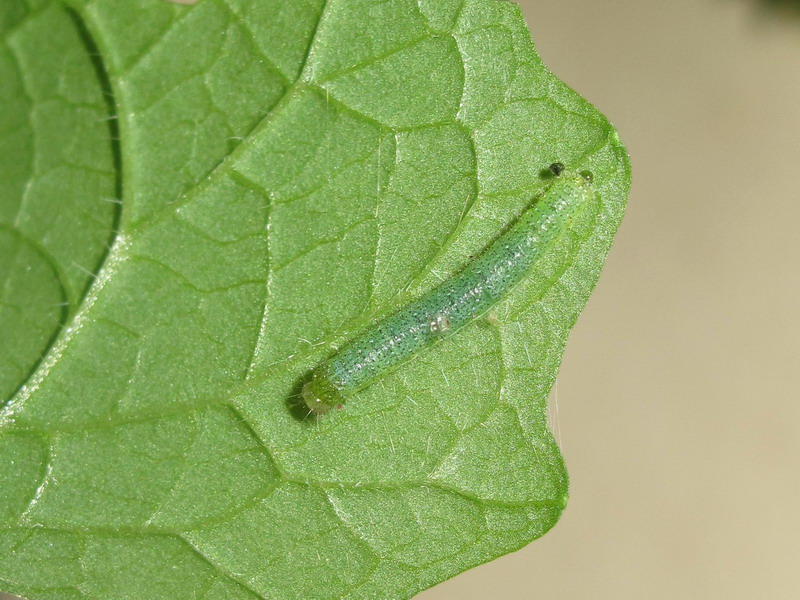
"Third moult took place on the evening of July 31st, 1901. Before fourth moult, eleven days old, it measures 15.9 mm. long. All the smaller spines have dull black tubular bases; they vary much in size, some being very small, others large and distinct and placed down the centre of each wrinkle. A bright gamboge-yellow blotch encircles the spiracles, which are situated on a faint yellowish line; below this line all the hairs and tubercles are white; in other respects it is similar to the previous stage. The larvae grow with remarkable rapidity, only existing two or three days in each stage. The same individual is described and figured throughout." - Frohawk (1924)
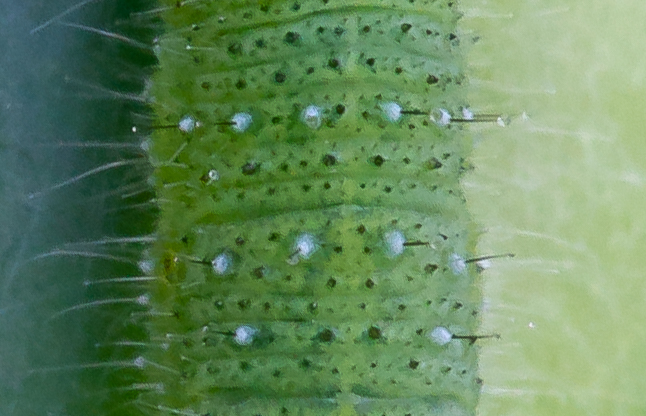
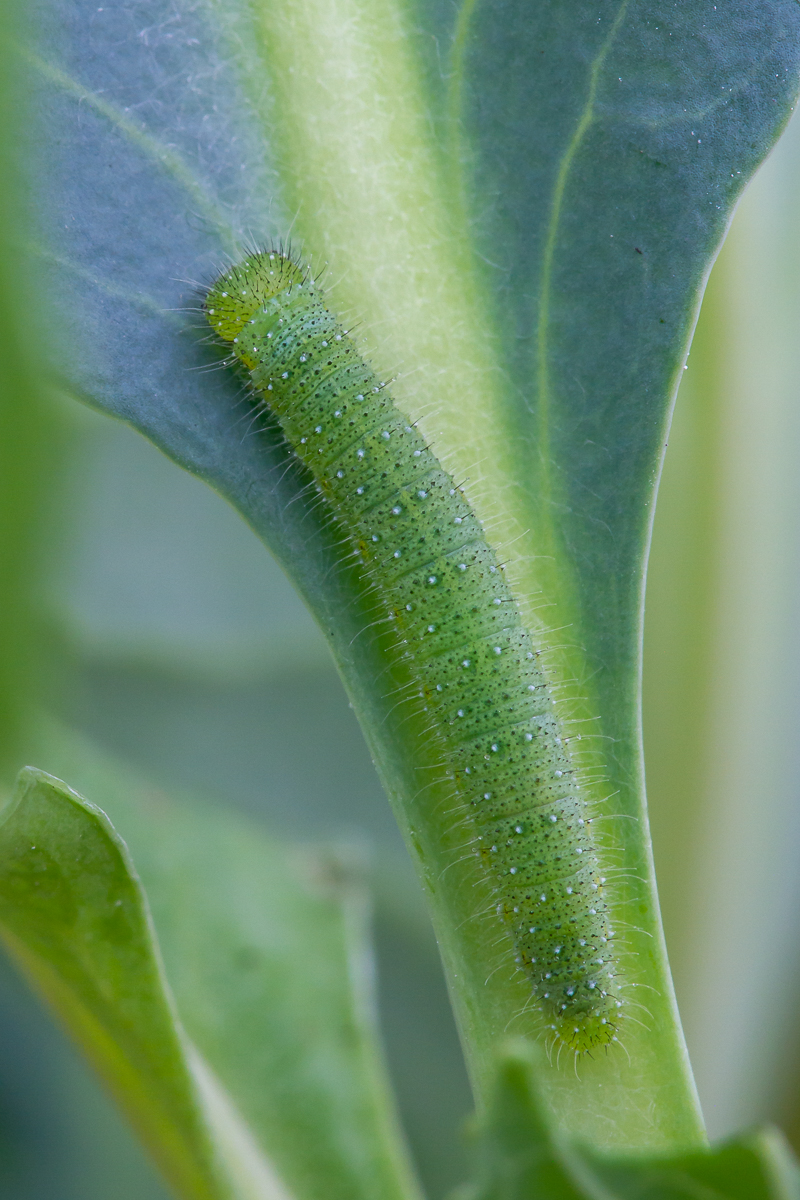
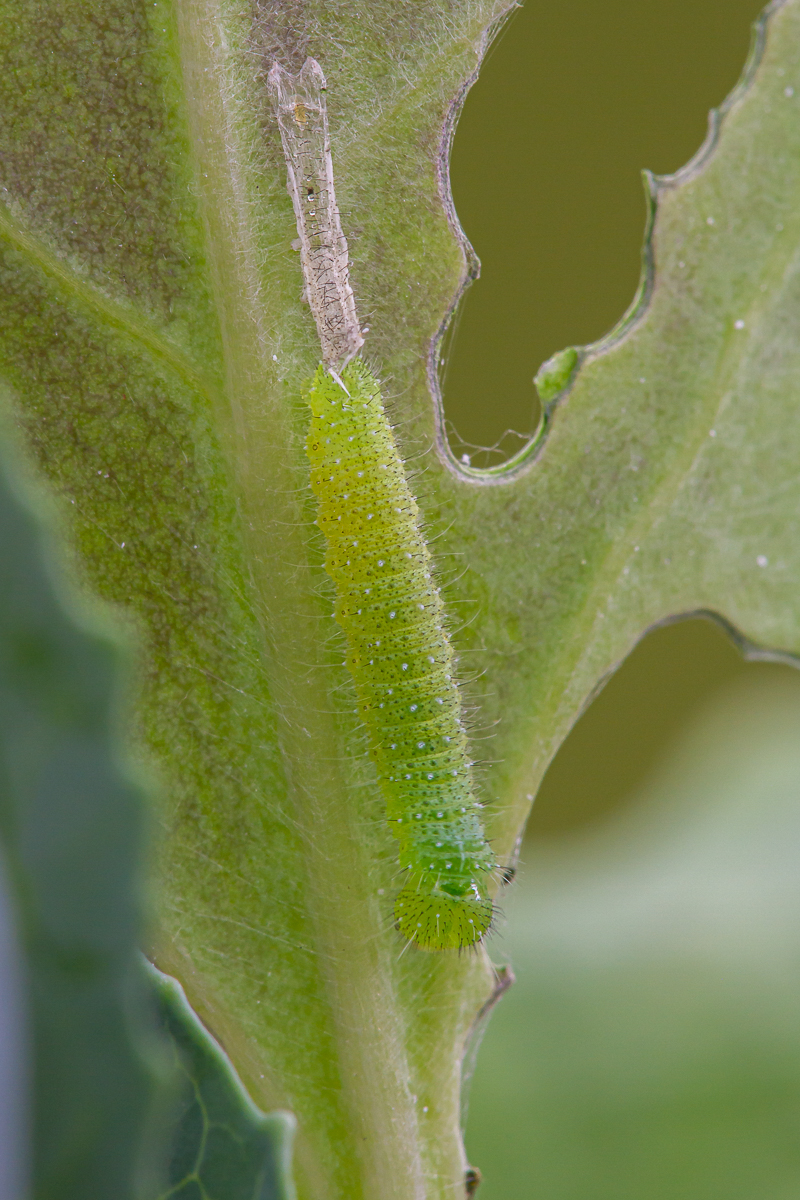
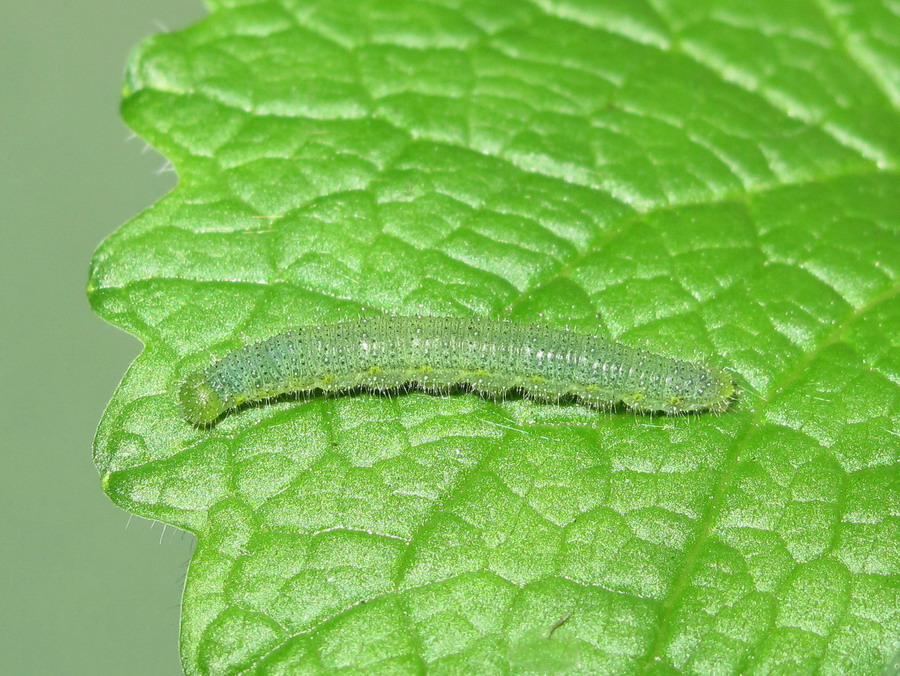
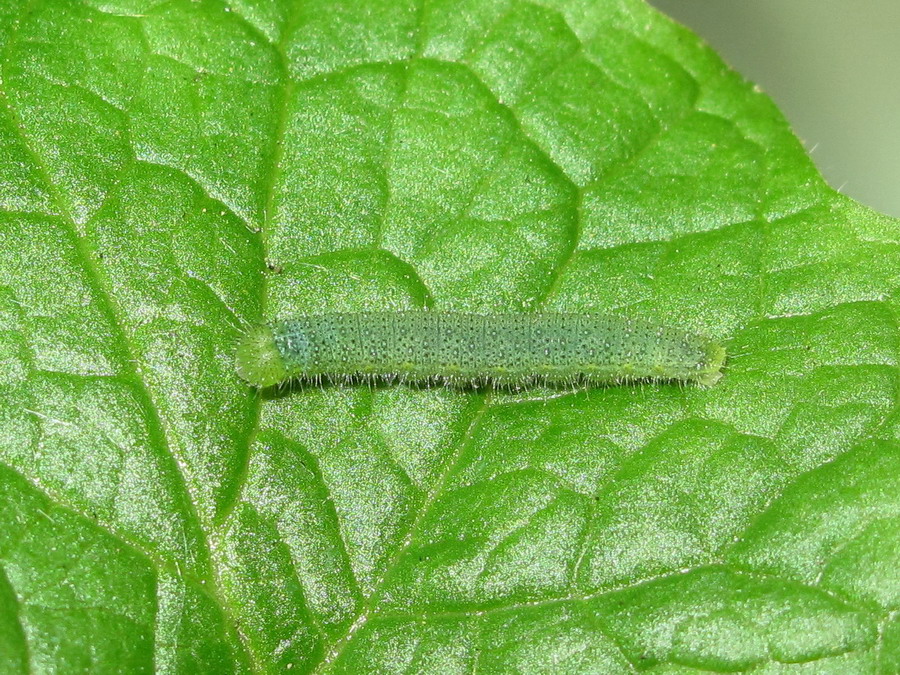
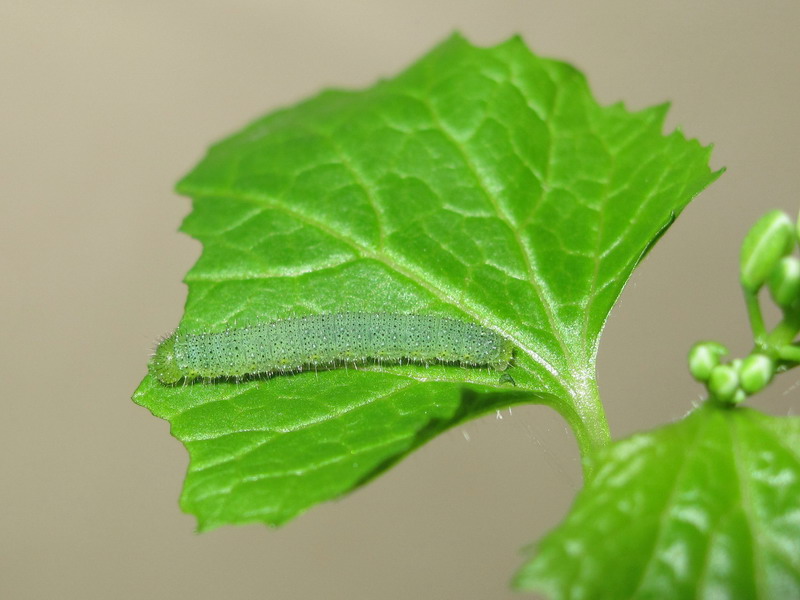
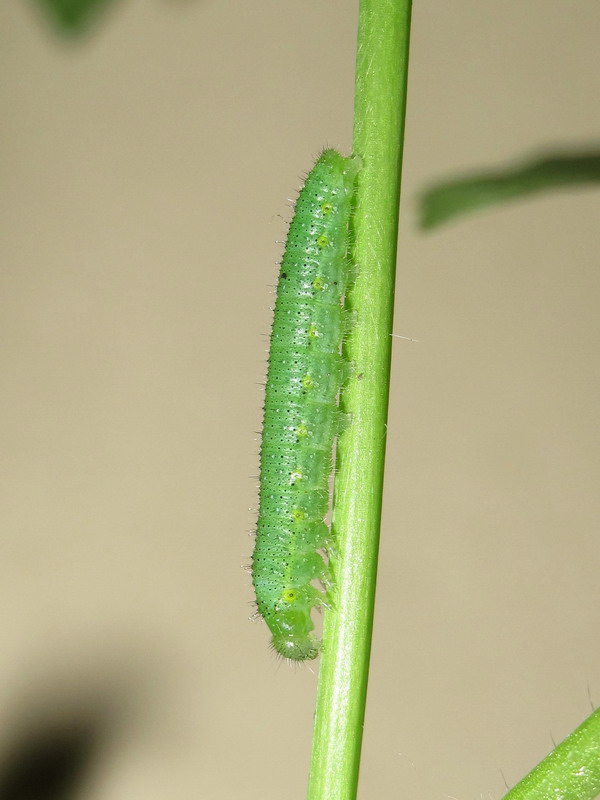
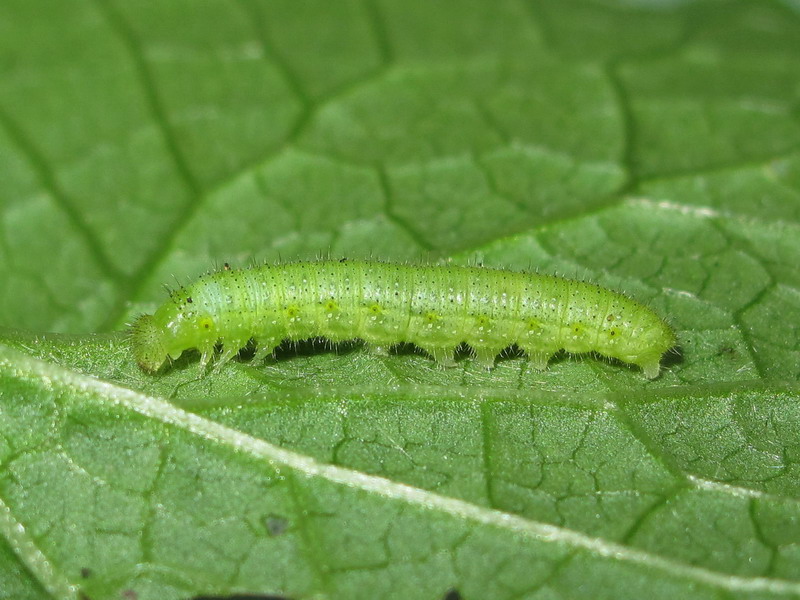
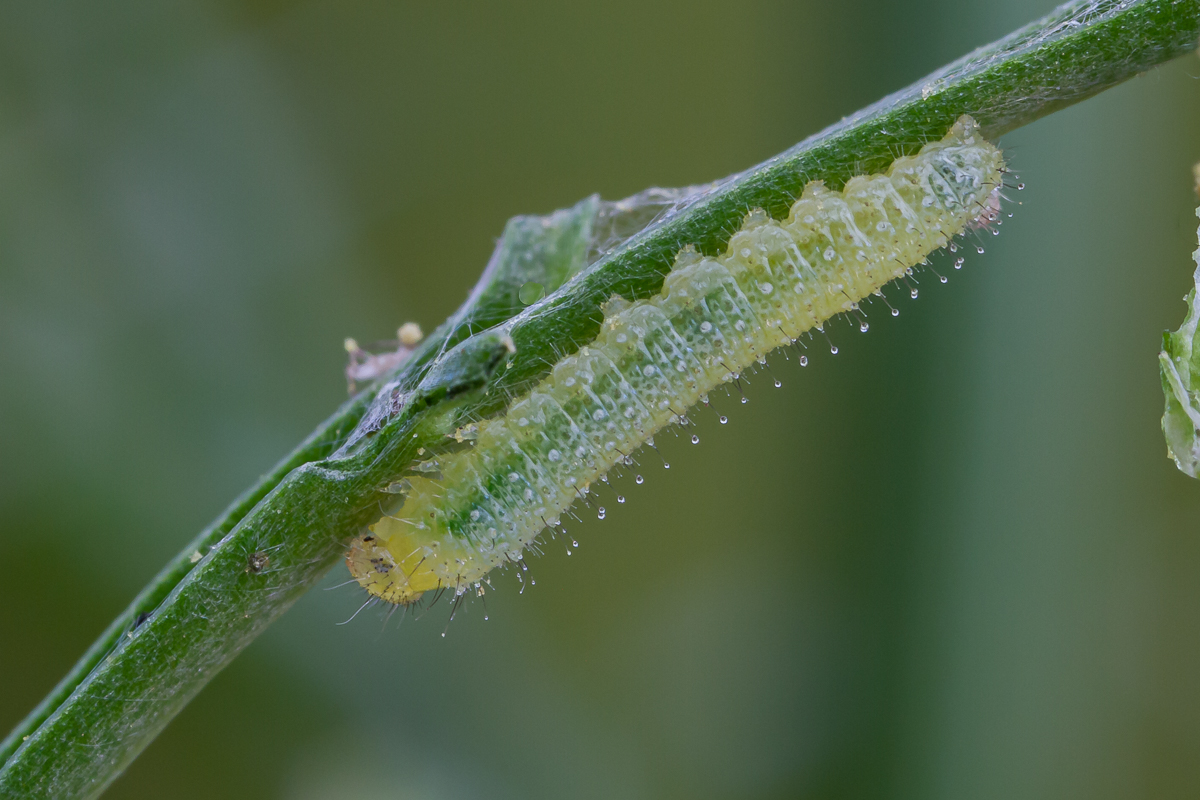
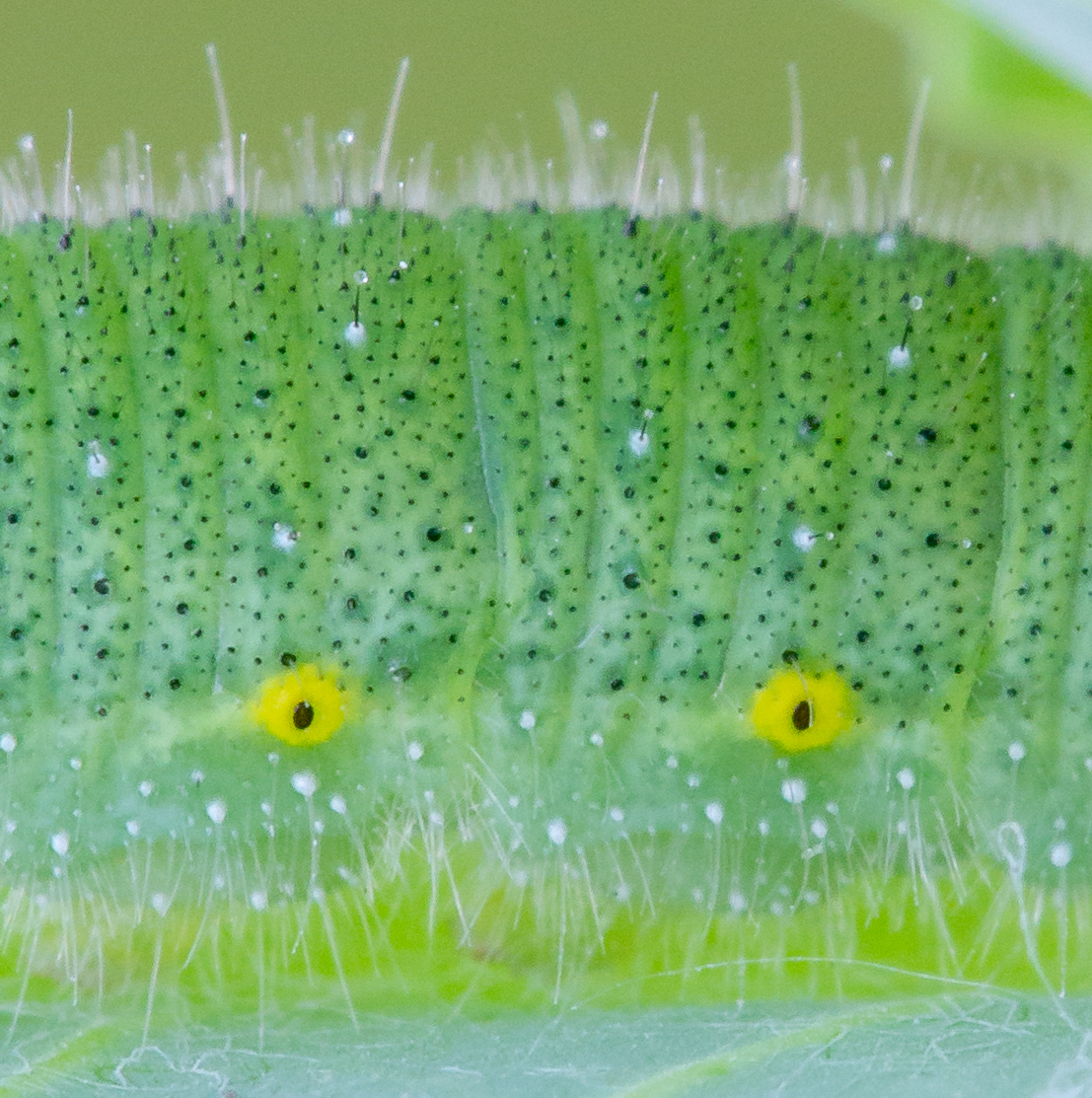
"After fourth and last moult, fully grown, sixteen days old, it measures 25.4 mm. long. The body is rather attenuated at either end, stoutest about the middle. The segments are deeply wrinkled transversely, the middle segments have each six sub-divisions. The larva is precisely similar to the previous stage except in size. The spiracles are black and encircled with bright gamboge-yellow and the spiracular line is pale and indistinct. The tubercles at the base of the hairs are more clearly defined on account of their larger size; with the exception of the three large white ones bearing black spines, all the rest above the spiracular line are black with greyish hairs; they vary greatly in size, and the longer ones have each a minute bead of white fluid adhering to the tips; all the hairs and tubercles below the spiracular lint are white. The head is covered with hairs like the body. The ground colour is pale green, lightest on the ventral surface; the head is likewise green. It bears a very close resemblance to P. rapae, but the green of P. napi is lighter in colour and the latter has no yellow medio-dorsal line and no other yellow marking on the spiracular line, excepting that encircling the spiracle, and no black tubercles below the spiracular line. The first few larvae spun up for pupation on August 7th, being only sixteen days in the larval state. They crawl with a gliding, slug-like motion, waving their heads from side to side. The specimen figured spun up on the evening of August 7th, and pupated the following evening, and emerged August 20th, 1901. The first four emerged August 17th." - Frohawk (1924)
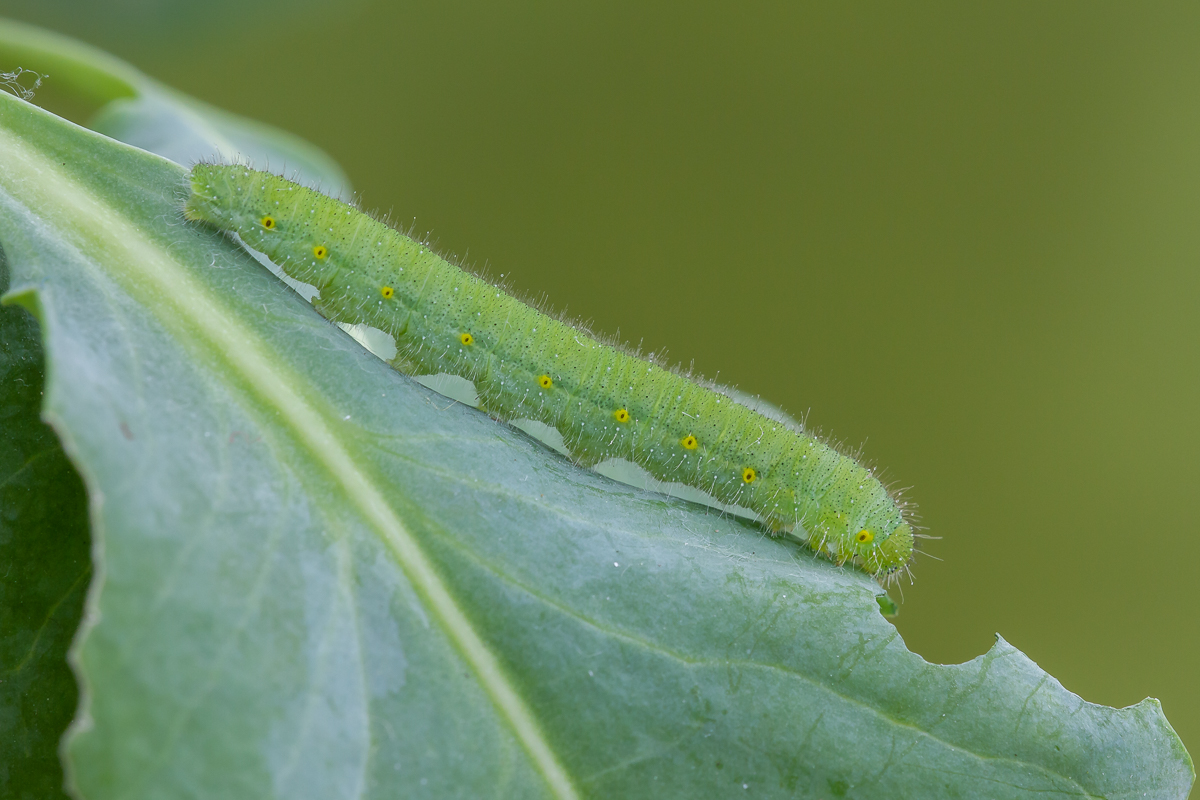
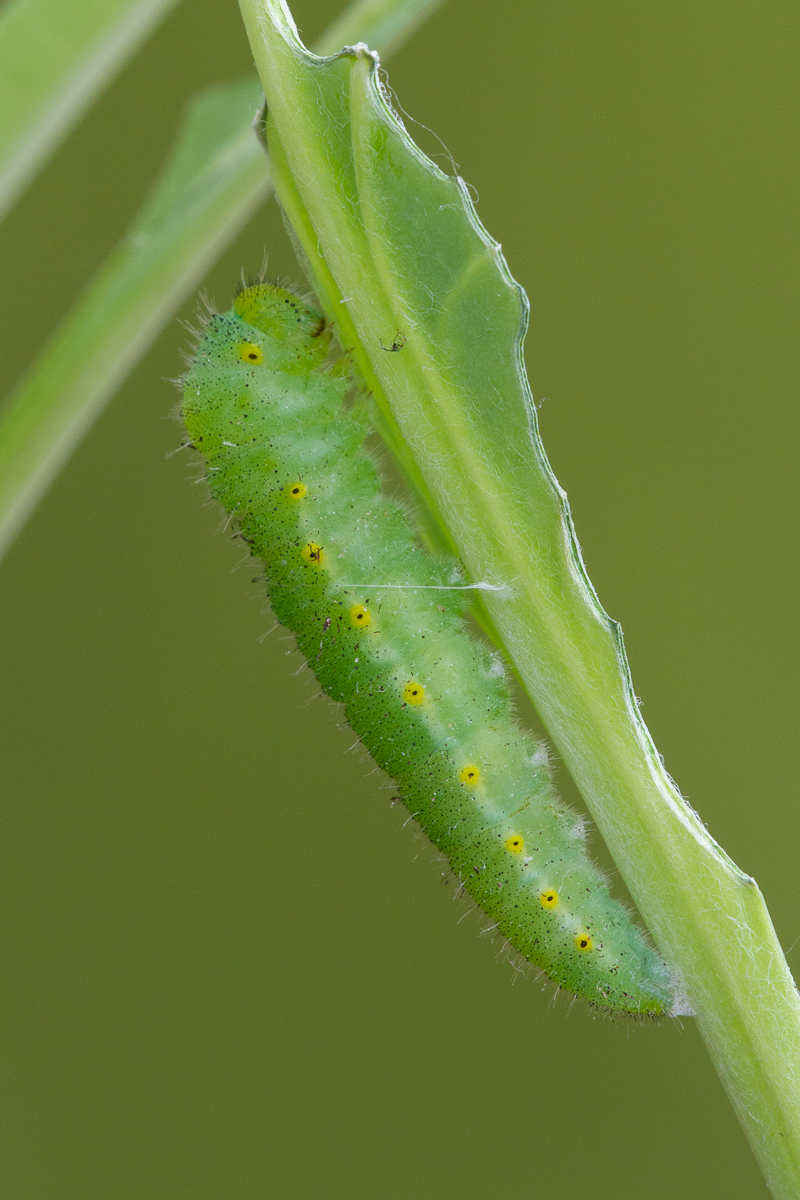
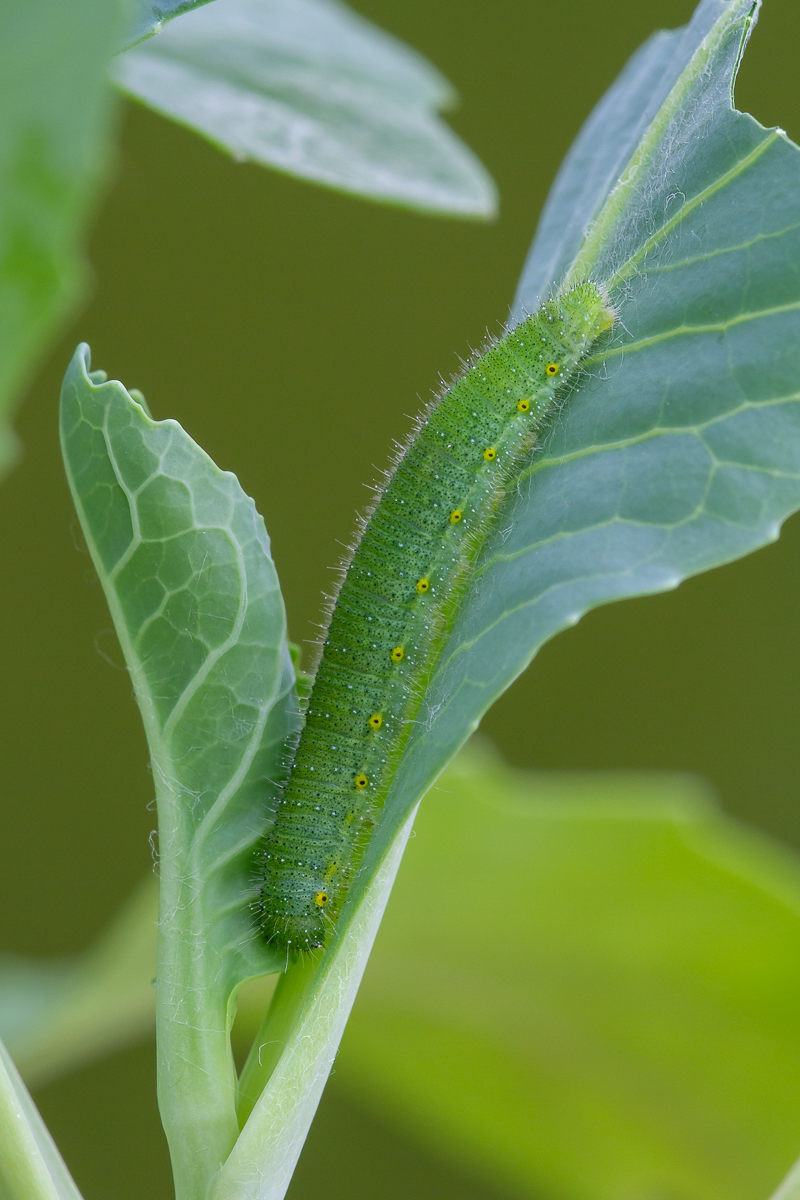
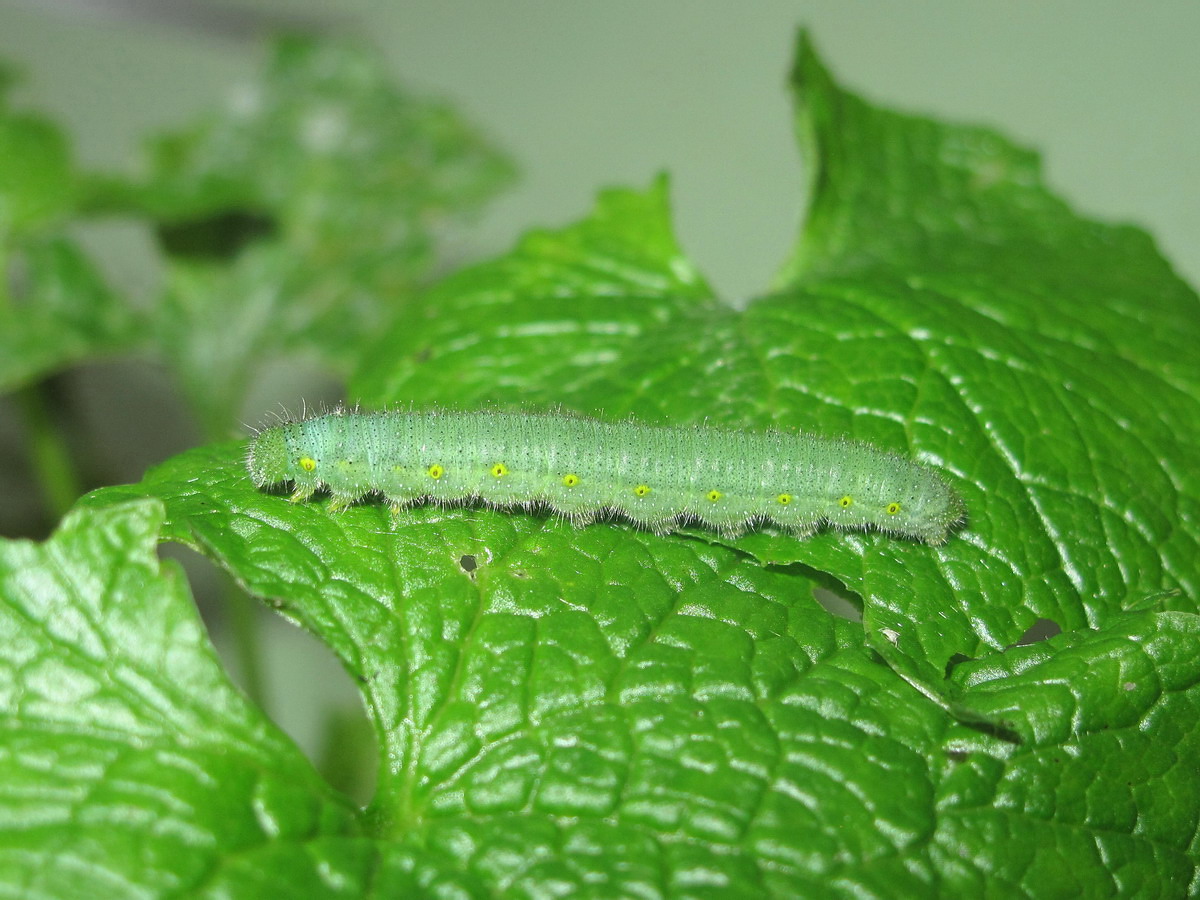
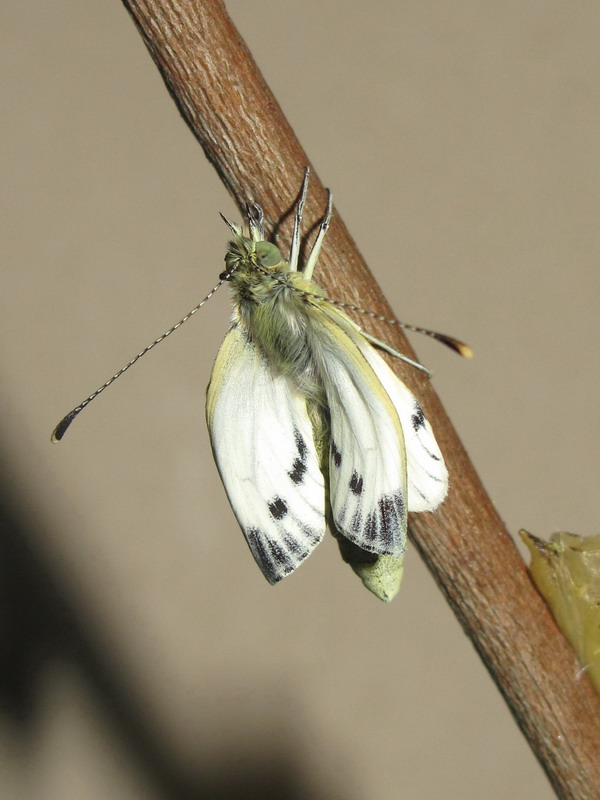
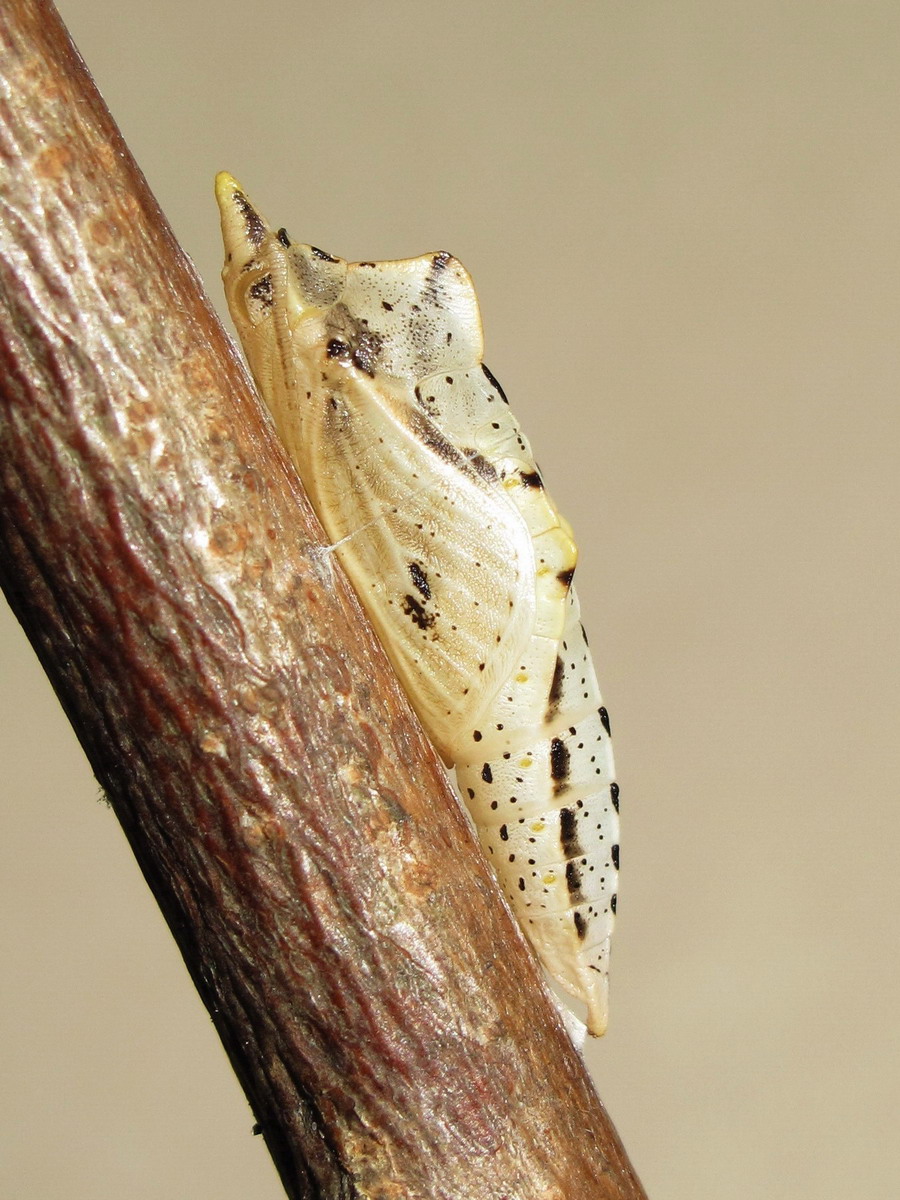
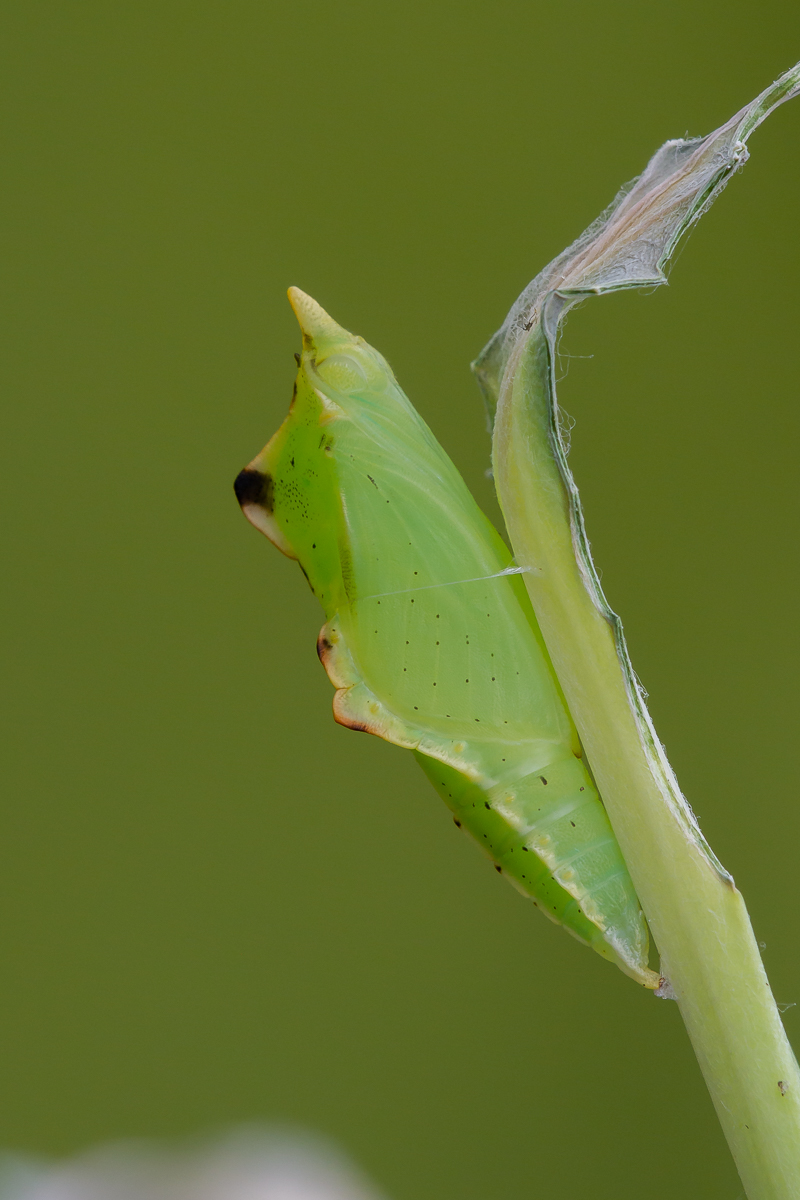
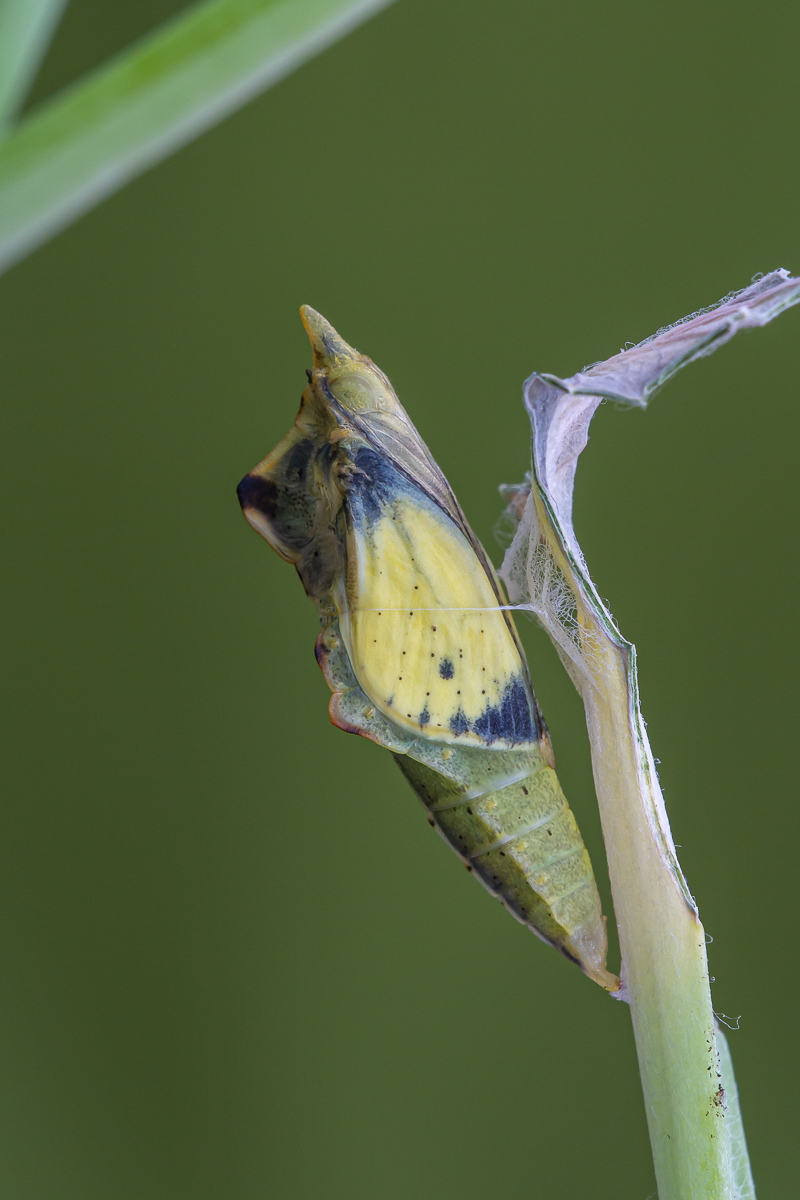
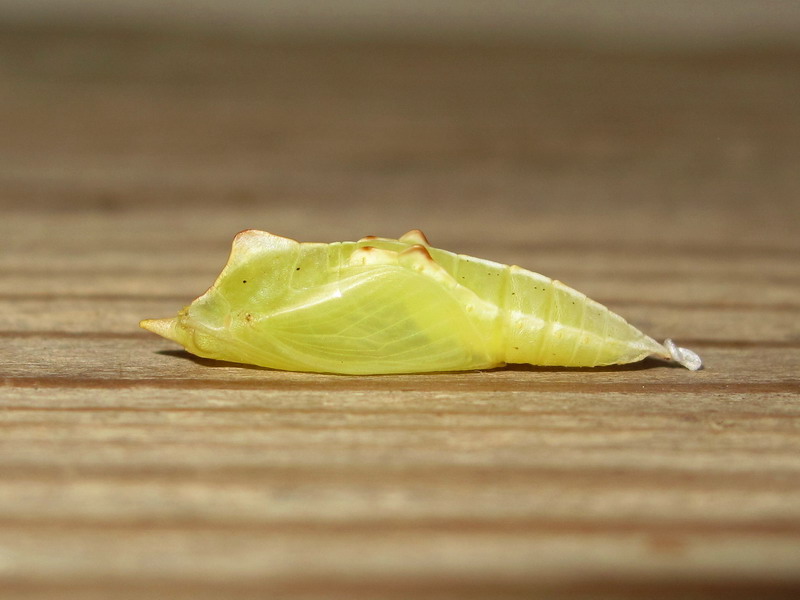
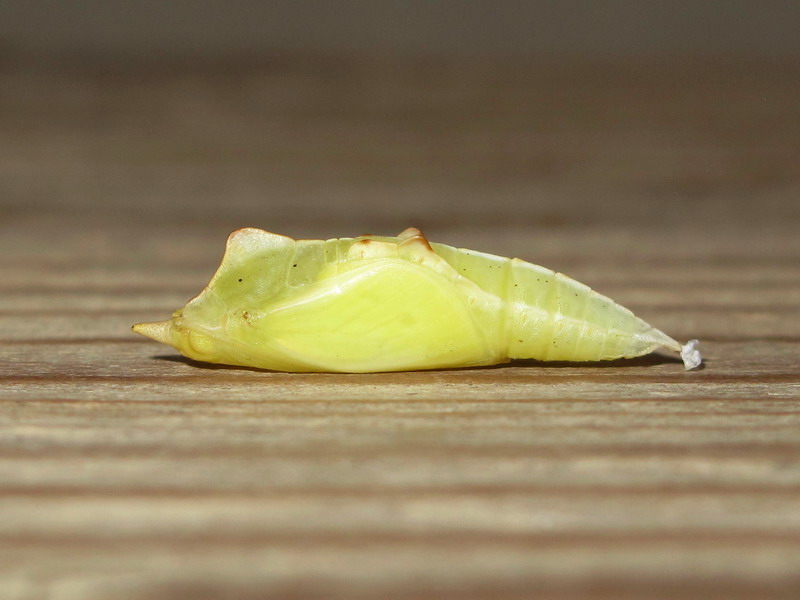
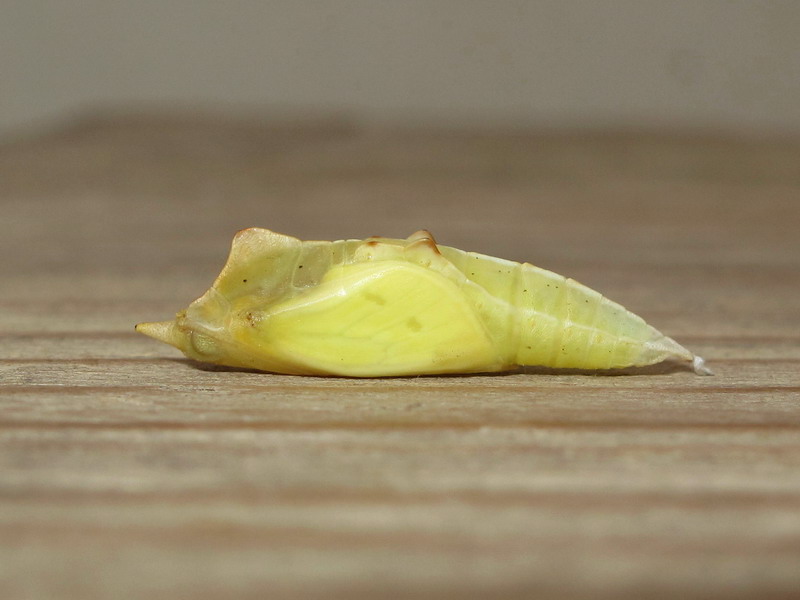
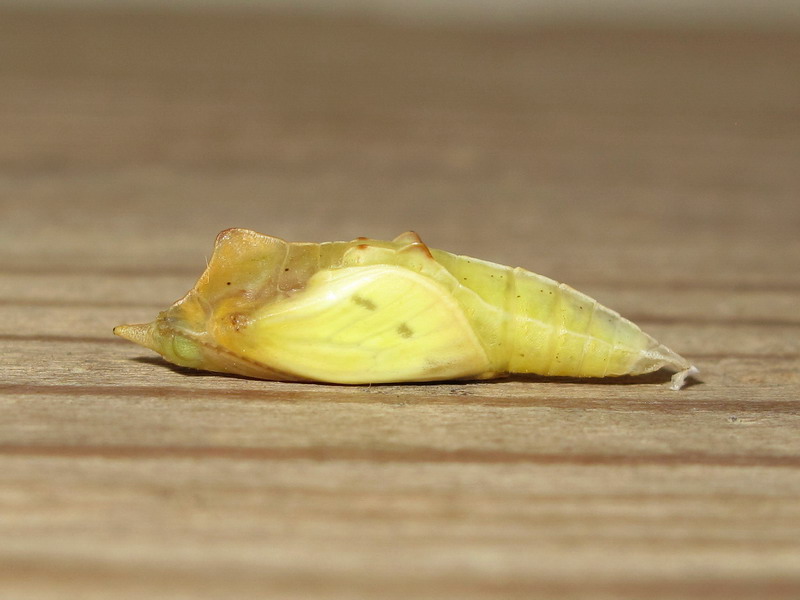
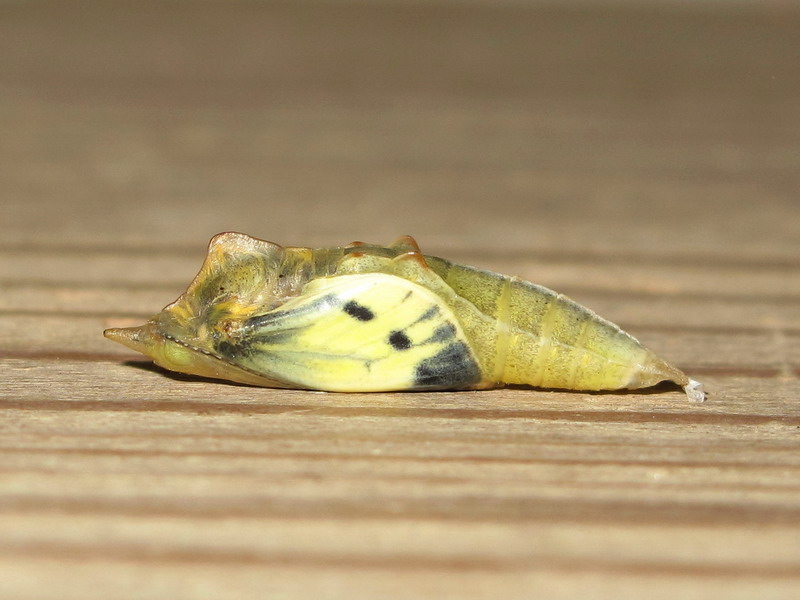
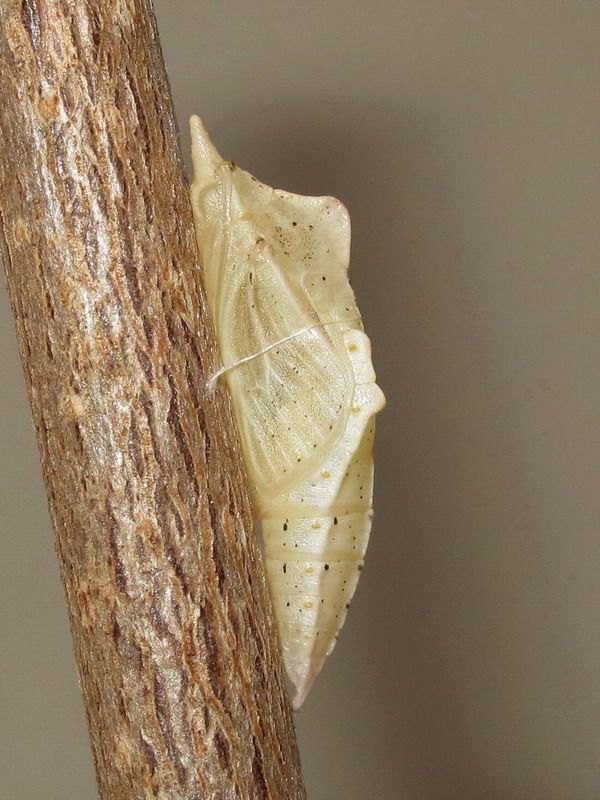
The pupa is generally formed away from the foodplant, low down in vegetation. It is supported by a silk girdle and the cremaster. The pupa has 2 colour forms, green and light brown, although some pupae have an intermediate colouring. This stage lasts around 10 days unless overwintering.
"The pupae are at first of a clear light green. The pupa measures 19 mm. long; it closely resembles that of P. rapae, but in P. napi the abdomen is straighter, the sub-dorsal keel is less bi-angular above the anal angle of the wing; and the meta-thorax less sunken. The head is beaked, the thoracic dorsal keel rises abruptly to an acute angle, and passes over the meta-thorax in almost a straight, unbroken line with the abdomen, which is but slightly curved to the anal segment, the ventral outline is fairly straight; the sub-dorsal keel rises above the anal angle of the wings; at the base of the wing is a slight point from which extends a small keel to the eye, and along the costal and inner margins of the wing. In colouring the pupa is very variable, both as regards the ground colour and markings: pure green, yellow green, ochreous, straw-yellow and pale buff; some are almost spotless and others heavily speckled and marked with black; while every intermediate variation occurs in extent of the markings. The variety of colour is more or less influenced by the surrounding colouring of the site selected for pupation. Fig. 10. The form figured is uniformly of a rich straw-yellow, almost spotless, having only a few minute black specks on the abdomen, which are almost invisible. Fig. 11. Yellow-green form showing black markings on the sub-dorsal keel points. Fig. 12. In the clear pure green form the keels are yellow, spotted and blotched with black and pinkish-brown, with a conspicuous black blotch on the point of the meso-thorax keel; upper edge of beak black, and continued along base of the antennae; also black in the centre of the prothorax; along the spiracular yellow line is a black mark on each segment, forming a conspicuous streak; the wings and abdomen are delicately dotted with black, those on the wings are placed on the nervures; the ventral surface is unspotted and paler green. Fig. 13. The cream-coloured form is spotted and blotched with black, similar to the green form but more deeply so, and in addition has black blotches in the centre of the wings. In more heavily marked specimens the black is very prominent, the markings almost forming continuous lines, giving the pupa a dusky appearance; in these dark forms the ground colour is more of a buff hue, in some inclining to pinkish-buff. The pupa is occasionally found attached to palings and walls in a similar position to that of P. rapae, but owing to napi inhabiting more open country, away from buildings, the pupa is usually attached to the branches, stems and foliage of vegetation." - Frohawk (1924)
The following links provide additional information on this butterfly.