UK Butterflies
Building a Community of Responsible Butterfly Enthusiasts in Britain & Ireland
Building a Community of Responsible Butterfly Enthusiasts in Britain & Ireland
Wingspan
25 - 31 mm
Checklist Number
61.015
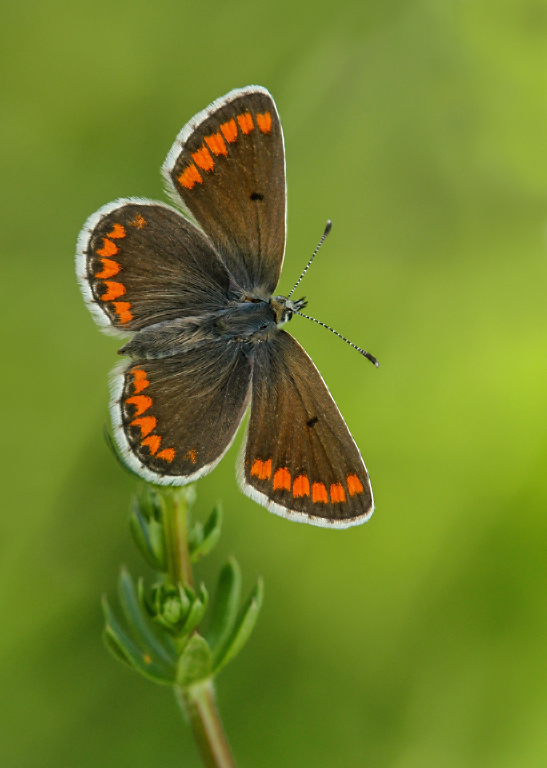
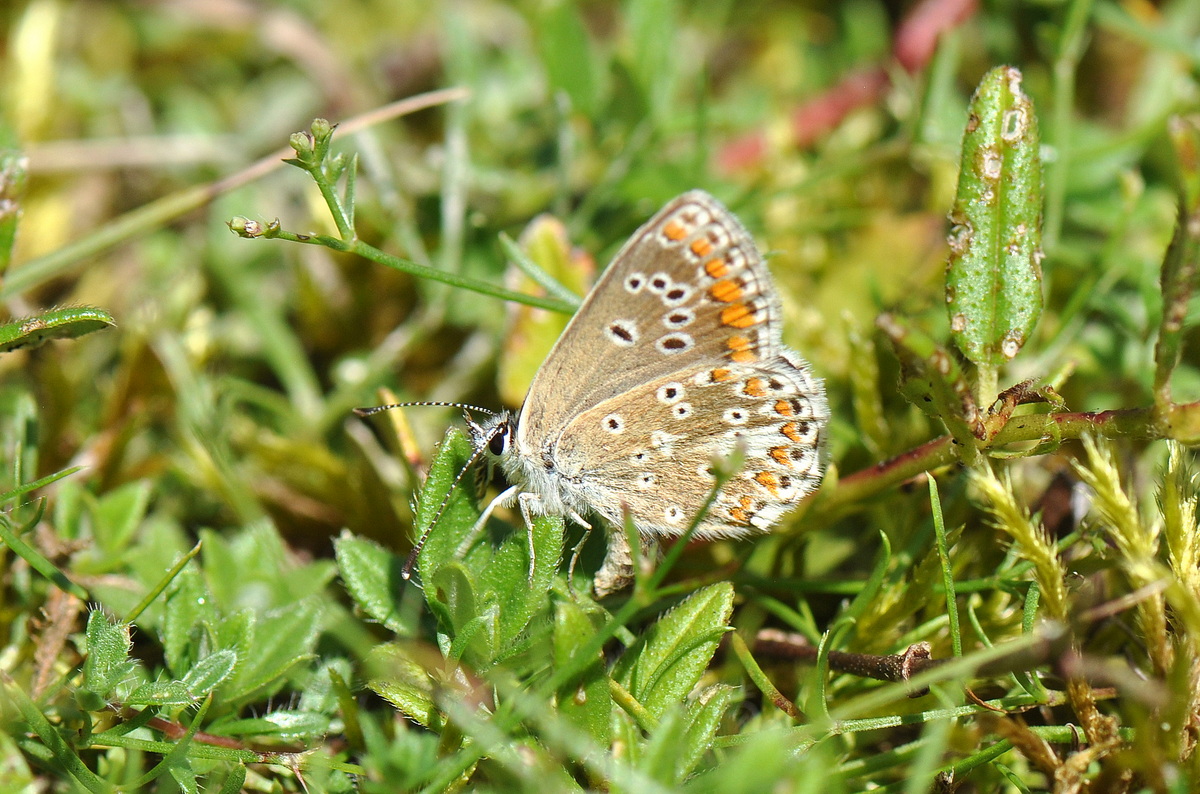
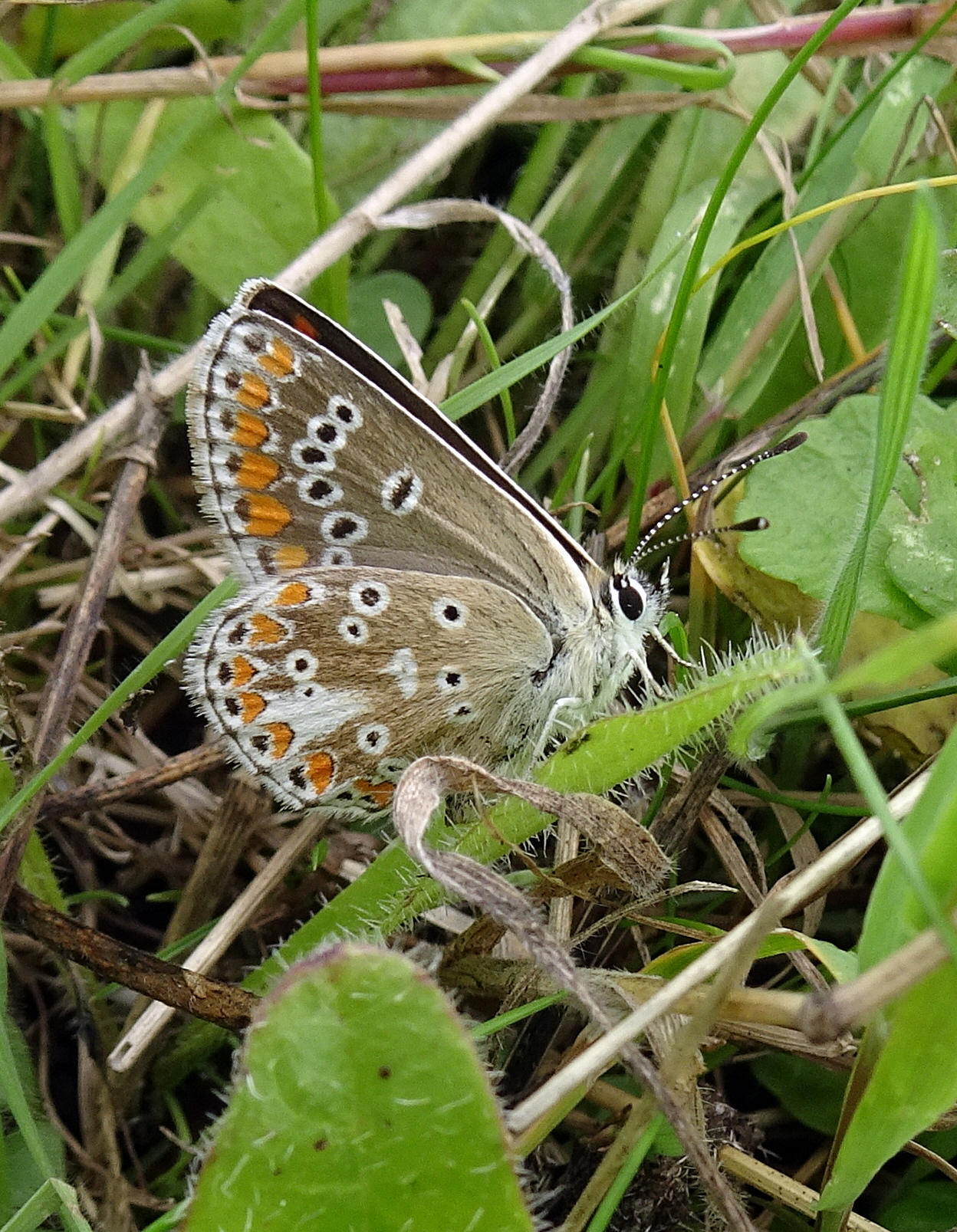
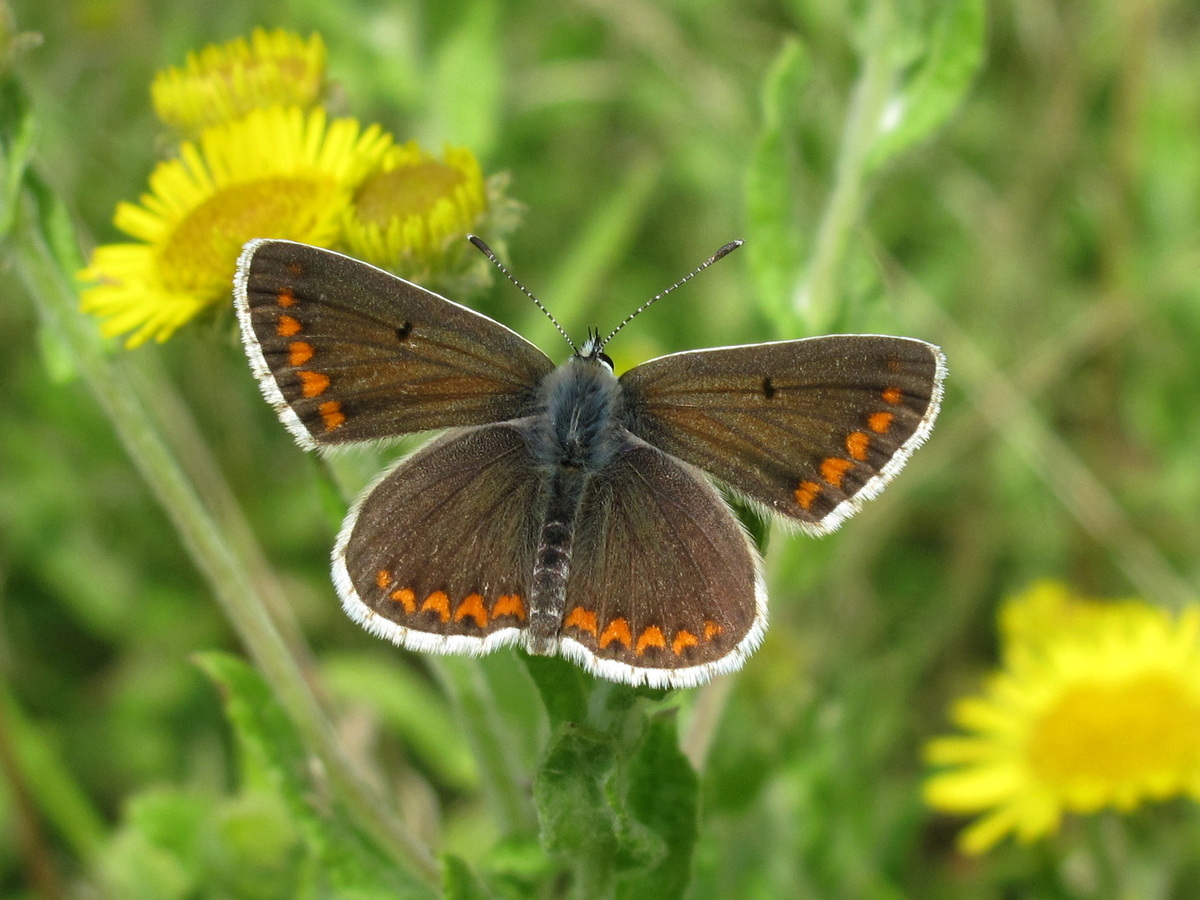
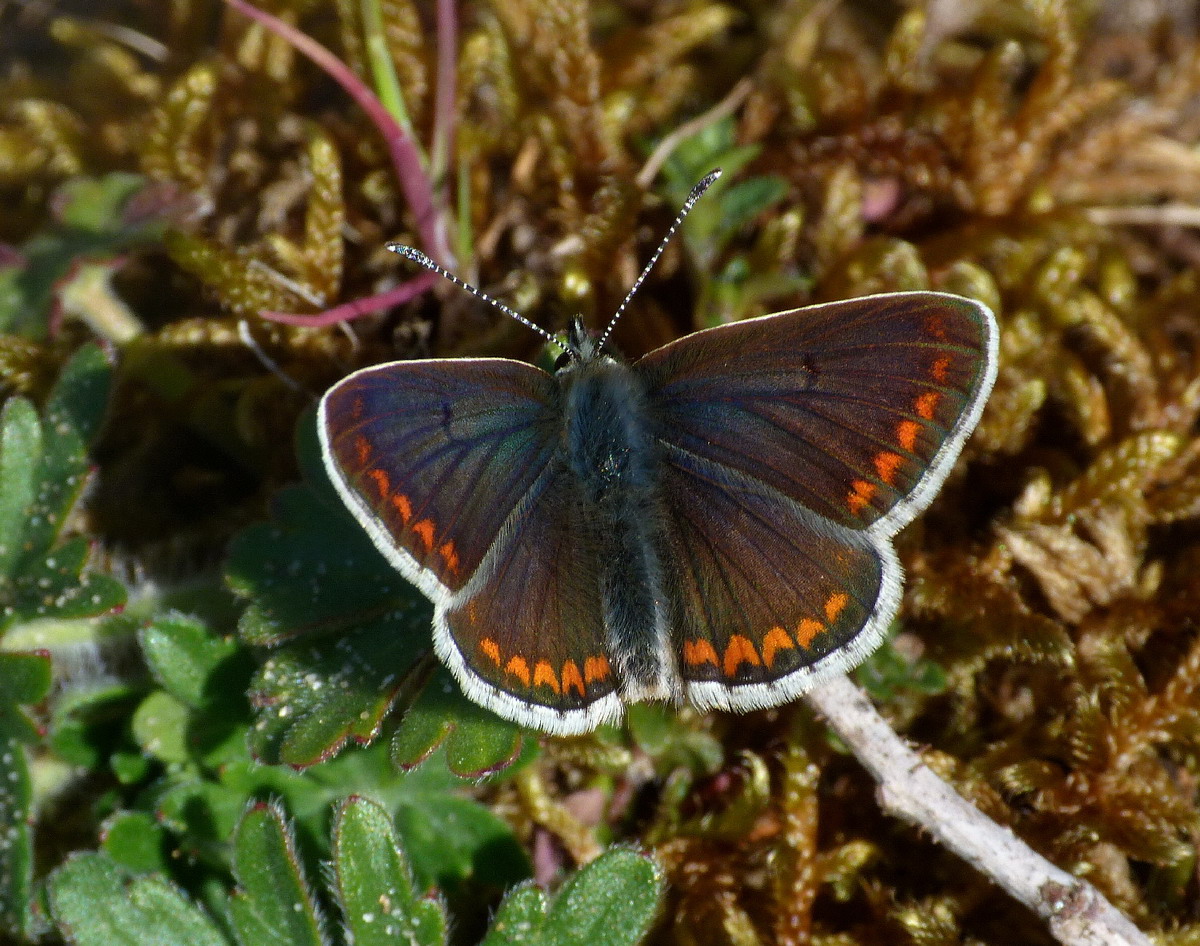
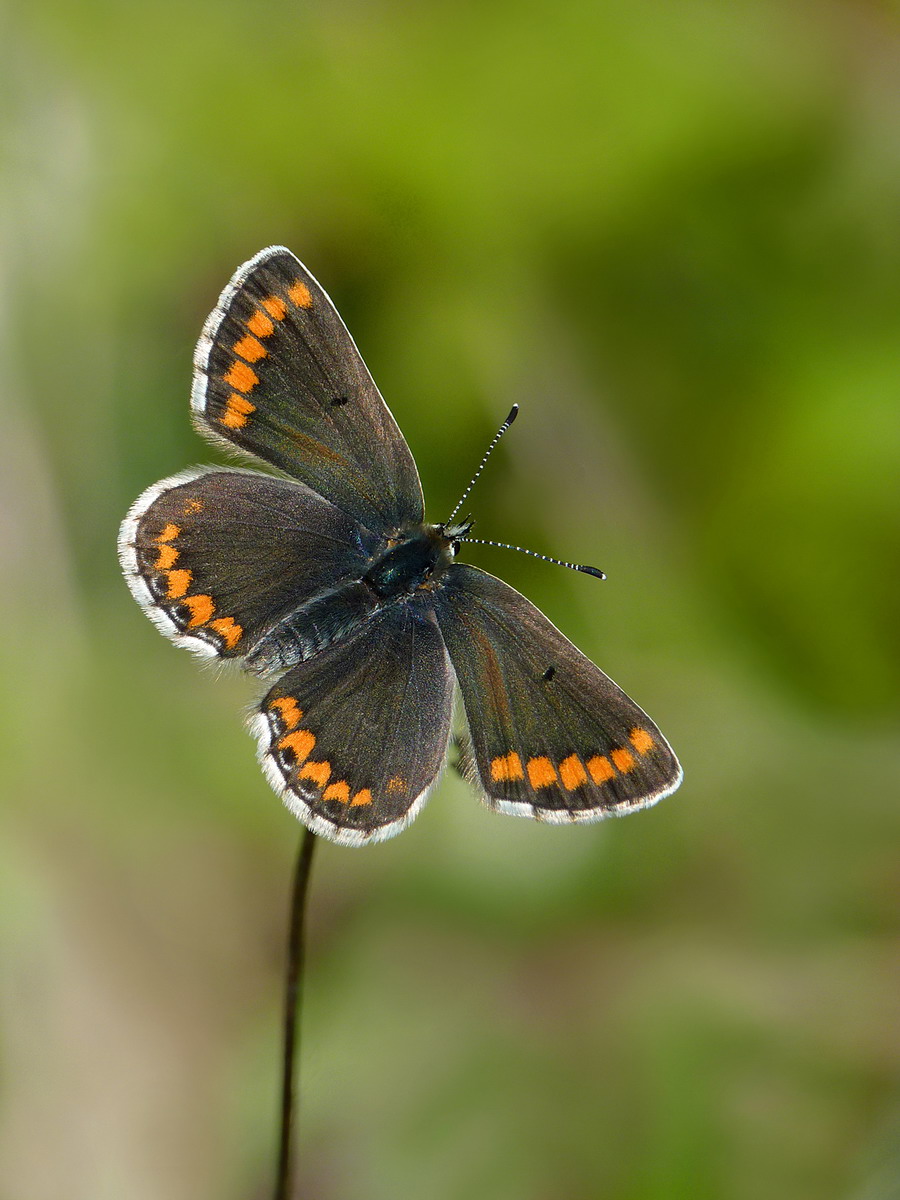
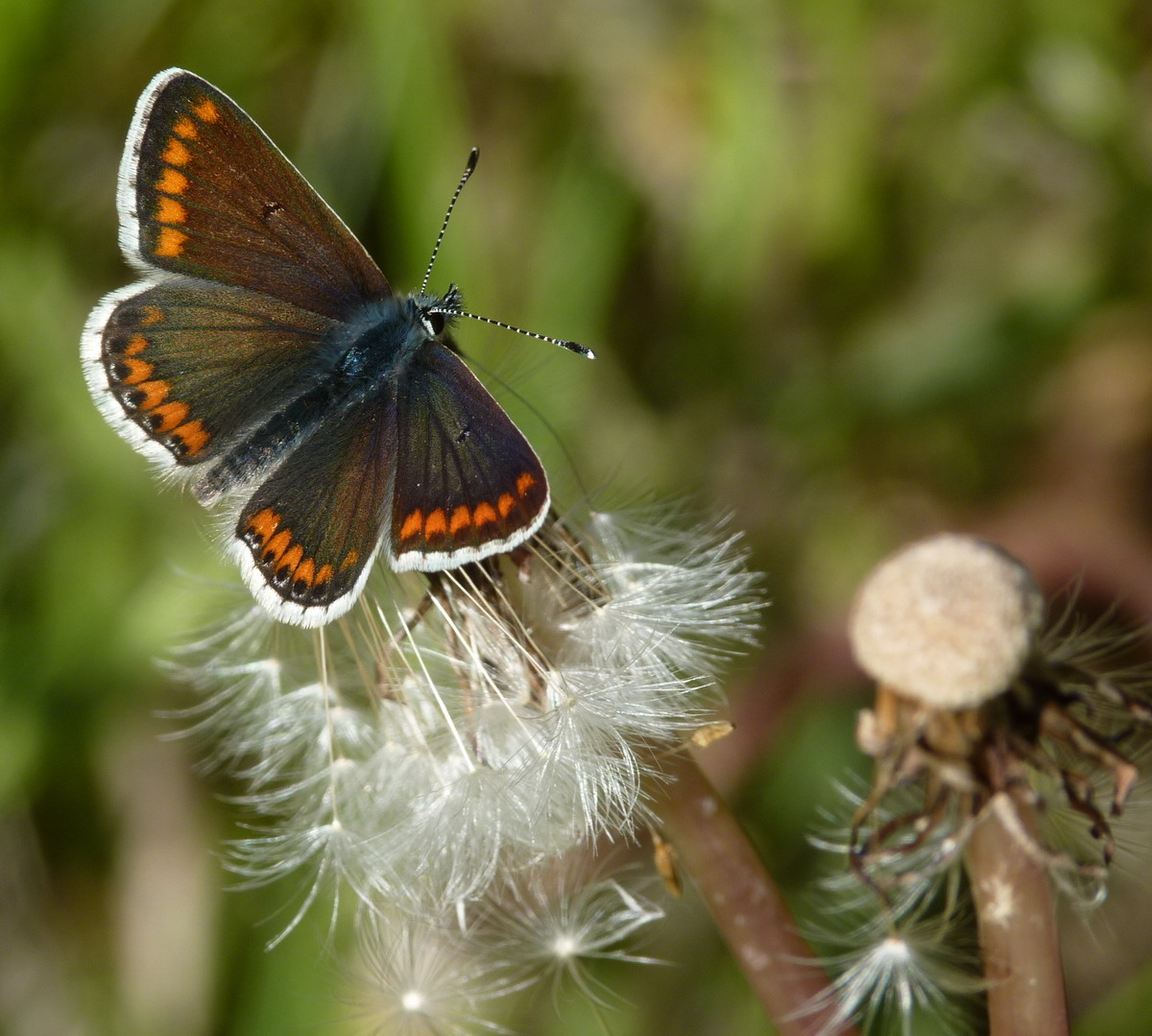
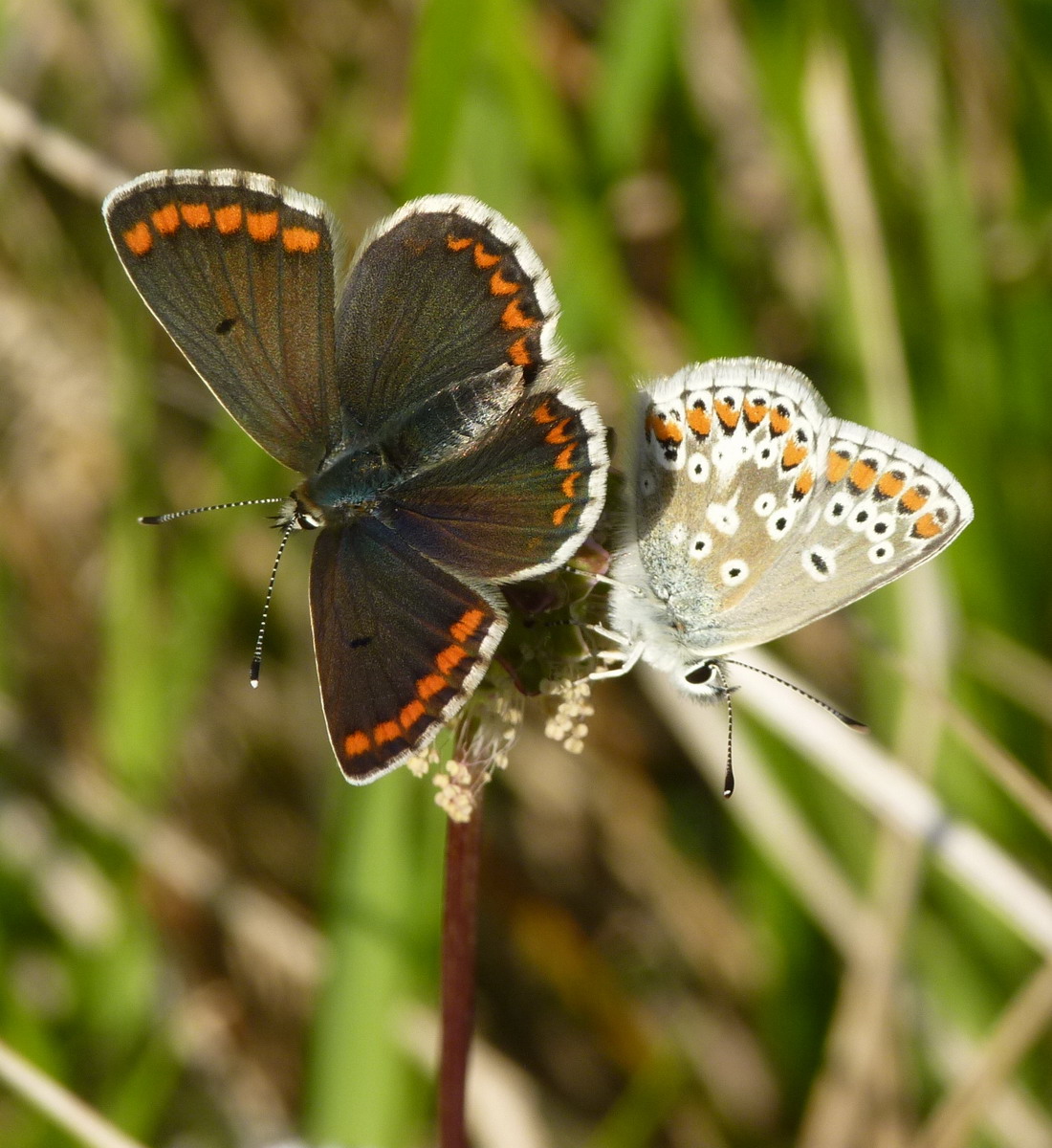
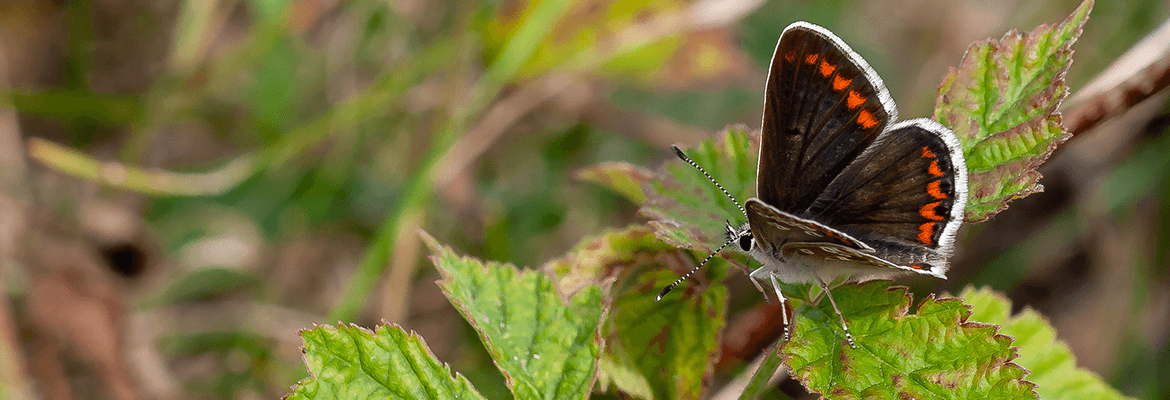
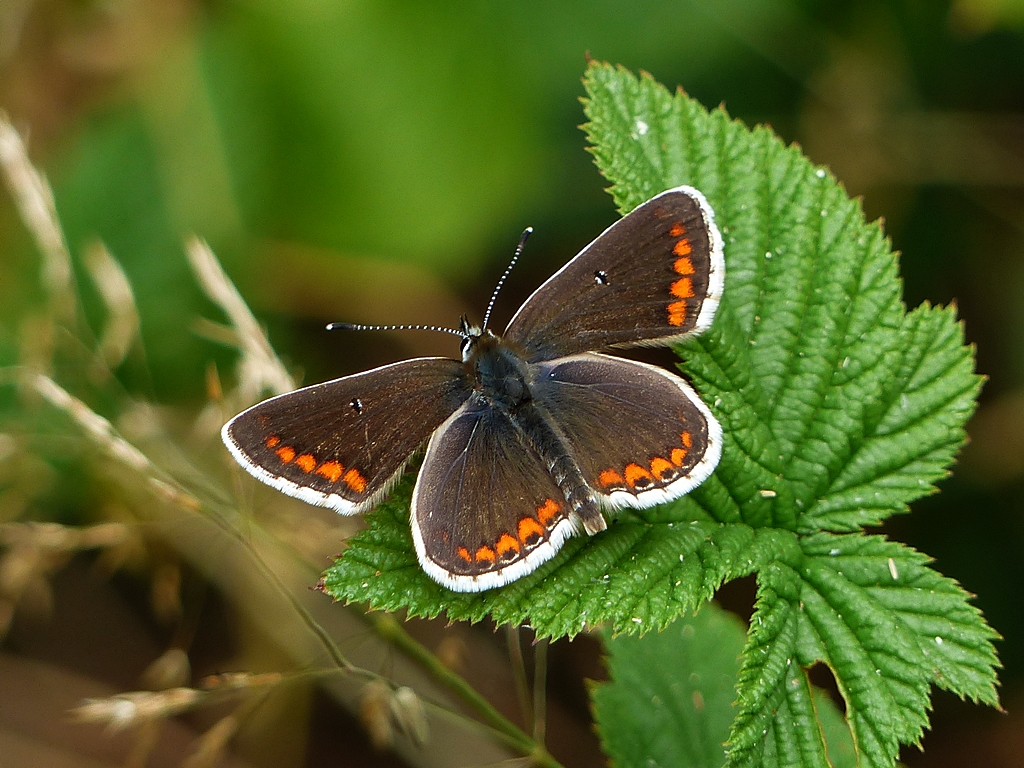
Unlike most other "blues", the Brown Argus has no blue scales on its upperside, both sexes being primarily brown in colour as its common name suggests, although the butterfly does exhibit a blue sheen when at certain angles to the light. Both sexes have beautiful orange spots on the upperside of both forewings and hindwings. This widespread species can be found south of a line between Dorset in the west and South-east Yorkshire in the east, along with colonies in Derbyshire, North Devon, East Cornwall and West Cornwall. It is also found in north and south Wales, but is absent from central Wales. This species is also absent from Scotland, Ireland and the Isle of Man. This species occurs in small, compact colonies, and is not a great wanderer, only travelling a couple of hundred metres, at most, from where it emerged.
This species was first defined in Denis & Schiffermüller (1775) as shown here (type locality: Vienna, Austria).
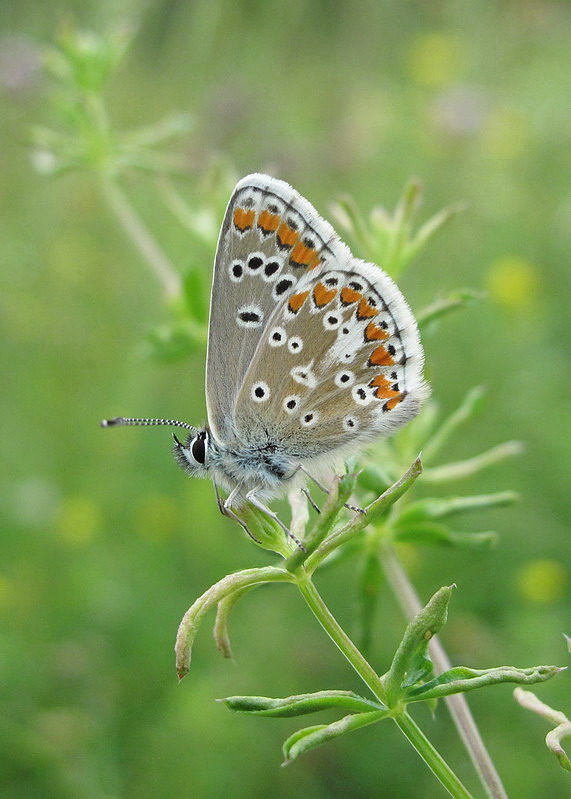
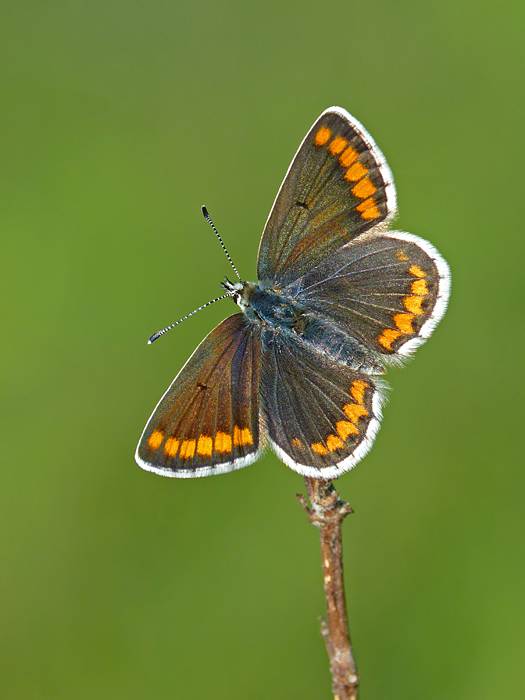
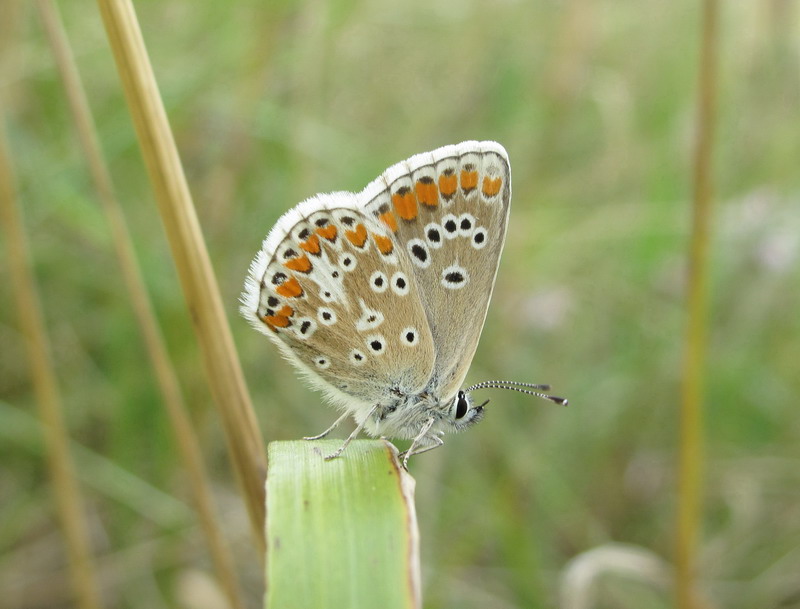
| Family: | Lycaenidae | Leach, 1815 |
| Subfamily: | Polyommatinae | Swainson, 1827 |
| Tribe: | Polyommatini | Swainson, 1827 |
| Genus: | Aricia | Reichenbach, 1817 |
| Subgenus: | ||
| Species: | agestis | ([Denis & Schiffermüller], 1775) |
Description to be completed.
The distribution data (2000-2009) has been made available through the generosity of Butterfly Conservation and any subspecies distribution is taken from Riley (2007). Click here to see the distribution of this species together with site information overlaid.
Colonies are typically found on chalk or limestone downland where the foodplant is abundant. However, this species can also be found on heathland and in open woodland.
Both distribution and population trends show an increase and this butterfly is not, therefore, currently a species of conservation concern.
The table below shows the occurrence (distribution) and abundance (population) trends, using information from The State of the UK's Butterflies 2015 (Fox, 2015). Any UK BAP status is taken from the UK Biodiversity Action Plan (UK BAP) (2007 review).
1976-2014 (%) | 1976-2014 (%) | 2005-2014 (%) | 2005-2014 (%) |  +115 +115 |  -25 -25 |  +2 +2 | -11 |
|---|
This species generally has 2 broods a year in central and southern England, with only a partial second brood in north Wales and the north of England. In good years, a partial 3rd generation may appear in the south. The adults emerge first in central and southern England in early May, peaking at the end of May and beginning of June, and giving rise to a second brood that emerges at the end of July and into August. In north Wales and northern England, the first emergence starts in early June with any second brood appearing in early August.

This is a warmth-loving species and, as such, is often found in sheltered areas or on south-facing slopes. When courting, the males congregate at the base of a slope where they either perch, waiting for a virgin female to fly by, or patrol the area looking for a female perched on a grass stem awaiting a mate. Mating takes place after a short flight low to the ground. When egg-laying, the female will make meandering flight close to the ground, searching out suitable foodplants on which to lay.
Like its close relative, the Common Blue, this species will roost communally on grass stems at night. In fact, the two species are sometimes found roosting together.
Adults feed primarily on buttercups (Ranunculus spp.), Common Bird's-foot-trefoil (Lotus corniculatus), Common Rock-rose (Helianthemum nummularium), dandelions (Taraxacum spp.), Horseshoe Vetch (Hippocrepis comosa), ragworts (Jacobaea spp.), White Clover (Trifolium repens), Wild Marjoram (Origanum vulgare) and Wild Thyme (Thymus polytrichus).
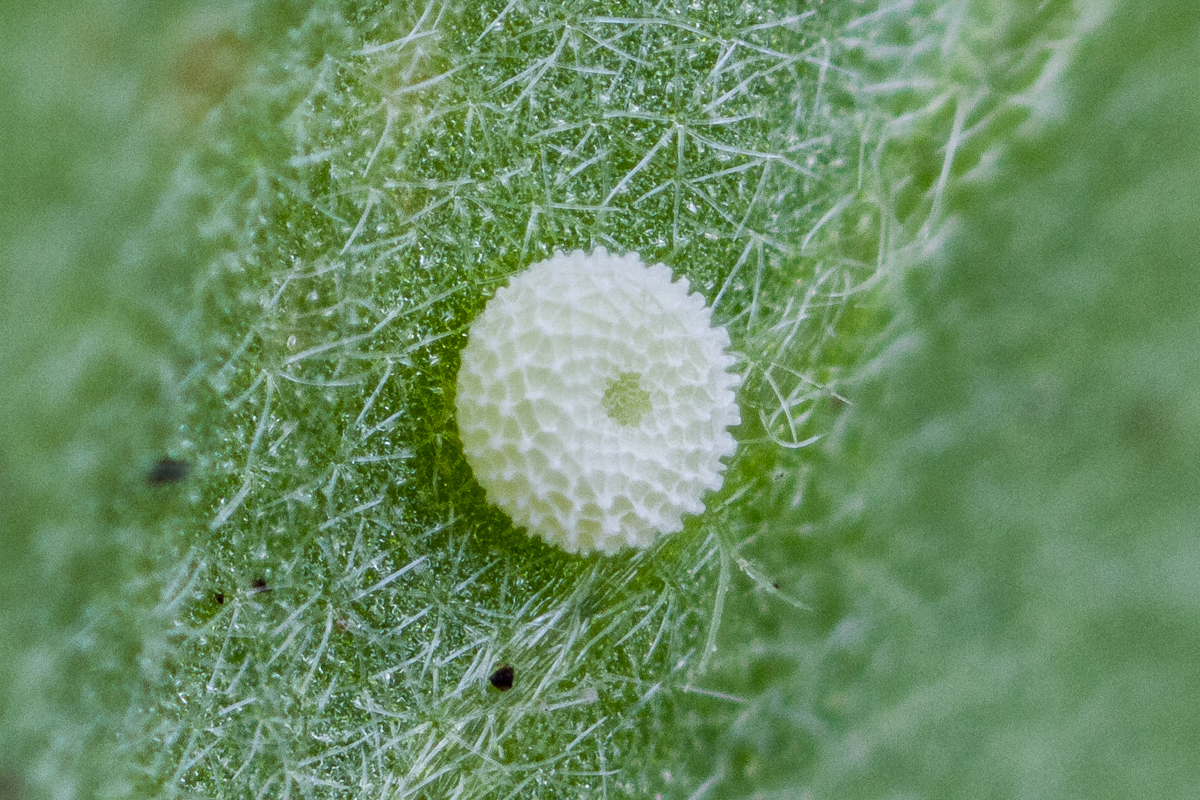
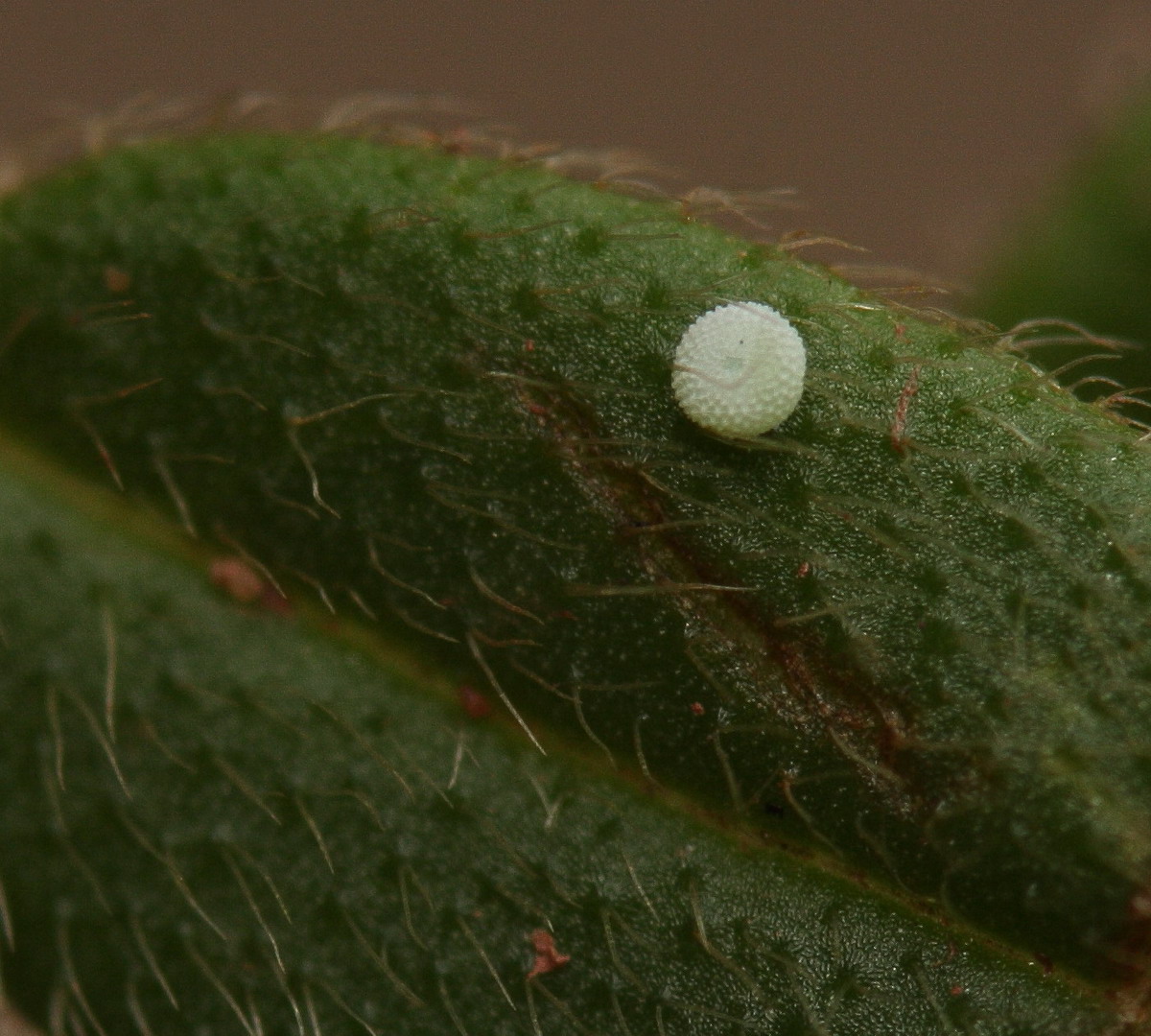
Eggs are laid singly, typically on the underside of a leaf of the foodplant, close to the midrib. Eggs hatch after about a week.
"On June 7th, 1900, the author watched a female depositing. It settled on a small sprig of rock-rose (Helianthemum vulgare) growing on a steep hillside in Oxfordshire, covered with a variety of small flowering plants, long grass, and studded with small hawthorn and juniper bushes, the hill facing N.E. As soon as it settled, it turned round once or twice, curved its abdomen down, and deposited a single egg on the under surface of a leaf next to the midrib, at 1:15 p.m. during bright sunshine. This particular egg hatched early morning on June 13th, remaining in the egg state five and three-quarter days. On June 10th, 1900, several females were placed on growing plants of rock-rose in three different pots, about six on each plant; nearly all commenced depositing at once. By the morning of the 13th they had mostly all died. The eggs were scattered over the plants as well as on the gauze covers. The majority of the eggs were hatched by the 15th. The egg is 0.50 mm. wide, of a compressed globular form, sunken in the centre; the micropyle is finely pitted; to the naked eye it shows as a dull central spot. The entire surface is covered with raised irregular reticulations of a network pattern. The juncture of each rib is raised to a prominent point. These are especially elevated round the upper side surrounding the crown; they become less on rounding the side, where the pattern forms a more regular design. The colour when first laid is of a delicate greenish-white, which remains unchanged until just before hatching, when it becomes an opaque pearl-white." - Frohawk (1924)
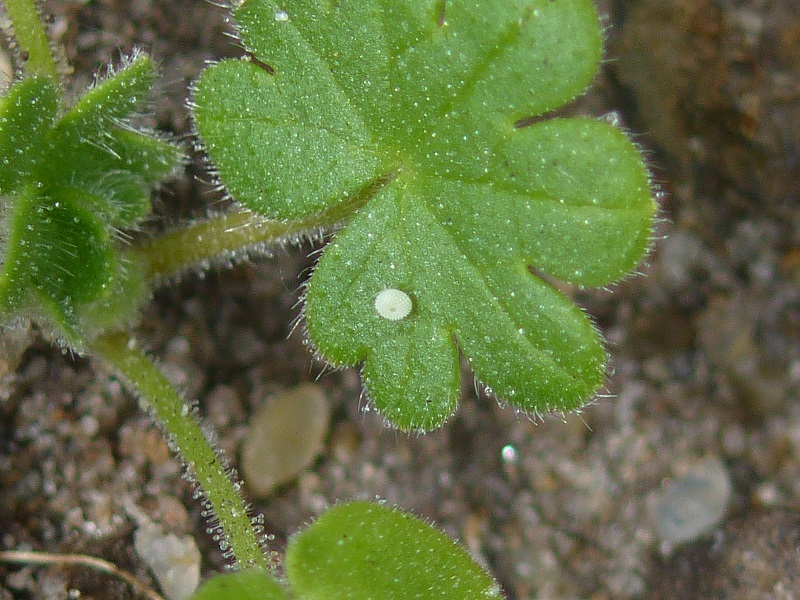
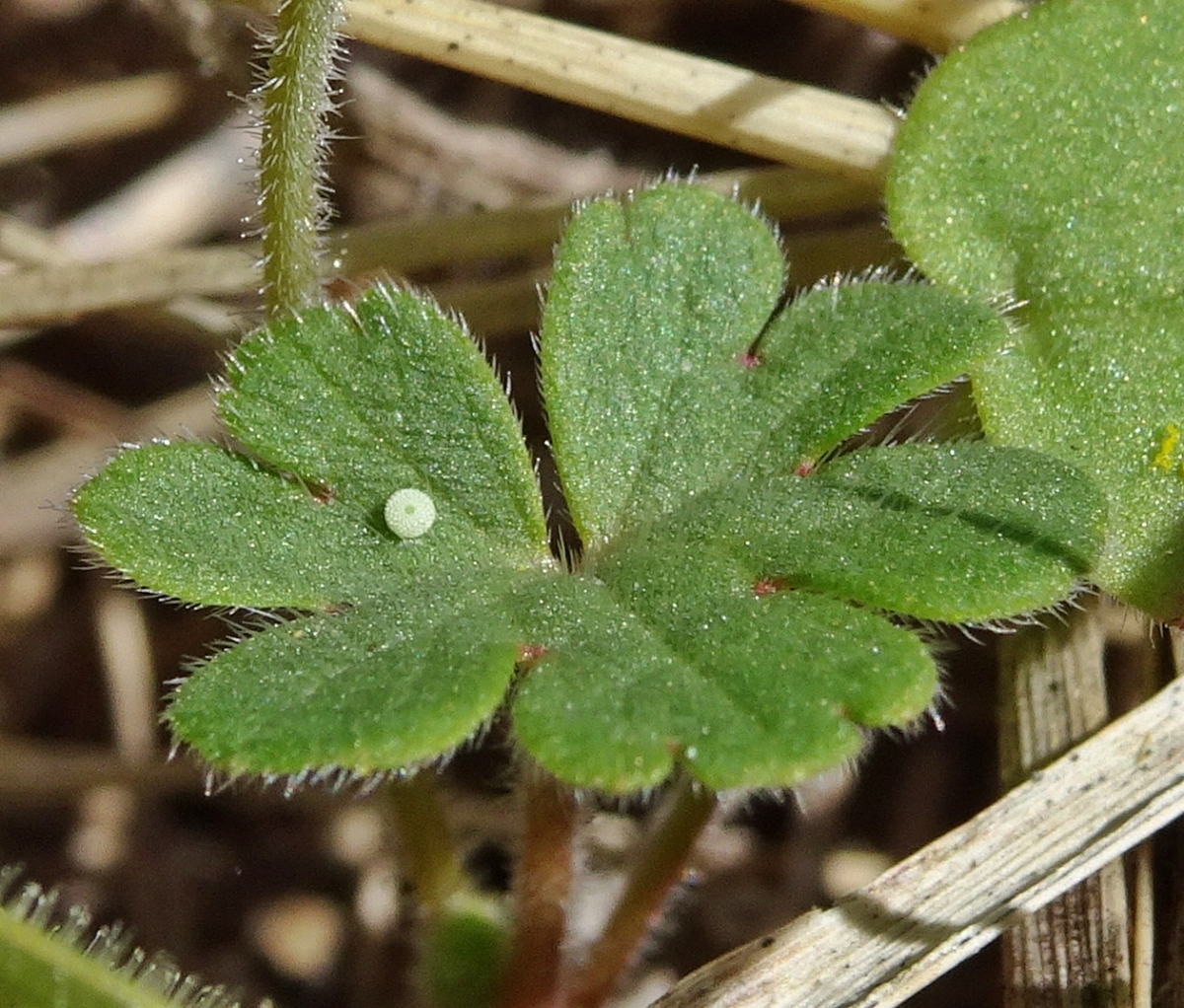
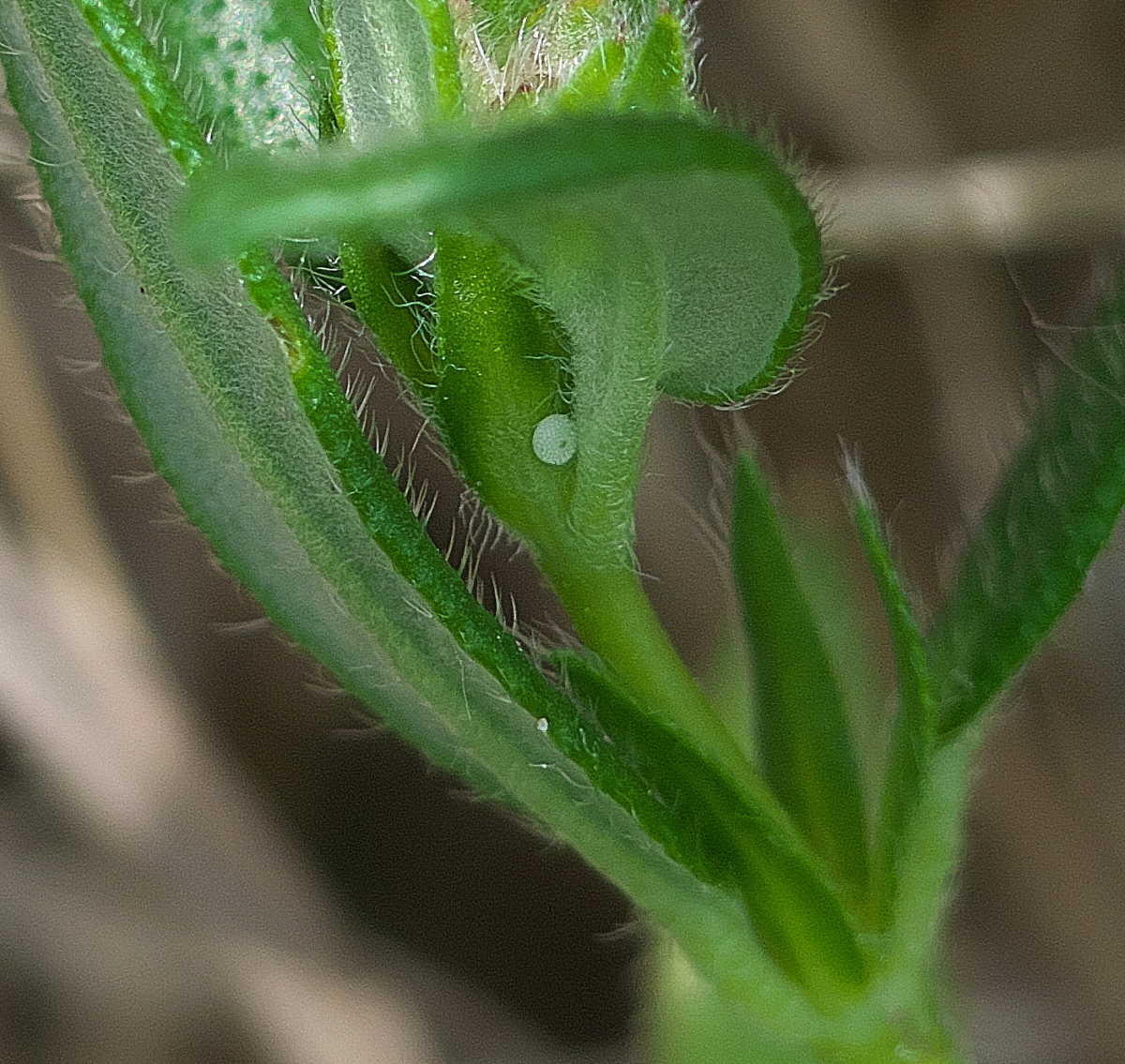
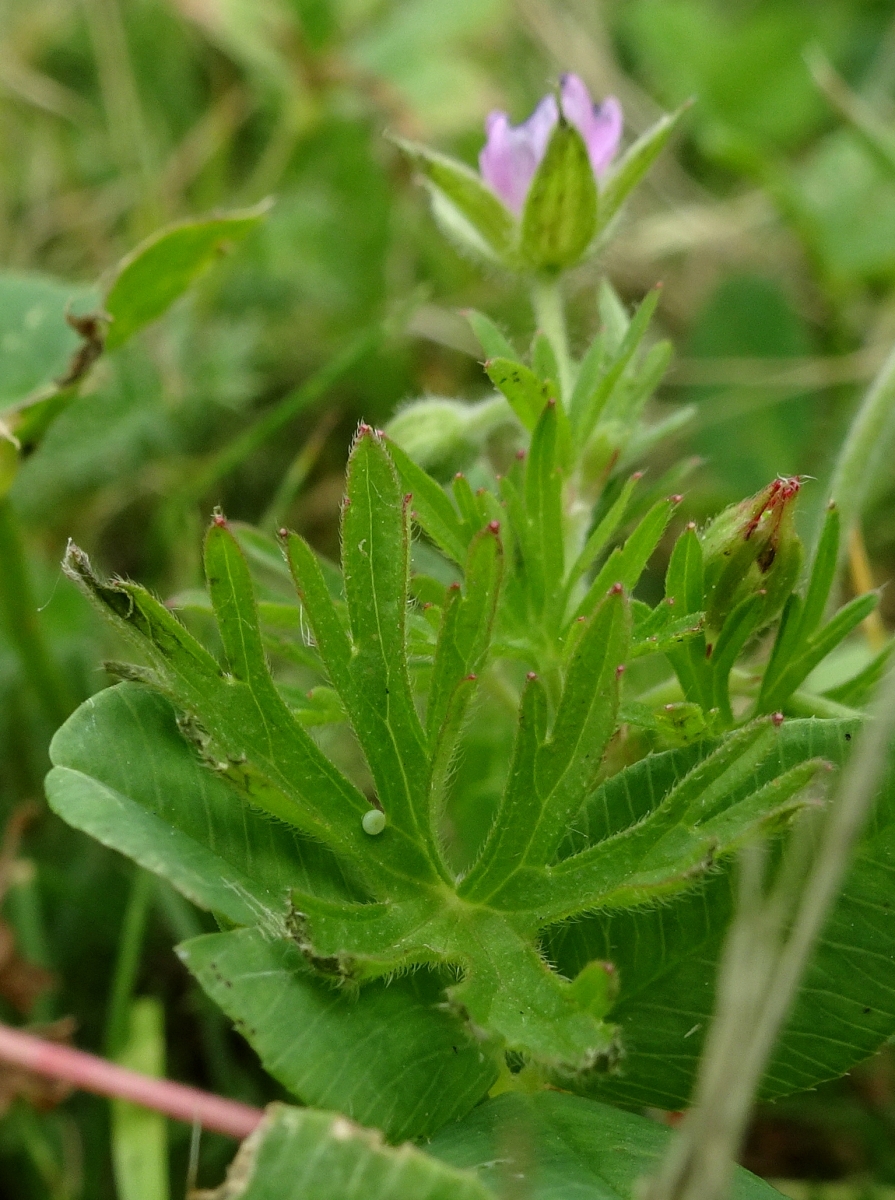
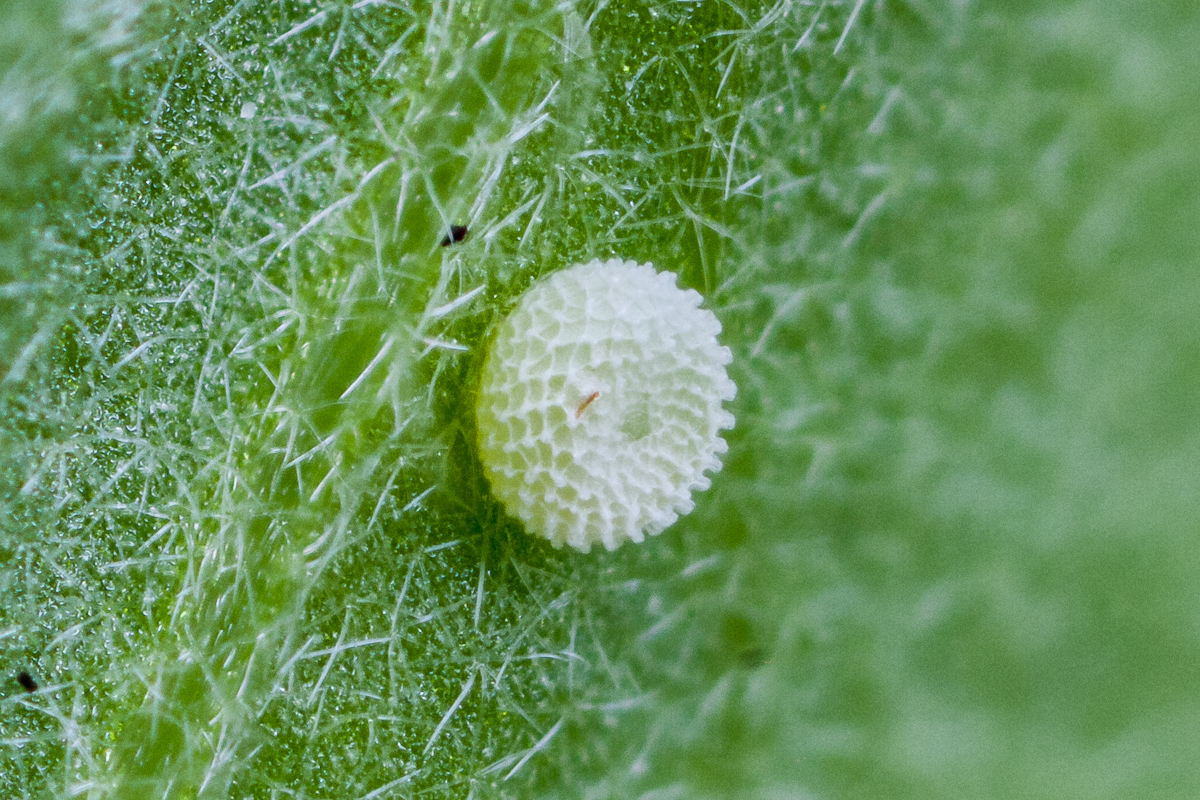

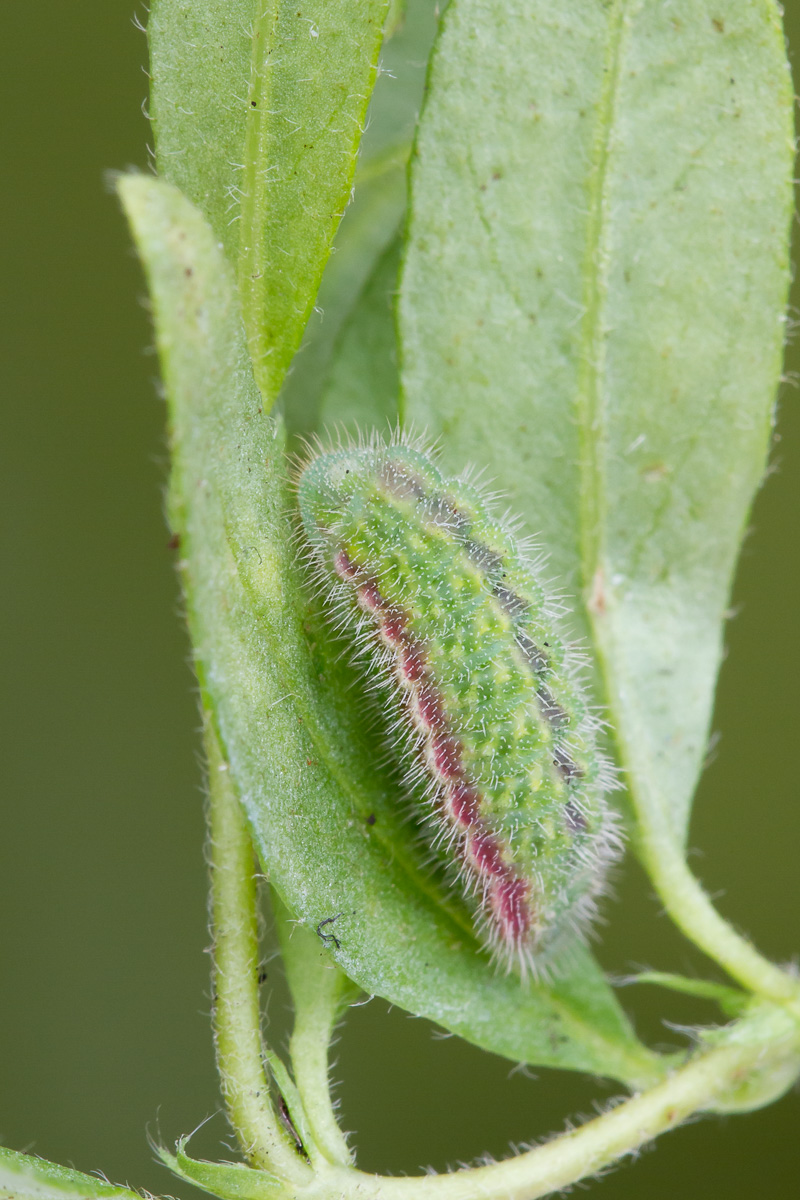
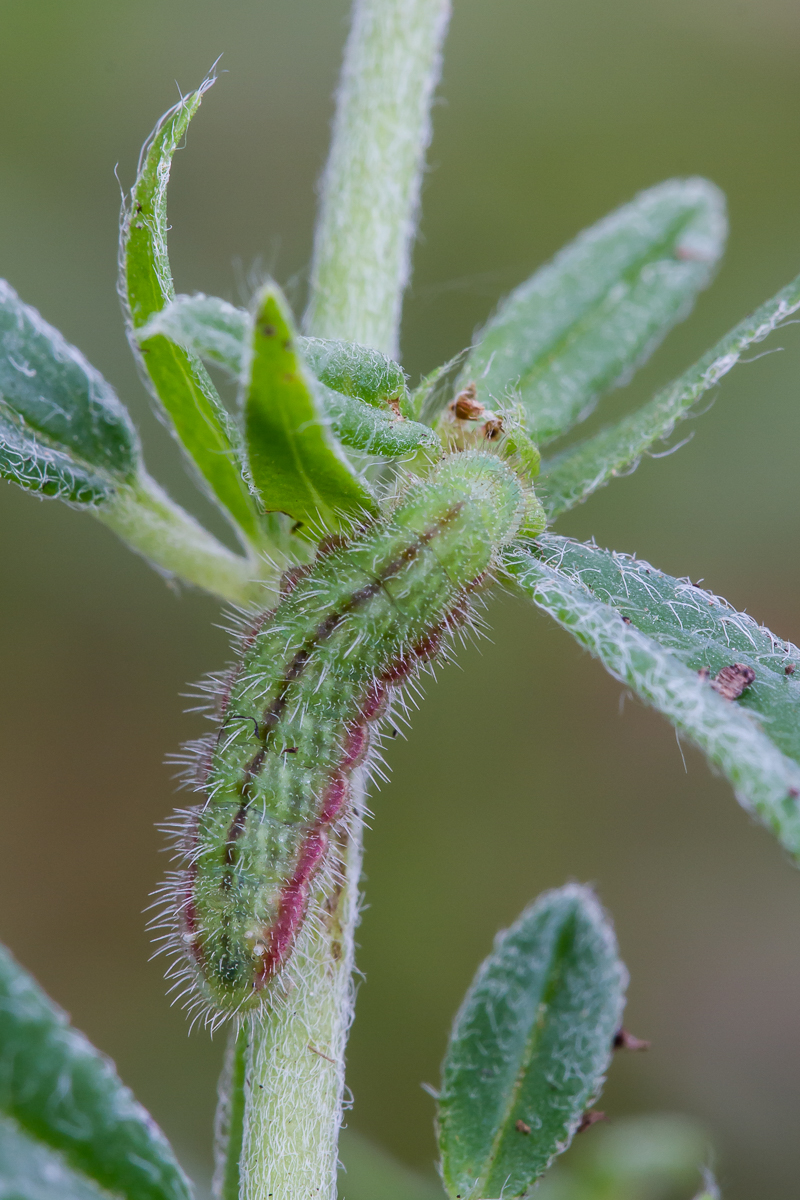
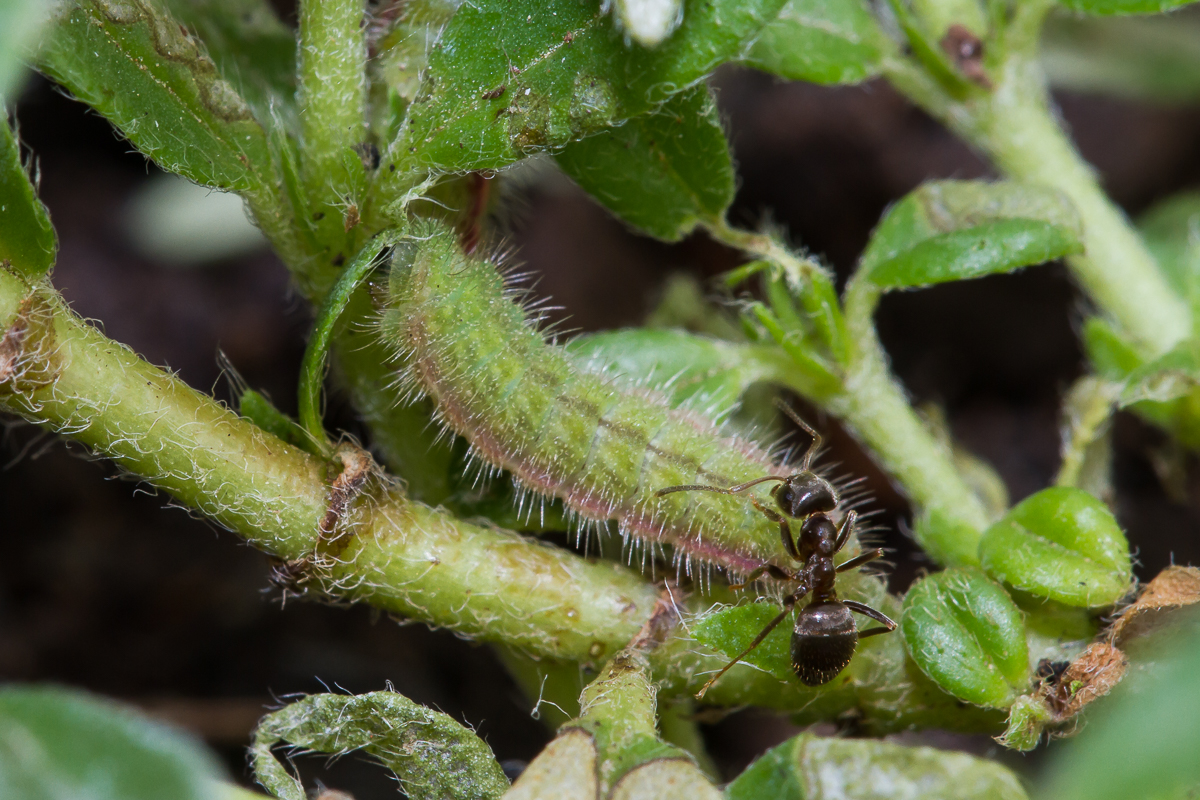
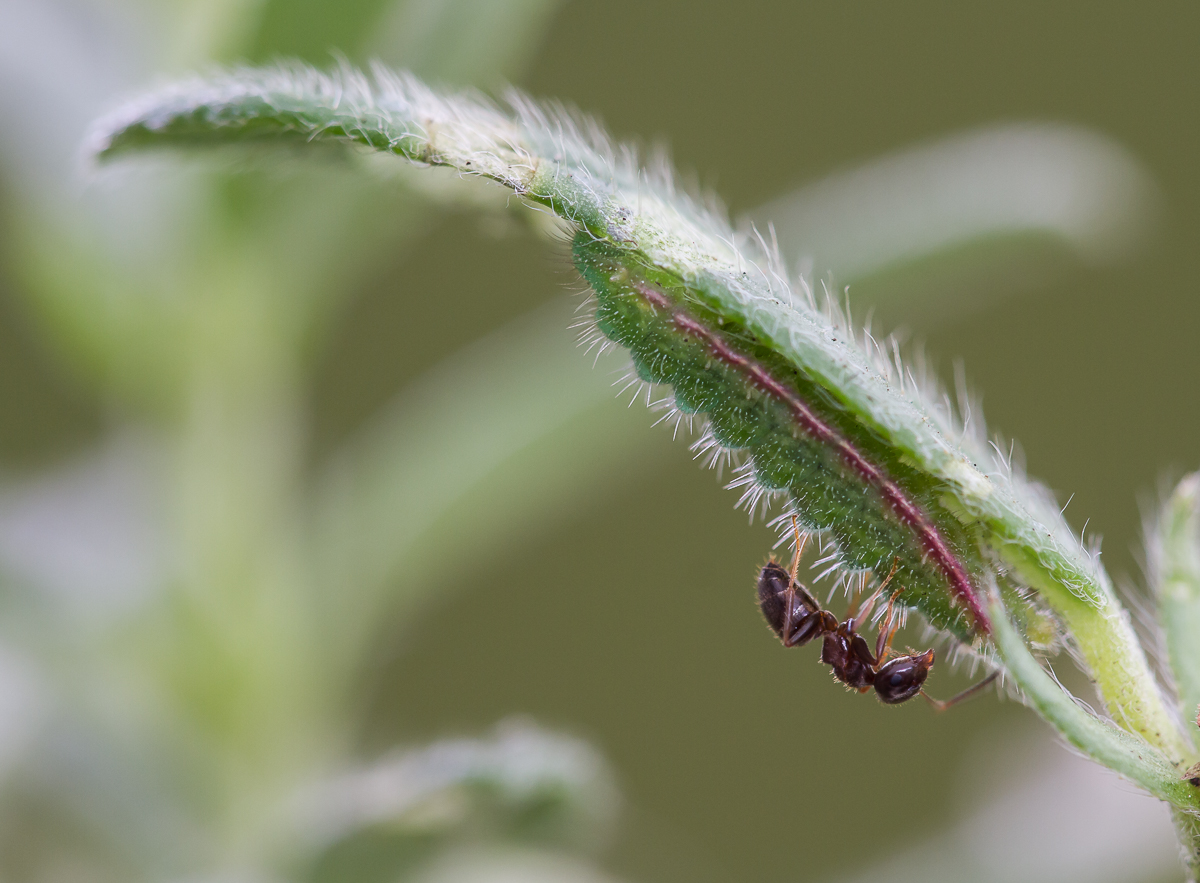
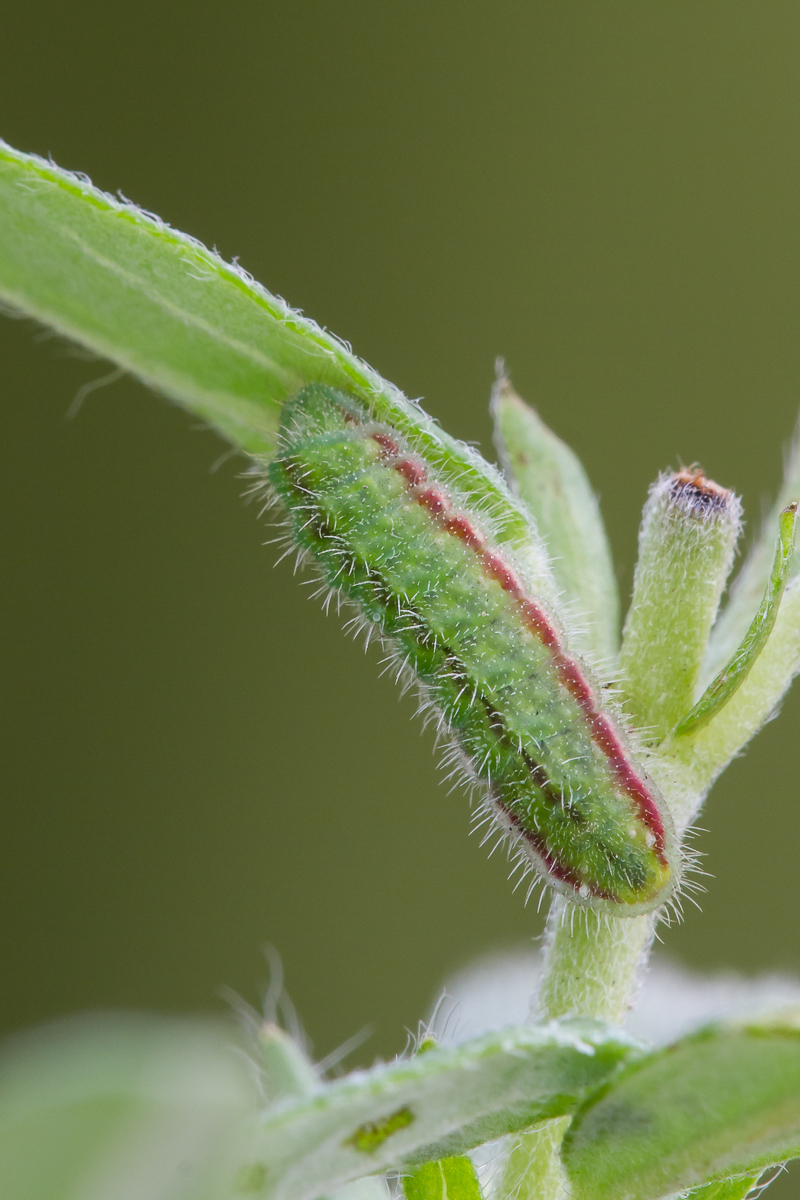
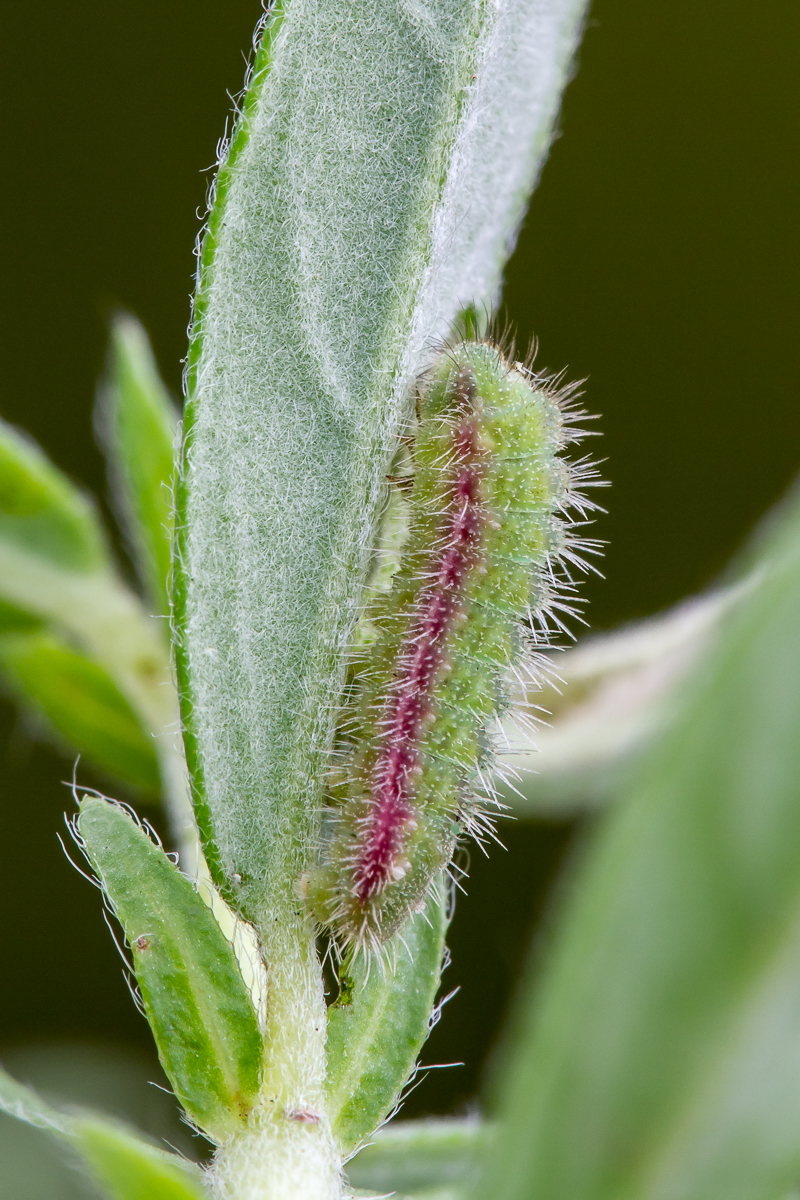
The newly-emerged larva eats the underside of the leaf, but without breaking through the upper surface. The resulting patches are visible from above which can give away the presence of a larva underneath the leaf. More mature larvae feed more openly and are often given away by the presence of the ants that are in attendance. In the last instar, the larva develops Newcomer's glands that exude a secretion that is highly attractive to ants. The association with ants affords the larva some protection against parasites and predators. Larvae of the generation that overwinters generally do so while in their 2nd or 3rd instar. There are 5 instars in total.
The primary larval foodplant is Common Rock-rose (Helianthemum nummularium). Common Stork's-bill (Erodium cicutarium) and Dove's-foot Crane's-bill (Geranium molle) are also used.
"The larva emerges by eating a comparatively large hole generally in the centre of the crown, but occasionally at the side, which is a somewhat unusual habit, as the manner of emerging in each species is usually constant. Directly after emergence the larva measures 1 mm. long, and closely resembles that of L. argiolus. It is pale lemon-yellow. There are longitudinal rows of long glassy-white serrated hairs running the entire length of the body. These consist of a pair on each side of each segment above the spiracle, and are placed obliquely; those of the dorsal pair are the largest, and curve backwards; those of the sub-dorsal pair are shorter, and curve a little upwards and forwards. The sub-spiracular series is composed of three on each segment, which project laterally, and curve slightly downwards and form a projecting fringe all round the larva along the lateral ridge. All the hairs have bulbous bases of an olive-brown colour; midway between the dorsal and sub-dorsal pairs is a pair of lenticles (circular shining brown discs with clear transparent centres exactly resembling the spiracles, but larger and without the aperture). Below the sub-spiracular hairs is another series consisting of two simple hairs on each segment, and on the claspers, duplicated by shorter ones; they all project downwards. The head is black and shining; it is extended while crawling, and partly withdrawn while resting. The young larva lives upon the under surface of the leaves, feeding on the cuticle of the under side only. On June 25th most of the larvae had assumed the second stage, but the one from the wild egg was still in the first stage, and measured only 1.6 mm. The sides are slightly flatter, but in other respects it is similar to when first hatched, with the exception of being more ochreous in colour." - Frohawk (1924)
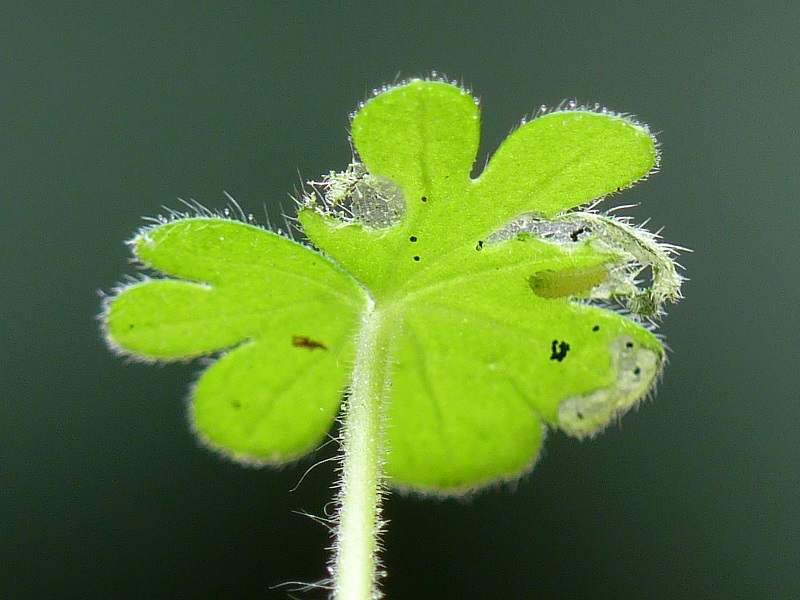
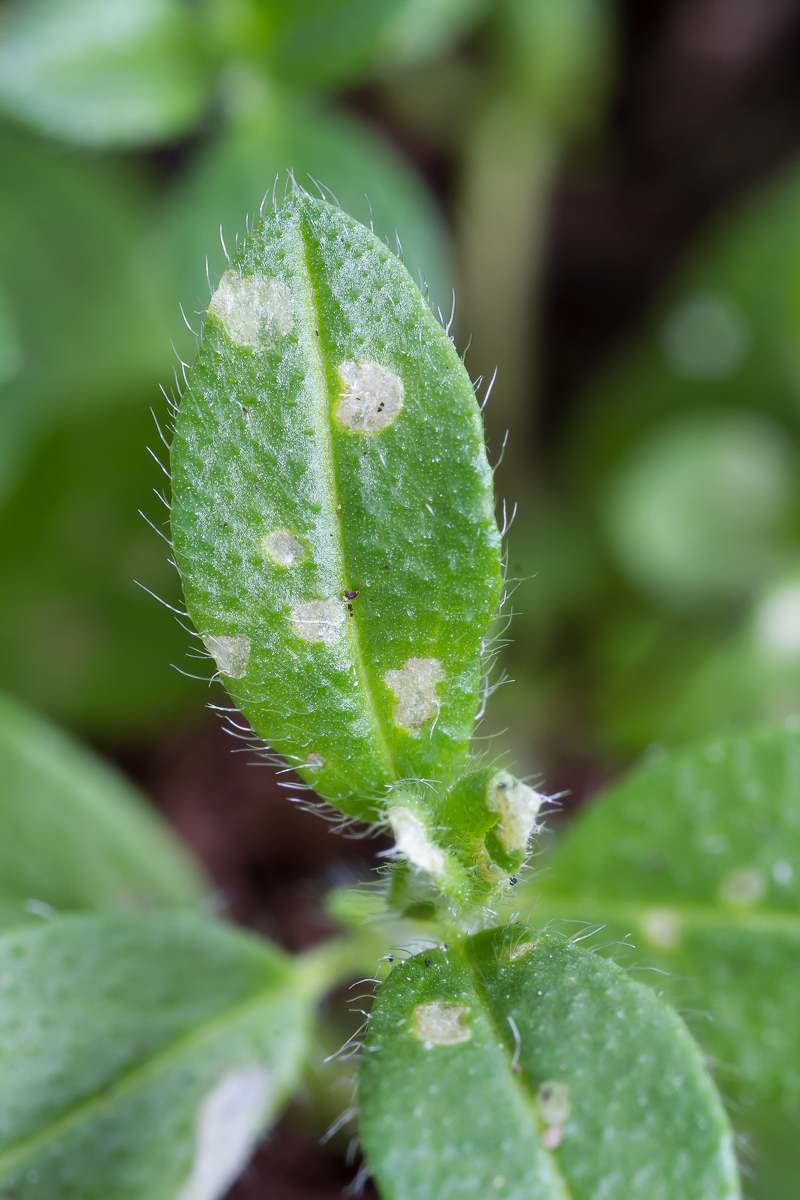
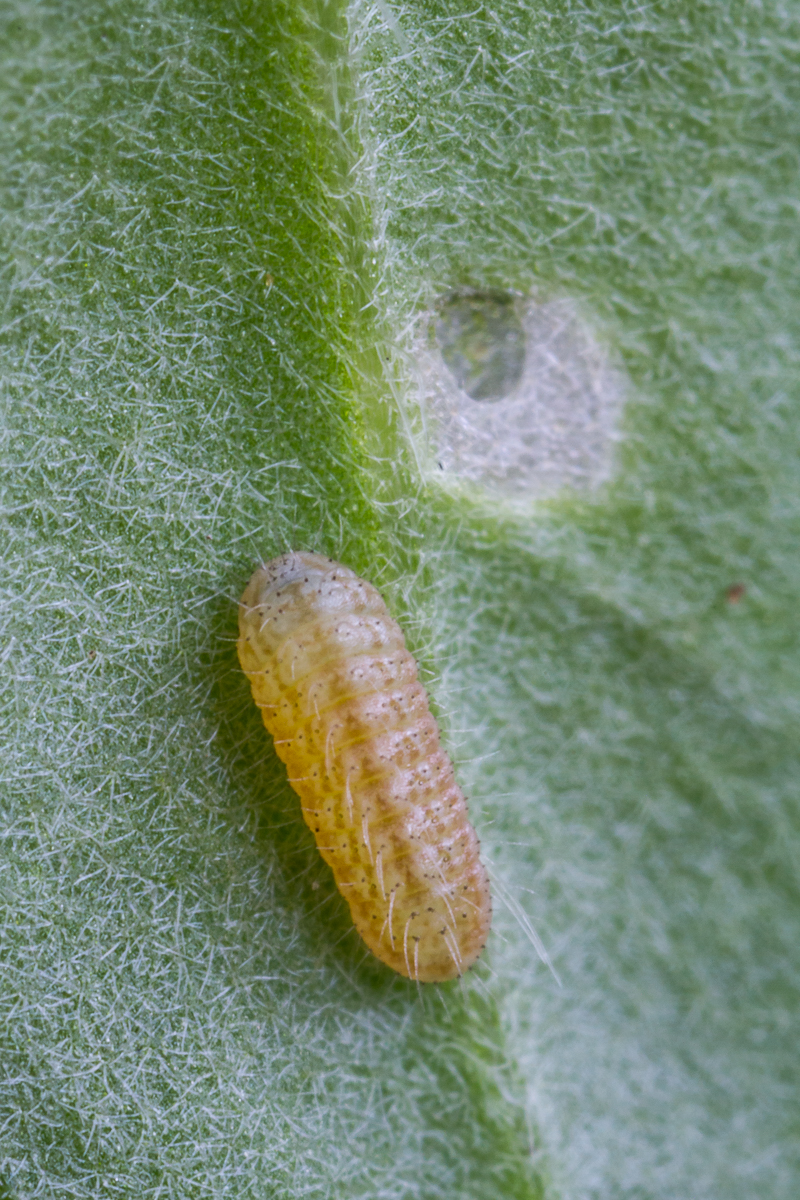
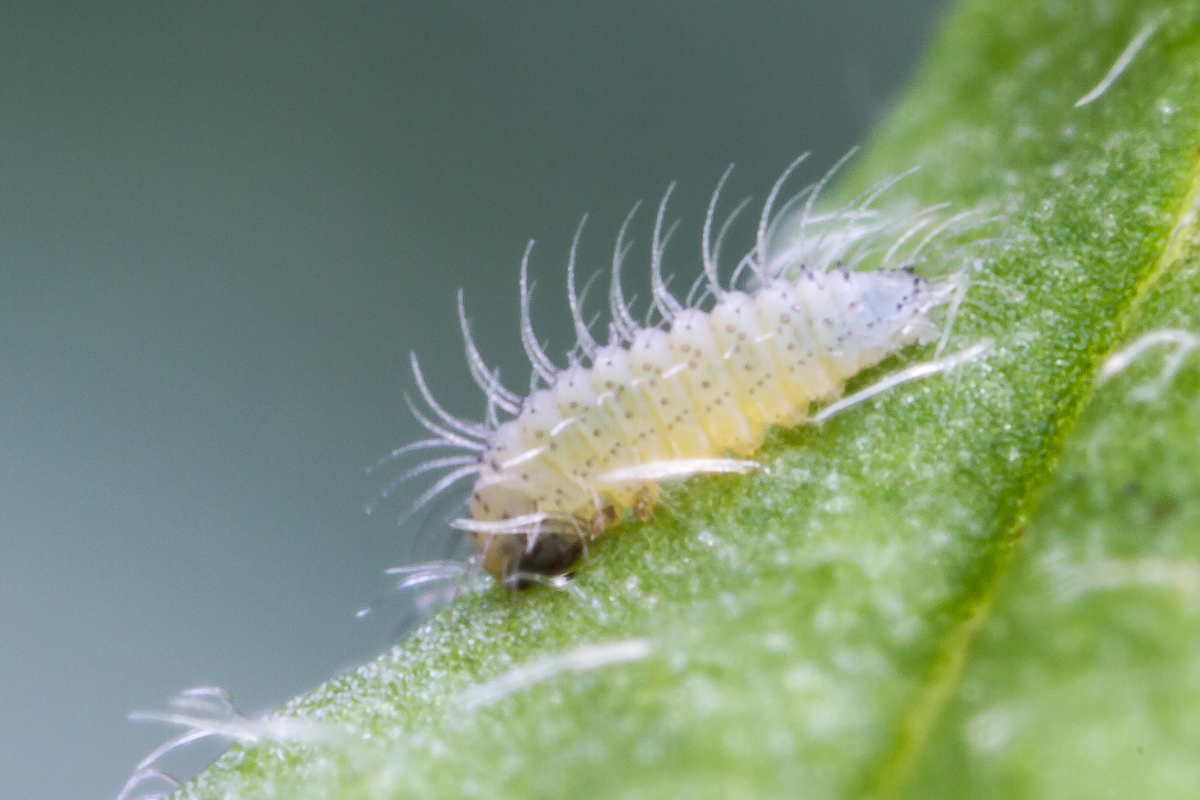
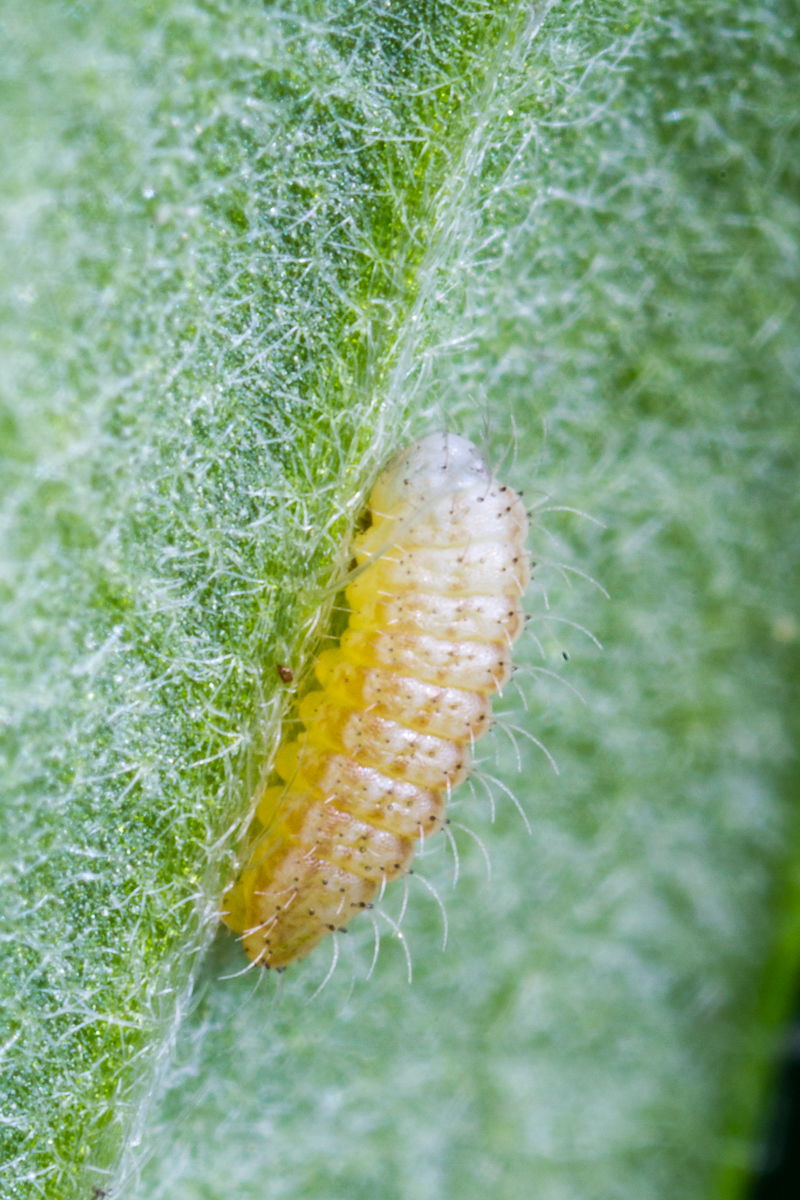
"Soon after first moult it measures 2.50 mm. long while crawling. The sides flattened with a medio-dorsal longitudinal furrow and a projecting lateral ridge, of a true Lycaena form; in other respects it is similar to the previous stage, but has now assumed a whitish-green, almost exactly the same colour as the under surface of the leaves of its food plant; the head is shining black. It lives entirely on the under side of the leaves, and tunnels between the upper and under cuticles, feeding on the interior substance, which produce yellowish patches on the upper surface ... The normal period occupied by the complete metamorphosis in the summer is between fifty-five and sixty days. Eggs laid by butterflies of the second brood hatch in August and September, and the larva when quite small, after the first or second moult (usually after the former), hibernate on the under surface of the leaves and remain in that state throughout the winter." - Frohawk (1924)
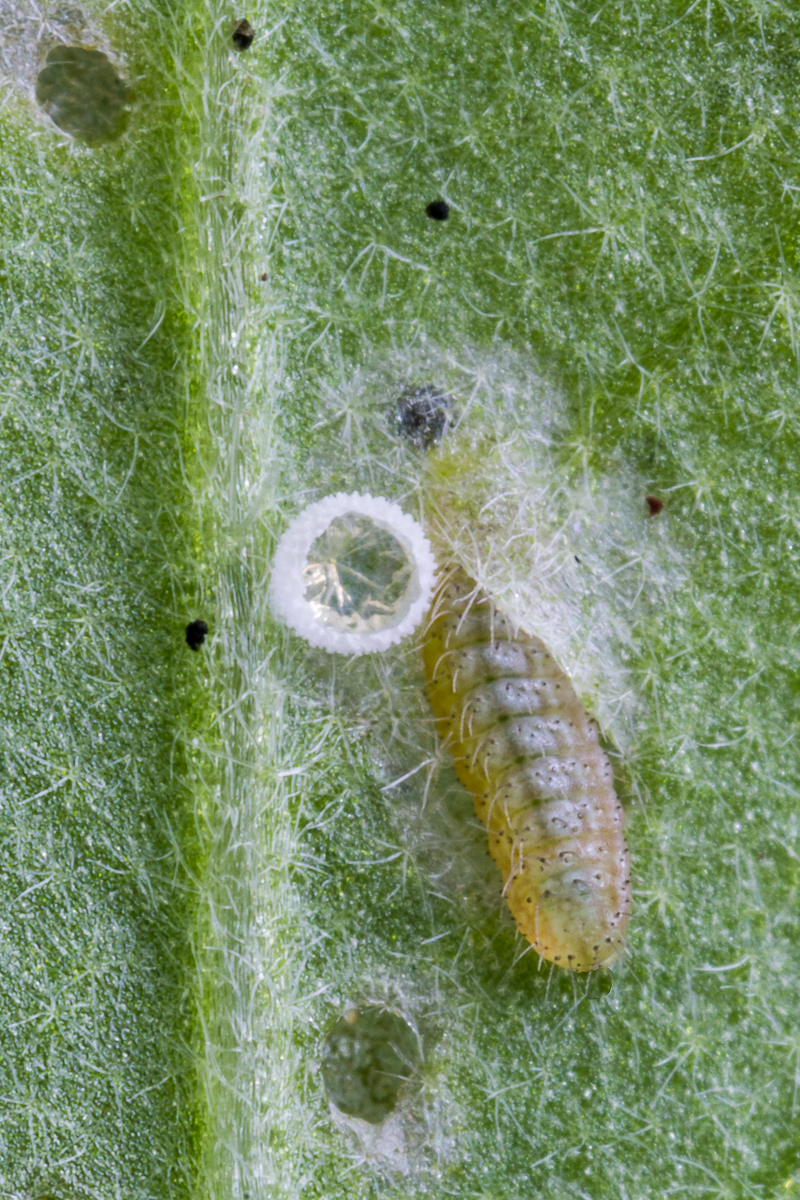
"Shortly after second moult, June 25th, it measures 2.8 mm. long, but attains the length of 4.8 mm. before the third moult. The usual colouring is a clear green, but varying from a whitish-green to a deep yellowish-green, with darker oblique markings on the side, a dull purplish medio-dorsal stripe, and a broad sub-spiracular band varying in depth from purplish-rose to delicate pink, and in some specimens inclining to rust-red; the surface is sprinkled with numerous minute warts, each bearing a whitish hair; the whole of the under surface is green, including the legs and claspers. The head is shining black." - Frohawk (1924)
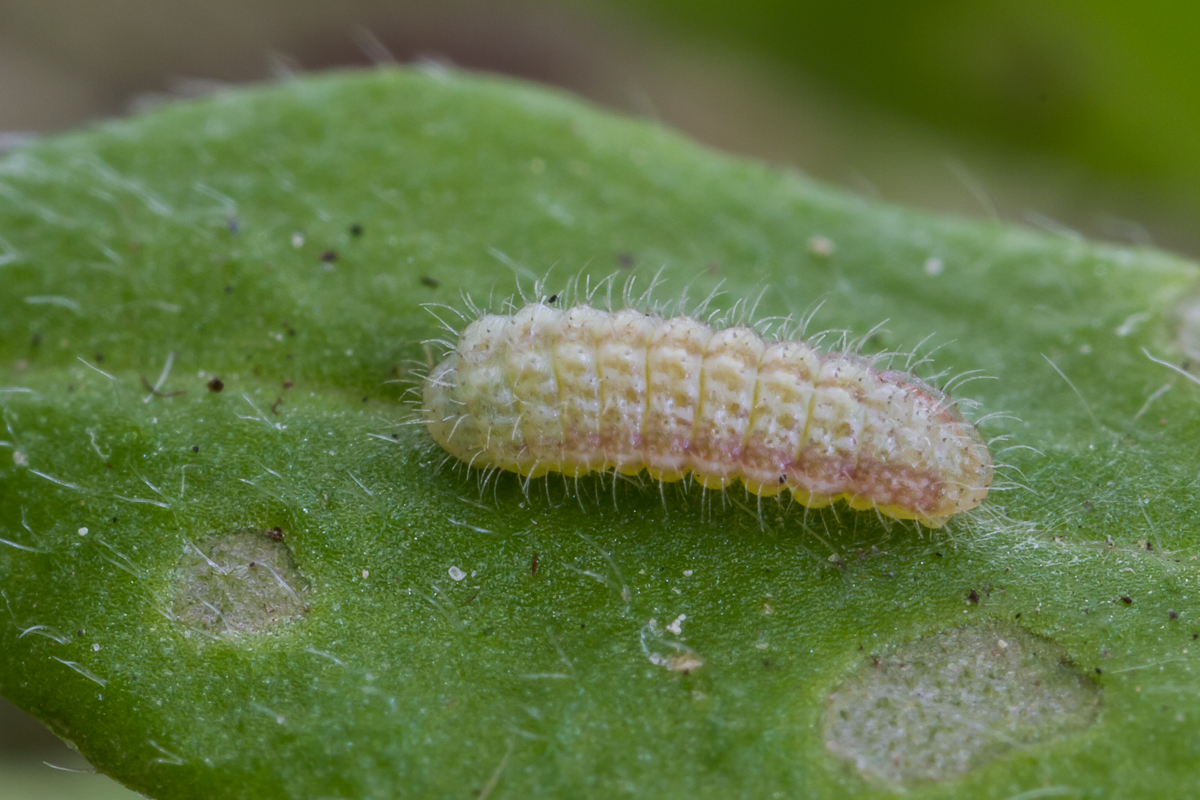
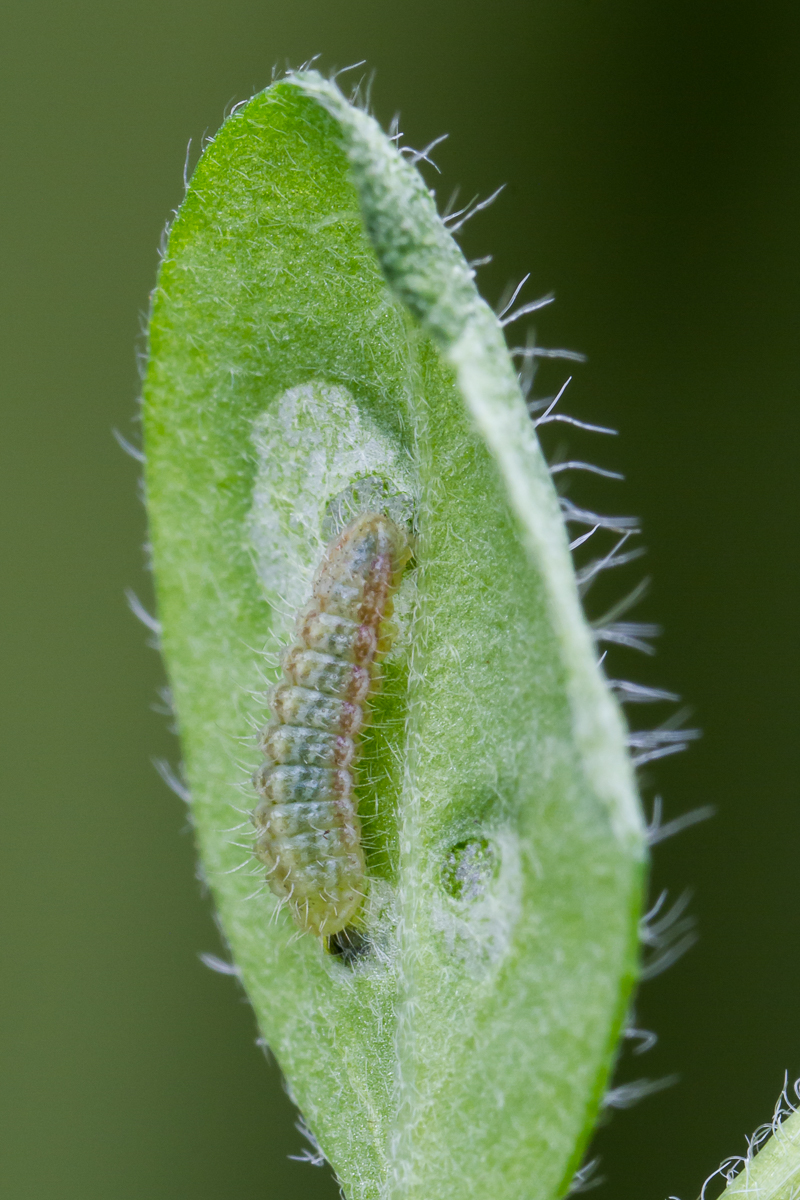
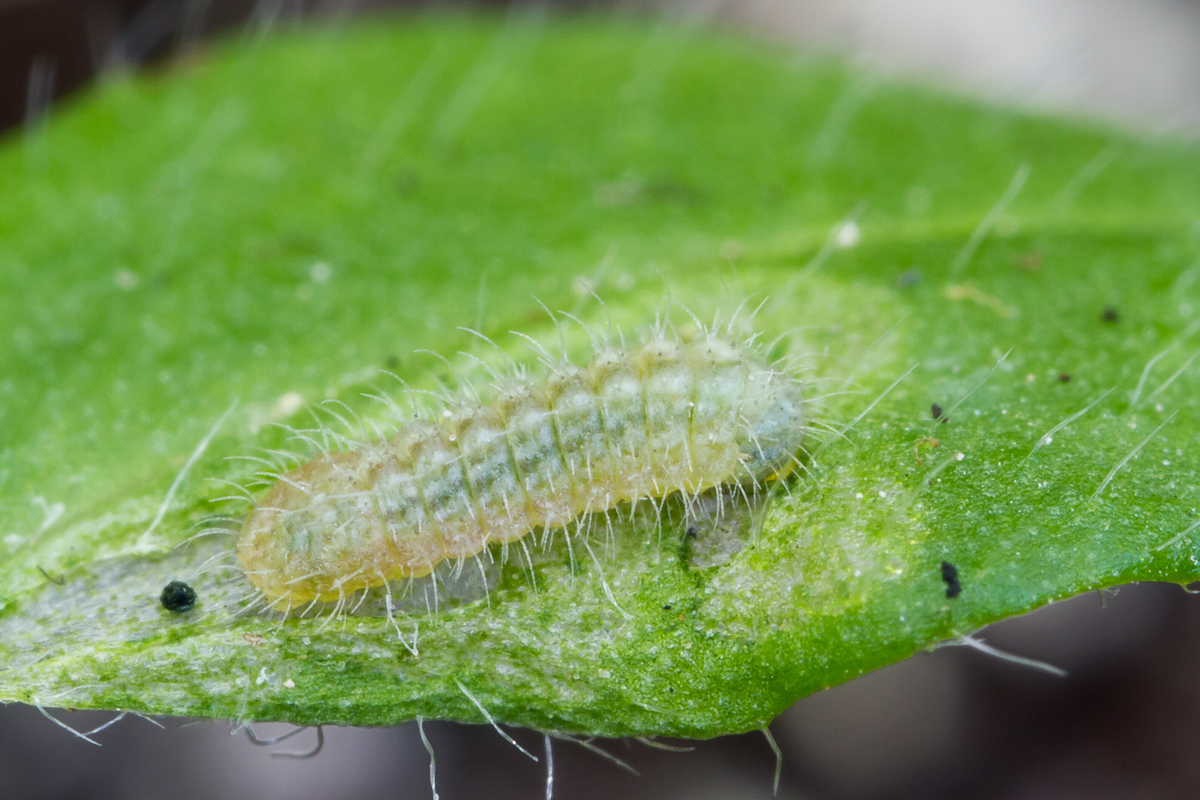
"After third moult, and shortly before fourth moult, it measures 6.35 mm. long while resting. The whole colouring is somewhat more brilliant, and the pattern more defined, than in the previous stage; otherwise it is similar." - Frohawk (1924)
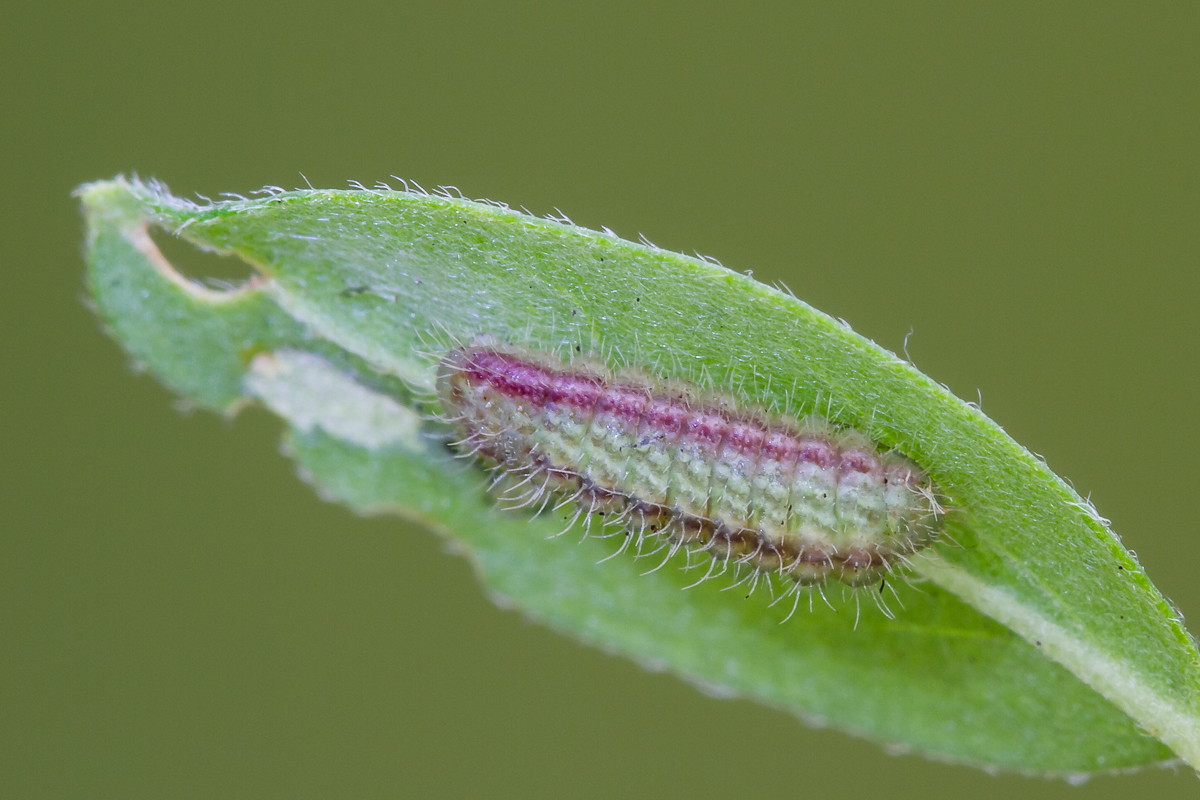
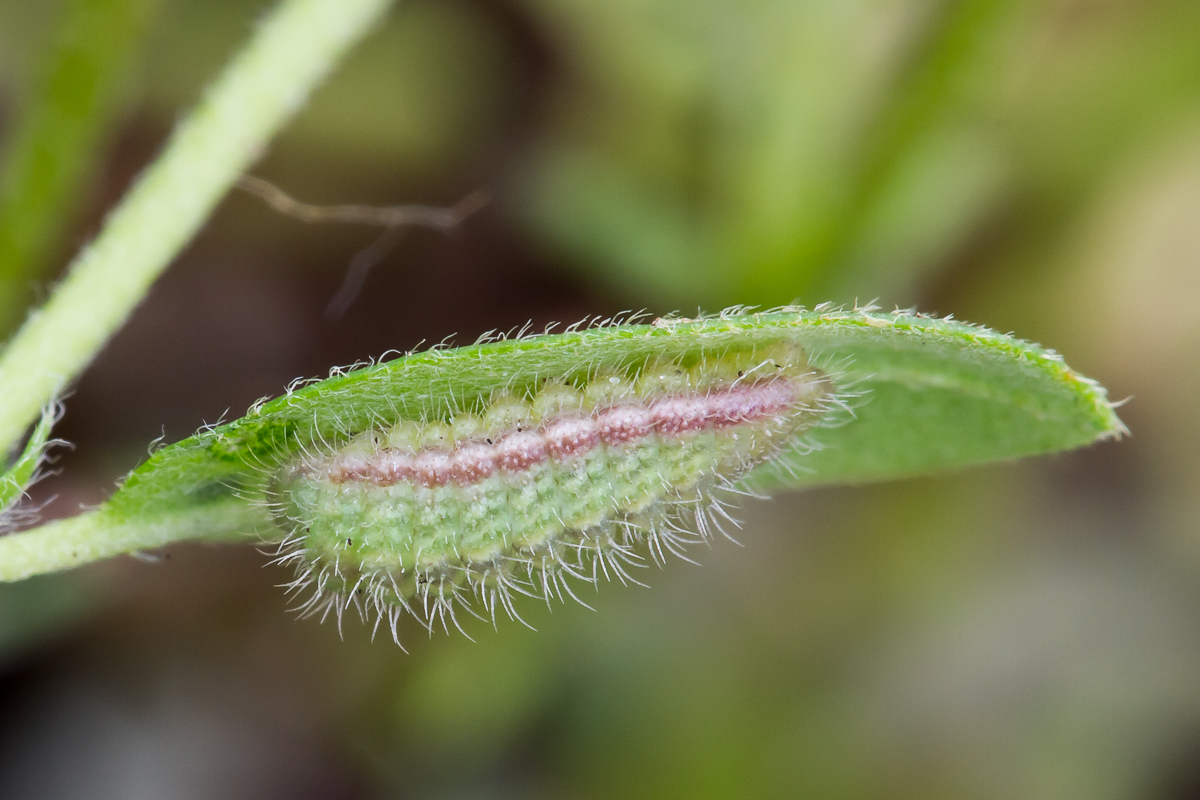
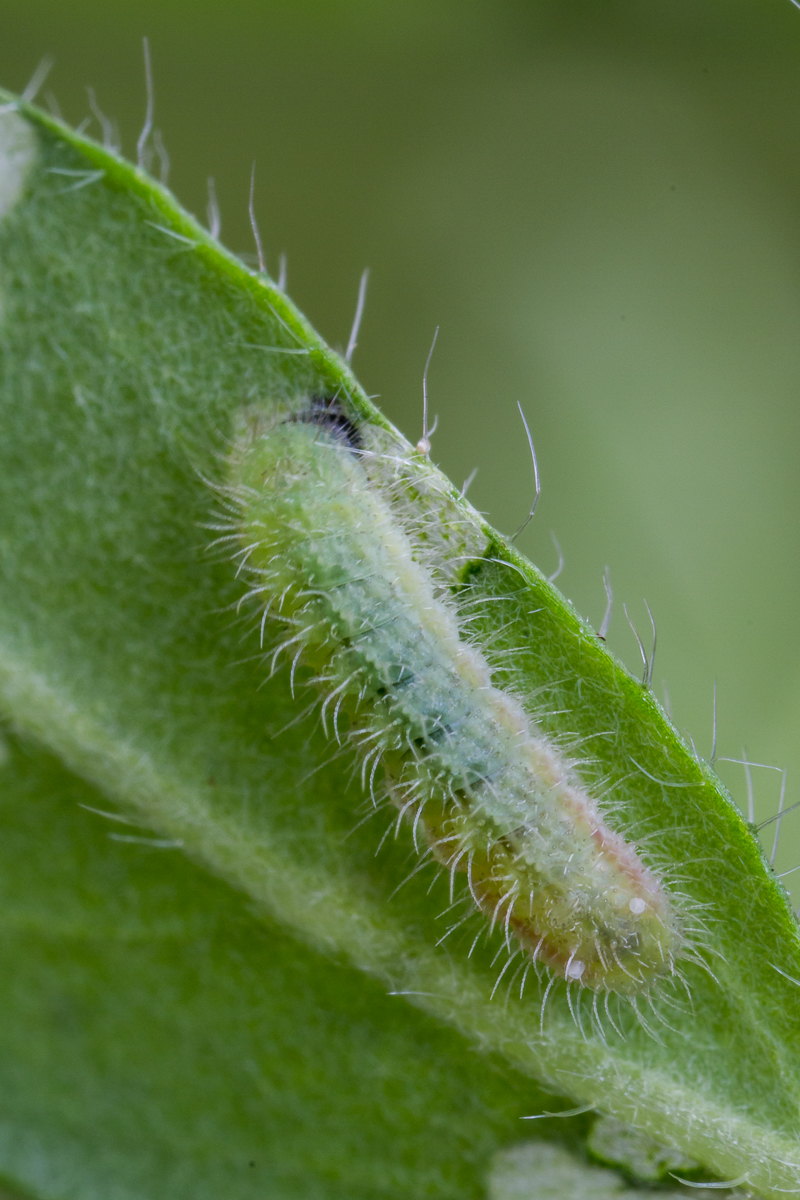
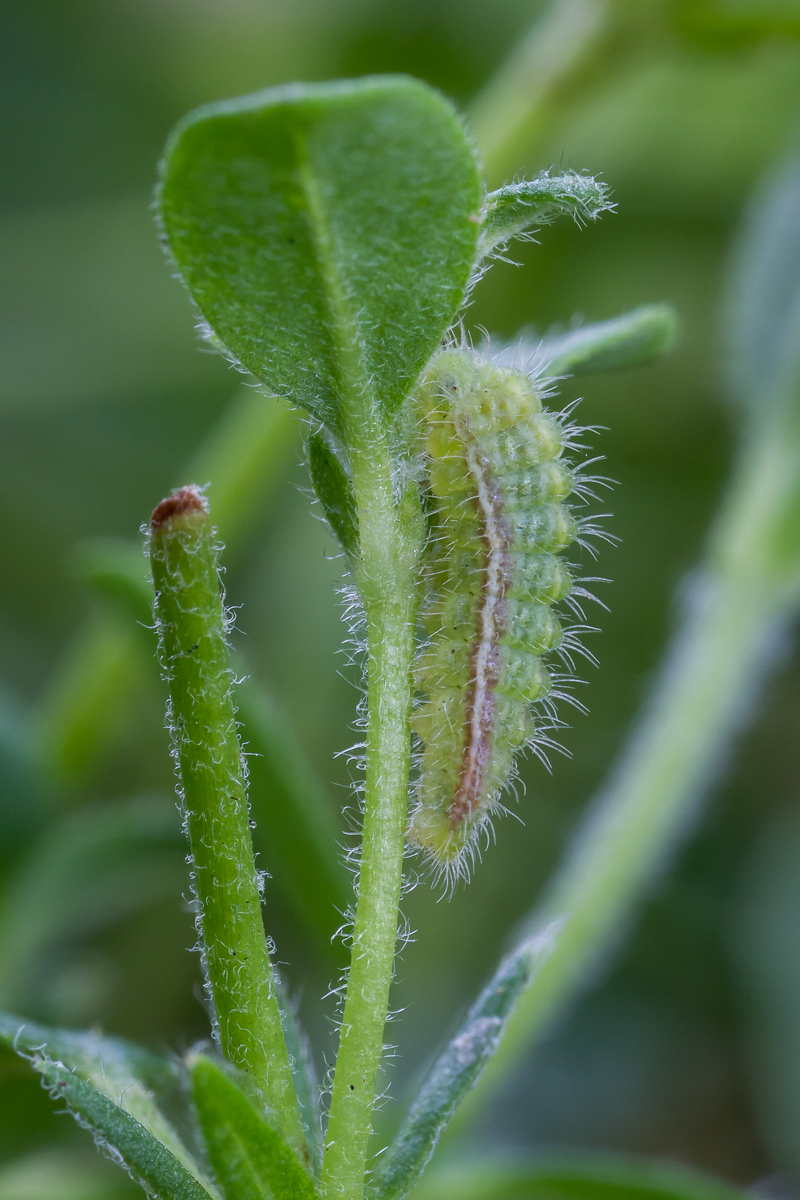
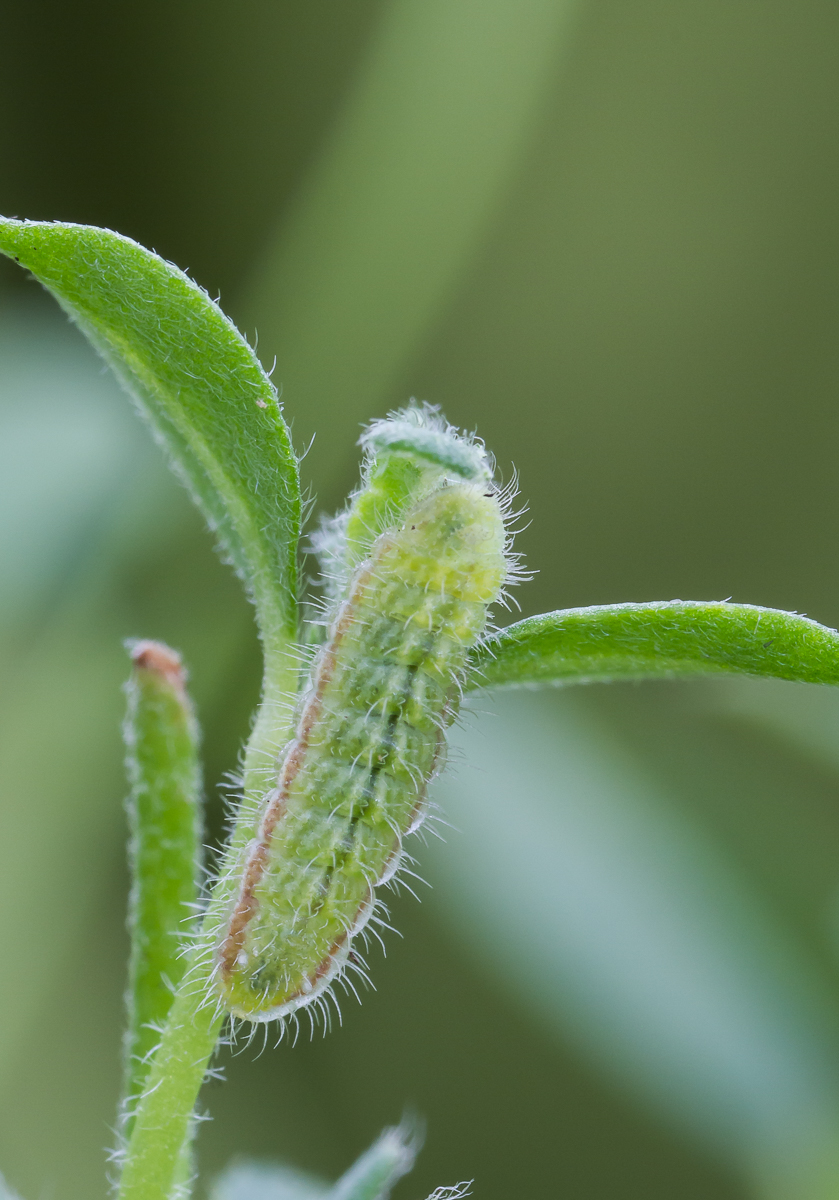
"After fourth and last moult, fully grown, it measures 11 mm. in length. The ground colour is a clear delicate light green. There is a medio-dorsal longitudinal stripe, commencing on the second segment, composed of a series of oval markings, of a dull purplish colour, and united but narrowed at the segmental divisions; it fades away on reaching the anal segment. The stripe traverses a slightly sunken surface forming a slight dorsal furrow, each segment rising above it on either side, and when viewed laterally the dark line shows through the elevations; consequently it has the appearance of being a sub-dorsal stripe; on the sides is a series of wavy oblique stripes of a much darker green than the ground colour. These commence on the third segment, and end on the ninth segment; there are three on each segment; then follows a beautiful sub-spiracular longitudinal band of a fine rose-pink or purplish-pink, succeeded by a narrow line of almost pure white, and then again bordered below by a double purple band; these bands extend all along the lateral ridge, encircling the posterior segment, but the colouring is sub-cutaneous, similar to that of the dorsal line. The whole of the under surface is green, including the legs and claspers. The entire surface is rather densely sprinkled with whitish hairs of varying lengths, and with bulbous bases; those on the dorsal area and lateral ridge are the longest, where they form a projecting fringe. The spiracles are whitish, and surrounding them are numerous lenticles of various sizes, all much smaller than the true spiracles, but exactly similar in appearance; there are also groups of the same situated along the dorsal surface, chiefly on the anterior and posterior segments. The head is shining black. The larva usually lives on the under surface of the leaf, which it admirably fits and resembles a good deal in colour. In feeding it frequently perforates the leaf and sometimes feeds on the edge. On July 19th the larvae were in various stages, from after the second moult to fully grown." - Frohawk (1924)
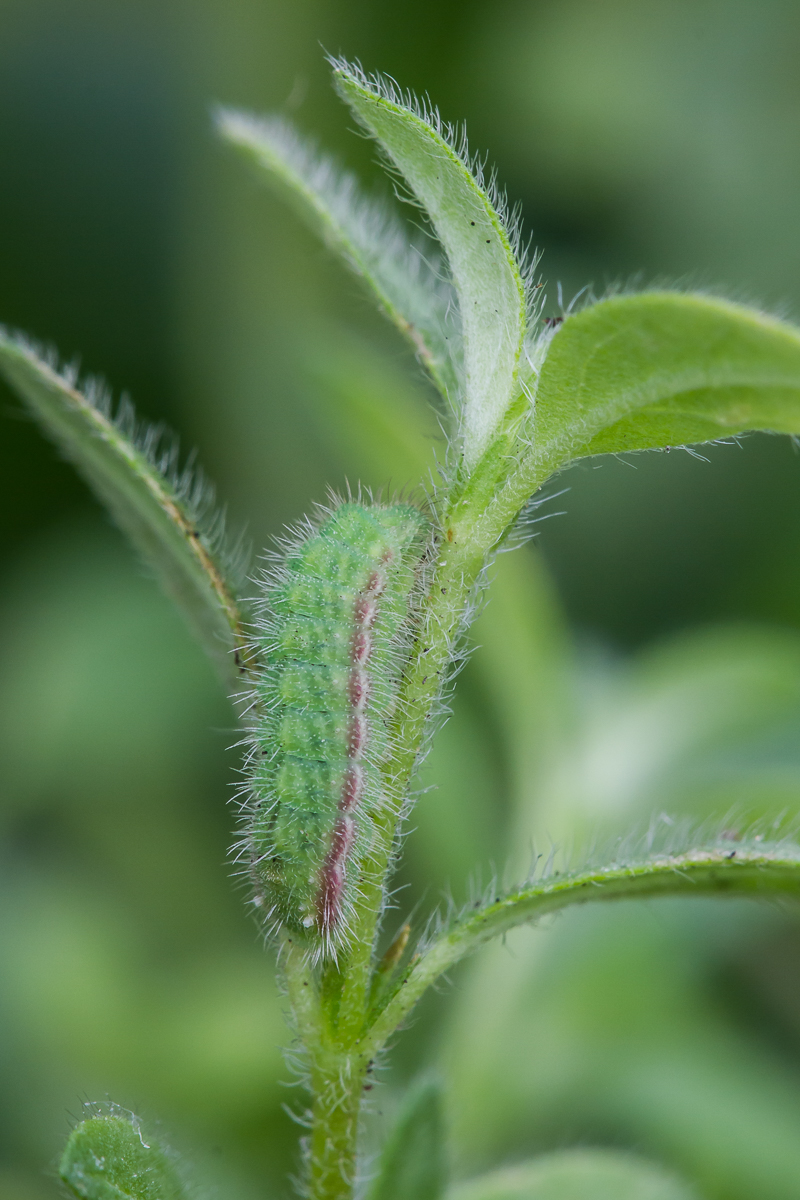

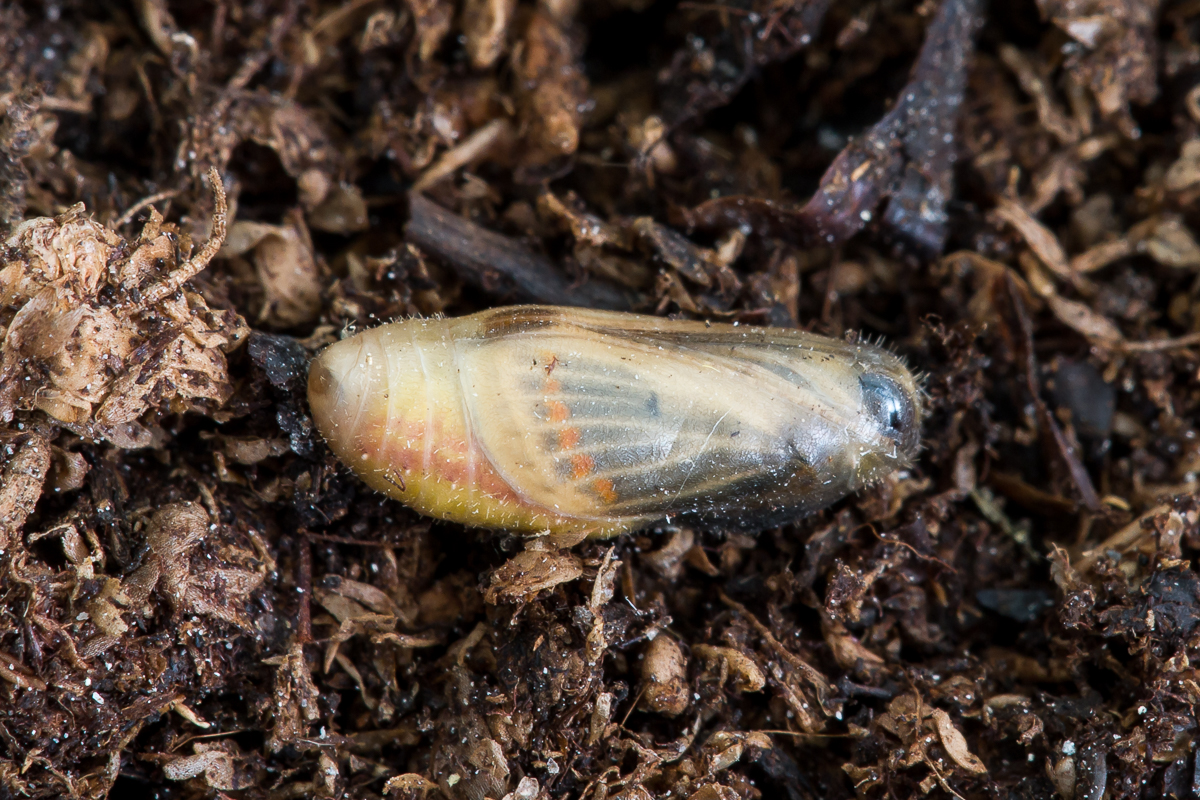
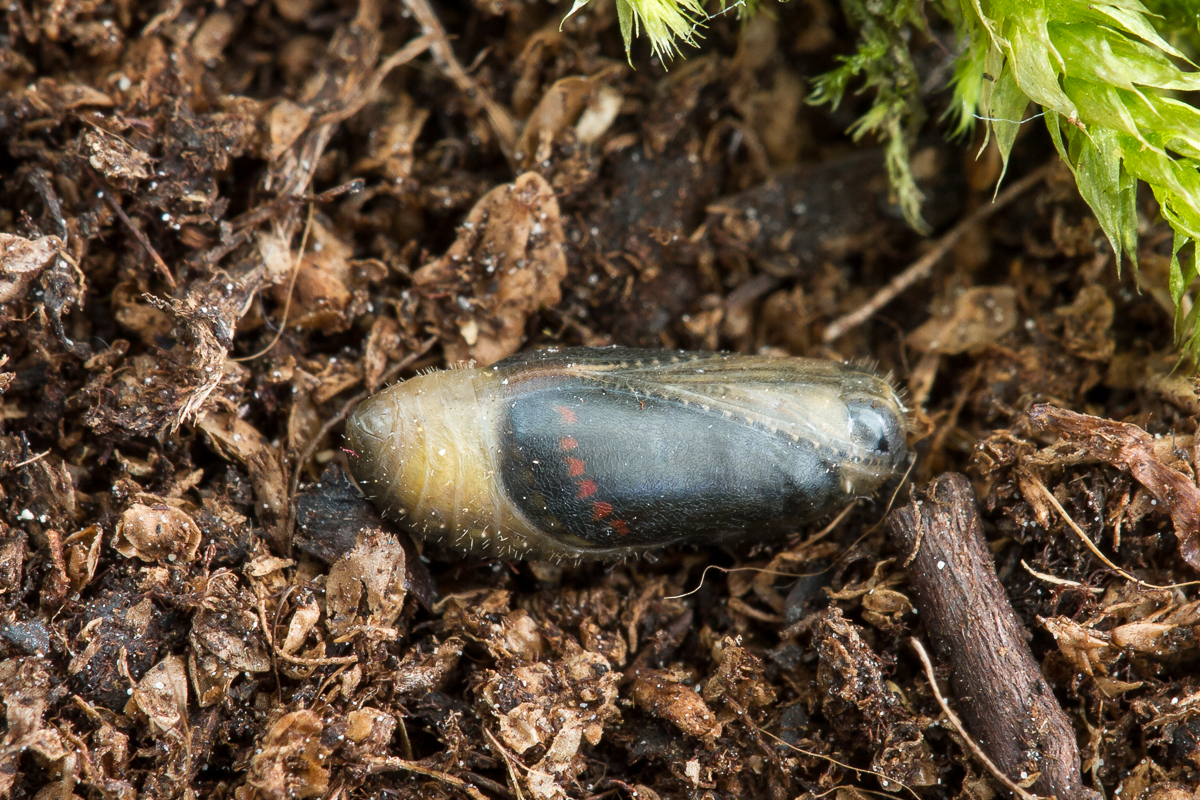
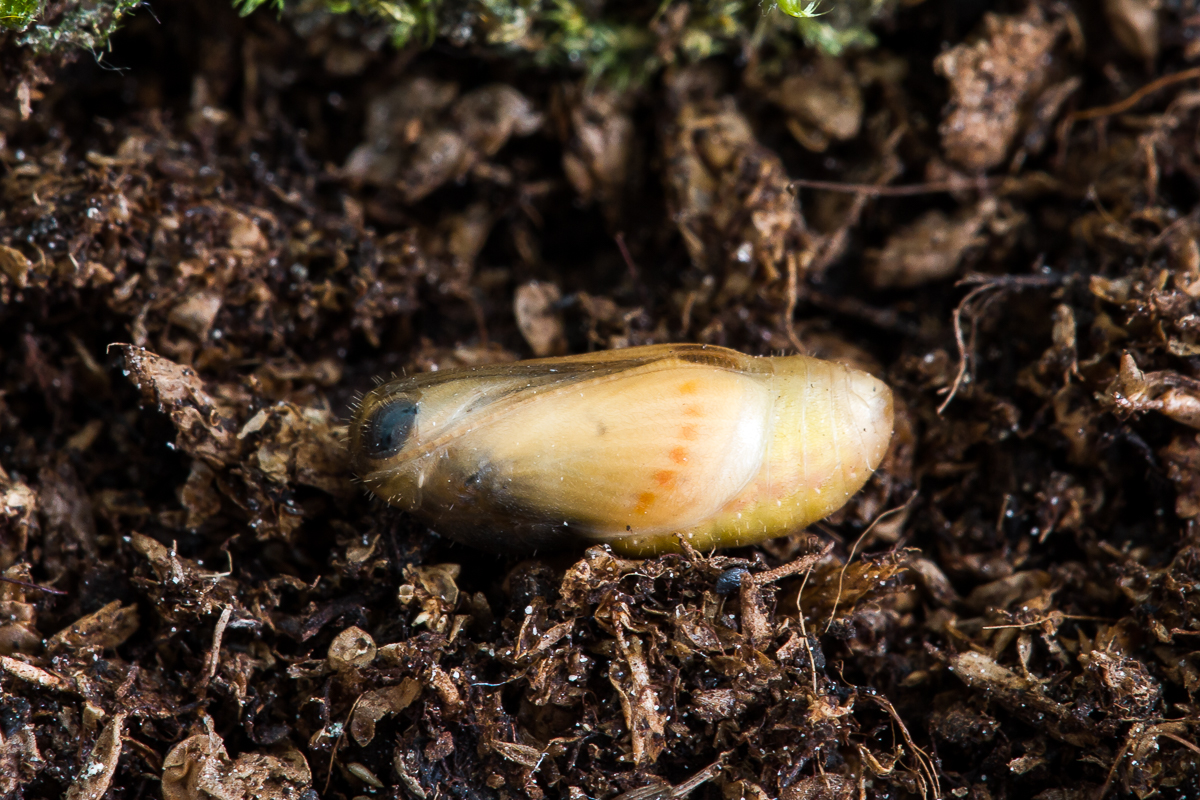
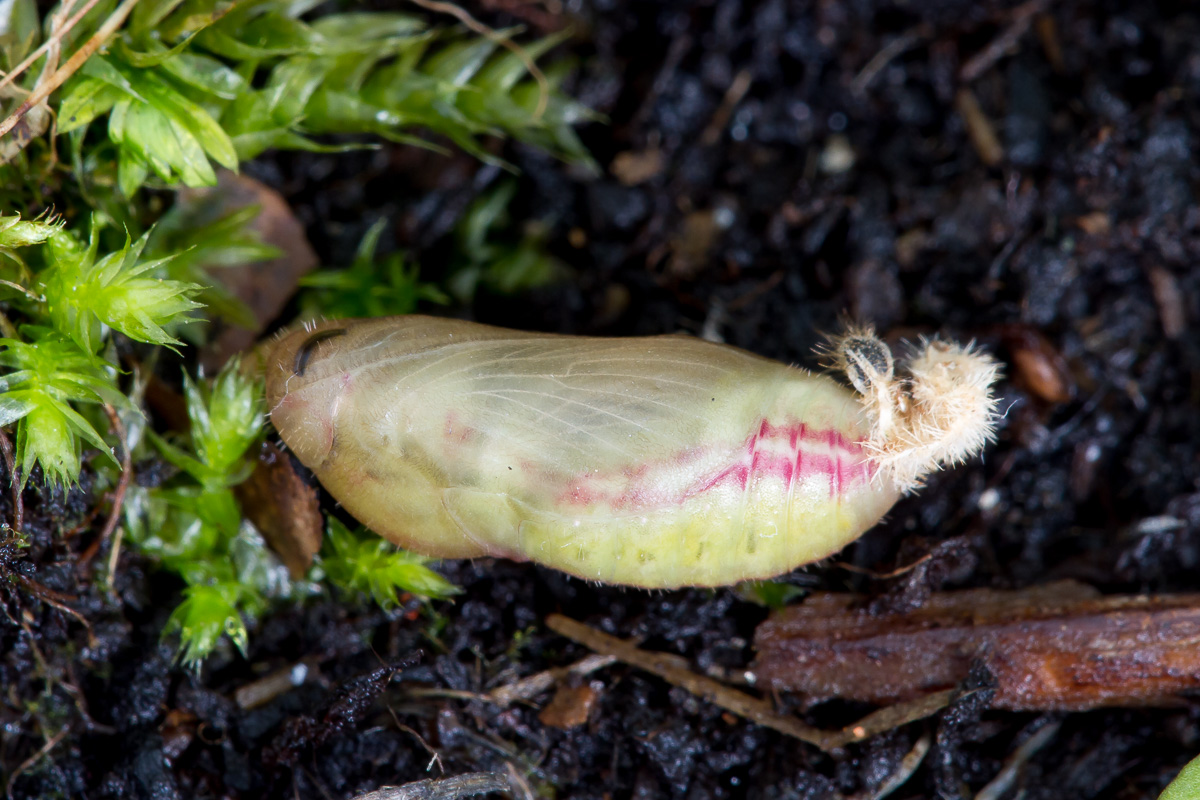
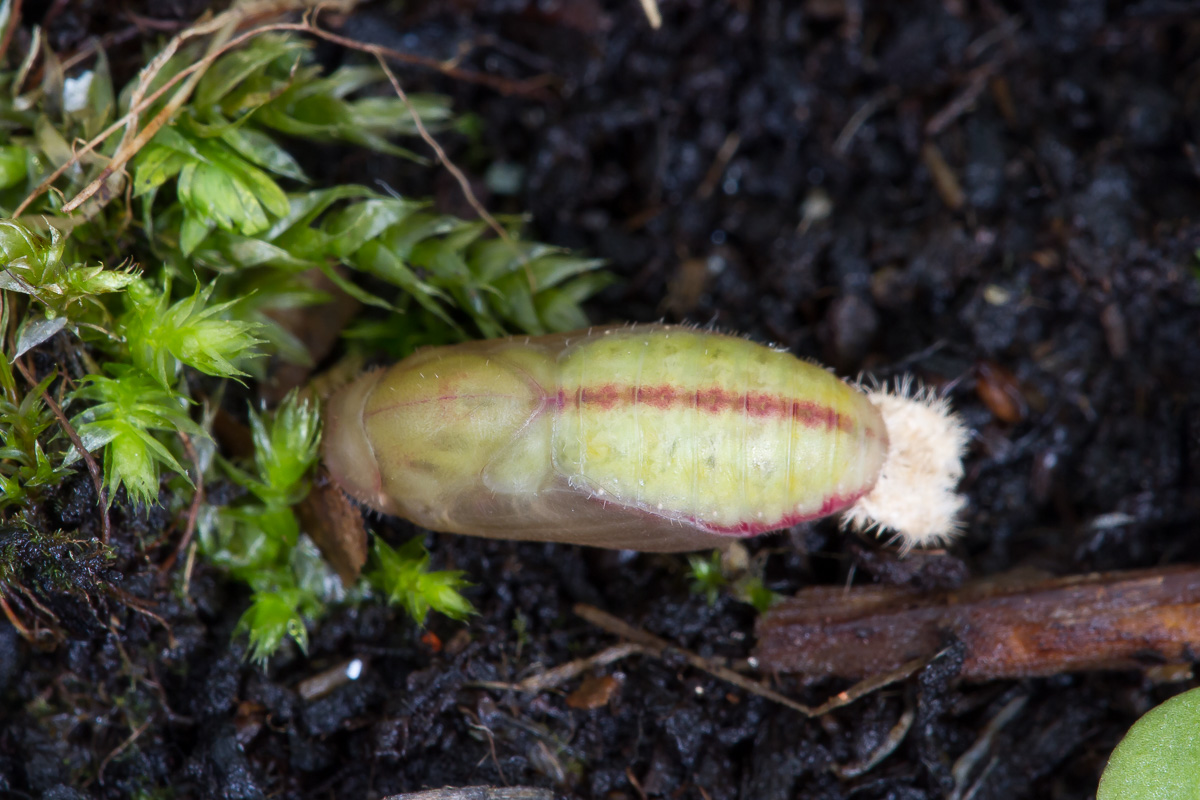
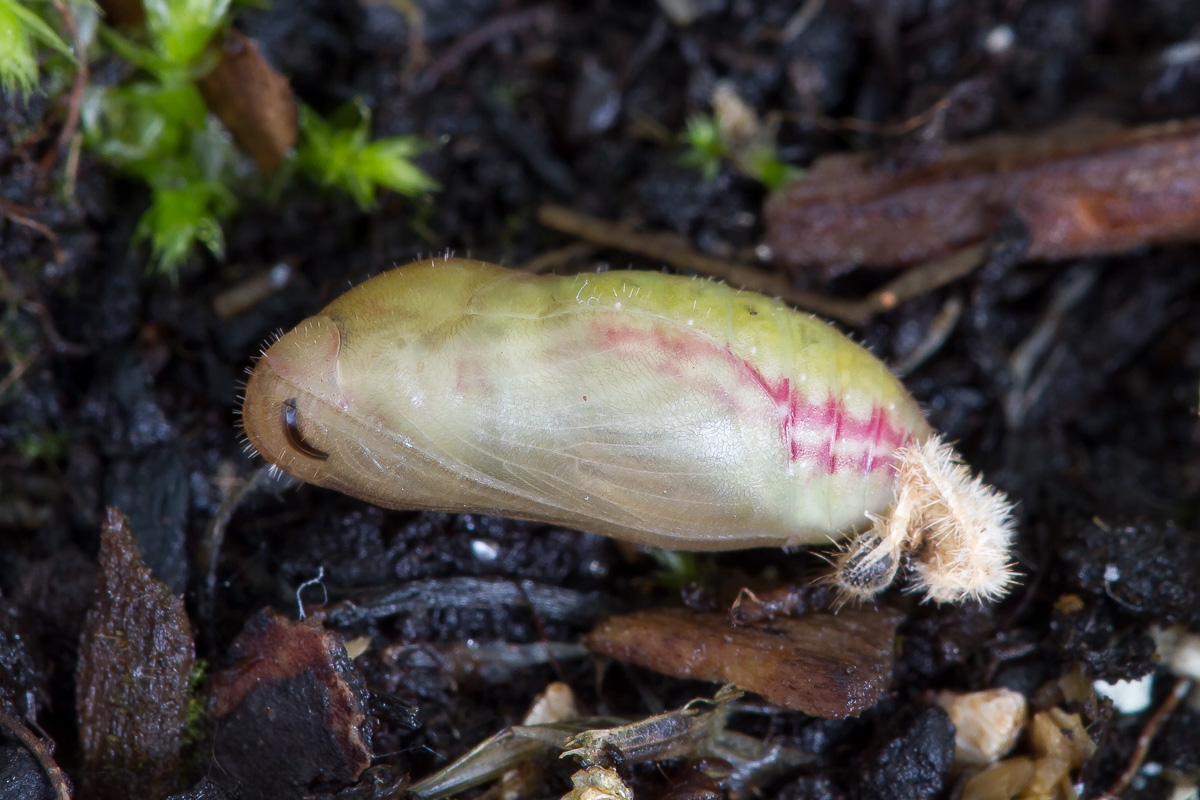
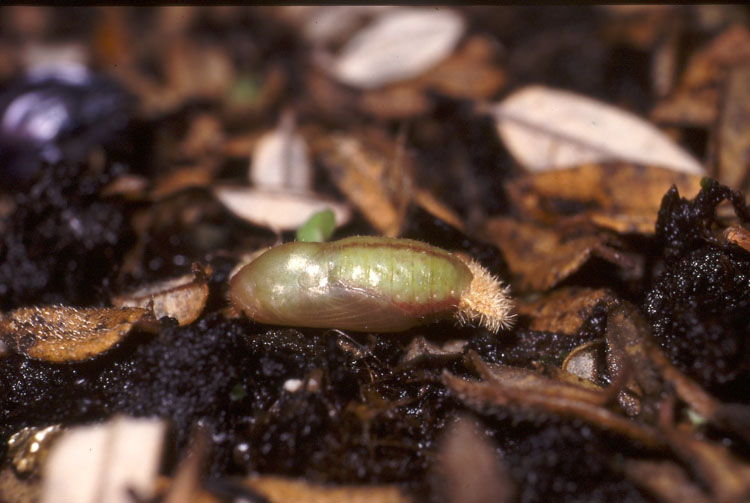
The pupa is formed on the ground at the base of the foodplant. However, pupae are often carried away by ants and buried in a cell in the earth.
"The first larva pupated July 23rd. At first the colouring of the pupa resembles that of the larva, having a dark dorsal stripe and a pink lateral stripe down the abdomen, the ground colour being pale green. The pupa when four and a half days old, and when the colouring is matured, has the head, thorax and wings pale green ochreous-yellow inclining to olive-yellow, the thorax greenest, the abdomen very light green, somewhat opaque; the base of the head is of pinkish hue, and a medio-dorsal brownish-pink line, a pinkish spiracular band, also a sub-spiracular band of a darker hue. The spiracles are pale ochreous. Over the eye is a black crescentic mark. The entire surface is very finely decorated with amber-brown raised reticulations, only visible under a strong lens, and numerous minute spines of an amber colour are sprinkled over the head, thorax and abdomen. There are no cremastral hooks, but in their stead the larval skin is usually closely fixed to the anal segment, which, being furnished with innumerable short bristles, readily supports the pupa as well as the cincture round the body at the base of the thorax, when the pupa is spun up, but in the majority of cases the pupa merely lies at the basal stems of the plant suspended in a few silk cords spun around. Before emerging, the colouring gradually changes to an opaque straw-yellow on the wings, and dull olive on the thorax; the abdomen loses all brilliancy of colour, becoming generally duller; the eye mark becomes absorbed in the darkening of the whole of the eye. Finally the colouring of the imago shows clearly through the delicate pupal skin. The surface is rather shining, and has a semi-transparent appearance. The male pupa is rather smaller than the female; the average length of the latter is 8.5 mm. In shape it is rather stout; the head is rounded, the thorax convex, dorsally sunken at the meta-thorax and first abdominal segment; the abdomen is swollen at the second and third segments, then gradually attenuated and rounded posteriorly. Two specimens emerged, a male and a female, at 4 p.m. August 4th, 1900. Another which pupated on August 12th emerged on August 25th, remaining in the pupal state thirteen days. This pupa was suspended by a cincture round the middle as well as a few other silk cords spun obliquely around it." - Frohawk (1924)

The following links provide additional information on this butterfly.