Wingspan
70 - 92mm |
|
Purple Emperor
|
|
Apatura iris
|
|
|
|
Linnaeus, 1758 |
|
Ref: 1585 |
|
| Superfamily: | Papilionoidea |
| Family: | Nymphalidae |
| Subfamily: | Apaturinae |
| Genus: | Apatura |
| Subgenus: | |
| Species: | iris |
|
|
|
|
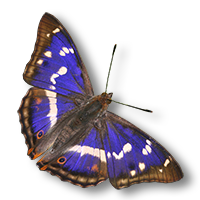
Male |
|
|
|
Male Underside |
|
|
|
Female |
|
|
|
Female Underside |
|
The Purple Emperor is a magnificent and elusive insect that is actively sought out by the many subjects of "His Majesty", as the male butterfly is affectionately known. This butterfly spends most of its time in the woodland canopy where it feeds on aphid honeydew, with the occasional close encounter when it comes down to feed on sap runs or, in the case of the male, animal droppings, carrion or moist ground that provide much-needed salts and minerals. Those that make pilgrimages to see this spectacular creature will often try and lure the males down from the canopy using all manner of temptations - including banana skins and shrimp paste. The male butterfly is one of the most beautiful of all of the butterflies found in the British Isles. From certain angles it appears to have black wings intersected with white bands. However, when the wings are at a certain angle to the sun, the most beautiful purple sheen is displayed, a result of light being refracted from the structures of the wing scales. The female, on the other hand, is a deep brown and does not possess the purple sheen found in the male. This is one of the most-widely studied and written about butterflies in the British Isles. The classic work "Notes and Views of the Purple Emperor" by Heslop, Hyde and Stockley is dedicated to this butterfly, as is the modern-day equivalent - the excellent website The Purple Empire.
This butterfly is confined to deciduous woodland in central southern England. Colonies vary in size, some being very small with just a dozen or so adults forming a viable colony.
There is a single generation each year. The adult butterfly emerges in early July, sometimes at the end of June in good years, with a peak in the second and third weeks of July. 
This is a butterfly of large expanses of deciduous woodland, usually those containing oaks, but less-frequently beech and other species.
The primary larval foodplant is Goat Willow (Salix caprea). Crack-willow (Salix fragilis) and Grey Willow (Salix cinerea) are also used.
Adults feed primarily on Honeydew / Sap. Carrion and Dung are also used.
This species is best seen in early morning and again in late afternoon, when the males will come down to the ground to feed on moisture from damp earth and animal droppings. The males are sometimes so engrossed in feeding that they will spend over an hour feeding in the same place, each displaying its characteristic yellow proboscis. The males are also notorious for feeding on mud and other debris that has gathered on surfaces of cars parked within the woodland. They are also partial to sweat and readily land on observers. However, both male and female spend the majority of their time resting high in the tree canopy and out of sight. In late morning, the males will fly off and ultimately congregate at so-called "master trees" that provide a vantage point for intercepting passing females. These trees are typically at a high point in the wood, such as trees growing on the summit of a hill, and the same trees are used year after year. Locating a master tree is one of the best ways to catch a glimpse of this elusive insect. Seeing the males battle it out for the best vantage points, with flashes of purple as the light hits their wings, is an amazing spectacle. When a virgin female is encountered, the pair fly off and settle in the canopy where mating takes place. If the female has already mated, then she has the curious habit of descending straight to the ground, where the male ultimately loses interest and returns to his perch.
Description to be completed
|
Photo © Matthew Oates 28-Jun-2009 |
|
|
Photo © Matthew Oates 28-Jun-2009 |
|
|
Photo © Matthew Oates 28-Jun-2009 |
|
|
Photo © Matthew Oates 28-Jun-2009 |
|
|
Photo © Matthew Oates 28-Jun-2009 |
|
|
Photo © Matthew Oates 28-Jun-2009 |
|
|
|
|
|
|
|
When egg-laying, the female "strikes" the sallow, as it is known, where she enters the tree and disappears within to lay a single egg on the upperside of a sallow leaf that is in half-shade. Eggs are usually laid on leaves toward the crown of the tree at various heights. Eggs are blue-green when first laid but, after a few days, the base of the egg turns purple giving the egg a distinct 2-tone appearance. Eggs hatch in 9 or 10 days, depending on the weather.
On hatching, the green larva eats its eggshell before moving to the tip of the Sallow leaf, where it rests facing the leaf stalk. It feeds by day on each side of its resting place, leaving characteristic feeding damage. After the first moult, the larva is a curious beast, being adorned with 2 horns that grow out of the head. After the second moult the larva turns light brown and moves to the fork of a twig or next to a Sallow bud, where it overwinters on a silk pad with its body flush against the surface on which it is lying. Larvae emerge from hibernation around the middle of April just as the Sallow buds are starting to expand. The larva initially feeds on the unfurling buds, until the leaves are fully-developed. The larva will then rest on a particular Sallow leaf, which is always left intact, and from which it travels to feed, returning after it has completed its meal. When at rest, the larva also sits with the front of its body slightly raised off its leaf thereby minimising any shadow that might give its presence away. It is also beautifully camouflaged with several subtle yellow stripes along the length of its body that perfectly match those of pale veins of the Sallow leaf on which it sits. When ready to pupate, the larva travels to find a suitable pupation site, and turns a much paler green. The larva will move to the underside of the chosen Sallow leaf and spend 1 or 2 days building a pad of silk from which the pupa will be suspended. At first, the larva rests with its head facing the leaf stalk. As the time for pupation nears, the larva reverses this position, with its head facing the leaf tip. The larva has 4 moults in total.
|
|
|
|
|
|
|
|
|
|
|
|
|
|
1st instar Photo © Tom Sleep |
|
|
|
|
|
|
|
|
|
The pupa is arguably the most difficult stage to find in the wild since, like the larva, it is perfectly disguised, matching the shades of green of the sallow leaf from which it is suspended upside-down, attached to the leaf by the cremaster. The pupa is a curious shape, being rather flattened so that, from the side, it looks plump whereas, from the back, it appears rather slim. This stage lasts around 2 weeks.
No similar species found.
Click here to see the distribution of this species overlaid with specific site information. Alternatively, select one of the sites listed below. |
 | Alice Holt Forest, Bentley Wood, Bookham Common, Fermyn Wood |  | |  | Oakley Wood |  | |  | Pamber Forest, Whitecross Green Wood | | Not rated | Ashtead Common, Bagmoor Common, Bentley Station Meadow, Bernwood Forest, Blackmoor Copse, Botley Wood, Box Hill Woods, Broxbourne Wood NNR, Carpenters Down Wood, Ebernoe Common and Butcherland, Finemere Wood, Grovely Wood, Norbury Park, Oaken Wood, Piddington Wood, Ranmore Woods, Rushbeds Wood, Southwater Woods, Thundery Meadow, Tring Park, Vann lake, Wallis Wood, Warburg Reserve, Whiteley Pastures |
Determining the status of this species has always been problematic given its elusive nature and, although its status is considered relatively-stable, is still considered a species of conservation concern. |
| Species of Conservation Concern |  |  |
From The State of Butterflies in Britain and Ireland and the UK Biodiversity Action Plan (UK BAP) (2007 review).
The following links provide additional information on this butterfly.
The species description provided here has been derived from the author's own observations and the information contained in the following works:
- A Natural History of British Butterflies, by F.W.Frohawk.
- British and Irish Butterflies, by Adrian M. Riley
- South's British Butterflies, by T.G.Howarth (which is based extensively on the classic work, "The Butterflies of the British Isles", by Richard South).
- The Butterflies of Britain and Ireland, by Jeremy Thomas and Richard Lewington.
- The Millennium Atlas of Butterflies in Britain and Ireland, by Jim Asher, Martin Warren, Richard Fox, Paul Harding, Gail Jeffcoate, Stephen Jeffcoate.
- The Moths and Butterflies of Great Britain and Ireland Volume 7 (1) Hesperiidae to Nymphalidae (the Butterflies), by A. Maitland Emmet and John Heath (editors).
- The State of Butterflies in Britain and Ireland, Richard Fox, Jim Asher, Tom Brereton, David Roy and Martin Warren.
Site brought to you by Webified
Copyright © Peter Eeles 2002-2010 All rights are reserved Administrator Login
|