Wingspan
Male: 68 - 72mm Female: 72 - 75mm |
|
Large Tortoiseshell
|
|
Nymphalis polychloros
|
|
|
|
Linnaeus, 1758 |
|
Ref: 1594 |
|
| Superfamily: | Papilionoidea |
| Family: | Nymphalidae |
| Subfamily: | Nymphalinae |
| Genus: | Aglais |
| Subgenus: | Nymphalis |
| Species: | polychloros |
|
|
|
|
Male |
|
|
|
Male Underside |
|
|
|
Female |
|
|
|
Female Underside |
|
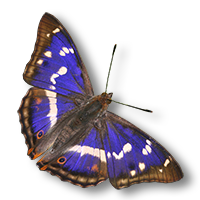
In Victorian times the Large Tortoiseshell was considered widespread and common in woodland in southern England. However, this beautiful insect has since suffered a severe decline and there have been less than 150 records since 1951. This butterfly, whose numbers were always known to fluctuate, is generally considered to be extinct in the British Isles, with any sightings considered to be migrants from the continent or accidental or deliberate releases of captive-bred stock. Several causes of its decline have been suggested - including climate change, parasitism, and the effect of Dutch Elm disease on one of its primary foodplants. The hope, of course, is that this butterfly is able to once again colonise our islands.
This species is extinct in the British Isles. Although previously found in many parts of England, Wales and Scotland, the greatest concentrations were in the midlands, south and east of England. This species has not been recorded from Ireland.
Adults emerge in July and August and overwinter in this stage, re-emerging in the spring. There is one brood each year. 
This butterfly is found primarily in woodland, especially those containing sallows whose flowers provide a primary nectar source for the adults in the spring.
The primary larval foodplant is Elms (various) (Ulmus spp.). Aspen (Populus tremula), Birches (various) (Populus spp.), Poplars (various) (Populus spp.) and Willows (various) (Salix spp.) are also used.
Adults feed primarily on Honeydew / Sap.
This butterfly hibernates shortly after emerging from the pupa, finding a hibernation site in log piles or outbuildings. On emerging from hibernation in the spring, the butterfly feeds from Sallow flowers and sap runs and the adults mate soon after emerging. This powerful-flyer is often difficult to see when not feeding, as it can be difficult to approach, taking off at high speed at the least disturbance.
Description to be completed
Eggs are laid in a cluster around a terminal twig of the foodplant, usually 3 metres or more above the ground and on the sunny side of the tree. They are yellow when first laid, but turn brown just before hatching. Eggs hatch in about 3 weeks.
The larvae are gregarious in all of their instars, living in a communal web, although they disperse prior to pupation. When disturbed the entire group will jerk in unison, which is clearly designed to deter predators. Early collectors often obtained this species by collecting the conspicuous larval webs and rearing the offspring through. This stage lasts around a month.
The pupa is suspended head-down, attached by the cremaster to a twig or other platform. This stage lasts around 2 weeks.
Description to be completed
No sites found.
This species is believed to be extinct as a resident, although sightings are reported in most years which are assumed to be immigrants. As such, no conservation action is relevant.
The following links provide additional information on this butterfly.
The species description provided here has been derived from the author's own observations and the information contained in the following works:
- A Natural History of British Butterflies, by F.W.Frohawk.
- British and Irish Butterflies, by Adrian M. Riley
- South's British Butterflies, by T.G.Howarth (which is based extensively on the classic work, "The Butterflies of the British Isles", by Richard South).
- The Butterflies of Britain and Ireland, by Jeremy Thomas and Richard Lewington.
- The Millennium Atlas of Butterflies in Britain and Ireland, by Jim Asher, Martin Warren, Richard Fox, Paul Harding, Gail Jeffcoate, Stephen Jeffcoate.
- The Moths and Butterflies of Great Britain and Ireland Volume 7 (1) Hesperiidae to Nymphalidae (the Butterflies), by A. Maitland Emmet and John Heath (editors).
- The State of Butterflies in Britain and Ireland, Richard Fox, Jim Asher, Tom Brereton, David Roy and Martin Warren.
Site brought to you by Webified
Copyright © Peter Eeles 2002-2010 All rights are reserved Administrator Login
|