Butterfly Conservation is a registered charity with a national membership of over 14,000. The Society is dedicated to the conservation of butterflies, moths and their habitats.
Butterfly taxonomy (classification) The skippers The swallowtails The whites The hairstreaks, coppers and blues. Includes the Duke of Burgundy. The nymphalids, fritillaries and browns. Includes the Monarch.
Camberwell Beauty - imago - Thatcham - 20-Sep-07 (1208) {REARED}Wingspan
Male: 76 - 86mm
Female: 78 - 88mm
Camberwell Beauty

Nymphalis antiopa
Pronunciation nim-FAY-liss
an-tee-OH-puh
Linnaeus, 1758
Ref: 1596
Superfamily: Papilionoidea
Family: Nymphalidae
Subfamily: Nymphalinae
Genus: Aglais
Subgenus: Nymphalis
Species: antiopa
< Previous Species (Click here to load all available images for this species) Next Species >


Camberwell Beauty - imago - Thatcham - 20-Sep-07 (1208) {REARED} Camberwell Beauty - imago - Thatcham - 16-Sep-07 (1199) {REARED}

Male Male Underside Female Female Underside

Introduction  

The Camberwell Beauty is a rare migrant to the British Isles, originating in Scandinavia and mainland Europe. In some years there is a relatively-large influx of individuals, as occurred in 1846, 1872, 1947, 1976, 1995 and 2006, where individuals were reported throughout the British Isles. Like many migrants, this butterfly does not maintain a sustainable breeding population here since mating only occurs after hibernation and those adults that do manage to overwinter successfully are so few in number that the chances of finding a mate is small. None of the immature stages has ever been found in the wild in the British Isles.

The Aurelian by Moses Harris, published in 1766, gives this butterfly the name "The Grand Surprize" or "Camberwell Beauty", based on 2 individuals that were caught in Cold Arbour Lane near Camberwell in 1748. In America, this butterfly is known as the Mourning Cloak.

Distribution  

This species is a rare migrant to the British Isles. Although there have been sightings from many parts of the British Isles, most records are from eastern counties.

Annual Cycle  

Although the adults have been seen in every month of the year, immigrants start to arrive in June and July, with a definite peak of sightings in August and September. Some of these adults go into hibernation and are sometimes disturbed from their hibernation site, such as a log pile or outbuilding. A small proportion of hibernating adults survive until the following year. This happened quite recently when several individuals from the 2006 influx were seen in early 2007. There is one brood each year.


Habitat  

This butterfly is a great wanderer and is often seen in gardens feeding on rotting fruit, such as plums. The same individual will often remain in the same location for several days. In the spring the adults will feed from sallow flowers and sap runs.

Larval Foodplants  

The main larval foodplants are Elms (various) (Ulmus spp.), Poplars (various) (Populus spp.) and Willows (various) (Salix spp.).

Nectar Sources  

Description to be completed

Imago  

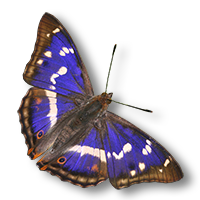
This is a distinctive butterfly, even in flight, as the white wing borders are unmistakable. The adult is a solitary insect and, as such, migrates singly rather that in the swarms associated with other migrant species.

09 N. antiopa  Valais du Rhone Suisse 0806 004 09 N. antiopa  Valais du Rhone Suisse 0806 006 Camberwell Beauty - imago - Thatcham - 16-Sep-07 (1199) {REARED} Camberwell Beauty - imago - Thatcham - 20-Sep-07 (1205) {REARED} Camberwell Beauty - imago - Thatcham - 20-Sep-07 (1208) {REARED}
Photo © Paul
Photo © Paul
Photo © Pete Eeles
16-Sep-2007
Photo © Pete Eeles
20-Sep-2007
Photo © Pete Eeles
20-Sep-2007
Camberwell Beauty - imago - Thatcham - 25-Jul-08 (1) {REARED} Camberwell Beauty - imago - Minsmere RSPB Reserve, Suffolk - 17-Aug-06 (2) [James Wright] Camberwell Beauty - imago - Newbury - 29-Aug-06 [Paul Olive] Camberwell Beauty - imago - Unknown location - 2008 [REARED] [Nigel Venters]
Photo © Pete Eeles
25-Jul-2008
Photo © James Wright
Photo © Paul Olive
Photo © Nigel Venters
Aberrations  

Description to be completed

Ovum  

Eggs are laid in clusters around a twig of the foodplant. The size of the clusters varies considerably and may contain any number of eggs, usually between 30 and 250.

Camberwell Beauty - ovum - Unknown location - 2008 (2) [REARED] [Nigel Venters] Camberwell Beauty - ovum - Unknown location - 2008 (3) [REARED] [Nigel Venters] Camberwell Beauty - ovum - Unknown location - 2008 (4) [REARED] [Nigel Venters] Camberwell Beauty - ovum - Unknown location - 2008 [REARED] [Nigel Venters] Camberwell Beauty - ovum - Unknown location - Unknown date (2) [REARED] [Nigel Venters]
Photo © Nigel Venters
Larva  

Larvae feed gregariously but disperse just prior to pupation, where they may travel quite some distance.

Camberwell Beauty - larva - Thatcham - 02-Jul-08 (1) {REARED} Camberwell Beauty - larva - Thatcham - 25-Aug-07 (2) {REARED} Camberwell Beauty - larva - Thatcham - 25-Aug-07 (3) {REARED} Camberwell Beauty - larva - Unknown location - 2008 [REARED] [Nigel Venters] Camberwell Beauty - larva - Unknown location - Unknown date [REARED] [Nigel Venters]
Photo © Pete Eeles
02-Jul-2008
Photo © Pete Eeles
25-Aug-2007
Photo © Pete Eeles
25-Aug-2007
Photo © Nigel Venters
Pupa  

The pupa hangs upside-side attached by its cremaster to a leaf stem or twig. This stage lasts around 3 weeks.

Camberwell Beauty pupa. Chur, Switzerland. Jul 87 Camberwell Beauty - pupa - Thatcham - 04-Sep-07 (1189) Camberwell Beauty - pupa - Thatcham - 13-Jul-08 (5) {REARED}
Photo © Mikhail
Photo © Pete Eeles
04-Sep-2007
Photo © Pete Eeles
13-Jul-2008
Similar Species  

No similar species found.

Videos  

No videos are currently available for this species.

Sites  

No sites found.

Conservation Status  

This species is a rare migrant and no conservation action is relevant.

Links  

The following links provide additional information on this butterfly.

References  

The species description provided here has been derived from the author's own observations and the information contained in the following works:

  • A Natural History of British Butterflies, by F.W.Frohawk.
  • British and Irish Butterflies, by Adrian M. Riley
  • South's British Butterflies, by T.G.Howarth (which is based extensively on the classic work, "The Butterflies of the British Isles", by Richard South).
  • The Butterflies of Britain and Ireland, by Jeremy Thomas and Richard Lewington.
  • The Millennium Atlas of Butterflies in Britain and Ireland, by Jim Asher, Martin Warren, Richard Fox, Paul Harding, Gail Jeffcoate, Stephen Jeffcoate.
  • The Moths and Butterflies of Great Britain and Ireland Volume 7 (1) Hesperiidae to Nymphalidae (the Butterflies), by A. Maitland Emmet and John Heath (editors).
  • The State of Butterflies in Britain and Ireland, Richard Fox, Jim Asher, Tom Brereton, David Roy and Martin Warren.

Site brought to you by Webified
Copyright © Peter Eeles 2002-2010
All rights are reserved
Administrator Login